Welcome back to another episode of our show Beautiful Women. . .
relatively. For every time and place, there are different beauty standards. To put an end to it, we invited Mr Beau Ty himself to answer all these questions.
-Hello, Mr Beau Ty. -Hello and good evening to all viewers, especially you. We keep hearing about standards of Beau Ty everywhere.
Let's end this debate, and hear it coming from you. Honestly, my standards are simple. A woman has to be skinny, and that's not changing.
Ok. . .
sure. But, I don't know. I could change my mind and say a woman has to be curvy.
I can't say for sure. What about skin color? -White of course.
-Ok. Or brown as well. So, I get from you that your standards aren't fixed?
Not at all. It depends on the latest fashion. I have an indecisive personality.
What about beauty standards for men? Listen, ma'am. My dad always told me -men don't.
. . -Men don't what?
-Cry? -No. Men just don't.
They don't exist for us. -That's why you have indecisive standers. -Yep.
. . more or less.
Mr Beau, a lot of our viewers want me to ask you something, may I? Of course, go ahead. Can you please leave?
Oh ok, that's fine. Wait, I borrowed this from uncle Said. Here you go.
Hello, my dear viewers, welcome to a new episode of ElDaheeh. My dear viewer one of the reasons why I love you is that you're beautiful. You might ask: "How did you know, Abo Hmeed?
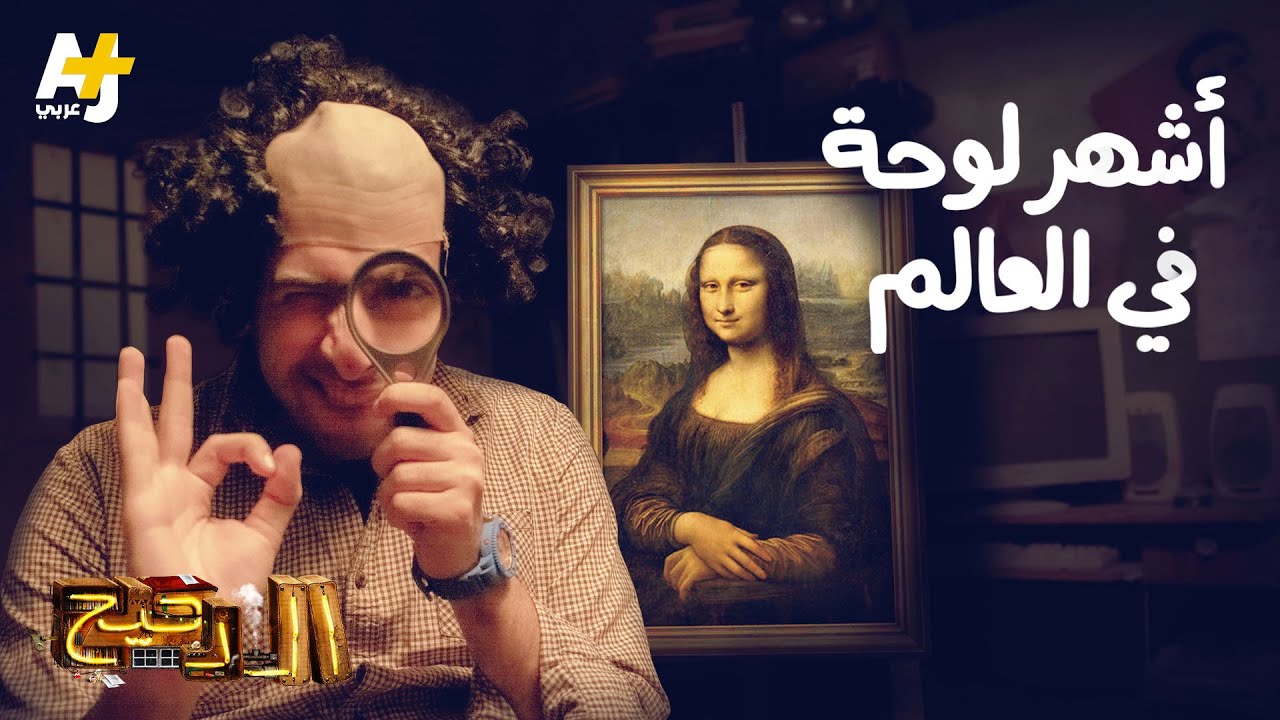
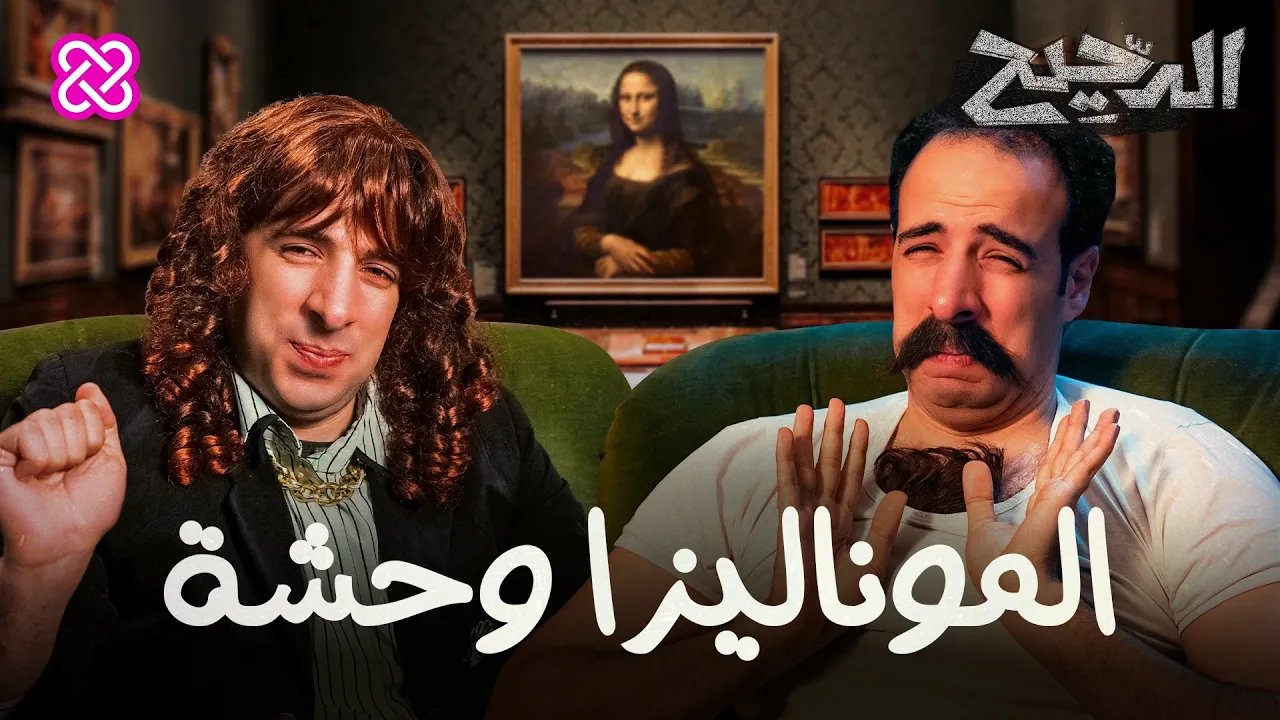
" Listen, my friend, beauty is in the eye of the beholder, and there's beauty in mine. In August 21st 1911, during his visit to the Louvre, The Italian Vincenzo Peruggia hid inside until the museum was closed, and then he quietly got out of his hiding spot, toke the Mona Lisa off the wall, put it in his coat, and left. That's it.
He stole the Mona Lisa. The Mona Lisa Back then there was no creativity in theft. There wasn't enough TV series to encourage criminals' imagination to do more complicated thefts.
When that happened, everything was chaos. The Mona Lisa was a well known portrait at the time by Leonardo da Vinci. However, it wasn't the most popular painting in the history of art as it is now.
The Mona Lisa's popularity that we know now originated because of the way the press described this robbery as the disappearance of the greatest art piece ever. The press wanted to hype it up. They started to write nonsense about the charming Mons Lisa smile that led this crazy thief to steal it.
As if the Mona Lisa stole his heart, so he stole her. That was back in 1911. There was no Google, YouTube, or the Internet, to know what it looks like, or how valuable it is.
Thousands of people went to the Louvre to see where the missing painting used to be, and try to imagine it. Anyway, two years later the Mona Lisa was found and put back, after they arrested the thief. Even though, when the thief got caught, he said that he stole it to send it back to it's home in Italy where he and Leonardo da Vinci are from.
According to him, it was a patriotic deed. Ever since the Mona Lisa was put back and till this day, the painting gets thousands of visitors. Thousands and millions fall in love with the Mona Lisa daily that became one of the most iconic paintings in history that represents beauty.
It's worth over 775 million dollars. But, the question that remains after all this. .
. Is the Mona Lisa actually beautiful to deserve all that praise? Find out after the break.
In 2018, the plastic surgeon Julian de Silva talked about the golden ratio, which is a mathematical ratio by the Greeks to measure beauty. Leonardo da Vinci, the Mona Lisa artist, used it in his famous drawing Vitruvian Man. To achieve beauty by the golden ratio, all the quantities have to approximately be equal to 1.
62 Let's apply that golden ratio on the Mona Lisa, that thief-charming heart-stealing painting. We'll find that the Mona Lisa doesn't match those requirements. Her closeness to the perfect golden ratio of beauty is about 87%.
There's 13% missing. Literally, the words couldn't describe. Even if we look at her from the eyes of a plastic surgeon, we'll find a lot of flaws in her face.
For example, some people say she has a masculine face, asymmetrical eye shape, and her mouth is too close to her nose. In fact, a painting for Marilyn Monroe by Andy Warhol is closer to the golden ratio than the Mona Lisa. Anyway, my friend, till this day the president of the Louvre says 80% of visitors come only to see the Mona Lisa.
The 87% painting, Abo Hmeed? See, my friend, it's never about the scores. It's about manners and extracurricular activities.
That brings us to a more important question. Even though that painting never met the beauty standards in it's own time, it still managed to be the prettiest painting in everyone's eyes. So, the question is: What is beauty?
In her book "Ugliness: A Cultural History", Gretchen Henderson says that beauty in the old Western culture was tied to perfection. Like geometric shapes and golden ratios. That means something that's ugly is something that's deformed, or incomplete.
That's why old stories used deserts and monsters, as they were considered deformed images and caricatures. Images of a normal person, but with a missing arm or leg. Like Captain Hook, my friend.
Why not treat him, instead of scaring kids. He needs to go to a hospital. However, Gretchen said this definition is cultural not scientific.
Since there are other cultures like Japan that had an opposite definition of beauty called the Wabi-sabi, which is "Taking pleasure in the imperfect. " For example, Apple's logo, which has a bitten apple. It's incomplete.
Another example is the kintsugi, which is a famous Japanese art, in which the artist mends the broken parts of pottery using gold. The writer Umberto Eco in his essay "On Ugliness", says that the definition of beauty is very important to humans. Because it's the definition that created a historic misunderstanding.
That misunderstanding happened when the Greeks tied outside beauty with inside goodness. So if you're handsome, that means you're good on the inside. But, if you're ugly, that means you're ugly on the inside too.
That made sense back then for them. It's alright. According to Eco, that whole philosophy will fall apart when Socrates enters the scene.
Who was described in literary works as a very ugly person with a large belly. Seems a little rude, my friend. Despite all these negative descriptions, his mind is considered the greatest product of the Greek culture.
At that moment they went: "Wait! Really? " "We don't have to be pretty on the outside to be pretty inside?
" "Wow! " What do you mean "wow"? Why did you need Socrates to tell you that?
Anyway, humans will later try to fix this prejudice in their stories. Like "Beauty and the Beast" that talks about a scary-looking monster with a good heart. Also, "The Hunchback of Notre-Dame" the ugly creature, that lives within the confines of the cathedral, written by Victor Hugo.
The story also shows how beautiful he is on the inside. He has a good soul. Just like me.
The Hunchback of YouTube. If we look at newer opinions, like the philosopher Karl Marx's, we'll find that he defined beauty in 1844 as a word in disguise, when we uncover it, we find that beauty is about money. It's a roundabout definition, my friend.
Or just like he said it: "I'm ugly, but I can buy for myself the most beautiful women, and the best of minds. Then I'm not ugly. " That is what the historian Nell Irvin confirms.
She says everything that makes us prettier like clothes, make up, and jewelry are considered proxies of wealth. Someone might ask: "Which of these beauty definitions match you? " Honestly, my friend, I'm not pretty on the outside, I don't have a golden ratio, I don't have money, and I'm not even good on the inside.
Anyway, the researcher Gretchen says that if we look through all of these opinions, we'll find that beauty is variable from one culture to another. Beauty for others could represent perfection or imperfection, money or wealth. The problem isn't that.
The problem is when one culture declares a definition for beauty, It indirectly considers anything otherwise ugly. That's why in all languages, The synonyms for the word ugly are so much more than the word beautiful. Just like the author Victor Hugo said that in every culture "the beautiful has but one type, the ugly has a thousand.
" How strange! Imagine, my friend, if a certain culture not only defined beauty and ugliness for themselves, but also spread these definitions worldwide. It strongly popularized it's standards on all the other cultures.
I'm talking about Europe, my friend. Of course It wasn't Shibin El Kom that did all that. In the 17th century, the German philosopher Christoph Meiners with the anthropologist Johann Blumenbach presented theories claiming to be scientific that aims to rank races according to beauty and intellect.
They considered the Caucasian race to be "The most beautiful of the races. " Wasn't it Formula One? Meanwhile, other races like black people are considered, in their view, less beautiful and intellectual races.
Even though, they have bigger skull sizes, they have smaller minds. I think this is dis-race-pectful. These writings will be known as scientific racism, which is justifying racism with science.
It will be used as a philosophy to justify events like slave trading and colonialism. All the way to Hitler using it to eradicate certain groups of people, such as Jews, Gypsies, and the disabled. Because they are different from the powerful white German.
However, the thing is that starting from that century, Europe will invade Asia, Africa, and the Americas. It'll invade them with army and colonialism physically, and will also invade them with a certain definition culturally. A definition that says beauty equals white skin, beauty equals slimness, blue eyes, and the Caucasian race.
Meanwhile, the oldest statue discovered for Venus, goddess of beauty, that is over 20 thousand years old, looked like this. However, in the early 19th century, Venus will be depicted in paintings looking like this. And anything that doesn't represent the white race, will not only be classified as ugly, it won't exist in the first place.
That's why up until 1940, it wasn't allowed for any person of color to enter any beauty pageants, like Miss America pageant. Well, skin color makes sense because of racism, Abo Hmeed, but why being skinny? Why did white men hate the curvy?
Honestly, some sources say that happened due to the industrial revolution. Is that what the sources always say when they have no answer? What does the industrial revolution have to do with bellies?
Wait, my friend, please. When the industrial revolution started, clothes sizes got smaller. Because factory owners had uniforms for the workers.
So, the smaller the uniforms were, the cheaper they were for the owner. That was the moment that forced people to wear certain sizes. The X-large was executed.
It used a lot of fabric. Europe didn't only conquer the world with army and tanks, they also had a beauty catalogue that they shoved down everyone's throats. The whole world has to look like us to be beautiful.
Now it's time for a very important question, How did that catalogue affect the cultures invaded by Europe? In a study titled "Occidentalisation of Beauty Standards", researches examined the effects of the beauty standards forced by Europeans in areas that faced European colonialism like India and the Middle East, and areas that didn't like East Asia, Korea, China, or Japan. In India, the British colonizer used scientists like Herbert Hope Risley who will divide the Indians.
To play a game, Abo Hmeed? Aryan in North India, and they'll be called Indo-European, and Drvidian in South India. That division was based on nose size, and how close the skin color is to white.
Looking like this, my friend, I wouldn't be in the North or the South. They would have thrown me into the Indian ocean. However, that division would create a different treatment, and different social status.
That will not only separate this society forever, it will also lead a lot of Indians towards European beauty standards. Because they see the Aryan in North India, with lighter skin color, living in better conditions than the ones in the South. Slowly, the Indians would take on the European beauty standards, and try to copy it.
Meanwhile, the study shows that Indian beauty standards before colonialism was nothing like that. For example, the Hindu goddess Drupadi and Krishna, worshiped by Indians, had dark skin. And the saddest part is.
. . no not your life.
Something else. The word Krishna in Sanskrit means dark skin Then we look at the Middle East, which was completely invaded by Europe. In a study around beauty in 2019, more than one feminine figure was presented.
Then people were asked which do they think is the prettiest. The weird thing is that most participants who were Middles Easterners, choose Angelina Jolie as the prettiest. Now guess who was compared to her and lost?
Nefertiti. What? They didn't choose the queen?
That meant that the Middle East embraced the European beauty standards. Even though, there were people in the Arab history that suffered from racism and different skin color, like Antarah ibn Shaddad, but still the Arabs were like Indians. They had to some extent different beauty standards than Europe.
Imru' al-Qais, for example, wrote about loving black hair. "Hair black as coal falls down her back, thick and hanging like dates from a palm tree. " Wow!
Like dates from trees! How cute! Here, he praises his lover's black hair that looks like coal.
Also, Al-Mutanabbi said in his poetry "Urban faces will never be as beautiful as nomadic round faces. " These nomadic round faces meant tall and chubby women. "The urban's beauty is made, but nomad's beauty is natural.
" Paraphrase! Al-Mutanabbi, like we just saw, praised nomadic women with chubbier bodies, and natural beauty that doesn't need make up. These are standards not affected by Europeans and their skinny bodies.
Arabs, my friend, like rounder bodies. The study also talked about parts in East Asia, like Japan and Korea that didn't experience any European invasion. They found that till this day, they have different ideas about beauty.
For them, beauty isn't slimness, or blonde hair, or white skin. Beauty is Kawaii. I saw those at the supermarket for 130 EGP, but I didn't buy it.
Should I? No, my friend, Kawaii means wide eyes that show innocence. Those big eyes you see in anime movies.
these are their beauty standards. To the point that all plastic surgeries in that part of the world try to make the eyes look wider. That's why in the 60s, with the fall back of colonization and European power, rights movements start to rise.
However, it doesn't just focus on freedom and democracy, it also deals with definitions of beauty. For example, the Black is Beautiful movement in the USA that calls for Afro-Americans to be proud of their skin color. Also like the Indigenismo movement, which had the Mexican artist Frida Kahlo as one of it's icons.
The artist who drew herself in many portraits exactly the way she is, in her local clothes, natural skin color, thick eyebrows, and her mustache. She defies all European beauty standards. Honestly, so pretty.
That's why after her death, she turned into an icon of beauty in Latin culture. Someone might say: "That was all in the past. There's no more colonialism.
Let's all go back to our old beauty standards like nothing happened. " It's true that colonialism is over, but you're still impatient. Because life isn't that easy.
The story didn't end here. You think that colonialism comes and goes, then everything is hunky-dory? Edward Said will beat you up.
In an article in The Guardian titled "Beauty industry: a stealth imperialism", the writer Hannah Betts says that everything the colonialism had planted about beauty and ugliness will be passed down to the beauty industry. According to statistics in 2012, 40% of Indians to this day are still using face whiteners. These are creams that lighten the skin color.
Also, in New York, Asians and Latins are consistent clients for plastic surgeries. Even though, the invasion has ended, the colonialists and their army have turned around and went home, Their culture is still invasive and everlasting. Beauty companies will take these colonialist values that says there's a unified definition for beauty worldwide that we all have to achieve or else we'll be ugly, and acts on it.
The great french pharmacist Eugene Schueller, the owner of a very famous beauty brand, and one of the beauty industry pioneers, says that his marketing is all about one sentence, "Tell people they're disgusting, they don't smell good and they aren't attractive" That's mean. Then people will go to buy a lot of beauty products to try and not feel that way. That's why the writer Jessica DeFino, described the beauty industry as one that targets ones insecurities.
The ones that were embedded in them due to long years of racism and slavery. Then, the industry presents their products to give them feelings of beauty and power. While, they don't care, if you're powerful or beautiful.
They don't care about anything. They just want to fiscal year to end and count their profits. What do you mean?
Do I leave my house with no make up or deodorant? Honestly, if it's make up, you can leave without it. However, the deodorant is a little important.
That point of it all, you shouldn't tie your own worth and definition of beauty to your beauty products consumption, and that without them you're ugly and incomplete, because either way, you are ugly and incomplete. No, I’m joking. You're beautiful, perfect and god bless you.
Jessica DeFino gives advice and tells you to listen to your feelings. You'll find that tying your own worth to these products, instead of making you feel beautiful, It will actually make you feel depressed and anxious. That usually develops, especially in women, into an eating disorder and self-harm.
That's why we see new brands, like Fenty Beauty by Rihanna that tries to present beauty products that celebrate all skin colors that some may find not pretty and needs to be lightened. Here's an important question. Are we originally good and it's the colonizer that changed our understanding of beauty?
Are we angels? Or do we in fact have some racism in us? Something that the colonizer and the exploiter see and we just make it easy for them to influence us, and change our definitions of beauty.
Here, we come to the most important part in the episode. If colonialism adopted a racist outlook on beauty, it's over now. At least technically.
And if beauty companies rely on marketing that always makes me feel not enough and not beautiful, then I should be able to let it go. However, what if society itself and everyone in it acquire beauty standards that I can't meet. I can forget about the colonizer and the exploiter, But how can I forget about my society?
Let me tell you two stories, my friend. Why not three, Abo Hmeed? That's what I got.
Next time, I'll have more. The first story happens in 1974, when Catherine McDermott applied for a job as a system analyst at the global corporation Xerox. The problem is that Catherine didn't get the job there.
That's not the problem actually. The real problem is that the reason wasn't her efficiency or qualifications, the reason was, according to the company, gross obesity. They described her obese and not attractive according to their standards.
That made Catherine sue the company, until she wins the court case. However, the ruling happened 11 years later. The other story happened in 2018 in Florida, when an American teen called Cameron Herrin hits a mother and her baby with his car, and kills them while racing.
Cameron was arrested and trialed. He was sentenced to 24 years in prison. Suddenly, people start raging on social media against that sentence.
His account an Tiktok went from zero to more than 2 million followers. Meanwhile, Twitter deletes more than 900 accounts and 9k tweets sympathizing with him. Everyone felt sorry for this guy.
The question is why did people feel sorry for a reckless guy who killed a mother and her baby while racing? Because he was cute, my friend. Millions sympathized with him, simply because he look good.
Look at him, my friend. He's so handsome, but also a murderer. In 1920, the psychologist Edward Thorndike, coined the term Halo effect.
Which means a conscious bias. His studies found that we think people who have attractive physical features, as not just beautiful on the outside, but also beautiful on the inside. We assume that beautiful people are smart, skillful, and polite.
Like the Greeks, Abo Hmeed? Like the Greeks, Abo Hmeed. And vice versa.
Ugly people are dumb, unskilled, and have manners as ugly as they are. That is the prejudice that Umberto Eco talked about. The one that tricked the Greek culture, when they found that their most important philosopher is Socrates, who wasn't a good looking person at the time.
That Greek theory wasn't a simple historical mistake. A bunch of people had wrong beliefs. We discovered that it's something we all share.
We think beautiful people are smart. It's in all of us, and it affects our choices. It's hard to think of a pretty girl, as an evil murderer.
That's why it's hard to think of a cute guy as a criminal. And that a women like Catherine could be a fit employee. According to studies, my friend, 70% of black people and minorities have faced difficulties in their jobs due to their skin or looks.
Also, 60% of the same groups have to send the CVs more than once just to get an interview. By the standards of every culture, some patients for example, the prettier ones get better care. Also, students that are better looking, get better grades.
That's a good excuse to tell your dad. I get bad grades, because I have bad genes. You should have chose better, or maybe she should.
I got an F in multiple choice, like my parents! Not just that, according to studies, our choices for animals that deserve mercy and sympathy increases the cutter they are. Their wide eyes and baby-like facial expressions.
So, we feel like they are simply babies, just like our own. And as it shows in that chart, We can sympathize with dolphins and advocate for their safety, because they look like us. It's like their always smiling and happy.
Unlike bats, for example. Even though both of them are animals. Also, how we can easily eat chicken, but think that other cultures that eat cats cruel.
*Chicken*: "I can meow, if that's all it takes. " The writer Zahira Kelly describes the danger of that and says "People who do not fit standards of beauty are denied resources. " Sometimes, if you're not pretty, as per society's standards, then you simply don't exist, and not seen.
Not by corporations, not people. The philosopher David Hume. .
. -Isn't that the new city in Saudi Arabia? -No.
That philosopher says 'Beauty exists in the mind. " Beauty, like I told you before, is not in reality. It's in the eyes of the beholder.
It's a feeling inside of us that we add to reality. The writer, Gretchen Henderson, said that ugliness also doesn't exist in reality, but when we say that someone or something is ugly we just express a fear inside us specifically, the fear of others. Beauty and ugliness aren't hidden truths waiting for us to uncover and realize, unite on their concepts, and set their standards.
It's hard to find universal and scientific standards to describe beauty in a generalized way for all people. This is evident in everything that previous cultures left behind that never agreed on one form or look for a beautiful person or the absolute beauty that everyone has to resemble. Beauty and ugliness are tryouts from every group to distinguish itself from the other.
. . the other that we always fear, because it simply doesn't look like us.
And as Voltaire says, If you ask a toad what beauty is, he will answer that it's that toad with its gooey eyes and skin, and if you asked the devil what beauty is, he will say the horns, claws tail, and flaming body. Beauty, my friend, is how we define ourselves and ugliness is how we define the other. Describing the other as ugly, is easier to attack, mock, and get rid of.
That's why explorers, hundreds of years ago, when they found a new world filled with resources and fortunes, and people who didn't look like them, they needed to describe them as ugly, to justify enslaving and getting rid of them, and also to turn this view into a polished science not a bias. Even within the same group, each one sets its own standards, so you come to life in a group with its own ideas and biases. That's when you experience a different fear, fear, not from the other, but from being different than your group and becoming lonely and outcasted from your own group.
Beauty, my friend, as we said is the result of a cultural process, that's created differently in every culture to differentiate groups from one another, and to give the sense of majority within a group. It gives us feelings of harmony and supremacy over a different group. Beauty standards, that most people sometimes agree on, turn to strict qualities an image that we turn into a checklist, and judge people on how close or far they are from that image.
Beauty and ugliness are two lenses in one glasses, where we see the world through our fears, our fears from the other and our group. Fear makes us like monsters who think they're pretty, and wants everyone to look like them to rest assured. Remember my friend, that I'll always see you beautiful.
Or not always, but based on the following conditions, To watch the old episodes and the new ones, to look at the sources, and to subscribe to the channel if you're not. Excuse me, beautiful, You beautiful, don't let them say you aren't, you're beautiful. .
. and what do beautiful people do? I told you.
My friend, you're the kind of beautiful that works all palettes, because some people don't. They should wear neutrals.