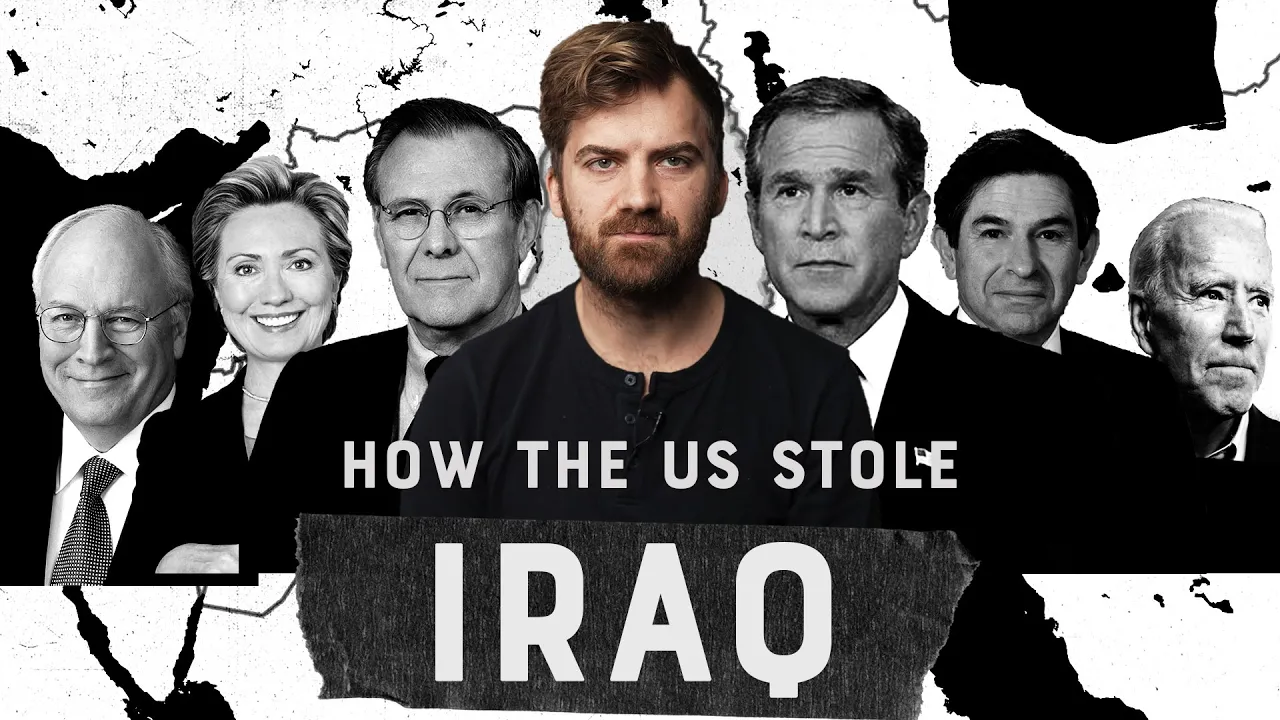
- Why did the US go to war in Iraq? - [Man] In the early stages of evacuations. - Growing up, the narrative was always oil.
We went to Iraq to get oil, like America always does. - We might find ourselves without adequate supplies of energy in the future. - [Reporter] All major oil fields in the south are now under coaliltion control.
- But that's kind of the lazy explanation, it's not quite it. Oil is a part of it but it's not the main reason. We went to war in Iraq because several powerful American men wanted to.
Some of them thought it was vital, we had to. Others just wanted to project American power. But either way, here we are 18 years later, nearly 10,000 Americans dead, over 200,000 Iraqis dead, over a trillion tax dollars spent.
And the result? A Middle East that is less stable than ever in part because of the US presence and really because of it. How did this happen?
I mean, I grew up and lived through this. I studied it as an undergrad, I studied it in grad school, and yet it's taken me until now to really take a hard look and to really understand exactly what happened. So this is how the US stole Iraq.
- [Man] Saddam Hussein is a tyrant, a murderer, and a man who has started two wars. He's clearly someone who cannot be trusted or believed. - All right, so it's the night of 9/11, the country is reeling.
Who did this terrible thing and why? How should the US respond? And it became clear very soon amongst intelligence and counter-terrorism people that al-Qaeda was behind it, this terrorist group that was mainly based in Afghanistan.
Later that night, the night of 9/11, over at the Pentagon, which earlier that day had been hit by an airplane, a memo comes in from the Deputy Secretary of State. The memo is urgent. It's for the Defense Intelligence Agency, the people who've spent their time doing all the intelligence for war and other defense purposes.
And this memo tells the intelligence agents not to look into al-Qaeda, the people they know did it, but instead to look into ways Iraq has been involved in terrorism for the previous decade. The intelligence agents who got this memo sort of scratched their head and were like, "Wait what? What's going on here?
" These people were very familiar with the intel and they knew that this attack had come from al-Qaeda in Afghanistan. Afghanistan is more than 1,000 kilometers away from Iraq. It is a completely different place, they speak a different language, has nothing to do with Iraq.
Afghanistan and Iraq are totally different. We had just been attacked by al-Qaeda, and yet the Deputy Secretary of Defense is asking for information about Iraq and its ties to terrorism. The person who sent this memo was the Deputy Secretary of State Paul Wolfowitz, and he was just getting started.
(gentle music) A few days after 9/11, the president gathers all of his top advisors out at his forest retreat right outside of Washington, DC. They were there to discuss how to respond to these attacks. The focus of this discussion was, of course, Afghanistan.
How do we retaliate against al-Qaeda, this terrorist group that has been given sort of a safe haven by the government of Afghanistan? So they're sitting in some conference room in some lodge in this forest retreat debating how they're gonna retaliate against al-Qaeda, and who pipes up again but this guy, Paul Wolfowitz? This time with the support of his boss, Secretary of Defense Donald Rumsfeld.
So Wolfowitz pipes up and he's like, "You know, 9/11 was a pretty sophisticated attack. "There's no way that this ragtag terror group of al-Qaeda "could have pulled it off all alone. "They probably had help from Saddam in Iraq.
" And then Wolfowitz says that "when it comes to global terrorism, "Saddam is actually the head of the snake. " He actually said that, basically saying that Saddam is behind all of this. And everyone in the room is sort of like, "Um, what the hell is this guy talking about?
"Saddam Hussein is a really bad guy, "but he's not the head of the snake "of international terrorism. " All these people, these very informed international advisors. (chuckles) Oh man, after some astonished glances, the head of the Counterterrorism Center raises his hands and says, "Mr President," quote, "we were attacked on 9/11 by Osama Bin Laden "and al-Qaeda in Afghanistan.
"Saddam Hussein and Iraq has nothing to do with this. " It's just like, I'm sorry, I feel like as an eighth grader at this time I was asking these questions. I was like, "Is Iraq the same as Afghanistan?
" And here are the leaders of our country having to explain that Saddam Hussein has nothing to do with Afghanistan and al-Qaeda. So this meeting at Camp David, they move on and they keep talking about these plans to bomb al-Qaeda. But Paul Wolfowitz is stubborn and he does not give up.
Later that day there's a break in all of the meetings, it's like the afternoon. Attorney General John Ashcroft is playing the piano in this sort of lobby and a few others are singing along these piano spirituals that he's playing. Condoleezza Rice is one of these people singing along.
President Bush is sitting over by the fire. It's this rustic cabin, it's all cozy. He's drinking a cup of coffee.
And who cozies up to him at the fire but Paul Wolfowitz? And Bush is like, "Uh, here we go again. " So he's like, "Listen, check out my plan.
"Half of Iraq's people live either way up here "where they don't like Saddam. "They're Kurds, they've been brutalized by Saddam, "they do not like him. "Or they live way down here in the south "which is right near the border of our good friend Kuwait.
"We could easily come into Iraq "and take both of these big population centers. "Oh, and in doing so," says Paul Wolfowitz, "we could naturally take the major oil fields in Iraq, "thus cutting off Saddam from his main revenue source. " Or, in other words, he said making Saddam, quote, "the Mayor of Baghdad.
" He would only have power in Baghdad, he would be cut off from the north and south of his country. In this moment I can almost see George Bush's ears literally perking up when he hears this last part about cutting off the oil supply. After all, Bush was a former Texas oilman and he knew the importance of having access to oil.
So this plan sort of intrigued Bush and he literally said to Paul Wolfowitz, quote, "Why didn't you bring this up in the meeting? " And Wolfowitz is like, "Well, I didn't wanna step on the toes of my superiors. " Wolfowitz, we know you just wanted to cozy up against the president and plant this seed of how it would be to take over Iraq.
(gentle music) So put yourself in George Bush's shoes for a second. Your country was just brutally attacked on your watch, and you are completely at a loss of what to do. There's no clear easy target to retaliate against.
After a day of meetings, of sitting around trying to figure out how to retaliate, George Bush is realizing that retaliating against a tiny group of terrorists living in caves in Afghanistan is like trying to hit smoke with a baseball bat. Kind of impossible. What George Bush wanted and felt like he needed, and it turns out what a lot of American lawmakers also wanted, was a clear decisive target.
Not to try to hit smoke with a baseball bat, but a nice solid hit. A home run. So I believe this day at Camp David, four days after 9/11, is when President Bush decided that he would find a way to invade Iraq, to make Americans and himself feel like he was actually doing something definitive, like toppling dictators, as a rebuttal to the terrible attacks of 9/11.
Even though Iraq had nothing to do with al-Qaeda, he and his people around him would find a way to make a connection. (gentle music) - If they're harboring terrorists, why not go in and get them? - Well, the evidence is pretty conclusive that the Iraqis have indeed harbored terrorists.
- So, over the next year, this seed that Paul Wolfowitz really planted and nourished in George Bush's mind starts to spread to everyone around him, and they start to find a way to sell the American public on this idea of war with Iraq. They get the British on board and soon there's a full-blown debate which revolves around this story that Saddam has really big terrible weapons and that he will likely give those weapons to terrorists who will strike the United States in another 9/11-type attack but way worse. - The debate about the war against Iraq has divided many along the political spectrum.
- Hundreds of millions of dollars and I think that that is unnecessary. - Real concern about this Russian war. - And Bush kept saying weapons of mass destruction over and over again.
He learned that short phrase. - Very dangerous weapons of mass destruction into this country. - But wait, hold on a second, don't be fooled.
The lead-up to the Iraq War is often remembered as this robust debate about WMDs, weapons of mass destruction. - Saddam Hussein will continue to increase his capacity to wage biological and chemical warfare and will keep trying to develop nuclear weapons. - But I'm here to tell you that you need to think differently about it.
The decision to go to war in Iraq was already made. It was made moments after 9/11 when a small group of powerful men imagined a glorious military campaign to liberate oppressed Iraqis and topple a dictator to make themselves and their country feel like we got a home run after we were attacked. From there, everything molded to fit that decision.
Did Saddam Hussein have weapons of mass destruction? Did he wanna give those to terrorists? No, there was no evidence.
The little evidence there was was threadbare and super speculative. But these guys turned into sort of like tea-leaf readers where you can look at the tea leaves and see whatever you need to to support the decision that they made many months earlier. And it wasn't just these guys.
Soon, this vision of toppling Saddam and having this American victory spread to the American Congress, Republicans and Democrats who were also getting on board with this idea of America, a force for good, toppling the bad guy. It's a really wild study in human psychology. When you're a true believer in something, you really really believe that you need to do something.
Everything you see confirms what you want to believe or what you need to believe. We all do it, but it's just scary when our leaders are doing this, and they're doing it on beliefs and decisions that have deep ramifications for human suffering. So yeah, you can go over the debates and the intelligence and the back and forth on whether or not Saddam had weapons of mass destruction.
It was all a show to help these people confirm what they'd already decided they wanted to do. So by the end, after weapons inspectors had done 700 inspections and found no weapons, this group of guys eventually just start resorting to full-on lying. Dick Cheney gets up in his speech and says.
- Simply stated, there is no doubt that Saddam Hussein now has weapons of mass destruction. - Well, there was plenty of doubt. In fact, he simply stated, there can be no evidence that Saddam has WMDs was the reality at the time.
Even the Secretary of State, Colin Powell, who was totally against this fantasy-filled vision of going and invading Iraq, even him eventually got on board, painstakingly getting in front of the UN and going over a bunch of thin or non-existent evidence and claiming that it was watertight. - My colleagues, every statement that I make today is backed up by sources, solid sources. These are not assertions.
What we're giving you are facts and conclusions based on solid intelligence. - Solid intelligence, no no no no. These are words that Colin Powell has lived to regret for the rest of his life.
A lot of people saw Colin Powell as the one sane guy in the room. And so here at the UN when he's drinking the Kool-Aid and backing this intelligence, a lot of people got on board. By October 10th, 2002, the US Congress was fully on board.
Almost all the Republicans in the chamber as well as a sizeable group of Democrats voted to authorize the US to use force against Iraq. - [Man] Senate Joint Resolution 45 to authorize the use of United States Armed Forces against Iraq. - He has said he wants the power to be able to go to war.
This seems completely consistent with that request that we say, "Yes, Mr President, "you have that power to go to war. " - This resolution gives the president the authority he needs to confront the threat posed by Iraq. - Saddam Hussein and his sons must leave Iraq within 48 hours.
- And then it happened. - [Reporter] Sirens went off in Baghdad just a few minutes ago. An air raid is in progress over Baghdad.
- Explosions in Baghdad. - [Bush] Our nation enters this conflict reluctantly. - [Reporter] You could have a report that an estimated 30 Iraqis surrendered at the border.
(dramatic music) (jet whooshes) (triumphal music) - Two months after the invasion, George Bush gives a speech on an aircraft carrier with this giant sign that says, quote, "Mission accomplished. " This is the type of thing Bush surely was dreaming about while he was sitting by the fire at Camp David, drinking coffee, listening to Paul Wolfowitz explain the plan to take over Iraq. Big triumphant America just toppled the dictator.
Mission accomplished. But this is the part of the story when all of the dreams, the fantasies, the visions of glory start to topple. Mission accomplished was really mission just beginning.
(gentle music) One of the first things that the US did when they took over Baghdad was they dissolved the huge Iraqi military. They just said, "No, we don't want you anymore. "All of you commanders and leaders, soldiers, you're out.
"We're gonna start fresh. " In typical simplistic thinking of these visionary leaders, the idea was that doing so would allow them to start totally fresh with a new army, completely rid of any sort of influence of Saddam Hussein. So now you have a bunch of ex-Iraqi army members who are angry at the United States and unemployed.
Oh, and all of them have extensive military experience. - There is a large number of former Iraqi soldiers that are unemployed now. That is a huge concern.
- It is just painful. What a terrible decision. So these guys run off and they start to join the growing number of rebel groups that are there cropping up to oppose the United States presence.
One of those groups is called al-Qaeda in Iraq, which later turns into the Islamic State of Iraq, which eventually becomes the Islamic State of Iraq and Syria, or ISIS. A well-oiled governmental and military organization run by many of the military leaders who were ousted by the Americans from the Iraqi military when they took over Baghdad. So Iraq turns into the US trying to fight this growing rebellion.
Billions of dollars turns into tens of billions of dollars, and then hundreds of billions of dollars, and eventually crossing over into over a trillion dollars of tax payer money to fight this unnecessary war. Saddam Hussein was a really bad guy. He committed mass genocide against his own people, the Kurds.
He executed many others, imprisoned many others. (man speaking in foreign language) - All in all, the number of dead on Saddam Hussein's hands numbers around 250,000 according to Human Rights Watch. That was over 25 years of his brutal regime.
And yet in just eight years of this war that the US started in Iraq, way more people were killed. A power vacuum was opened up that allowed ISIS to thrive, and for what? Why did we do this?
How was this worth it? I really believe that in the aftermath of those towers falling, this group of guys began constructing a story for themselves. A fantasy, one not grounded in real facts from intelligence, but one grounded in fear and in desire to be the hero, in the messianic complex that always infects the powerful.
That fantasy trickled down and spread to other people in power, leading us into one of the most catastrophic and unnecessary wars in modern history. (gentle music) - I challenge the president or whoever has us here for 15 months to ride alongside me. I'll do another 15 months if he comes out here and rides along with me every day for 15 months.
- Oof, Saddam Hussein, George Bush, Paul Wolfowitz. What a story, what a story. Yeah, anyway.
I wanna thank the sponsor of the video today, ExpressVPN, which is a service I've used for years. When I traveled, I would use it all the time to basically route my connection through the United States so I could not be kicked out of my Gmail. I don't travel very much anymore so I use ExpressVPN these days to watch Netflix, specifically Canadian Netflix.
So basically with ExpressVPN it's not only a security measure that helps you secure your connection with encryption and all of this great technology. The reason I like it so much is because I can route my connection through other countries, and then Netflix thinks I'm in the UK or in Canada and I can watch UK and Canadian stuff that isn't available on Netflix in the United States. This is actually the case with a lot of different steaming services.
I love ExpressVPN. It's super easy. It's in the menu bar of my computer and all I have to do is click it and decide the country and boom I'm there within a few seconds.
Oh, and the best part is you can get three months of this literally for free if you use the link in my description. It's expressvpn. com/johnnyharris.
When you click that link, it helps support this channel but it also gives you three months literally free, zero money to use this. Thank you ExpressVPN for supporting this channel and thank you all for watching. If you want more Middle East content, there is endless.
It's what I studied in my undergrad, it was Middle Eastern politics, and there's just a lot. So I'm gonna get there, I'm gonna get to the rest of them if you all want it 'cause there is endless videos I could make for the Middle East. Anyway, have a good day, see you.