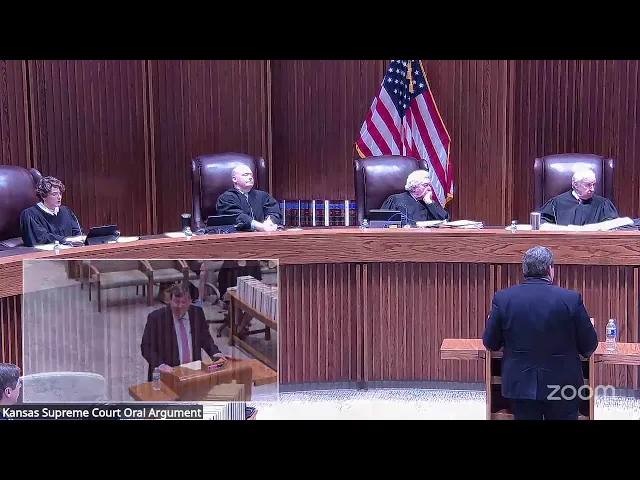
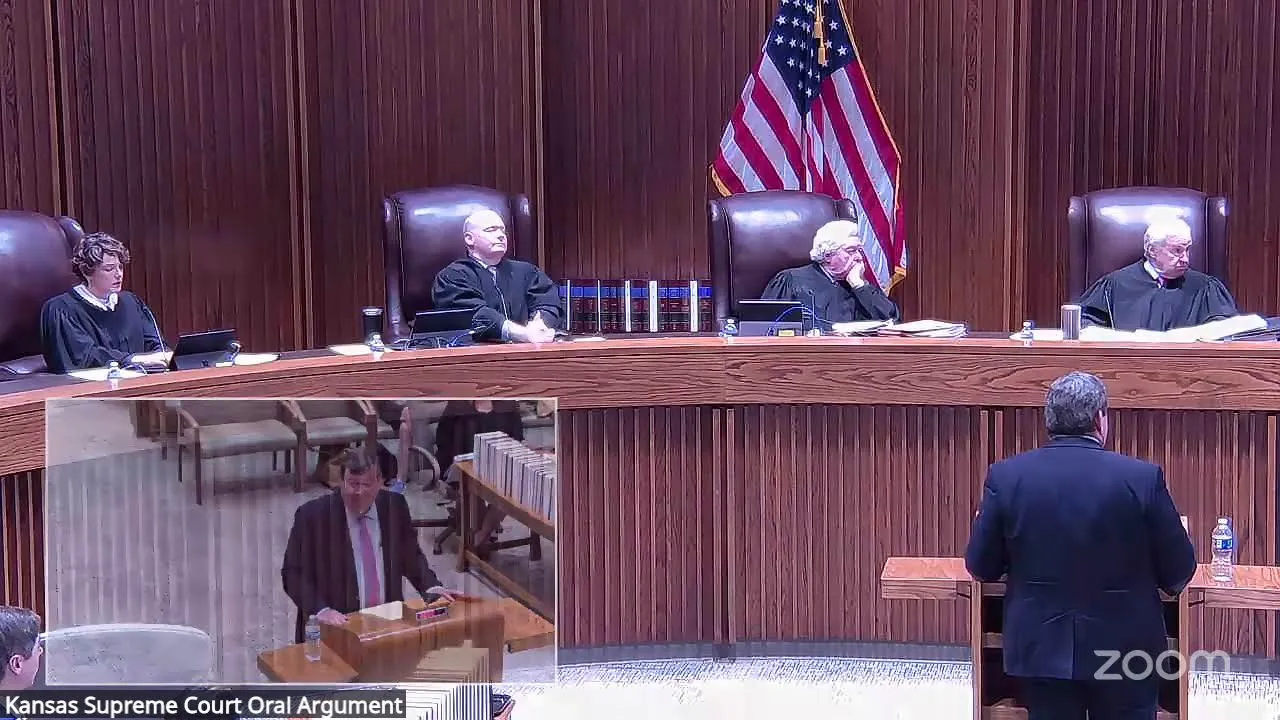
All rise. >> The honorable justices of the Supreme Court. Hear ye. Hear ye. Hear ye. All persons having business before this order in order to draw nigh and give their attention to the court now. >> Please be seated. >> Well, good morning everyone and welcome to the Kansas Supreme Court. The court meets today in special sess session to consider case number 129788, Governor Laura Kelly in her official capacity versus Kansas Attorney General Kris Kobach in his official capacity. And a few of you may be unfamiliar with the court's process, so I'll just go over it
very briefly. I would like to explain that all of the justices are familiar with the issues of the case, the party's arguments, having read the briefs and those authority relied on in those briefs and otherwise prepared for this morning's argument. We now look Forward to the party's oral arguments and our exchange with the attorneys. And one more thing I want to remind council that my uh the chair on the far left is not occupied because chief uh justice Mara Lucer will not participate in the hearing today or in the discussion or resolution of the case.
With that uh will council please come to the lecture and enter your appearance. Mr. Mallister, >> Mr. Chief Justice and may it please the Court. Steven Mallister for Governor Laura Kelly and with me at council table I have Justin Whitten council Ashley Stites council and in the first row Emily Dewall from the governor's office. >> Thank you very much Mr. Cowser Mr. Kobach. >> Thank you very much Chief Justice Rosen. Uh I am Kris Kobach representing the office of the attorney general. We were just joking that I guess I'm perceiving this. You know what they
say about it. >> Yeah, I do. I do. Hopefully that doesn't apply. And with me uh are Dwight Carwell and and Adam Steinhel. >> Thank you, Mr. Kobach. >> Thank you. >> One more just uh uh the court met. Um depending on the length of the argument, that opening argument. We may take a short break in between arguments just depending on the length and I can let you know and we'll determine that as we as we hear the arguments. Mr. Mr. Mallister, when you're ready, you may come to the lectern and begin your argument. >>
Thank you, Mr. Chief Justice. It may it please the court. With the court's indulgent, I would just like to take a brief moment to emphasize two fundamental points and then I welcome any and all questions from the court. >> And just to recall, you did reserve 10 minutes for rebuttal. >> Yes. >> Okay. Thank you. First, what is at stake here is that the governor is seeking that to avoid the loss to Kansas and to canons of millions of dollars of funding that would support programs and projects that benefit canons and would also be pumped
into the Kansas economy. Second, I want to be clear about the relief the governor seeks. Uh I fear our briefs may not have always been completely clear in that respect. So I Want to make that clear at the outset. What the governor seeks is a ruling from this court that her supreme executive authority includes the power to litigate to protect her executive interest. She is not seeking to represent the state of Kansas. That is the attorney general's job. But she is the chief executive of the executive branch. She is charged by statute and constitutionally with
administering a number of state Agencies. And when those agencies are disrupted or threatened in their operations and litigation may be necessary, that is when she wants authority to litigate. >> So can I just jump in really quickly and clarify? Um, I understood you just now to say that all the governor seeks is the ability to litigate in her official capacity in her name and perhaps on behalf of the executive agencies that are under her authority. Is that Correct? >> That's correct. >> So she does not seek ever >> to name herself at the state of
she represents the sovereign that is the political entity known as the state of king. >> That is correct. And you're conceding that under our current constitutional structure and statutory scheme that responsibility is exclusively dedicated to the Kansas attorney general >> as the state with I guess I would add a caveat that under 75108 she does have the authority to ask the attorney general to take up matters either defense or prosecution on behalf of the state. But what we are saying and recognizing is if he declines, which he often does, then she has the power, if
it's in her executive interest, to go ahead and hire her own counsel and proceed with litigation. >> But that is only litigation with respect To her as in other words, this is a fight over who's the client, right? it. You You're saying that even under that statute, if the attorney general declines, that her authority is limited to engaging in litigation >> in her own name under her official capacity and on behalf of her executive agency. >> Yes. >> Okay. >> Exactly. >> Exactly. >> And with that, let me tell you what my concern is. I
understand the merits of the fight here. Um it's the procedural part. It's the posture of what's happened coming here. Um this is a quironto action. You know, by what authority do you do something? Um I'm afraid what you're this what's going on here is a battle of words between Elected officials and like we're being asked for an advisory opinion. One way to charact and that's what I want you to push back on. >> One way to characterize this case is are you really trying to say that >> we should exercise quoonto responsibility because the attorney
general filed an amikas brief in Massachusetts making legal arguments that you disagree with? >> Not legal. >> It seems not legal arguments alone, your honor. legal arguments that the governor has no authority or standing to participate in that proceeding. He is entitled to express a view as the attorney general on the merits of a claim. So if he wants to argue why it's great that the federal government is terminating grants or seeking the private data of thousands of Kansas, he can make that argument. But what he's Argued is that she can't be there. But and
that's legal disagree just a disagreement that you >> over her authority. But again, if every time she files in her own name, she has to fight the battle with him coming in and saying she has no authority, there's only one court that can actually ultimately answer that question, and that's this one. >> Right? Which is why I'm worried about the posture. I have no problem. And honestly, if the attorney general really believes what they said, and we have to assume they did. They're officers of the court. They signed that pleading in Massachusetts. If they believe
what they said in that pleading, I don't understand why they're also not in a Kansas courtroom to press that point because there then the issues are really joined. For example, if what we're focused on is This amikas brief and can't the federal judge figure this out on his or her own uh you know who who's right and if the judge really thinks there's some merit there. They could certify the question. So don't you have an adequate remedy at law for the fight the way it presently exists as opposed to the way it's threatened to to
exist? Well, I don't think it's adequate, your honor, because again, there are a lot of things happening and happening quickly here Which may require the governor to act. And what you're proposing, I don't disagree, might ultimately resolve the question, but it would take considerable time for that to occur. That is why we initiated this proceeding because there's very real arguments. I mean, the attorney general has taken active steps to try to prevent the governor. He has also informed her very clearly by letter in writing that if she tries to pursue things in her name as
governor, he will Try to stop her. Uh so there's no doubt that this is a very real and live controversy. Might there be another way the issue could be resolved? Perhaps. But that's asking a lot to have everyone go to federal court and then try to get a federal court to certify to this court. This court doesn't have to accept a certified question. We'd like to resolve this now because it is this court ultimately that this is the only one that can give a definitive answer. >> But you're really asking us to resolve the threat
and not some real action. That's what's >> Well, no. I think we're the real action is the attorney general has stepped in already into this litigation and tried to say the governor cannot be here. That's a very live dispute. Maybe not in this court, but this is the court that can resolve the question whether he can do that or not. >> And if he'd have asked us, then the Fight's in my view clean. The Quironto fight is clean. This is a little messy. The biggest brief in Massachusetts where a federal judge can resolve the issue.
Well, I guess I'm a little unclear, your honor, on what more you want. Do you want us to file here before anything's happened in Massachusetts? I mean, that to me is what crystallizes the dispute. And then we come to this court as the entity that can answer the question far better than any federal court. And Anything a federal court does essentially advisory because it's it's an, you know, their best guess as to what Kansas law might be. This is the only body that can tell us for sure what Kansas law is. And that's the ruling
we'd like to have. And not only because of pending litigation, but given the threat of the attorney general that he will not in essence allow her or he will seek to obstruct the governor in any efforts to pres represent herself in her Own name. C >> can I ask a few questions about that? I want to follow up on Justice B to try to determine whether there's actually a real dispute here. Um, exhibits three and four I think are the letter from the attorney general and the amikas brief that were discussing that were attached to
your initial filing. Um, can you very specifically point to where in either of those exhibits the attorney general seeks to prevent the Governor from taking legal action in her own name? Because, and this is maybe highly technical, but as I read it, it it looks like one way to read the Amikas brief and this letter is that the attorney general is saying to the governor, you do not have the authority to take legal action, quote, on behalf of the state. >> He says that, but in at least one of the letters, he also says, nor
do you have the authority in your own name as Governor of Kansas. I we can >> and I I trust your point if you but in one of the letters he I agree he says for the state but he also says and on your own behalf as governor of Kansas >> and I'll look for that as well but if you find it I would like to see that. Thank you very much. Yeah. And what I'd like to say about the the issue here, there is of course a statutory part of this, but I want to
focus first on the constitutional part Which is supreme executive. One of the arguments the attorney general makes is that supreme executive is limited by the following clause power to enforce the laws of the state. That is simply wrong. If you look at the history of that provision, the Kansas constitutional convention, they were a borrowing from the Ohio Constitution, there were two separate provisions. Those things were not together. There was simply a supreme executive clause. There was another Clause that has the reporting of the agencies and so forth, but also at the end it had a
take care clause. The executive shall take care that the law shall be faithfully executed. That's what they were adopting. It was a committee on phraseology, not the substantive drafting committees that put those in one, but even in one, it doesn't matter. >> Well, is is is the term supreme executive power is is that without Limitation and and if if there are limitations, where do they come from? >> Constitution. The limitations are inherent in the nature of executive power and also on they are determined to some extent by statute. So the supreme executive power means she
is the highest official within the executive branch within her realm. But I'm going to define her realm. Her realm is not the attorney general's role. Her realm is Not the secretary of state's role. It is not the insurance commissioner's role. Those have been treated separately and authorized separately by the legislature. But her role is things like KDH and Department of Children and Families and Department of Agriculture for which she is the chief executive. So she is supreme in those context. She has the power to appoint and remove. She's in charge of supervising making sure those
Agencies fulfill their obligations and responsibilities. And that's what's at stake here. What's at stake here is threats to the operations of those entities that are clearly under her supreme executive power. She's not, again, we may not have been as clear as we could have been in the briefs. She's not seeking to put her name on a brief as the state of Kansas. She wants to put her name in litigation as the governor of Kansas who is responsible for KDHE, Who is responsible for the secretary or for the Department of Agriculture. Those are the things she
is supreme executive over. So your honor, yes, there are limitations. It does not mean she can order the attorney general around. Does not mean she can order the secretary of state around. Does not mean she can order the insurance commissioner around. And in your in in that Massachusetts case, correct me if I'm wrong, but is my view of those pleadings Was that the governor came in as a party in the amended in an amended complaint. And the allegation was that, you know, she had the ability to sue in her official capacity as governor as the
administrator, which was in fact the same premise, I guess, as governor's and governor Shapiro because the other parts of the caption are a little different. So different governors come in through different approaches. >> It might depend on their particular State laws, but yes, that is how she appeared. She did not purport to appear as the state of Kansas. You know, I spent a lot of years in the attorney general's office. We would file multi-state AMA's briefs in the Supreme Court, for example. That is the state of Kansas. That's what the attorney general does. She's not
seeking that kind of litigation authority. She wants to be able to protect the supreme interest. So, the who enforces the laws of the State that is describing one aspect of her duty. It's like in article two of the US Constitution that the president take care that the laws be faithfully executed. That's what that clause is about. It is not a limitation on her supreme executive authority which is independent in Kansas and it's independent in many other state constitutions. So that is where at some point when we talk about the statutes, there is the Potential if
they are read too broadly to preclude her from retaining her own counsel and proceeding in her own name, they would be unconstitutional. >> I don't think to be read that way. >> Sorry, it sounded like maybe you're transitioning to your statutory arguments. >> I'm happy to. But before you did that, I wanted to talk a little bit more about um how you define the article one powers under our constitution. Typically, we You know look for the intent um at the time of original ratification, but in this instance we have amendments uh in 1972 uh to
two articles in particular. Right. And do you believe that uh the historical background uh in 1972 in the period leading up to that is also relevant in ascertaining um the intent? >> Well, it certainly could be if it was intended to make any change in the Supreme Executive Power. I don't know That it purported to, but it is the point we can see it in a footnote. I think that when Governor Dawing proposed that the governor should be able to appoint all these officials in essence have a federal unitary sort of executive that was rejected.
That's not what we're arguing for. But I don't think there's anything in 1972 that says well now your supreme executive power is less than it used to be. We're somehow limiting it. >> Yeah. The history I'm really honing in On is Governor Dawing and other governors in the 1960s um created uh these commissions to study these proposed amendments right in 1972 that ultimately came to fruition. um in the background, as I understand it, um there was sort of a national trend and debate about a unitary state executive, right? And a governor having the power to
appoint and to remove um uh cabinet members. And this commission that the governor put together um generally Agreed that some centralization is important for government efficiency. But the majority of that commission ultimately recommended that even though we re we're going to reduce the number of constitutional officers, we think it's important to retain an elected attorney general to serve as a check against government uh potential gubanatorial power. How, if at all, does that history affect your interpretation of >> In my view, your honor, not at all. Um, I, you know, we had an attorney general for
a century before that. So, it wasn't like they created an attorney general suddenly to limit the the governor's power. They just wanted to retain a separate attorney general. So, I think it's pretty much status quo. Frankly, I don't think it changed anything. uh instead again supreme executive power has its own meaning and it makes the most sense in the context of she is the Chief over the agencies she is charged with supervising and administering >> well why would I'm just I understand the litigation strategy but why doesn't it mean more than that >> well >>
why doesn't it mean supreme executive means I am in a sense the boss quote unquote of other constitutional officers. >> It could, your honor, and we'd accept that if you want to go that direction. >> Uh it's that's a harder argument, but there is some historical evidence for that view. We still >> if I could drill into that harder argument a little bit because it gets at what I'm really after which is something that's puzzled me in this case and reading this court's prior struggles with a similar question which is how are we to draw
the line um separating the powers and duties of different Officers within one branch of government within the executive branch. Um, and I think that is a crucial question that frankly I've not seen anyone provide, including this court in our prior statements. Um, a sort of a coherent explanation of that. Can you help with that? >> Um, well, I'll take a shot. Uh, that is one of the challenges of state constitutions and divided executives. uh it's it's a much less straightforward Sometimes more messy system than a federal unitary executive. Uh that said, I think to a
great extent uh it has been done by the constitution recognizing separate statewide elected officers. So they are recognized, they must have powers. Uh and then legislative implementation which by and large we don't argue with. So the legislature says the secretary of state has these responsibilities. The insurance commissioner has these. >> I appreciate that where you're going cuz that's kind of where I wanted to go. Just my followup which is yes that we can read in the constitution these are separate constitutional officers. They obviously have powers and duties. The constitution says that article 1 section 11
says the AG has powers and duties. I can only find two specific powers or duties outlined in the constitution itself >> for the AG. That's correct. and then There's nothing else and our court has said well the legislature gets to define the powers and duties that's how can that be right I guess is my question I do see that in article 1 section 12 with respect to the lieutenant governor the constitution says duties as prescribed by law which typically means the legislature gets there is no such provision with respect to the a so why does
the legislature get to Define the role of the attorney general? >> Uh, that's a fair question. Uh, you know, as a practical matter, they're the ones who've done it. And as I said, I spent many years in the attorney general's office. There are statutes that we would have questioned the legislaturator's authority to control the attorney general. I do think at some level with these officials, attorney general and governor especially, there are Constitutional bases that the legislature cannot exceed. The challenge is figuring out where those lines are. >> And and that's what I wanted to and
I know I'm asking a bunch of questions here, but if I could ask one more, do you think it's a coherent constitutional theory to posit that the the office of attorney general in the abstract had common law powers and duties at the time? time our constitution was enacted and that the our constitution Essentially constitutionalized those common law duties. >> You could take that view. >> Do you agree with that view? I have some weariness about that view given that the attorney general if you're going to go back to English common law and so forth was
truly the agent of the crown and subject to the control of the crown whereas that's not our system and there is no more crown in the American system. So the analogy to me is not perfect, but It may be helpful in the sense of generally, for example, the AG's in charge of criminal prosecutions, you know, those kinds of things that wouldn't necessarily be controversial, but I don't I wouldn't follow it necessarily 100%. >> Thank you. Sorry. >> In our case law about separation of powers, you know, we talk about trying to identify where the problem
is and we use different terms. We use usurpation, intrusion, and significant interference are the three ones that I put on my list here. Do you think those are synonymous in this context? Or was the court moving the goalpost, if you will, moving from, you know, usurpation, which sounds more forceful, to significant interference. I mean, I I see your point, your honor, and that certainly usurpation could be The strongest form there. Significant interference, maybe it's something lesser. I I don't know that the court was necessarily trying to talk about different concepts. Um, you know, certainly at
the federal level, usurpation or a grandisement, those are terms that get used as one branch stepping over the line into the prerogatives of another. This court has not really talked about a grandisement. Uh I think ultimately though the question is there have to be and there are certain core constitutional powers granted not always easily defined but given to these officers and whether it's the legislature or another executive officer who is trying to intrude or try take away that power that is a problem under the constitution. So, we would actually describe if you want uh take
the strongest term. We would argue the attorney general is trying to Usurp the governor's litigation authority here. He is certainly significantly interfering with it. So, I'm not sure in this case it would matter. >> Articulate how it's actually happening as opposed to the saber rattling. It's going >> well. It's it's the it's the filing of the amicus telling a federal court she has no legal authority to be here. It's the writing of the letters saying if you Try to pursue name or pursue litigation in your name as governor I will do everything within my power
to stop you. Um that is a very real threat I think of perhaps more litigation initiated by the attorney general's office maybe instead of us. We in a sense are trying to get ahead of that. It's already started. So the dispute >> how does that interfere? I mean, she could just go do it and then have a fight about it. >> Yes. But your honor, realistically, if you're a litigant in a case and you come in and you want to argue the merits of the case and another high status, the attorney general litigant comes in
and says, "You can't even be here." Now the federal court may disagree but that is that is a tough way to have to litigate each and every case you may want to be involved in. It is fine and we are not saying the attorney General can't come in and say I disagree with her on the merits of this federal law or this dispute that happens all the time. But for him to come in and say she can't be here is a different kind of interference. And and and the way this keeps going on in my
head though is okay, it's Massachusetts. It's an amikas brief. I didn't see anywhere in the pleadings where any of the the real parties have taken up that argument. Not even sure That federal court's going to take it seriously. Uh but again, if they do take it seriously, either the court can decide it and there you are. Or they can certify a question and get it to us and then it's a real clean dispute. >> Well, I don't for our purposes I'm really worried about this whether you're you're pushing us over to advisory opinion land. No,
I I I hear you, but I think it is a very real ingenuine dispute. And I think What you're suggesting is a way the dispute could be prolonged. We're preferring that it would be settled sooner. Uh but I don't see how if the court in Massachusetts takes it up and gives this court a certified question, how it's any more real then than it is right now. I mean, we know the same facts already that we know now. about what's going on in the stat situation between these two officials. Be >> before you sit down, there's
some real Basic thing concepts here that I'm having trouble identifying either in the constitution or in the statutes. And a real basic one is and I want to give you an opportunity to weigh in. I want Mr. Kobach do the same is where in the constitution is there gives you authority or anyone authority to decide what is in the interest of the state? uh who who who makes that basic can both entities make that determination and also uh what is clearly adverse to the Legal position identified to the state interests? I just having trouble tying
those into concepts presented by both. >> Well, I think in terms of who decides the interests of the state, it's the bodies that are charged by the people through the constitution with making those decisions. that is not one single entity or official. So I mean certainly the legislature has some role in defining the interests of the state. The Governor within her sphere has a role. The attorney general within his sphere may have a role. The secretary of state within his role may have or within his sphere may have a role. That's the nature of a
state constitution. And there is that's one of the challenges. I agree it is a challenge >> because there is no client. we can simply go right >> walk across the hall and say what is your position on this state of Kansas. There's not that kind of >> and and I would say your client believes that the attorney general has taken a position that's clearly uh identify adverse to the state's interest. Um >> and I would that that's kind of your lever to get into into court isn't yet. >> Yes. Well, partly, but that's maybe you're
sort of talking at least or I'm going to talk about 75108, >> right? >> That last clause. Uh, so a couple things I wanted to say about 75108 that I'll I'll do briefly. Uh, it does say that the governor, he or she may, if the public interests require it, employ counsel. It also says if the attorney general shall be in any way interested adversely to the state, she also can employ counsel. I think those under the statute have to be left to her discretion as governor to make those Judgments. >> Thank you. to how you
started out your argument and I'll be curious to hear um if your colleague is as surprised as I am to to hear the reframing of what I think we understood the issue as presented in the briefing certainly the decision seemed clear it's prayer for relief asks for a declaration of that and I'm moving 55 a declaration that if the attorney General Can you hear me? >> I can. >> If the attorney general makes himself absent by declining or refusing the governor's request, she may retain counsel under KSA 75108 to sue and litigate actions on behalf
of Kansas. Is are are we to understand that that's not that's not the relief you're requesting? that that harder question. I mean, I I think you're trying to make this an easier question for us. Um, but I think there's a harder question here that's presented by what's going on. >> Well, I don't think it has to be presented. I think it would be one way to answer the question if she does have the authority to represent the state, but actually that may be in artfully phrased on behalf of Kansas probably would have been better stated
as on behalf of the interests of canons and her role as governor. So she clearly Has authority as governor to make decisions that she believes are in the interest of Kansas in fulfilling her executive responsibilities. I think if you go back to paragraph 53 in the petition, it's more consistent with what I'm saying this morning. So that I think we articulated. She just she wants to be able to sue in her name as governor of Kansas, protect her executive interests. The bigger bite would get us where we Need to be. It would certainly give her
the freedom to litigate. Uh but I think that's a harder question. As I talked with Justice Steagle about, we can make some arguments for it. They're there in our brief, but I don't think the court needs to go that far to say, for example, she can order the attorney general to do something that he refuses to do. Um, she might have some authority there. Certainly both statutes and the Dawson case suggests that some history Suggests that. But we don't need to go that far in order to resolve this dispute. >> Thank you. >> I'm Oh,
sorry. I I I that brings some follow-up questions to my mind because I do think then I'm sure you agree that nailing this issue of what the governor is requesting is really important to help us decide this case. Um, I had thought you were pretty clear at the beginning of your argument. Just now you Seemed a little less clear, which makes me >> I'm trying to say the same thing, but tell >> and I appreciate that. Help me with the >> So, there's a difference in my mind between saying we are not asking for X
and in fact, we concede that we can't get X. There's a difference between doing that and saying we don't need to ask for X to win. We can just ask for Y and we still win, but X might still be On the table. And that's the answer I just heard you give. Whereas at the beginning when I said for example, are you effectively you are not requesting relief to represent the state of Kansas and then you went so far I think when I asked to as to concede that only the attorney general under our current
legal structure and statutory scheme has the authority to represent quote the state of Kansas. >> So kind of like which is it? The the First is what I intended, your honor. So, we do say you don't need to we don't ask you to decide that bigger, harder question. All I'm suggesting is there are historical arguments that might support that position. We talked about some of them in our briefs, but we are not today asking the court to do that. And are you indeed conceding that only the attorney general can act as the legal representative of
the entity known as the state of >> only the attorney general can act as the legal representative? The historical question is more to what extent might the the governor compel him to actually step up and do that because even in the Dawson case the governor was not talking about stepping in as the state. It was about whether the governor could require the attorney >> and I think you said that um you don't take issue with the fact that the attorney general may refuse that request When it's given. >> He does it regularly. >> Yep. >>
Thank you. >> And just moving on to one more stat statute um 75703. I understand you know there's a larger question about whether any of the statutes may infringe on article one powers but setting that aside um what what it does 75703 do because on its surface one might take The position that that statute uh the legislators asking the aternal attorney general to serve as the representative uh for the governor and those agencies um which >> it's not very similar to the role that you've trying to carve out. >> And you could take that view
and certainly that could be applicable here in the situation where we're losing grant money that is attached to and funds all sorts of contracts that are Implicated with the agencies she supervises. So that is why we pointed to 75703. This particular litigation does have impacts on contracts and potential financial obligations of the agencies she supervises. That might not be true in other circumstances, but here it could be. But is the legislature carving out a role uniquely for the attorney general under that statute >> to occupy that sort of >> Oh, I don't think if you
the point is he get to occupy the whole territory and decide whether or not No, I think it would be that the governor if you really want to apply that statute, the governor could compel him to step up and defend and represent the interest she's asserting. So then we might be back to Dawson, I suppose. that prompted um me reminded me of something um in I'm not going to be able to cite the statute. The statute that sets up the Authority of the secretary and that's cited kind of by both of you. Nobody bothered to
site subsection K of that scheme which where the legislature said the secretary can sue and be sued. And I wondered is there a does that section apply to this controversy? >> Well, for some reason that didn't happen because that's very typical language across all of our statute. >> It is. It is. And that happens with some regularity. So there's certainly cases In which the attorney general is asked, would you represent this agency? No. So the agency gets its own counsel and proceeds. But the irony and the the irony of the result that I understand the
attorney general to be seeking is he's quite happy to say no KDH go defend yourself. But if the governor who's in charge of KDH wants to try to defend KDH, he's saying she can't do it. And that really makes no sense under a constitutional system in which She is the supreme executive. Why can a subordinate go find legal counsel, but the governor herself cannot do that? So, that's the problem I have with with that. But it is certainly not an uncommon thing that the attorney general's office one says, "No, thank you. Go get your own
counsel if you want." Or two, even sues the agencies himself sometimes. So, they have to defend themselves against lawsuit by the attorney general. >> Any other questions of Mr. Mallister. Thank you very much. And I note that you reserve 10 minutes. Mr. Kobach. >> Thank you, Mr. Chief Justice. And may it please the court. I want to begin with one really small point and then I'll return to it later. And that is the opposing council is asking this court to erase a definition that this court has already given to the phrase supreme executive power. And
that definition was Given in stubs v Dawson 86 can at page 180. I apologize for our briefs not emphasizing that clearly enough. There is already a definition and I'll come back to that. But the second thing which I think is on everybody's minds opening observation is that the governor's position continues to change dramatically through this legislation. Um I justice Walsh asked and I had pulled it out myself the uh the relief sought paragraphs 53 54 and 55. My Impression is we started this briefing assuming they were asking for all three things init then they dropped
as of their latest brief they dropped 54. 54 says that the governor has the authority to direct the attorney general to sue. Became clear they had dropped that one. But now today I think the opposing council has dropped 55 too. 55 as well, which is the a declaration that the governor may sue and litigate actions on behalf of Kansas. In other words, on Behalf of the sovereign. So, I think they're they're down to only seeking the relief in paragraph 53. But even paragraph 53 has a lot to it. A declaration that the governor has the
constitutional authority to sue on behalf of her office and the interests of Kansas. Once you add and the interest of Kansas, then you're talking about everything. And so >> what is that phrase in I mean that's been bandied about by both sides here. And I mean we're all lawyers here and interests are not a client, right? >> That's exactly >> what does that So does that have any real meaning or is it kind of um boilerplate puffery? >> I I think it has no real meaning. And what it means is if any attorney walks up
and says, "I am suing on behalf of the interests of Kansas," which is what the uh governor is claiming the Authority to do, and now she's narrowed it, I think, to executive interests. And I'm not sure if that phrase has any concrete meaning either. And she's basically saying, "I'm suing on behalf of Kansas, but I'm not suing in the name of Kansas." >> Only entities can have interests. Right. >> Correct. So, what this fight really is about is what I mentioned to your opposing council, which is who is the client? Um, and once We answer
that question, and it sounds like the parties may actually not disagree on that question anymore, if that's true, I mean, the interest question really isn't for us to decide. The question is, who's the client? And if the client is only the governor in her own name, her own official capacity and the executive agencies which she is um which she has authority over by law if those are the clients that she is Seeking to represent. Well, you wouldn't have a problem with that, would you? Or maybe you would. >> I I actually No, I wouldn't, your
honor. And that gets to the final position they've retreated to. It's still kind of unclear. I'm hearing two different definitions. If they are retreating to the position, she can she still can sue on behalf of her office, then we are in 100% agreement. And that's what she's doing today. She's suing on behalf of Her office. But the phrase that opposing council used was no, she can sue still sue on behalf of her executive interests. What are executive interests? That's that's the whole waterfront. Anything any agency does is within that agency's executive interest. Government agencies do
everything. Would you agree with me that determining the interests of a client in any particular piece of litigation is up to that client? I mean, They can articulate their interests however they want. You know, the KDH&E can say our interests we believe is on behalf of the canons we serve and we think that it's XYZ. That doesn't mean that they're setting the the legal position as to the legal position of the state of Kansas. I understood the opposing council to say that's reserved to the attorney general. >> But perhaps we could phrase it this way,
your honor. KDH could say we have an Interest in um protecting the um the earth's atmosphere and the climate of the earth. That is one of our interests. And so we seek to uh sue whatever federal administration is in power because they are taking actions that are impeding our mission to protect Kansas's environment and the climate. So that's the problem. Executive interest goes too far still. If you're talking >> why can't they do that? I mean it may be a frivolous lawsuit that they'll lose, But why can't an executive agency exclusively under the authority of
the governor take whatever legal position or action that they want to? Because at that point, your honor, they are advocating on behalf of the interests of Kansas. They're they're taking so something so general. It's not limited to their the powers of their office. It's about the general interest of the people of Kansas. And that's treading upon the attorney general's authority. If we're arguing something broadly about what >> we we have to really get into the merits of the what I'm trying to do is keep it simple, which is focus on the client. But it sounds
like both parties want us to get into the merits of the substantive claims made before we can decide who the legally authorized lawyer is. And that strikes me as from a from a judicial perspective unmanageable. It's an unworkable state. I am we are not asking you to get into the merits of we we are asking you to take a very simple and and very constrained role of the governor's authority and that is she may only litigate on behalf of the powers and the prerogatives and the scope of her office not on the things her office
would like to do in the world but just the power >> not just the magic words interests of Kansas you object to >> yeah we object to this word interest Which is >> you have the power to decide that right >> actually this court has said that I have the power to decide that it goes back to the Finch case, your honor. >> No, and Finch, >> master of the univer. Let me >> No, no. I in court, your honor. In court. >> Understand that. >> Finch said that. >> Okay, let me give you a
hypothetical. Let's assume the Department of Justice sues the secretary of the Department of Children and Families in federal court over this SNAP business. Are you saying that you have the power as attorney general to go into that courtroom and confess judgment? Um it that one I guess classic attorney answer it depends but I I think in >> depend on because >> well it depends on the case >> you guys have both bantied around this Interests of the state thing and that's the black hole here. I you know she sued in Massachusetts in her official capacity
as governor and you said she can't do that. Mhm. >> So t take my hypothetical, what does it depend on? I thought you decided what was in the legal interest of of >> and that's that's where I'm going. >> You can come in and and wipe away that lawsuit just by confessing judgment because you believe it's right. >> It it the reason I says it depends. It it depends. If you're talking about the current dispute about the SNAP payments, I would say that the attorney general has the authority to come in and say Kansas law
obligates us to give the requested information to the federal department of educa, Department of Agriculture. As a result, our position is that we have to abide by Kansas law and the agency may or may not have made certain errors and may have been out of Compliance with state law and that's indeed what we argued in Shauny County District Court. >> Well, you that was a mandamus action that wasn't >> Yeah. over this authority thing, >> right? >> And and just so I'm right, that was dismissed and you didn't appeal >> as as not right. Correct.
And we decided to wait until things progress before >> I still get back to If the secretary doesn't if the secretary wants to fight that fight with the Department of Justice, why can't the secretary do that? because the this court has recognized that the attorney general controls the advocacy of the state's legal interests in all courts and so and the Finch case is is really instructive and it's it's amazingly broad when you read it and I'll get into some of the I can get into it right now >> before you get into that where where
in The constitution does it same thing I asked Mr. Mallister where in the where in the constitution does it give you the sole authority to decide what is in the interest of the state? Uh I would argue your honor uh by use of the term attorney general which a term that has been around since the 15th century and the attorney general this is what the court infinched explained the attorney general comes into the constitution as a term laden with meaning and so the Attorney general is presumed to be have all of these authorities not those
authorities but the attorney general has all of this meaning and then Finch added the legislature may subtract or modify all of those powers inherent in the term attorney general But this is what it comes in with. And now the legislature can mold that clay and change it. But the term attorney general implies or not according to this court more than it implies the term attorney general Includes the ability to um define the state's interests. And I can if you'd like me to point you to a a specific provision. >> While while you're looking at that,
a couple questions about Finch. And I asked your opposing council similar questions. This is sort of the idea that um our constitution cemented in place the common law powers of the quote attorney general. >> Yeah. >> Um and I understand that. Um whether or not it's right or not, I guess remains to be seen, but I do I can understand that. Sort of like how we treat our section five juristp prudence. You know, the common law right to a jury trial was constitutionalized um at the time of ratification. What I don't understand or I want
you to help me understand if you can is this idea in Finch that the legislature gets to change it after the fact because if It's if the constitutional theory is that the constitution mented in constitutional law what was previously common law. How does the legislature get to just change that after the fact? You know, I I think that's a great question and I think the answer probably is the basic thing we learn as lawyers that the common law exists everywhere in the United States until the legislature modifies it. And so I think there is this
sense that the Legislature always has the power to um >> and that's generally true. But if I stick with my section five analogy, that is not the case. You clearly said, and it makes sense >> that if you constitutionalize >> common law, right, >> the legislature no longer has the ability to statutoily mod statutoily modify it. >> I agree and in principle, you're absolutely right. I I think the term Attorney general contains so much meaning in it that there that maybe in that one that you would say, "Wow, there's there's a lot here." The legislature
might have to say of these 20 things, only 19 are included in Kansas. >> Which which position are you taking today, if if any? >> I I'm going to stick with the um even though it's constitutionally problematic, I'm going to stick with This court's precedence, and that is that the common law powers of the attorney general are the ones he had. So you think that the legislature, if it desired to, could pass a statute that simply said the legislature shall have no powers other than the power to remove county sheriffs in article 9, section 5
and the power to ch to file reaportionment. You think that you mean the attorney general shall have no power? >> Yes, I'm sorry. >> Um, yes, I agree. The legislature could do that. They couldn't they cannot remove the attorney general's office from existence because that's in the constitution. But they could take away all of our power and give it to the governor. If that's the case, then doesn't Finch not support what you're saying? Because the quote from Finch is, "The attorney general's powers are as broad as the common law and less Restricted or modified by
statute." >> That's ex I think that's exactly what I'm saying, your honor, is that that the attorney general's powers in the Constitution are as broad as the common law understanding of the attorney general, but the legislature can come in subsequently and modify it. If they wanted to, they could come and erase 90% of >> But doesn't 75108 modify it, >> right? And the legislature can pass 75108. We're not disagreeing with the uh validity of 18. We dis disagree with the meaning of 75108 and I'll get to that. >> You want to go into that? >>
Okay. Let me Can I finish answering? >> Oh, sure. >> This one and then I'll go to 75108. Okay. So, um Mr. Chief Justice, the uh the point of infinch that I was pointing to. >> Sure. >> Uh is on page and then I'll go to 108 after that, your honor. Is on page 912 and it says, quote, "As the representative of the state, an attorney general is empowered to bring any action which he deems to be necessary for the protection of the public interest. And as a rule, the attorney general has the power both
under common law and by statute to make any disposition of the state's litigation that he deems for its best Interest. for instance, he may abandon, discontinue, dismiss, or compromise it." End quote. Again, that's at page 912. Um, so I think the this court has recognized that it is the attorney general that gets to define what the state's interest is in any litigation. Um, no, go ahead. >> Okay. Uh, can I Sorry, we're bouncing you around all over the place. I apologize. U, but now I'm losing sight maybe of the larger picture and the Developments today.
Um, let me just uh try and keep that fresh in my mind at least. Um, and I'm thinking of two different uh concepts. One being uh party status or capacity and the second being uh standing. And it sounded like today uh you were in agreement in terms of the governor having uh as is recognized as a legal entity that has capacity to sue or be sued uh in their official capacity, right? >> Yes. >> Okay. Um, but the question about whether they have an interest, is that simply dealt with on a case-byase basis with a
standing analysis or a justice justability analysis? >> I think the standing analysis would be a little different, your honor, because there you'd be asking for an injury in fact, and you'd be assessing questions of remedi remediability and whatnot. But I do think that uh here we we can if I'm understanding your question I think we Can say this is a little different here and that the governor uh can be certainly a party she can be a defendant all day long and she is a defendant quite often and usually the attorney general steps in because it's
a collection of defendants and the attorney general uh leads the defense. Um but as a plaintiff, she has to step forward only representing her office and not the interests that she has as the chief executive of the state, but her Office. And we would hardily agree. And she of course in any case, she can as a as an individual file an amikas brief. All of us can file Amikas briefs. So she could do that as long as she made clear it was not on behalf of Kansas or um you know the interests of Kansas. But
why can't she file a lawsuit in her official capacity as governor over legal matters that are affecting programs that Are statutoily set up to be operated by the executive branch, by the governor, by the secretaries. Um, that just seems logical to me. as opposed to giving the attorney general the ability to just decide whether that affects the legal interests of canons and you alone control that. >> Well, that's why I say she could certainly file an amikas brief saying as governor my office or in her personal Capacity. >> I don't understand why where does it
say she can file an amikas for you? Because once she's representing, she steps in as a party or attempts to step in as a party, she is representing the Kansas. She's she's litigating on behalf of Kansas. She can say, "No, no, no. It's not Kansas. It's the interests of the executive branch of Kansas." But that's a distinction without a difference. Your >> honor, we've got statutes littered with The phrase that so and so or this entity can sue or be sued. That tells me the legislature recognized that there might be litigation against this entity or
this official and they're giving them the capacity to sue and be sued. By definition, the interests of Kansas, the the legal interests are involved in that. And it seems to me you're saying you get to step in and take over that litigation and control the outcome >> regardless of what the agency says. the Kansas term pike or or anything else. All these entities have the capacity to sue and be sued. Your >> honor, I don't see where it says that can be overridden by your analysis as to whether it's a good case or a bad
case. >> Your honor, it says it in 75702. quote, "The attorney general shall appear for the state and prosecute and defend any and all actions and Proceedings in which the state shall be interested or a party and when and shall when so appearing control your word control the state's prosecution or defense." End quote. The legislature gave the attorney general that power. Now, opposing council has argued that perhaps that is unconstitutional and that runs into supreme executive power. And I think that's where the really interesting argument is here is that did the legis there's no question
the Legislature gave us this authority that they off this authority. The question is could they do it entrenched upon the meaning of supreme executive power. >> A different way to resolve that conundrum might be that the legislature understood that the state is not the same thing as a subdivision of the state. It strikes me that your argument sort of views the subdivisions like a nesting doll and the the state as an entity subsumes all its subdivisions. But there's a different theory of government which is subdivisions have their own legal standing independent of the legal standing
of the sovereign the state. I would say, your honor, typically most litigation isn't isn't constructed that way, though. When when the when the state is a defendant, it it will be we sue Governor Kelly, uh we sue the department of you name the department, Department of Transportation, and we sue This secretary of the Department of Transportation. And in effect, and what they're actually doing is they're they're challenging a state statute that the legislature has passed. And so they're suing a bunch of entities in the state and the attorney general has and must and should inter
step in and say, "Okay, we will defend everybody here." And so I think it is like an nesting doll. >> I mean, your argument is or not. >> Well, no, I do believe though >> you get to say whether the defense is has any merit and if it doesn't have any merit, you just surrender. >> No, I don't think the attorney general has the uh there there is a it's not in our constitution, but there's a traditional duty of the attorney general to defend all state statutes. And I think when it comes to a statutory
challenge, the attorney general absolutely has an obligation to defend. >> Well, I mean, when I was in the attorney general's office, we sued lots of times about the constitutionality of a statute and said it was unconstitutional, and we want a few of them. So, I mean, each attorney general is going to view how they want to perform their function. Some are more defensive of what the legislature does, others are not. Um I just don't see where that's discretion gets becomes control. Um I mean to me this case is a lot like The Vern Miller versus
Marian school district the old Peabody case arguing over who has authority over local school districts or the state board of education or the legislature. And in the end, the Supreme Court said the people have given a lot of authority over this subject to a lot of different groups. It may be messy at times, but y'all sort it out. There's not any one Supreme Commander in effect. >> I would just say that, you know, in 2013, the legislature came in and passed 7572 and and appeared to maybe try to clean up some of that messiness. If
they did so unconstitutionality that would be unconstitutionally that would be a question for this court. I still have your question about 108 uh that I want to answer but I think right now I'll I want to make one more constitutional point and then jump to that and that is this court already defined the constitutional text supreme executive Power back in 1911. The Dawson court itself defined the term and I'll just read the the two sentences. Quote, "Perhaps the term itself taken in connection with the context is sufficiently explicit. An executive department is created consisting of
a governor and the other officers named and he is designated as the one having the supreme executive power that is the highest authority in that department." End quote. 86 can 180. I think that's the most important thing I can leave you with today. if if if it's constitutional the constitutionality of 7572 as that issue. This court already defined supreme executive power and it did so in I think a a way that's truly ingenious because you have what we've been talking about the legislaturator's authority to go in and treat the executive branch like a Lego set
and reassemble and change and take power from the governor give it to The attorney general take power from the attorney general give to the secretary of state. So what the this court did in Dawson is said well what it means where it's supreme is when the legislature does use its Lego set to create a new executive department the governor has to be supreme in that department. And so that's what supreme executive power means. And so this definition recognizes the authority this the the incredible authority of the Legislature to reorganize the executive branch. Our constitution does
not recognize that the executive can reorganize the legislative branch, but the legislature has that authority and it's a big one and in many ways it reflects the federal constitution as well. Um, and I could just >> a quot another quote from Dawson is um, the court found it clear that the phrase supreme executive power is more than a verbal adornment of the office and Implies such power as will secure an efficient execution of the laws in the manner and by the methods and within the limitations prescribed by the constitution and statutes enacted in harmony with
that instrument. >> Exactly your honor. I and and take it in context here's here's where that quote is going. The there were two laws at issue in Dawson and the attorney general was the question was was he following those two laws and the governor was Saying you're not I'm ordering you to follow them. One of them was the early version of 75702, but the other one was general statute 1909 section 4366. And here's the quote. If the attorney general shall be notified, it shall be his duty forth with diligently to inquire into the facts of
such violation. End quote. It was about violations of the prohibition laws of the time. That case was all about prohibition. And the attorney General was saying, I already talked to the guy. I don't need to do a formal subpoena of this person and witness him. I I sp I know I have all I think I need to know. The governor was saying no, you have a statutory obligation to do more than that. Um and therefore I the governor am pushing you to obey the statute. So that that's what I think the when the the court
this court said it's more than a verbal adornment. This court was saying you we can tell you you have To follow the law and that was the law at issue uh in in Dawson. Um, let me just quickly touch on the legislaturator's constitutional authority to reorganize the executive branch. I think everybody here is familiar with it, but I think the best quote is from 1973 in Venickle versus Shanahan. This court said, quote, "The legislature has constitutional authority to organize or reorganize the executive branch and assign functions to it on Terms of its own choosing." End
quote. That's 212 CAN at 448. Um, and then we've already mentioned how in Finch this court said, "We conclude that the attorney general's powers are as broad as the common law unless restricted or modified by statute." End quote. And so, >> so that kind of goes to the interaction between the two laws here, >> which is 75702 and 75108, >> right? >> And how do you believe um those two laws should be read together? >> Okay. Thank and that's exactly where I was going your honor. Thank you. Um so first I've mentioned 75702 and as
as I pointed out earlier the I believe that it gives the attorney general control of the litigation and the t the word control is used in the statute uh whenever the state's interests are in involved in court in any case and the attorney can control The case. Now then the opposing council would say and you might be suggesting your honor, well what about 75108 um which says that the governor shall inform the attorney general of a proceeding and ask the attorney general to act in conjunction with the council of the proper party to protect the
interest of the state. >> Okay. Well, what I would like to do is um split you know that's kind of a long statute. I mean it's a very long yes it Paragraph right there. Um and split it into three parts. Okay. So the first part identifies this triggering event, the commencement of any action. Um but then the second clause allows and I guess there's some ambigu sorry Siri wants me to try again. Um so the second clause and there's some ambiguity in he or she to employ counsel when public interest requires. Um, and so there's
ambiguity with those pronouns, but what I'd like to focus on Is the third clause. Um, that the governor can hire counsel if the attorney general is unavailable or quote unquote interested adversely to the state. So, I'd like to know um, you know, what independent work does the phrase interested adversely to the state do? Um um >> I know in your brief you said, "Well, that means an ethical conflict under the Kansas professional rules of conduct." Is that right what you're arguing? >> Uh yes. And it's not just a This is something another court has recognized
with the same words in another state, which I could talk about too. Yeah. We think that the adverse uh interested adversely is nothing more than conflict of interest. And uh that exact question uh >> well why would the legislature have added that if it really means nothing given the rules of professional conduct? >> Well no they added it because they're saying if if the attorney general is uh conflicted out the governor has the ability to put someone in. And I think we need to step we need to really understand 108 in context. uh 75108 was
drafted and and enacted in 1861 and then it was amended in 1879 and it's been pretty much the same ever since then. Um we did a little research on this and we mentioned it in passing in our brief but I can give you the exact number right Now. So from 1861 all the way in well into the 1880s any idea how many officers there how many attorneys there were in the attorney general's office? One. The attorney general. Then in 18 at some point in the 1880s early 1890s it went up to two an attorney general
and one assistant. And then 1894 the report of the attorney general complains and he says two is not enough. We need a third attorney. That's nothing compared to the 60 attorneys Approximately that the attorney general's office has today. But that makes uh 75108 perfectly clear in context. If the one person who represents the state in court is sick or absent or conflicted out, the governor can employ someone and we agree it could the he or she could be the governor. The governor can employ someone to act in hisstead. This is about a frontier state barely
able to provide one attorney to appear in the various cases where the State is interested and it is simply providing a way to substitute for the one attorney that the state of Kansas has. It is not the opposite which the other side is trying to draw meaning from these words. They're saying, "Oh, no, it's you could have duplicative attorneys everywhere. We could have the the governor representing her executive interest. We can have the attorney general uh on behalf of the state of Kansas. No, it was about filling a a Void where there was only one
attorney. >> Where do you get that? I how do you reach interests adversely to the state? Seems to imply to me a broader u a broader determination and an important determination other than just a conflict or absence from the case. >> Yeah. And that to me I I don't see where that authority lies with you in the con constitutionally anyway or or with the governor. Who who gets to determine That? >> Well, I I think it's a it's the same the answer would be the same. Who determines what a conflict of interest is? It it
>> say conflict of interest. >> Well, the the here's where I was going to the answer I was going to give you earlier, your honor. The Illinois Supreme Court interpreted virtually identical language uh in its constitution in EPA versus pollution control board. And we do cite this in Our brief on um page 12 of our November 17th brief. Uh and the site is 69 IL 394. That was a 1977 decision and said yes, that refers to they they phrased it the same way and said that's conflict of interest. And it makes sense because it's right
alongside sickness and absence. But they be read in line of the the statute's purpose, which is really to protect state interests. >> Sure. And if an attorney is conflicted out, you got to have somebody step in And and represent the state's interests. This statute is an 1861 statute that's all about making sure there's somebody in court representing Kansas. And it also recognizes that the governor can point to the attorney general in this frontier state with no telephones and no internet and say, "Mr. Attorney General, there's something that happened uh out in Wabuny County and we
need you to go investigate and represent the state there. Attorney General says, I've I Don't have time. That's where it says he may employ other counsel to assist the attorney general. Not >> that's in the second. That's in the second. >> That's in the second, right? But you read it all together as we must with these statutes. It's all about finding people to represent the state when there was one one person in the attorney general's office. And so I think it is a statute that still has some meaning, but It it's the context makes clear
it's all about just making sure somebody goes to court. Now, if I'm sick, one of these guys steps up. If I'm conflicted out, depending on the nature of the conflict, we have a private law firm do it. Or if it's a sufficiently narrow conflict, maybe somebody else in the agency can do it. That's >> this is such, you know, this is really just the bedrock almost of this case if we Get to the statutes. Um and you and um the governor have different definitions and and we say that it's you know ambiguous because you say
it's you know Kansas rules of professional conduct and they're saying um that you know if the executive uh agencies you know to protect them um what is there in any kind of um constit legislative history you know going back to the 1800s that make you think that it's an ethical >> beyond the fact that you know I mean You're saying there was one person >> your honor our points about the ethical conduct were back back at the beginning of this litigation when we thought their position was that they get to that the governor gets to
order the attorney general to litigate in a case and there is very clear precedent from this court saying that it is an ethical matter and the governor can cannot order the attorney general to argue something he doesn't want to and that is in Um it's in it's in Foster and it's in Morrison Sibelius. The Foster Court said based on the constitutional separation of powers, the attorney general, and this was I'd never read this until I reread the the Foster case, the attorney general is a member of the judicial branch. Did you know that? Um I'm
I guess a quasi judicial quasi executive official. And so the foster court says because the attorney general is a is an officer of the court and a member of the Judicial branch and here let me read the quote since the since the attorney general is an officer of the judicial branch under the separation of powers of the three branches of government he was limited and restricted in his conduct before this court by the code of professional ethics. If therefore the attorney general considered the action unmmerritorious he had not only the authority but also had a
duty to move for dismissal. That's under the first Clause though. We're talking about the third clause that talks about, you know, I'm talking about that you're saying that third clause. >> Oh, I'm sorry. I was I was jumping to the other references to ethics in the constitutional argument um where this court has said that there's a >> right I'm I'm focus clause 108. Okay. >> 75108. >> Okay. the adverse interest um and Whether that would reasonably include where the attorney general has taken a clear legal position aligned with um an opposing part party and contrary
to um identified interests in this case of the governor related to the agencies. >> Um your honor, I' I'd add one more thing here uh and I'm going to get into the grammar of it. if he or she shall be in any way interested adversely to the state and that that is a statement of he he is in a it's not a if he wants to Be or he believes something different than >> right that's what did you hear my question um so why wouldn't it be reasonable in to conclude where the attorney general takes
a clear legal position um so here you know filing the request for mandamus and also filing um an amigus um opposing the governor uh aligned with the opposing party and contrary to the governor's um uh interest in you know her executive Agencies >> because in that position the attorney general is I am saying the interests of the state we don't agree with the assessment of the interests of the state that the governor is is has >> so it comes down to what is the definition as we said before of What is um I think Justice
Steagle what what is the definition of the interest of the state? >> Which is why your honor and I am Answering your question that last phrase in 75108 says shall be in any way interested adversely in a state of being interested adversely is not I think I've taken a position that other people you know my my will is to do something that's against the interest of Kansas. No, it's a shall be. He is it's a an objectively defined he you are in a position interested adversely. You have t you've represented a party that has sued
the state um on on a similar Question. You are interested adversely. That's why I think it has to be read. It just the grammar of the sentence as conflict of interest. It's it it's the word conflict of interest is not something that you know the term interest in contra conflict of interest is very different than the term interest in the state's interests. And I think it's like just be very simple. It's like if you're or the attorney general is a big shareholder in a corporation that Has allegedly committed a crime. I mean there's a clear
that's what you're saying. >> That's what I'm saying. >> You're interested adversely. >> You're interested adversely because if the state wins, you're going to lose a lot of money, >> right? >> Or something like that. >> It's it's a it's we use the phrase conflicts of interest today. Back then In 1861 they said interested adversely. But when you believe that the administrative agency is legal argument that they need to make or want to make is without merit. There's no conflict because you win. That's the way you're interpreting your authority as attorney general. You get to
decide what legal arguments even the the network of the governor's offices or these separate entities that have the power to sue and be sued. You get to Decide what the meritorious legal argument is in their operation. That's that's what I'm hearing from you. >> Well, I then I apologize, your that's not what I'm >> What's the limitation? >> What I'm saying is we will defend and do defend and have an obligation to defend all of these uh agencies. And that's where uh 75703 comes in which uh was mentioned earlier. The only stopping point there is
when the agency's action Is in clear violation of state statute because I also have a parallel obligation. >> I mean people can have a different view. I'm just saying that when you decide that you win, >> right? But but some statutes are very clear. And when it is clear that this the the department is violating state statute, and I mean very clear, not gray area could be, but it's clearly going against the law, then I think the Attorney general has an a much higher obligation to defend state law than to defend a an an agency
action. something to defend because they don't get to they don't get to represent their viewpoint that you're wrong because you because your position is you control the litigation. You get to say, "Well, I win." >> No, I think a perfect example of this was the uh driver's license case of uh which this court recently declined to Review uh of 2023. there the the the new statute said uh that the that all agencies that that attract vital statistics shall uh define sex as biological sex at birth. And the governor's agency said, "Well, we think that that
means we can have it in our database, but we don't need to put it on the license. So, we we we track it. We we identify people that way, but we don't actually put it on the license." We said at the attorney general's office Issued an opinion and then litigated and said no the statute means it's on the license too. The agents in in that action the which was a mandamus action. The agency was able to come forward and say no no no no the attorney general is wrong. The you can interpret these words differently
than he does. >> What I don't understand is why isn't that a usurpation of the authority you're claiming as attorney general? Because the >> because you you're supposed to control what happens in the appellet court. I >> I do not I do not assert that the attorney general controls the meaning of all of all state statutes. Whenever there is a dispute between the attorney general and a state agency about the meaning of a statute, it is this body, the Supreme Court of Kansas, that decides the meaning of that statute. And I'm not suggesting that the
attorney general has any procedural mechanism or Should have any procedural ability to foreclose the agency from saying no, the attorney general is wrong. the statute doesn't mean X, it means Y. >> That's what they're doing in Massachusetts. They're saying that the law permits the their legal position. You're saying it doesn't, but then you're also saying she doesn't get to speak it. >> She doesn't get she can in her private capacity, she could file an Amikas brief And say, "I think this is what it means." But in terms of the the state entering litigation, she's entering
as a fellow plaintiff, as a party representing the state of Kansas in her official capacity as governor is exactly what it says. There are other parties who are where the state is the entity, but in her instance and Basher's um and Shapiro, they're there in their official capacity of government. The attorney general shall appear for the state in All federal courts 75702 and when appearing shall control the state's prosecution or defense. >> Do do you think that when a governor um represents that they are attempting to appear in their official capacity that that's no different
than a governor uh attempting to represent the state in over which they're governor? >> I agree with that your honor. when the when the governor says I'm here in my Official capacity as governor, she is representing the state and that's exactly what she's doing in this in this >> but and you would >> but if she >> would you would you take the same logic to a secretary a cabinet level secretary so when a cabinet level secretary says I am here in court in my official capacity as the secretary of KDH is that person also
representing the state >> almost certainly uh the I don't know if You're talking about joining plaintiffs >> just in what >> like the Massachusetts >> I'm not sure it matters. >> Yeah. Right. Yeah. That's all that person's also attempting to represent the state. >> So your argument if I'm following correctly is that the attorney general has the constitutional and statutory authority To override or to to take over that litigation. Yes. Shall when so appearing shall control the state's prosecution or defense. I think it is. >> So again, this is sort of similar to my questions
I had with your opposing council. Like I thought I understood where you were and now I'm a little less certain because I thought at the outset you said >> you're fine with the governor Representing herself in her official capacity. You're fine with the governor representing the executive agencies she has authority over. But now it sounds like you're not fine. >> No, no, I don't think I said exactly that. I said I'm fine with her representing her office and the powers of her office. So like in this case where where it is, >> how would you
do that other than appearing as the governor in her Official committee? If the subject matter over the case was does the governor have the authority to do X or have the >> So that gets back to my earlier question which is it seems like both parties are asking this court to adopt a standard which requires us to inqu to to do an analysis of the substantive claims. Yes, that was my earlier question. >> Yeah, you're and and on reflection I think you're right. you would have to Address at least what exactly is the governor's office
>> from my perspective at least and that presents a judicially unmanageable standard whereas if we simply ask the more simple question >> who is the client that strikes me as a much more manageable standard do you have any response to that I mean because typically courts desire >> to avoid judicially unmanageable standards. >> I I I think you I think you your direction sounds correct, your honor, to look at the client to to make to if you're going to draw a line in in this opinion that that might be a line you want to draw.
But I would just caution or add a caveat that just because you've identified the client and then all of a sudden the governor's office is representing that client's interests, suddenly it it becomes representing the state de facto. And that's why I think The position they're taking it their their theory is a parallel litigation theory. The governor can sometimes get into cases and litigate on behalf of the governor's interest. And I'm not sure how broadly it is now, but the governor's interest. The attorney general clearly has the ability to jump into that same litigation on behalf
of the state on the opposite side, which is exactly what we're seeing in the M. We didn't intervene, but we filed an Amikas Brief uh on the opposite side. And I think that becomes uh very difficult to judicially manage. Let's suppose that the attorney let's suppose that we had intervened and we were a party uh along with the defendants in that Massachusetts case. Okay. Now we how does the court decide what the interest of Kansas? >> Let me ask question. This case right here might be a great example of this. >> Okay. >> Is the
state of Kansas a party in this case? I think technically no is the >> we have two subdivisions of the state that disagree with one another over various important legal issues and that seems to me to happen all the time. The state of Kansas is not always in fact probably most of the time if we exclude criminal law is not a party in these kinds of disputes. >> Oh, I'd quibble with you on criminal Law. I think the state is always a party. >> That's why I said excluding. Oh, >> excluding. Okay, gotcha. >> Yes,
obviously they the state is always the party in a criminal context. >> Yeah, that might be right, your but let me let me go on to the judicially unmanageable things I was thinking about. So, let's say the state intervenes and and if if the opposing council gets what the governor is Seeking, and that is ability to enter cases all over the country on behalf of the executive interest, whatever that means. You're going to have the governor of Kansas on one side, you're going to have the attorney general of Kansas on the other, and the court's
going to have to decide what the attorney general says the interest of Kansas is A., the governor says the interest of Kansas is B. Which one is the controlling compelling government interest to be Assessed? the governor um cited in her brief and in her reply reply brief the case of Burger versus North Carolina yeah state conference of the NAACP and I noticed that um that you didn't address that at all but isn't that case stand for the proposition that courts can proceed when state law authorizes multiple officials to represent um different you know I mean
the state's interest in litigation and that federal courts can't second Guess a sovereign sovereigns um internal allocation of authority. >> Yeah, I I I disagree, your honor. The there are two important distinctions uh in the Burger case. The context is important too. The context was it was a state photo ID law. The governor didn't like the law and in fact vetoed it. The state board of elections didn't like the law and they are appointees of the governor and the attorney general didn't like the law. All of them publicly Saying they don't like it. The legislature
passes it. Governor vetos. Legislature overrides the veto. Then the law is challenged in court. The attorney general who doesn't like the law is defending the board of elections. The defendant who also doesn't like the law. The legislature said using the standards of intervention, we don't think our interests are being adequately represented here because these parties that are purporting to represent the to Defend the law won't defend it. And so they were coming in on the same side using the standards of intervention because in those in those facts of that case the attorney general and the
board of education's commitment to you know fully defending the law was in question and the sup and the >> how is that different from what's going on here. >> I'm not sure I understand how perhaps you can tell me how you think it's the Same and then I'll >> Okay. The legislature had a different position than the attorney general. Two branches of government >> in which burger and burger 702 or >> right in that case. >> I'm responding to what you said about how it would be chaotic. >> Well, it's not chaotic in that case
because you had all of the entities of North Carolina all on one side and they were on the same side in the all Defending the state the state statute. Everybody was. But the the legislature said, "We don't believe the attorney general is going to defend it faithfully and we don't believe the board of elections." >> Here's a quote. When state law authorized more than one official to to participate on the state's behalf, courts must respect the allocation even if it results in multiple state actors advancing different perspectives, >> different perspectives on the same side of
the case. They were not on opposite sides of the case. They were all saying that the photo ID law must stand, but they were advancing different arguments as to why it should stand. They were all fellow defendants in the case. Well, it's I understood it to say that the legislature was defending the law, >> right? The legislature was defending law as was the board of elections as was the law was the law had just been passed Over the governor's veto. The private entity sues, the NAACP sues, and the board of elections and the attorney general
representing the board of elections are defending the law. The legislature says, "We don't you guys don't like this law. We don't think you're going to adequately represent the defense of the law." So we are stepping in intervening using the standards of intervention which the board is familiar with and under those standards we can Step in with you and all of us can represent >> so yeah so different perspectives >> different perspectives on the but on the same side >> but why does that matter whether it's on the same side I >> well different perspectives means
different arguments there are 10 arguments in favor of the law and the the legislature comes in and adds one two and three >> right but the issue is whether or not they both can participate the legislature and the attorney general and the court said yes if state law says it's okay >> right and and I think the court had to defer to state law as well and they said under the standards of intervention this qualifies the state law seems to also allow them to come in on the same side as the attorney general and the
board of elections so we're going to allow it Remember the question was is intervention permissible and the court said yes intervention is permissive under those circumstances >> I'm still hung up on the arguments that you're making in Massachusetts that you file this amikas brief in the middle of August. I don't understand why if the governor's participation in that Massachusetts case is a usurpation of your authority as attorney general, why you aren't in the Kansas courtroom the day after you file the Amikas brief going that governor is intruding in an area that I have sole authority
on. I have control over pursuant to the statute. I like that because it's in my mind it's still cleaner. It puts the issues directly instead of an amikas brief that's in front of a different it's almost like you don't want an answer from a Kansas court. >> That would be binding, but you want to Play in Massachusetts with these issues. I It doesn't make any sense to me. >> I see exactly what you're I see exactly what you're asking, your honor. And you are absolutely right. is cleaner if we had uh brought a quot warrant
to action in Kansas court. For us, it was primarily a question of speed. There was a preliminary injunction uh already sought and we wanted to notify the court as quickly as possible in Massachusetts that hey, this this new plaintiff Doesn't represent the state of Kansas. We do and we don't agree with position being taken. And so it was merely a matter of speed. We reckon that >> Well, you get to do it there, but >> I suppose we could have done it simultaneously. You can you can do it several places maybe, but >> I I
think you know in retrospect, your honor, >> the place that's definitive that defines what the Kansas Constitution means, what Defines what statutes mean, you know, is Kansas corporate. >> Yeah. And ultimately, it's right here. No, your honor, I you know, I think looking back, we probably could have and maybe should have done both at the same time. >> So, it's maybe to assuage my actual controversy problem. >> Okay. Based on what you've said in your letters and what they're citing to, If the uh appeals board in that SNAP case gives an adverse ruling to the
governor, are you telling us that you are going to stand in the courthouse doors to block the governor from being able to seek judicial review of that adverse decision from that appeals court? you know, we we have been uh discussing that within our office uh because it's going to happen. It's it's quite clear the governor is going to lose uh in that appeal and we have Already taken the position that the governor was acting contrary to Kansas law when she refused to provide the names of the SNAP recipients in Kansas, which is all that was
being sought and so names and addresses, identifiers. Um, and so we believe that the position she's taken is understand is in violation of Kansas law if we have an actual controversy. Are are you going to impede her ability to seek judicial review based on these legal theories That that you're giving us? >> We we haven't talked through all of the options. One might be to allow the governor to uh employ her own council to pursue it. We've already taken the position in our agency that which her actions violate Kansas law. So it would be hard
for us to represent How can this dispute be right if you're still leaving yourself with an exit strategy on the authority that you say you alone have? How does this come to us in a in a in a Real fight as opposed to a a couple of elected officials who have a disagreement rhetorically and would sure like to have somebody point to one or the other as a winner. There is, your honor, there is definitely live controversy, but I agree with you that there are ripeness problems uh in this case. >> For for legal purposes,
for actual controversy purposes, where is there a live controversy other than a difference Of legal opinion as to who gets to do what? It depends on how you define live controversy, of course, but um I believe uh the opposing council could argue that the controversy became live when the attorney general's office refused to join the the litigation. Uh we could they could also argue it became live when the attorney general uh took a position opposing the governor in an amicus brief. And so you have presented To another court uh two different positions of the state
of Kansas, representatives of the state of Kansas. and that at that point there is a live real controversy. >> And my problem with the amus brief maneuver is that another judge has got that. So to me that seems like an adequate remedy at law. I still get back to how you know aren't we being asked to give advisory opinions. Well per yes in a certain sense but on the Same if we had done what you suggest your honor and just gone straight to a colorto action uh to this court >> then we don't have this
problem >> right so >> this thing is you brought it this governor is usurping my power please decide it by what authority does she file that action in Massachusetts >> I I I agree it's cleaner if it were done >> who brought this action >> this was brought by the governor you Are. >> Okay, that's what I thought. >> So I I believe your your colleagues point is if if we had brought this action, it would change the posture different quite a bit. >> And so given that you're the respondent in this action, what's your
position with respect to whether it's it presents a true quote warrant to action andor is ripe? Do you have a position? We we concede that ripeness is uh is not clear, but we think it is ripe enough because you do have, as I mentioned, we do have these these actions in other courts and you do have a decision formally made by my office to decline the governor and you do have a very uh well crystallized conflict uh on what the constitution means and what the statutes mean. So you you do have >> and how would
the ripeness analysis change if it was your office that had Filed this action as opposed to the governor's office? >> Um that's a good question your honor. I'll everything else will be the same. >> You'd have her you not your brief you have an amended complaint where she's trying to do what you say she can't do. Now she's doing it here. The argument is over what you might do if she goes forward. And you know, you were pretty firm earlier in your in your documents and Now you're telling me, yeah, we may let her do
that. Well, if you may let her do that, maybe we don't have a fight. >> Oh, are you talking about as far as appealing judicially in the We don't think she has any legal basis for >> I understand that. But if you're saying you might let her make the argument anyway, >> we we haven't done >> she has a complaint. We haven't done all of the legal research to determine if She, you know, what what what ways in which she might be able to defend her because, you know, ultimately there's a question of federal law,
right? The qu there's a question of state law, there's a question of federal law. We think she's dead wrong. And we are not seeking to prevent any court from answering that question. But as to the the interplay here about whether it changes when another party brings it, I think it's effectively the same. All the briefs are The same. Everything's the same. And so we might be a little bit we're being very formalistic but maybe that's what we have to do as lawyers and to say that there's ripeness in one one posture and no rightness in
the other posture. Well, I let me let me end where I began, and that is to simply reiterate that if this court does get to the constitutionality of 75702. This court has already defined Supreme Executive Power in Dawson and it's at Page 180 of 86 CAM and that settles the matter and so I 75102 75702 is clearly constitutional. >> Thank you, Mr. Kobach. Any other questions, colleagues? Thank you, Mr. >> Thank you, >> Mr. Mallister. reserve 10 minutes. >> While you're getting ready, counselor, it sounds to me like you may be able to hire a
lawyer and go make your >> That would be news to the governor, I think. Um, not unwelcome news, but our Point is she could do it anyway. Um, so I would start with a couple of points. Um, we're not saying that the governor wouldn't ask the attorney general to represent interests. She does and she did. So, he in essence may have a right of first refusal. There's no problem the governor has with that. The problem is when he refuses, as he often does, and it implicates things that are clearly within her purview, she needs the
ability to retain counsel and pursue Them on her own. And I want to go back to something Justice Stagel asked me early on. the attachments or the exhibits. Um, exhibit three is a letter he wrote to the governor in the final paragraph is where the attorney general says, "With respect to your closing threat to bring suit in your official capacity as governor. Only the attorney general is authorized to engage the state in litigation, whether it be state court or federal Court. Should you proceed with another attempt to imprudently and unlawfully sue on behalf of the
state, I will take all necessary actions in response to such a violation of Kansas law. >> Right. >> I think that goes both to ripeness but also his view that her suing in her official capacity, which is what I heard him say, is the state. I mean, what what kind of a remedy is it to say the governor can file an amicus brief as a Private individual? I mean, that's ridiculous, frankly. Any of us, of course, can file an amicus brief as a private individual. Well, this see this whole issue seems to be at least
one of the the crossroads of this case, the turning points in this case um is this idea of the governor in her official capacity being the state and I asked the opposing council a few minutes ago in this case whether the state of Kansas was a party. I think the answer was no. Do you agree with that? I agree that the >> Kansas the governor in her official capacity is a party in this case >> is a party but she's not the state of Kansas and is is >> so that would seem to resolve this
question about whether automatically at least a governor in his or her official capacity is representing the state that's not >> and and as I listened to the attorney general I thought I heard him say because we referenced her suing over interests of Kansas, she was somehow representing. She >> It seems to me this rhetoric about interests is really confusing the legal issue. >> And I could I think the governor could live with your proposal that this is about who's the client. >> Yeah. Because you can only a lawyer can Only represent the interests of his
or her client. Right. >> Correct. You can rhetorically say a whole lot of things, but at the end of the day, as a matter of law, you are only speaking on behalf of the interests of >> of your client. And again, you know, the notion that if KDH sues or DEF sues or the Department of A sues, that that is automatically the quote state of Kansas, that that makes no sense and it's not at All consistent with the statutes authorizing those entities to sue and be sued. Uh, I'd also say, uh, you know, at one
point I thought I heard the attorney general say he agreed the governor could perhaps sue in her official capacity, but of course, even if that's what he said, it's belied by his own actions and by the things he said in in written communications to her. Uh This is not about 1861 and there being only an attorney general. The attorney general is not here telling the governor he can't represent her because I don't have enough attorneys. So now you can hire somebody. He's got plenty of attorneys. He's telling her I won't represent you because I don't
like the position you want to take. So I don't think the resources have anything to do with it. The language of the Statute is was pointed out is pretty clear. Uh it talks about a state interest being affected in any way. Uh it's it's not limited to a conflict of interest as lawyers would know that and it would be redundant today anyway because the rules of ethics would prohibit representation in those circumstances. Well, and if the attorney general doesn't believe in the merits of the argument, then they have an ethical duty to step aside because
they can't Give zealous representation. >> Sure. I mean, and so that's again, he has the right of first refusal. He can say, "I don't like the case. I'm not going to pursue it." But that does not mean the governor cannot then have her own counsel and sue in her own official capacity to protect the interests of her clients if you will the agencies and that's all she's trying to do here. So you know he he can have that view as wrong as it may be given that in both Federal cases we've talked about relief has
been granted. It might ultimately get reversed, but it's pretty hard to say it's frivolous when a federal judge says you win. Uh so again, the the notion, >> would you agree that in that case, hypothetically, the attorney general could seek to intervene purporting to represent Kansas and take a position contrary to the governor in her official capacity? >> Absolutely. And I and I completely disagree with his effort to to characterize Burger. Uh I don't think the Supreme Court, it didn't matter that they were technically all defendants. They were speaking with different voices. I mean, the
the the federal courts have dealt with this. Perhaps this court has dealt with it, but certainly the federal courts have dealt with it. uh when the attorney general sues the Kansas Department of Revenue, You have two state actors speaking with very different voices and the courts don't say, "Well, we can't deal with this because only one of you can really be state interest." So, Burger is not limited in that fashion. It was simply the recognition that many, if not most, states have divided executives. They often have other kinds of powers. They may let certain entities
sue that might not sue under the federal system. And the Supreme Court was saying, look, if The state authorizes it, we'll hear their voice. That's what Burer stands for. And our position is here, state law authorizes the governor to speak in litigation. That's all she's ultimately really trying to do. And I go back to Justice Biles. think you're right on when you characterize or at least ask is the attorney general saying he get he alone gets to decide that's exactly the position he's ultimately taking because he's saying anything apparently is Within the interest of Kansas
therefore it's the state of Kansas therefore it's him and him alone and I'm also a little surprised to hear him concede that the legislature could take away all his power I would argue differently for in that role But that's our point with the governor. The legislature can't take away the power that she is constitutionally granted. >> Having heard all the arguments that We've gone through, um I'd like to circle back to uh Justice Bile's um comment that this is a rhetorical disagreement. There's no live controversy and it would be an advisory opinion. Um can you
speak to his concerns? Well, again, I'm not sure what more we need to do to crystallize the dispute. Um, the attorney general, I think, agrees with this. I I respectfully don't see what difference it would make if he filed a quote warto Action in state court to do what uh to get an opinion on who has the power. decide whether the governor had the authority to participate in that Massachusetts lawsuit. That's an act. >> Does she have the authority to do that? That's clean. >> What we're here to argue >> clean when it's an amus
brief in front of another judge. So you got an adequate remedy of law kind of problem. And then When we then when I try to narrow it down to the impending threat or some something I can get my head around, the attorney general says, "Well, you know, we may let her do that." >> Well, that's news to us. But also, >> that's kind of the same problem Shaunie County had. >> But again, respectfully, your honor, so if he filed this suit, it's right, but because we filed it, it's not. And I just don't see >>
it is the issue that um if the attorney general filed it, it would be you know that the governor was interfering. It's your position from your briefs anyway is that the attorney general is interfering with her ability to represent the interests of her office. >> Yes. And as concrete um example of that is the amikas brief, the motion to dismiss that was filed. And so is it your position that that is what makes it a live controversy? >> Should be more than enough to make it live. And we've also got very clear promises in spite
of what he says today that if you try to file anything else in your official capacity as governor, I'll do everything. That's not really a live controversy. >> That is not That is not I agree. But >> the fact that there have been legal positions taken in public um by an amus brief and a motion to dismiss, that's not a threat. I mean, that's actual that Happened, right? >> Yes. And I think he would view it >> also. I I guess because I thought you're saying the state has I mean the AJ can represent the
state in these proceedings. So when they do just that that's not preventing the f from the the governor from filing in the in her official capacity. >> No, but the difference your honor is he's not just coming in and saying Here's the interest of Kansas. He's saying I'm the only one that can speak here. The governor has no legal capacity to speak in this lawsuit. And I would bet a lot of money if he filed something and the governor or someone else came in and said, you know, the attorney general has no power to be
in this lawsuit. He would view that as interfering with his ability to litigate. Now, the governor comes in and says, I have a different view. That's essentially an amicus. But In the in the DMass, I can't remember the names of everything, but in the DMass suit, um, didn't he ask the court to dismiss her as a >> done that at least in at least one of the cases? Yes. Actually, he wants her out of the case. And so that's our stating a different position. He's not coming. >> He's the only one that can speak and
you know, I read the brief and he's that's That's what he said. and so you should she can't be a part of this. >> Right? So he's not just saying I read this Kansas statutes differently than the governor about whether the data has to be turned over. He's saying she can't be >> well it would you concede that it is possible hypothetically in cases that the governor of any state in his or her official capacity would not have standing. Just depends on what's The subject of the lawsuit. Right. >> Absolutely. So >> absolutely >> I
don't see anything particularly nefarious about a different party saying this party over here doesn't have standing. >> Well, except it's not standing in that she's not interested in the matter or she doesn't have some sort of concrete stake in the matter. She does. It's a different kind of argument that there's No legal capacity for her. >> She doesn't have the authority >> file the suit. So, I would not disagree with you if he came in and said, "Look, she's not shown any injury to any interest of hers. She should be dismissed for lack of standing."
You could say that about any party, >> right? But that's not what he's arguing >> on this reference, and I've probably gotten lost in all the papers and everything, but this reference to a Motion to dismiss, that's just the the request that the attorney general made as an amus in the Massachusetts lawsuit that said the court ought to dismiss it. And my immediate question was, I you know, it's been a long time since I was around a federal court, but I didn't know Amikas got to file motions. >> They generally don't. uh would be my
so again trying to figure out if this is an actual controversy That's you know that that's not a major intrusion it seems to me and so >> well so but I think if the if the district court there said well look you're an amicus you can't I mean he could easily just seek to intervene and then make the exact same motion and of course what the governor faces is anytime she files he could do exactly that and he has done that uh actually intervene uh and take a different Position. He's intervened in cases and kicked
executive agencies out of those cases essentially. Uh so he's he's definitely done that. >> But again, getting back to my problem, is it really that big of a deal? I mean, I don't understand how we can have a quoberonto action that says uh the attorney general made a bad legal argument shouldn't be able to make that legal argument. >> Well, I think it's I mean that is get Sorted out. That is part of what we want and only this court can ultimately decide that that's an invalid legal argument. But again, I come back to it's
an unique kind of legal argument. It's not standing. It's not merits. is she doesn't have the power. Kick her out. I'm the only one who can speak there. So, if if this is going to go on and on every time she files something, I'm sure he would consider that an intrusion and a usurpation if other state officials Came in every time he filed something and said he shouldn't have power. He doesn't have power to do this. She just wants to be able to express her view without that kind of obstruction but acknowledges he's entitled to
express his own views on the merits. We don't we don't argue against that. >> Unless the court has further questions. >> Any other questions? >> Thank you very much and thank you very much both parties for your arguments This morning. We will take this matter under advisement and the court is adjourned. Thank you.