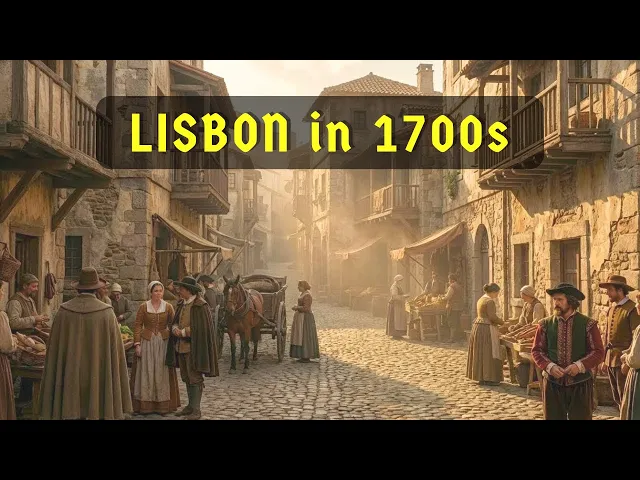
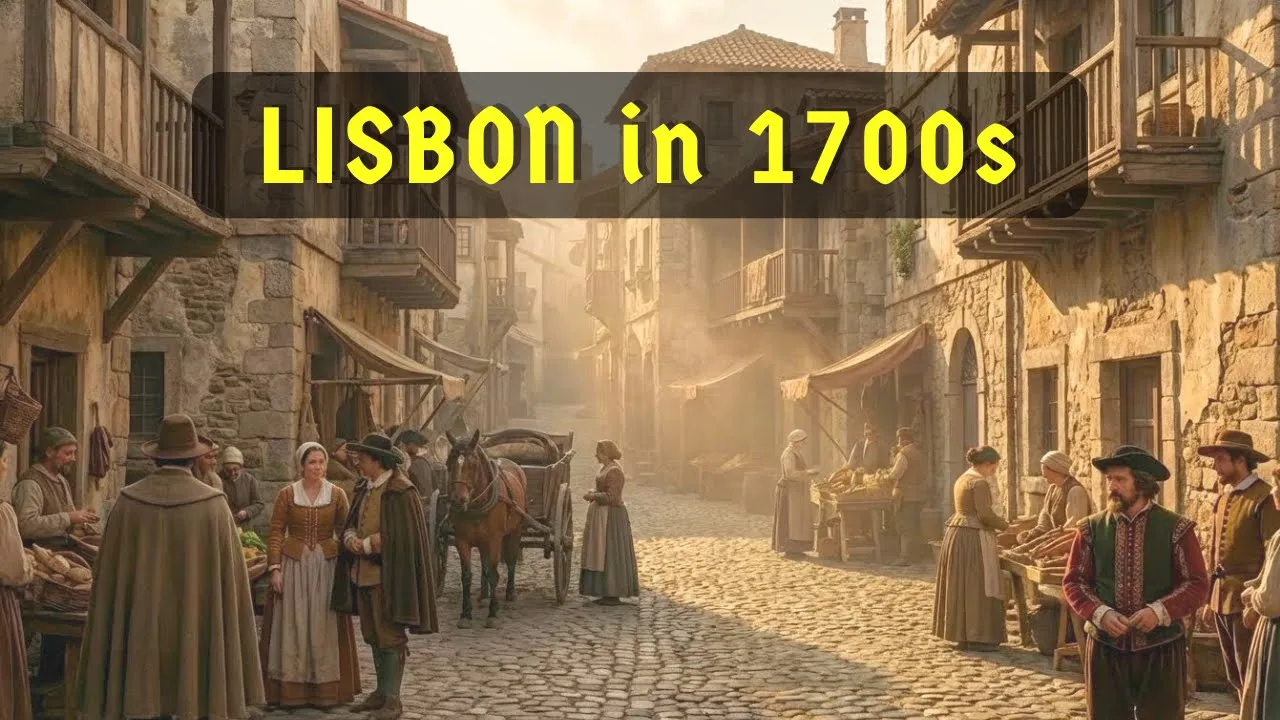
Welcome to a journey back in time to 18th-century Lisbon—one of the wealthiest, most beautiful, and most influential cities in the world. Before London or Paris claimed their modern dominance, Lisbon was the gateway to the globe. It was a city where the air smelled of cinnamon and pepper, where the streets were paved with the riches of Brazil, and where the echoes of the Age of Discovery still resonated in every stone.
Using advanced AI technology, we have transformed 18th-century sketches, copperplate engravings, and oil paintings into photorealistic scenes. Today, you won’t just hear about history; you will see it. You will walk the narrow, bustling alleys of the Alfama, stand before the magnificent Ribeira Palace, and witness the catastrophic event that changed the course of European philosophy and architecture forever.
In the early 1700s, Lisbon was home to nearly 200,000 people. It was the fourth largest city in Europe, trailing only London, Paris, and Naples. It was a city of extreme contrasts.
On one hand, it was the "New Rome," filled with more than 40 churches and 90 convents. On the other, it was a chaotic, medieval labyrinth where the wealth of an empire flowed through streets that lacked a modern sewage system. But this golden age was headed toward a terrifying climax.
We will see how a city was erased in a single morning and how it rose from the ashes to become the first modern city of the Enlightenment. To understand why the world stood in shock when Lisbon fell, one must understand that by 1750, this city was the beating heart of a global machine. This is the Tagus River—the golden throat of Europe and the lifeblood of an empire.
In the mid-1700s, this wasn't just a body of water; it was the most strategic and wealthy harbor in the Atlantic. Looking at this 1730 engraving by Joakim Ottens, we see a "forest of masts" so dense it was said you could almost cross the river by jumping from deck to deck. But why were all these ships here?
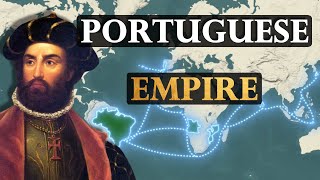
To understand the sheer scale of this movement, we must look at the Five Pillars of Portuguese Supremacy that made Lisbon the beating heart of a global machine. Ships arrived daily, fueling what historians call the first truly global economy. The first pillar was The Spice Link.
While other nations were still struggling to establish trade, Portugal held the keys to the East. From Goa, Malacca, and Timor, ships brought the aromatic treasures of the Orient—pepper, cinnamon, and cloves—directly into Lisbon’s warehouses, where they were sold at a premium to the rest of a hungry Europe. Close behind was the second pillar: The Silk and Porcelain Route.
Through the gateway of Macau, Lisbon held a near-monopoly on "white gold"—the delicate Chinese porcelain that every aristocratic house in Paris and London craved. Then came the African Connection; by controlling strategic ports in Angola and Mozambique, Lisbon dominated the Atlantic trade winds, funneling ivory, rare woods, and gold into the city’s coffers. But the true engine of 18th-century Lisbon, the fourth and most powerful pillar, was the Age of Gold—the Brazilian Boom.
After the 1695 discovery of massive gold deposits in Minas Gerais, a literal river of wealth began to flow across the Atlantic. It is hard to overstate the magnitude: nearly 1,000 tons of gold and millions of carats of diamonds arrived at these very docks in the decades leading up to the great disaster. This unimaginable wealth transformed Lisbon into a Cultural and Scientific Magnet.
The King didn’t just hoard this gold; he invested it in prestige. He commissioned the world’s most advanced aqueducts and gathered a "classified" library of nautical maps—the Roteiros—which were the 18th-century equivalent of nuclear codes, containing the secret navigation data of the world's oceans. In 1750, Lisbon was the world’s primary warehouse and its wealthiest creditor.
Yet, the riverfront was a scene of stark, noisy contrast. You would hear a dozen languages—Dutch, English, Italian, and African dialects—mingling with the rough Portuguese of the stevedores. The "Ribeira" was the city’s front door, and while it glittered with gold, it also reeked of reality.
Unlike Paris or London, which were inland cities, Lisbon looked directly out into the deep blue, obsessed with the horizon. However, the beauty was deceptive. The Tagus was also the city's primary sewer.
The "stench of Lisbon" was legendary among travelers; domestic waste was thrown from windows into the streets and eventually washed down the hills into these very waters. Yet, this river provided both the fish that fed the starving poor and the diamonds that adorned the crowns of kings. Today, the Tagus remains the heart of the city, but the heavy galleons have been replaced by cruise liners and sailboats.
The Ribeira district, once the center of this global power, is now the Praça do Comércio—a site we will visit later to see how it was reborn from the ashes of the greatest tragedy in European history Imagine standing before the Paço da Ribeira. This was the royal residence of the Portuguese kings for over 250 years. If Versailles was the symbol of French power, the Ribeira Palace was the symbol of Portuguese global reach.
Built originally by King Manuel I in the early 1500s, it was constantly expanded. By the mid-1700s, it was a treasure house. Inside its walls were more than 70,000 volumes in the Royal Library, hundreds of paintings by masters like Titian, Rubens, and Correggio, and the priceless archives of the Age of Discovery—maps and charts that showed the secret routes to the East.
King João V spent his riches here with an intensity that rivaled Louis XIV of France. He turned the Portuguese court into a spectacle of baroque excess. He didn't just want to be a king; he wanted to be the most "Apostolic" king.
He used Brazilian gold to pay the Pope for the title of "Eminent Highness" and to turn the Royal Chapel into a place of shimmering gold and silver. But the palace was more than just a home for the King. It was the administrative brain of an empire that stretched from South America to Indonesia.
In the lower floors, clerks tracked the price of pepper and the weight of gold bars. Today, this palace is completely gone. Not a single stone of the royal residence remains on this site.
When we reach the year 1755 in our story, you will see why. Now, the space is occupied by the vast, open Praça do Comércio. To understand 18th-century Lisbon, you must understand its relationship with God.
This is the Jerónimos Monastery in the district of Belém. Even in the 1700s, it was already 200 years old, a masterpiece of Manueline architecture—a style unique to Portugal that incorporates maritime symbols like ropes and coral into the stone. The monastery was built with the "Pepper Tax," the 5% levy on all goods coming from India.
In the 18th century, it was the spiritual anchor of the city. Sailors would pray here before leaving on voyages that might last three years; the lucky ones who returned would come here to give thanks. Nearby stands the Belém Tower.
In the 1700s, it sat much further out in the river than it does today. It was the last thing a sailor saw when leaving Lisbon and the first thing he saw upon return. It served as both a ceremonial gateway and a grim prison.
In its damp, underground dungeons, political prisoners and criminals were held in horrific conditions, often forgotten as the tide rose. Further into the city stood the Carmo Convent. Towering over the Rossio square, it was the most important Gothic church in Lisbon.
Its library was legendary, and its height made it a landmark visible from almost anywhere in the city. The Catholic Church in Lisbon was omnipresent. There was a church or a chapel on almost every corner.
The sound of bells was the city's heartbeat, marking the hours of prayer and the news of the day. But this religious devotion had a darker side—one that the Enlightenment thinkers of Paris and London looked upon with horror. This is the Rossio, the center of public life in Lisbon.
While it was a place for markets and celebrations, in the 1700s, it was also the site of the Auto-da-fé—the public penance of the Portuguese Inquisition. Portugal was a deeply conservative and religious society. The Inquisition, established in 1536, was still very active in the 18th century.
They targeted "New Christians"—Jews who had been forced to convert but were suspected of practicing their old faith in secret—as well as those accused of heresy, witchcraft, or "sodomy. " While the Enlightenment was sweeping through the coffee houses of Paris, Lisbon was still bur*** people at the stake in the Rossio. These public execu*** were grand spectacles, attended by the King and the nobility.
The victims would be paraded through the streets in "sanbenitos"—yellow tunics with red crosses—before being brought to the fire. This religious fervor created a strange atmosphere in the city. It was a place of immense wealth and artistic beauty, yet it was also a place of fear and intellectual repression.
Books were censored, and new ideas from the rest of Europe were often smuggled in like contraband. Today, the Rossio is a place of joy and meeting. The headquarters of the Inquisition was replaced by the Dona Maria II National Theatre.
The dark history of the Inquisition is a shadow that the city has long since stepped out of, but in the 1700s, it was a defining feature of daily life. If you left the grand palaces of the riverfront and climbed the hills, you entered a different world. This is the Alfama.
It is the oldest district in Lisbon, a medieval maze that survived the Moorish occupation and the reconquest. In the 1700s, life here was lived in the streets. Because the houses were so small and cramped, people cooked, washed, and socialized outside.
You would see the varinas—fishwives—carrying baskets of sardines on their heads, shouting their prices with a rhythmic, musical call. Lisbon had a serious water problem. There was no running water in houses.
Instead, the city relied on public fountains. The heavy lifting was done by "Galegos"—immigrants from Galicia in Spain. They were the city's muscle, carrying water barrels up the steep hills to the houses of the wealthy and the poor alike.
They were often treated as a lower caste, yet the city could not function for a single day without them. On the opposite hill was the Bairro Alto. By day, it was a quiet neighborhood of aristocrats and craftsmen.
By night, it became the center of Lisbon's nightlife. This was the birthplace of Fado—though in the 1700s, it was still evolving from the songs of sailors and the marginalized. You would hear the melancholic strings of the Portuguese guitar echoing through the darkness.
But the darkness was dangerous. There were no streetlights until the late 1700s. If you walked the streets at night, you carried a lantern and a sword, or you hired a guard.
Criminality was high, and the "night soil"—the contents of chamber pots—was frequently emptied from windows with a simple cry of "Água vai! " (Water goes! ).
It was All Saints' Day. A major religious holiday. Almost the entire population of Lisbon was inside the churches, which were packed to capacity.
Thousands of candles were lit on the altars, and the air was thick with incense. At 9:40 AM, the earth began to shake. This was not a small tremor.
It was a massive undersea earthquake, later estimated to be between 8. 5 and 9. 0 on the Richter scale.
The shaking lasted for nearly six minutes—an eternity during an earthquake. In the grand churches like the Carmo Convent and the Cathedral (Sé), the heavy stone roofs collapsed instantly, crushing thousands of worshippers. The narrow streets of the Alfama and Baixa became death traps as buildings leaned and fell into one another.
Those who survived the initial collapse ran toward the river. The Tagus was the only open space, away from the falling buildings. Thousands of people gathered on the stone quays of the Ribeira, looking back at their city in ruins.
Then, they noticed something strange. The water was disappearing. The earthquake had triggered a massive tsunami.
About forty minutes after the shaking stopped, a wall of water, estimated to be 20 to 30 feet high, came racing up the Tagus. It smashed into the riverfront, sweeping away the survivors, the docks, and the lower floors of the palace. But the nightmare was still not over.
Remember the thousands of candles lit for All Saints' Day? They had fallen into the wooden ruins of the churches and houses. Within an hour, dozens of small fires merged into a firestorm.
Because the streets were blocked by rubble and the water system was destroyed, the fire raged unchecked for five days. Lisbon didn't just fall; it was crushed, drowned, and then burned. The numbers are staggering.
Out of a population of 200,000, it is estimated that between 30,000 and 60,000 people died. The physical loss was even more absolute. 85% of Lisbon's buildings were destroyed.
The Ribeira Palace was gone. The Royal Library and its 70,000 books—burned. The archives of the Great Discoveries—lost forever.
Paintings by Titian and Rubens—turned to ash. This is the Carmo Convent today. It was left in its ruined state as a memorial to the earthquake.
When you stand inside it and look up at the open sky, you are seeing exactly what the survivors saw in November 1755. It is a skeleton of a city that was once the richest in the world. The disaster shook more than just the ground; it shook the foundations of European thought.
Philosophers like Voltaire and Rousseau debated: How could a "good" God allow such a tragedy on a holy day to a devout city? This event effectively ended the era of blind religious optimism and helped trigger the Age of Enlightenment. In the wake of the disaster, the King, João V’s successor José I, was paralyzed by fear.
He developed a phobia of living inside stone walls and spent the rest of his life living in a complex of luxury tents outside the city. The task of rebuilding fell to one man: the King's Prime Minister, the Marquês de Pombal. Legend has it that when asked what was to be done, Pombal replied simply: "Bury the dead and feed the living.
" Pombal was a man of the Enlightenment. He saw the destruction as an opportunity to build a "rational" city. He ignored the old property lines of the Church and the nobility.
He ordered the ruins cleared and designed a new city center—the "Baixa Pombalina. " He implemented the world's first earthquake-resistant building techniques. He required that every new building be tested using a "Gaiola Pombalina" (the Pombaline Cage)—a flexible wooden frame designed to sway but not break during a tremor.
To test the design, he had soldiers march in sync around models of the buildings to simulate seismic waves. He also standardized the city. The beautiful azulejos (tiles) we see today on Lisbon’s buildings were mass-produced under his orders to speed up the reconstruction.
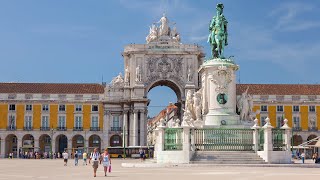
He replaced the narrow, filthy alleys of the medieval city with wide, straight boulevards that allowed for light, air, and the movement of troops and commerce. This is the result of Pombal’s vision. The center of this new world was the Praça do Comércio, built on the exact site where the Ribeira Palace once stood.
By naming it "Commerce Square," Pombal was sending a message to the world: Portugal was no longer just a religious empire; it was a modern, mercantile nation. The grand arch, the Rua Augusta, served as a gateway from the sea into the heart of the new city. In the center of the square stands the bronze statue of the King, trampling snakes under his horse's hooves—a symbol of order triumphing over the chaos of the earthquake.
Today, this square is the "living room" of Lisbon. It is one of the most beautiful plazas in Europe. When you walk here, you are walking on top of the ruins of the old palace, on top of the site of the great tsunami, and within the heart of a city that refused to die.
Lisbon’s history is a story of extreme highs and devastating lows. It rose as the "Queen of the Seas," fell in a morning of fire and water, and was reborn as a city of the future. The 1700s began with the glitter of Brazilian gold and ended with the sober, elegant lines of Pombaline architecture.
It was the century that saw Lisbon move from the medieval to the modern. Behind the grand façades and the tourist shops, the spirit of the 18th century is still there. It’s in the Saudade—that uniquely Portuguese feeling of longing for something that was lost.
It’s in the resilient stones of the Alfama and the defiant arches of the Carmo. Lisbon is a city that has seen the end of the world and decided to keep going. It reminds us that even after the greatest tragedies, beauty can be rebuilt—rational, strong, and more enduring than before.
If you enjoyed this deep dive into the golden and tragic history of Lisbon, let us know in the comments. Which city's secrets should we uncover next using our AI lens? Should we walk the streets of Edo-period Japan, or perhaps the marble halls of Ancient Rome?
Thanks for watching. I’m Tim, and together, we’ll keep history reborn. I’ll see you in the next era.