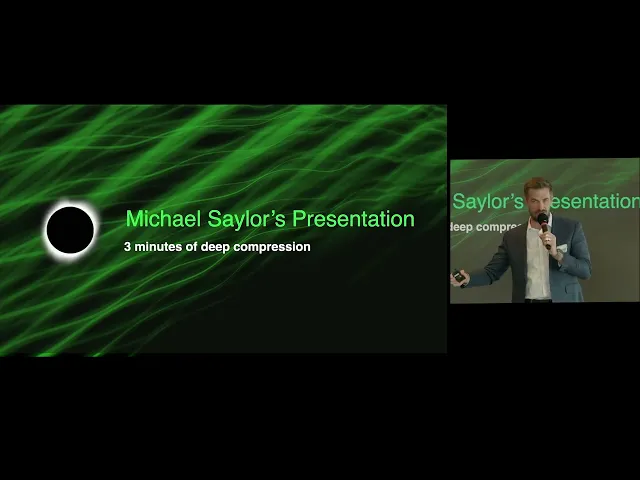
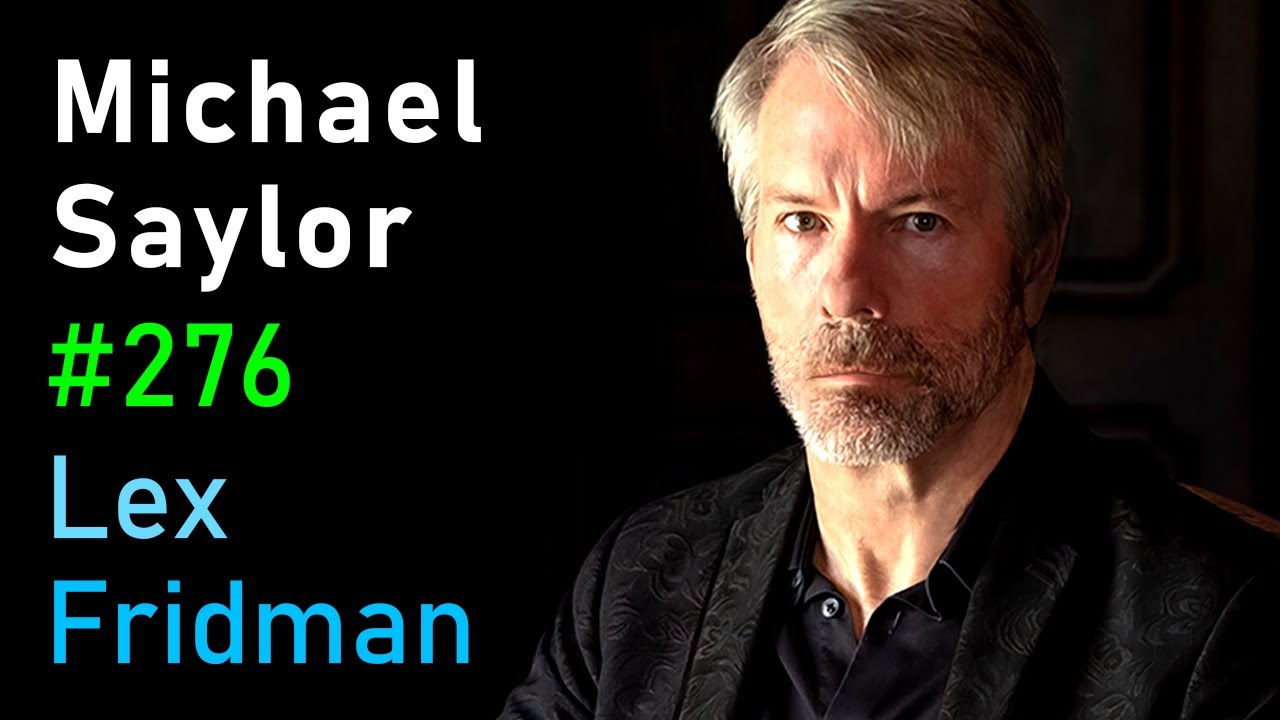
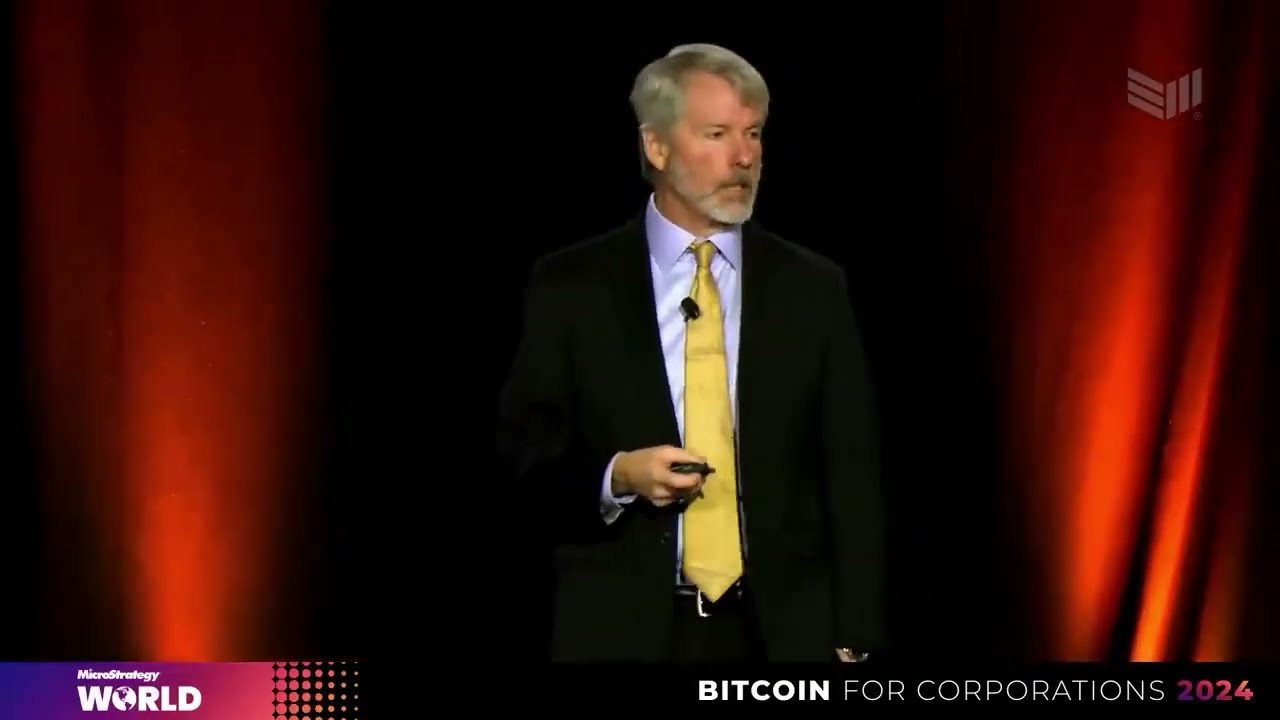
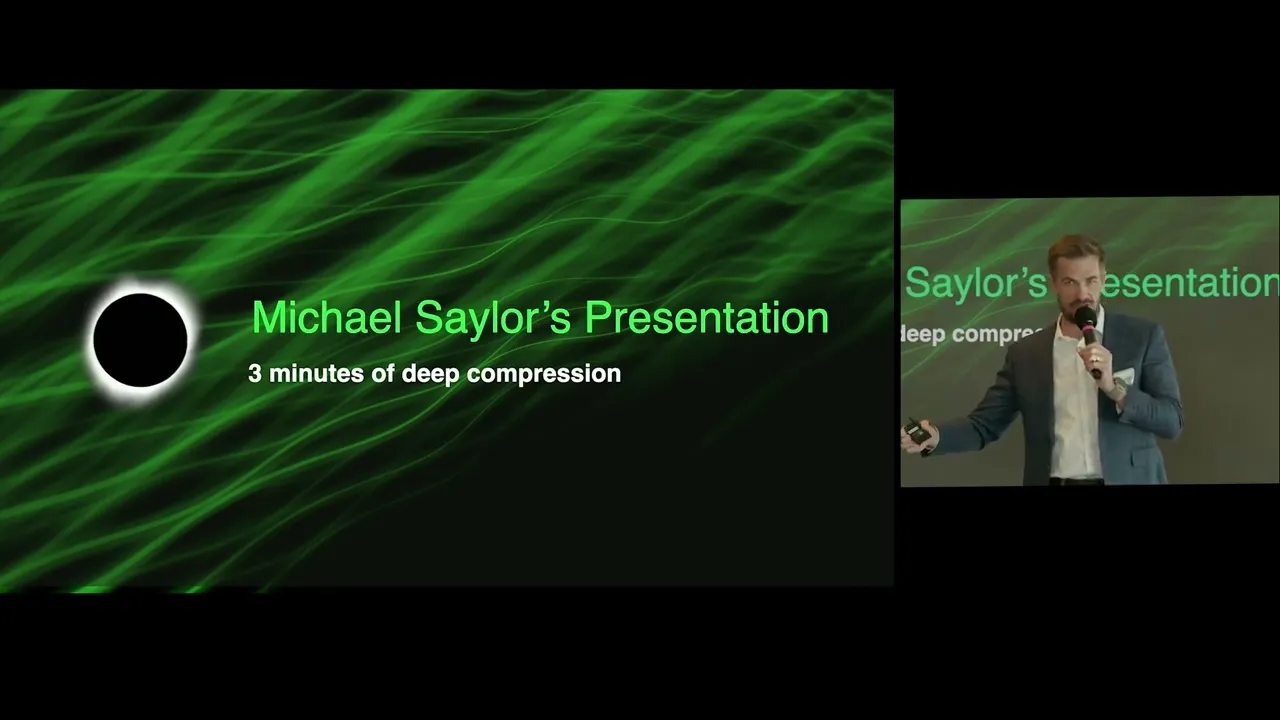
thank you so much Lynn um so we're going to hand over now to Preston Preston is going to take us on a very interesting journey through Bitcoin um including going over the recent presentation um that Michael sailor made to Microsoft um which is a very fascinating video we'll see it you'll learn all about it you'll understand it all after this very excited thank you very much actually one and we'll have a break after Preston's presentation all right so I stand between you and the break okay uh right there okay thank you the decompression of Bitcoin so I don't how many people were familiar with Michael sailor uh giving the talk uh to Microsoft uh recently he was uh he gave a three-minute presentation to Microsoft Microsoft had a vote on whether they were going to incorporate Bitcoin as a treasury asset the shareholders requested this Michael was asked to give a presentation and Microsoft gave Michael sailor 3 minutes to give the presentation on bitcoin and it was a Whopper so I'm going to start off with uh I was reading this uh book here the user illusion which is talking about intelligence and all this AI stuff just has me kind of fascinated at the moment uh and it it's talking about I gave this example example of the shortest communication according to the uh Guinness Book of World Records and it was Victor Hugo who was the author L Miz and also the author of Hunchback and not Notre and he sends an a letter to his publisher in 1862 and this was right after he finished writing lay Miz and he went on a holiday and uh he writes this letter to his uh publisher to see how the sales were doing this is this was the letter it was a question mark and that was it so his publisher got this I would imagine you know being in the publisher shoes you get this brilliant author and and you're expecting you know just a brilliantly constructed letter but no you get a question mark and so how do you think his publisher responded back to him this is how he responded back to him it was an exclamation uh point and uh in that commun unication tons was communicated an endless array of possibilities were communicated and so the transmission of knowledge is dependent on not only the sender but also the receiver in the context in which it is that communication that I just showed you was about 10 bits that was transmitted and it's not the number of bits again it's the context the conditioning of the receiver's past was vital to understanding the context of the message it was if you're the publisher and you get some random message from a person you don't know and it's just a question mark you're going to open that up and you're going to say well this is pretty much worthless and you're going to throw it in the trash but because he knew who it was from and he knew that they had this this relationship of something that they just worked aggressively on which was the manuscript for Lay Miz there was context there was understanding and then the response back which was equally hilarious the exclamation point was well sales are going well my friend and you can read into that in any way that you want so my message here is like how does this apply to bitcoin so bitcoin's message is very clear but the world's past experience and conditioning of what it is is why so many are confused in my humble opinion uh other cryptocoins not backed by real energy you just heard Ross literally say this on stage only makes this message more confusing it's almost like there was no sender on the letter so there's a lot of Mis uh Mis or confusion that's happening on this particular topic Bitcoin is a technology that solves an enormous problem that most people in the world don't even understand exists and that's what's so really strange about all of this the solution has already been built it's already out there the problem is people don't understand the problem in the context of what in the world it's trying to solve and you just heard a an amazing you know layout from from ly Alden on like what is this thing from a macro standpoint and all these other things that are going on could you imagine the amount of work and energy and focus that Lynn put in it to understand the problem on the receiver side of it and just as an example okay so what happens when Global Currency has no Peg and we talked through that with the uh you know the uh Petro dollar system was was a way that that was constructed but what what you're actually seeing is a competition to debase between nation states occurs and I want to provide an example that I think everybody in the room can kind of understand as to what I mean by a competition to debase so imagine everybody's familiar with the game Monopoly show a hands I'm sure yep everybody's familiar with Monopoly imagine just four people sitting at a table and they're playing the game in Monopoly and if we want to speed this game up the fastest way to do that is instead of collecting 200 every time you go around go let's just add 500 or a thousand and what you're going to find is the game speeds up very quickly because what you're getting is the polarization of the scarce assets which are the park places and you name it around the board right those are that's the equity on the board and as the printing and the Fiat is entering the game everybody is in incentivized to own as much of that property as they can because then it it kicks off free cash flows and let's say I'm starting to dominate the game and the person sitting to my right is trying to catch up and I just passed go again and I got the next wave of a thousand Fiat units added into the game My incentive is to immediately try to go buy other properties if they've already been scooped up by somebody else in the game or to go into the game and and buy that scarce Equity that's how I win the game but I'm going to put a Twist on this okay okay let's imagine we have those four people playing right here on one card table and then over here we have a second group of people that are also playing a game of Monopoly okay and they're playing the same game but here's the twist the fifth there's a fifth person that's playing the banker and they're the ones that are inserting the Fiat into the game here and then you have another Banker over there that's inserting the Fiat into that game and the and the players at the table look over at the banker and they say you know if you you just push a little bit more money into the game and I'm sorry one more rule here that that sets up this example is the players on this table can come over to this table and they can buy the equity on this table and the players on this table can come over to this table and buy the equity at this table okay so now imagine the relationship and the desire and the incentive that the players at this table have to whisper over to their Banker hey if you just give give us a little bit more of that Fiat we can go over there and we can extract the the scarce desirable resources off that table and we can dominate the the global scenario that I'm explaining if there's no Peg that forces the monetary units at this table to be fixed and the monetary units at this table to be fixed you can see very quickly how the incentives blow out of proportion and it's all about owning the scarce desire able resources that are on that table this is the this is the race to the base imagine if one of these if one of these people sitting at these tables said you know what we're not going to cheat we're not going to put more uh Fiat units in our game we're going to play by the rules and ours are going to be you know standardized at whatever many units but now we're not dealing with two tables we're dealing with 20 tables of people playing this game and they're all breaking the rules who's going to end up with the scarce desirable resources if you're the one if you're the one table that's playing by the rules and everybody else isn't so what you get yourself into is a game theory where people are incentivised to print as much as they can extract the natural resources of not only their local area but the other boards and you can see how it becomes a race to De base so here's the question what if a fair money outside of government control could exist that no government entity could control and those 20 people playing this the 20 different tables are forced to play by a fixed monetary standard with fixed supply of units call them 21 million units which is how many Bitcoin exist and Ross and I didn't have this conversation before he literally had this he said this and I was like yes cuz I knew my presentation was coming up and I have it right here I and this is uh from Frederick Hayek in 1984 he said this I don't believe we shall ever have good money again before we take the thing out of the hands of the government that is we can't take them violently out of the hands of the government all we can do is by some Sly roundabout way introduce something that they can't stop and this is the benefit for Citizens worldwide not citizens in in one domestic location with what he's talking about and this is the question what a fair money outside of government control could exist We Believe at ego death capital and Alex with time chain that this is what's playing out right now is that you have a fair money that nobody no outside person can control it's backed by energy energy consumption and we think this is really important so Michael goes and gives this presentation to the Microsoft shareholders going back to the to the situation that I initially started off with you can have the most you can have the most brilliant communication on the send side but if on the receive side the person hasn't done the energy or understand the context of what you're saying it's just straight over your head and so Michael had 3 minutes he gave a presentation I've extracted a couple of the uh slides out of his presentation that I want to talk to that I think are important and then we're going to play Michael's three-minute uh presentation that he gave to Microsoft just so you guys can kind of see it so this was an overview of his presentation he positioned Bitcoin as this critical component of the next technology wave uh for people that aren't intimately familiar with Michael he predicted the mobile wave uh wrote an entire book about it uh and he seems to have this innate ability to kind of see technology Trends as they're emerging and and well before they really kind of start taking hold he proposed that Microsoft similar to what you just heard Ross say that they've been doing at uh since 2017 as far as taking their free cash flows and plowing them into Bitcoin and keeping them on their balance sheet uh mik Michael proposed that to Microsoft um he he got into the Nuance of like how much uh value he think that it could that it could provide through shareholders with $5 trillion and their market cap over the next decade was his projection and he was pushing them to invest the number that you guys see there on on the screen so let's talk about Michael's performance in 20120 he had a company it makes about 75 to 100 million we're not talking billions only 75 to 100 million annualized in net income so he's profitable and he was looking at he had a treasury of about $500 million of of liquid assets on his balance sheet at that time in 20 whenever he decided to adopt the Bitcoin strategy with any type of retained earnings that he had and he took the 500 million that he already had and he invested in Bitcoin since that time in 2020 and this is the slide from his presentation this is his performance MST is micro strategy this is the performance that he's had in the stock compared to other leaders in the stock market Nvidia right there you can see nvidia's done really well Tesla and you look at you look at the the what is it that Nvidia is making and you look at the technology behind all that and how insanely impressive all of it is and you look at their stock performance which is impressive and then you look at micro strategy he hasn't changed the product he hasn't changed anything other than taking a Bitcoin treasury strategy and this is the performance which I think is extremely noteworthy doesn't mean it's going to be what it is moving forward but I think it's very characteristic of of what we've seen in the last four years um then he shows just Bitcoin itself the annualized performance since he uh has started using it as a treasury Reserve asset and I think it's noteworthy we had a lot of uh uh discussion about fixed income what role fixed income is going to have with this potential change and shift that's happening from a macro uh landscape and potentially a long-term Trend you can see the Bond's performance for the last four years so what is fundamentally enabling this for him to get this type of performance he makes the argument that these are some of the big giant trends that have happened in the past and his opinion is that digital capital is going to be a a massive technology wave moving forward I love this this is uh from a friend Jesse Myers that uh Michael used in his presentation and what he's doing is he's just saying all right let's just talk about the global perspective of all ass major asset classes you can see bonds 300 trillion and I also want to uh point out here at the top there the total Global asset value is 900 trillion for everything in the world bonds make up oneir of that at 300 trillion real estate 330 trillion equities 115 trillion you can see gold you can see Arts uh art cars and collectibles the money just the base Fiat money that that's out there 120 trillion across the globe then you can see Bitcoin there in the far left 2 trillion very small small and what Michael's suggesting is that these assets provide utility and preserve Capital but he thinks that the shift is going to take that 900 trillion in today's buying power and that half of it is going to be used as long-term uh Capital you often hear if you listen to a podcast or you listen to him just talking that he said people are using real estate as a way to preserve their wealth he's like you go out to the Hamptons the person might have five homes the reason they have five homes is because they're actually just wanting to preserve the buying power of the profits and the retained earnings that they that they have is it nice that they can go to The Hamptons and stay of course it is but it's also a way to not just freeze it but potentially keep up with the inflation because it's scarce and desirable and everybody's going to want to always have a house in the Hamptons and he uses this as an example of why has prices in real estate been bid so high is it because of the utility of it or is it because of the store value qualities of it and he would make the argument that it's because of the store value quality is much more so than the utility and so he thinks over the the coming two decades that this division of that 900 trillion that we saw is going 450 trillion of it is for store value 450 of it approximately for uh utility purposes so why is digital Capital so so important in his in his opinion moving forward and he's saying if you own the house in the Hamptons you have this uh this thing that's chipping away at it almost like a if you're an aircraft there's drag you can't have lift without also having drag that's associated with it and he's saying when you own the house in the Hampton or you own these other things that are being used as store value things they come with all of these risk factors and there's a lot there but Bitcoin he's saying you don't have any of these risk factors and so that that drag that's associated with those store value properties you you relinquish it it's almost like you're able to have the lift with near perfect zero drag associated with it because it's digital this is where bitcoin's currently at he says seventh uh largest asset it's the fastest growing it's the most popular when you look at the speed of the internet itself the Internet Protocol and the adoption of it and you look at the adoption of people that are coming to bitcoin it's actually faster than the internet itself uh over the past decade he continues to go on this is another uh you know side by side showing you the issues with traditional forms of store value and all that friction and all of that drag that's associated with it versus Bitcoin he likes to do this thing called a halflife where he's looking at a traditional store of value and he's saying you know after 70 years the the underlying value let's say I I took a million dollars worth of buying power today and I plugged it into gold well after 70 to 80 years I've pretty much consumed through the drag that same amount that I initially put into it and he has obvious calculations that he's using to to put them on this timeline but what he's also showing is that Bitcoin is far beyond anything that exists that we're using for store value properties today he saying how is Bitcoin secured and you heard Ross and Lynn both hit on this it's stored not just by energy and this is another misnomer that I think a lot of people that are new to the space misunderstand it's not just the energy it's the encrypted energy you have to have a mining rig that takes the energy and and is trying to to figure out the block that encrypted energy is what really makes it different because let's say a nation state wants to come online and say we want we want to control the Bitcoin well they have to figure out the supply chain of all the mining Rigs and all of that is so decentralized across the globe you have mining happening in China you have it happening in Russia you have it happening in the United States in fact you have it happening in style in the United States which I'm very excited and proud of as as an American but it's the encrypted energy that is causing Bitcoin to be secure that no no one entity can come in there and change it 20 gaw uh anybody have a guess as to how many gigawatts power New York City for a year it's about five to six just to kind of give you a an idea of how impressive this is as far as the security of Bitcoin Michael makes the argument we're at a really critical time right now from a political stand uh Point everybody's been concerned about Reg atory Guidance the lack of regul the ambiguity over regulatory guidance and it seems that and this is his slide uh that things are about to change whether and I'm very political agnostic but it seems like it's going to be extremely exciting for this space to uh navigate moving forward not only that you have black rock everybody knows who black rock is going on TV CNBC Larry all the time it's almost feels weakly this is a Bloomberg article it's what two the dates not on there this is within the last two weeks this article Black Rock Says 2% Bitcoin allocation is a reasonable range these are the things that are being said by the by the largest banks on the planet this was uh you know Michael's pitch to the Microsoft uh board saying hey instead of instead of giving out the the dividends instead of surren surrendering that's the word he uses there instead of surrendering your dividends back to your to your shareholders and doing BuyBacks which is the same thing as a dividend but has better tax implications and and take your free cash flows take all these things and plow it into Bitcoin he thinks that you can have way better performance for those shareholders than just surrendering it now back to this uh slide if you look this is a little bit different than the one that I showed you earlier that had a total 900 trillion units in it this one has 4,000 trillion units in it okay and what he's saying is in 21 years from now this is his opinion and he built a model that he released on GitHub for people to go in there and Tinker with whatever assumptions they want um this is how he thinks the world is going to look from a construction standpoint he thinks that they real estate and what's really interesting is if you take the previous one and you and you turn that into 4,000 trillion units your . 4 Xing it okay the amount of monetary units from a Fiat standpoint that are that are in the system he thinks that this is going to be the the construction and the composition of what all these asset classes look like after you 4. 4x it where did he get the 4.
4x over 21 years very interestingly you heard Ross talk about how the money supply is growing at 7 to 8% so when you take the 900 trillion units and it was interest this was my assumption of how Michael did this he didn't talk about it in his presentation but I went into Excel and I just did a you know a 21 year compound annual growth rate off of the 900 trillion and I used 8% because I've heard this talking point from Lynn and many others as to that's being the real debasement rate is around 8% and sure enough it gave me 4,000 trillion so it's pretty neat that that's how Michael is also doing these assumptions which is he thinks the money supply of Fiat is growing at about 8% compounded annually so uh I took the the chart that he had for today I looked at where the chart was in 2046 21 years later and uh you can see there at the top right here that the total number of units going from 900 trillion to 4,000 is a 4. 4x multiple so if any one of these are above 4. 4 that is an industry or a sector that we can expect to be somewhat of a Tailwind from an investment stand point if it's something that's compressing and it's below the 4.