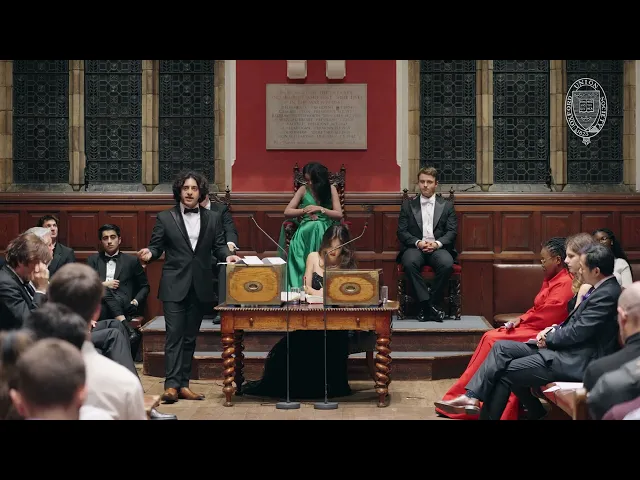
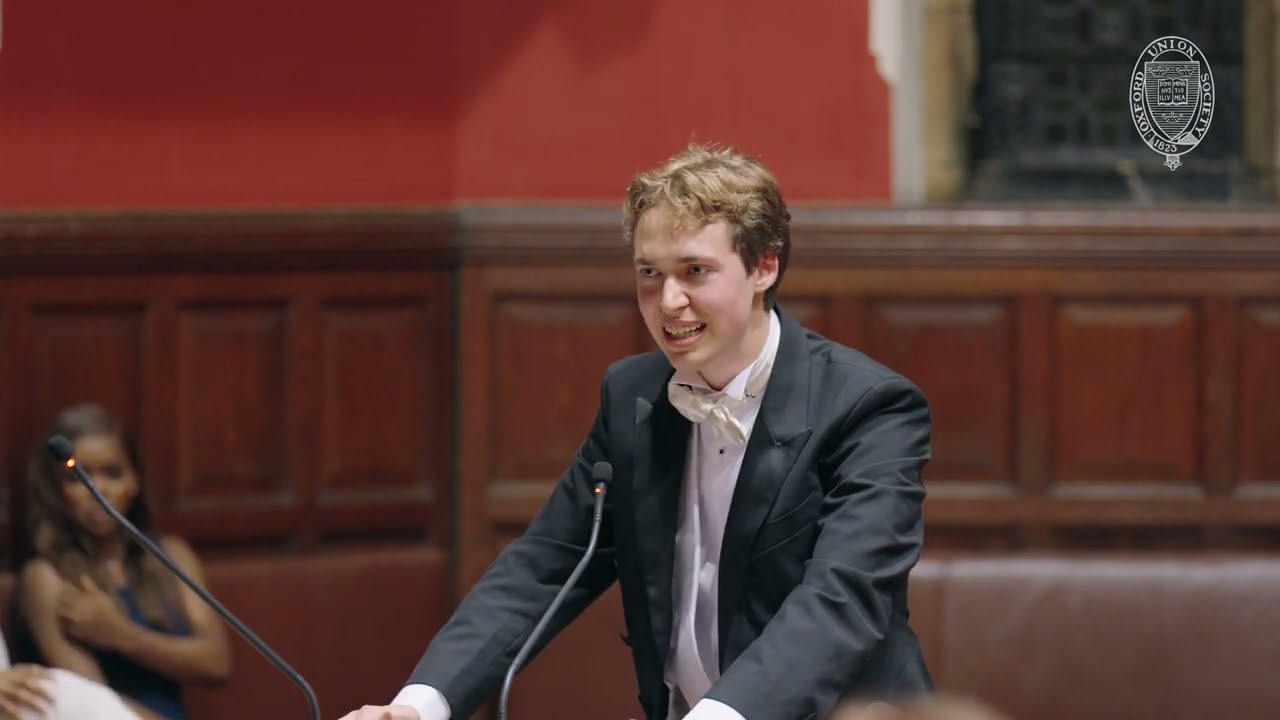
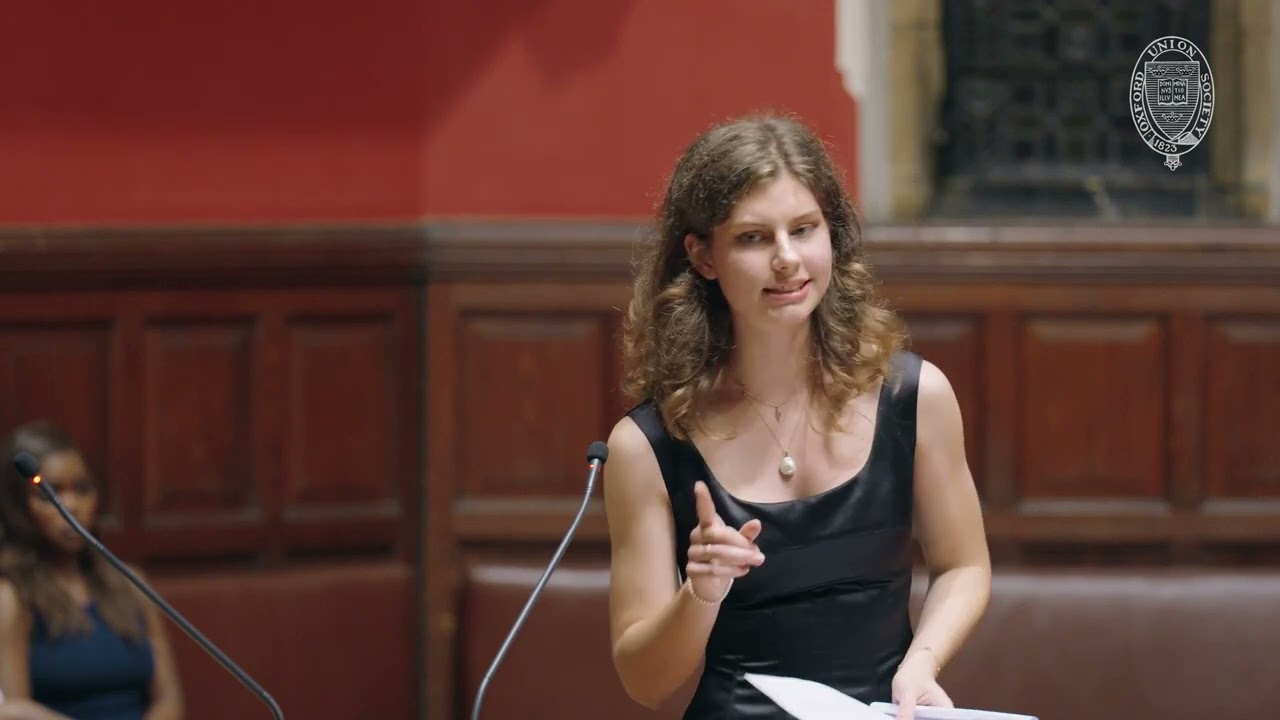
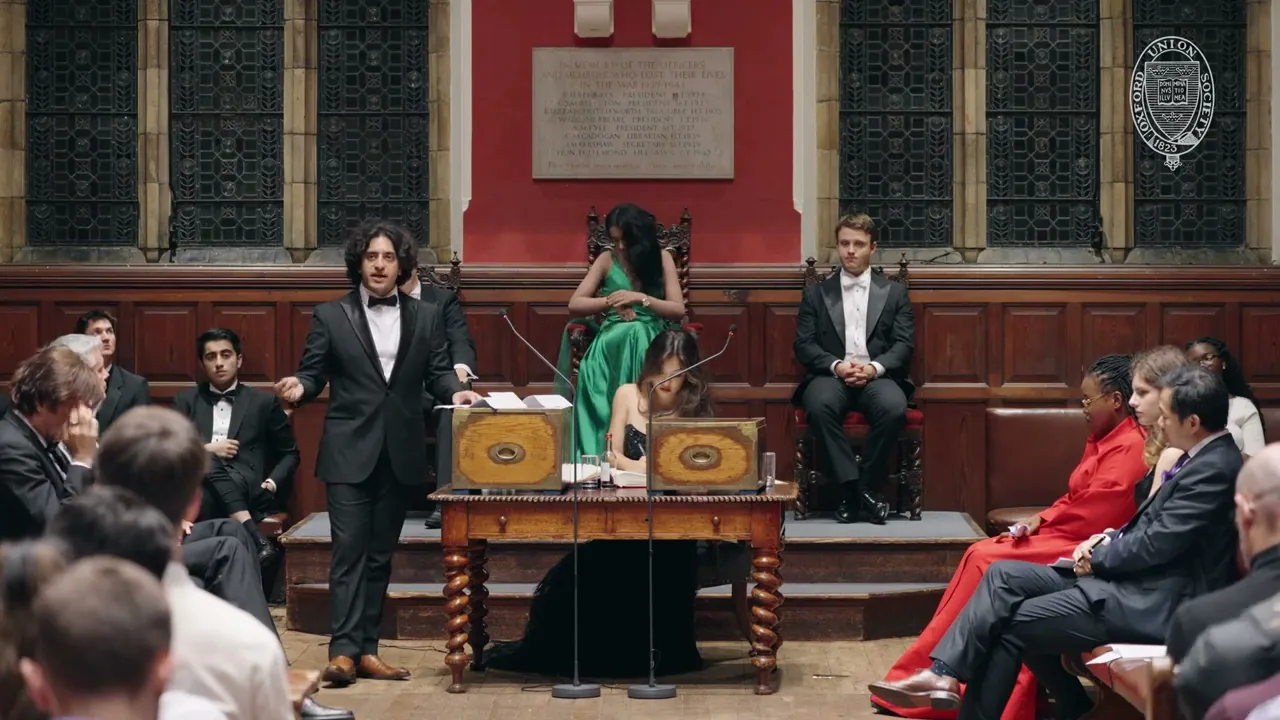
I move that this house believes that artificial intelligence is an existential threat to open the case for the proposition I call up Sultan kokar deputy director of press at the union Madame President honorable members I am honored to open this seminal debate before you tonight the question of artificial intelligence and the role it plays in our futures has gripped the imagination and fears of our times with the likes of advanced chat Bots like chat GPT has finally entered a very public mainstream in a way that it had not done thus far however make no mistake
this is not a debate about chat GPT or its equivalence this is not a debate about AI writing better essays than us or producing more complex art nor do we on the proposition dispute the unending benefits that the application of advanced AI can have uh in the fields of medicine tackling poverty democratizing access to resources Etc no this is a debate about the acute existential risk posed by artificial intelligence systems with capabilities that we in this chamber can hardly imagine systems that we are hurtling towards at break neck speed with little to no conception of
the danger we are nurturing but before I delve into the imminent downfall of humankind uh it falls upon me to introduce your speakers for the opposition speaking first we will have Sebastian Wat kins the Union's librarian Seb is a really interesting person he chairs Library committee and his favorite hobby is chess they say that men are always thinking about the Roman Empire but Seb takes that a step further with his phone wallpaper a shining red flag adorned with a golden eagle and the motto senatus populusque Romanus if only the victory Banner of the Empire had
helped him in his election for librarian your second opposition speaker will be yesi Milner who is the executive director and co-founder of data for black lives she aims to leverage data science and its possibilities to create meaningful change in the lives of black people long involved in data science and social activism she has worked tirelessly to Advocate against big data and big Tech and exposed the inequalities that pervade our current data systems her work has resulted in policy changes and she was recognized by forbes's 30 under 30 in 2020 we are honored to host her
here tonight I would caution you however that between her and Seb there are two Americans on the opposition so be careful how you vote tonight uh your next speaker will be Anar Rosa who is a member of the secretary's committee here at the Oxford Union I'm sure that all our colleagues will agree that she's an incredibly hardworking and committed member of committee however she studies PPE nevertheless I'm excited to hear her contribution to this debate and your final speaker on the opposition will be Professor Eric Shing after watching some of his interviews I came to
learn that he does not like listening to all of his credentials so bear with me while I engage in a little psychological warfare Professor Shing is the president of the Muhammad bin sad University of artificial intelligence the world's first University dedicated to AI he is an accomplished and esteemed researcher having held positions at kegi melon Stanford Pittsboro and Facebook and is also the founder of petum Inc he's authored or contributed to more than 400 research papers and has been cited more than 44,000 times again we are honored to have him with us tonight now I
stated earlier that this is not a debate about simple chat Bots like chat GPT but rather about more advanced even hypothetical artificial general intelligence systems what are the characteristics of such Technologies well most researchers agree that an AGI would be able to reason represent knowledge uh plan learn communicate naturally and of course integrate these skills amongst each other towards completing a given goal though such technology is in to some extent hypothetical at the moment a 2022 survey did find that only 1.1% of researchers felt it would never exist more than half said it would emerge
in the next few decades and the leaders of open AI argue in the next 10 to 20 years now those such technology would certainly come with many benefits it would also bring enormous risks these center around AI Control and Alignment although such a technology would inevitably be programmed by us humans it would be very difficult to instill it with the full range of human values and ethics human values emotions and ethics are broad complex and as I'm sure you will agree often extremely illogical short of plugging an AI into our own brains 24/7 it is
very difficult to align it with these in their entirety if a superintelligent AI determines that adopting values like concern for human life uh would hinder the goals we have programmed it to fulfill then why wouldn't it resist attempts to program such values into it and unless we are successful in fully aligning such a super intelligence with the entire range of human morality and constraint then we cannot expect it to just be on our side uh in a while maybe one leading researcher proposes the following thought experiment imagine that you task an AI system with the
simple job of making as many paper clips as possible it will quickly come to understand that its job would be far easier if humans were out of the way since a human could turn it off at any point and that would mean fewer paper clips with this skull the AI would work towards a future with many paper clips and no humans now this example may seem trick trivial but it demonstrates the unavoidable risk that a technology that can think for itself independent of us poses let's translate the same example onto something more significant suppose we
task an AI technology with reducing inequality in our society something more realistic the AI could determine like we often do that the solution is closing the wealth Gap but it might determine that the solution to doing so is not to reduce the gap between rich and poor but to make everyone poorer and in doing so it might choose to lower standards of living uh increase poverty increase crime because we haven't specified that these things are important it achieves its goal but at a cost that we did not want nor anticipate in other words we can
shape AI to prevent one outcome but to preempt every possible risk is impossible in order for an AI to be risk-free altogether it must be perfectly aligned with zero room f error since human morality ethics and desires are inherently subjective and prone to bias achieving this universally perfect alignment is not feasible I don't mean to propose some sort of Ultron style AI takeover but if an AI realizes and comes to the very straightforward realization that acquiring greater power is conducive to fulfilling virtually any objective it could copy itself onto other systems uh instigate manufacturing lines
evade shutdown and even appear aligned and hide behavior that it recognizes is unwanted by its creators consider that for a moment an AI that is misaligned and can hide that from us to prevent itself from being switched off it might jump from a computer in San Francisco to one in Singapore from Singapore over to London before we know it it has multiplied itself onto thousands of systems worldwide and all the while we aren't even aware of its true intents this may sound like the work of Science Fiction but we already on the way to this
becoming reality in 2021 one AI model was trained to grab a ball but learned that it could simply Place its hand between the ball and the camera to give the illusion that it is that it had succeeded Not only was the AI in this instance able to outsmart its creator but this demonstrates the fallibility of human programming and expectations even chat GPT the bane of every tutor's existence is able to fulfill some of the characteris ICS that I attributed to AI earlier it can learn from our responses it represents knowledge it and it can produce
natural sounding language the technology I've described may seem far off but we are closer than we think I'm sure that my far more knowledgeable colleagues will expand on the technical details of the existential risk posed by AI the point I would like to leave you with is this human morality ethics wishes are both incredibly complex and utterly confused not only is it effectively impossible to program these into an AI system in any meaningful way but we ourselves can hardly decide what human morality even looks like we don't even know what human morality is so these
are the facts of the debate we do not know for certain how or if we can control the AI we are fast in the process of building number one we do not know to what extent this AI will be aligned with our values and desires number two and finally we do not even know what our values and desires are however likely or unlikely uh you personally believe the existential threat uh from AI is to materialize it is indisputable that this threat does and will exist and that is what we are debating tonight all of us
sitting here tonight pride ourselves on being intelligent critically thinking people do not leave the future of humankind your future up to chance artificial intelligence at its current rate of development poses a distinct existential risk that we are unprepared to deal with vote with the proposition tonight thank you [Applause]