thanks um for asking me to present um at your meeting it's been um a real treat for me to listen in Dr kin's presentation and to try and present information that I think um maps on to a lot of what he's spoken about but also tries to take some of this work in a in a bit of a different area so um I'm a psychologist a professor at the University of Toronto um and I along with my colleagues um Mark Williams and John Teasdale um we founded uh mindfulness-based cognitive therapy which you heard about and
a lot of uh the things that Dr kiken talked about in terms of um the evidence base and the research behind mindfulness-based cognitive therapy um is very impressive and I would say that it's been about 30 years since we published our first paper um in 1995 we published a paper called um how does attentional control training help to prevent relapse and depression and attentional control training was one of the um ways in which we spoke about mindfulness based cognitive therapy we weren't fully comfortable using the word mindfulness in a scientific paper 30 years ago although
we did mention it in Brackets in the title and um if you look at mindfulness today um there are so many ways in which it's considered to be helpful both in terms of mental Health but also as Dr kiken was suggesting in terms of flourishing in terms of population Wellness not just focusing on people who have um problems with managing a mood disorder but more generally dealing with stresses of increasingly difficult and challenging roles at work Family Life Etc and so my study and what I'd like to talk about actually starts with some of the
successes of mindfulness-based cognitive therapy I won't speak too much about it other than to let's say share this one slide with you and this is a slide from a large metaanalysis of mindfulness-based cognitive therapy in which about 1,090 patients were studied the data came from nine studies um around the world and what they found was that when you compare the benefits of mindfulness based cognitive therapy and preventing depression relapse to um people who didn't receive mindfulness-based cognitive therapy there was a 31% reduction in relapse risk when people received mbct and in another figure in this
same study if you compare mbct to anti-depressant medication then there is no difference in in uh reduction of relapse rates so that means the nbct approach or the anti-depressant continuation approach are both equally effective in protecting people so this is the part of the story that I think is a real success um and we've worked hard and other people around the world have worked hard to replicate these findings but what happens when we start to actually look at what people people do when these programs are over and how does that help us understand the longlasting
effects of these programs so what I'm presenting here is um usage data from people once they have ended the 8we nbct program and are Then followed for um for two years so on the xaxis here what we see is uh weeks and here we have frequency of use of meditation practices so this is frequency data from um people who were asked how often they um practice the sitting meditation over two years after nbct and what you can see is something that is not uncommon in other studies as well people start to drop off in their
usage fairly quickly so after the course is over there are some people who continue to practice but very quickly fewer and fewer people are practicing mindfulness meditation it doesn't really continue for all that long now this is the sitting meditation if we look at a briefer type of meditation practice the three minute breathing space that is also in our uh nbct program what we find is that this briefer meditation practice doesn't follow the same pattern there isn't that same steep drop off once the course is over but still the frequency of people practicing it is
um very low over time so these are frequency rates of practice over time and so both of these values um continue to go down now in order for people to maintain the gains from these treatments uh the idea is that they should continue to practice some form of mindfulness because the mindfulness um skills will help them to regulate their emotions and help them to um you know prevent more significant difficulties so what do we make of this problem that a program that is taught on the basis of mindfulness runs into difficulties when the program is
over and yet the value of mindfulness begins to show Once people are practicing in their daily lives and they no longer have the program so this is a problem that's not uncommon in the world of prevention if you think about uh anti-depressant medication people are prescribed an anti-depressant and when they feel better they're no longer longer depressed they'll sometimes stop taking the anti-depressant because they feel they don't need it anymore but the clinical treatment guidelines suggests that people need to stay on anti-depressants for about a year or so after they've recovered or achieved clinical remission
the same is true with dieting people can go on a diet and lose weight but then they need to maintain the type of eating or the type of vigilance or the type of um structure around food choices and caloric intake um for long periods of time in order to maintain the weight loss so we're not dealing with something that's unheard of it's just that in our world continuing to expect or ask people to work with u mindfulness practices on a daily basis is something that people just do not seem to to do at least not
do in very large numbers and so one possibility is um maybe we can find something that is tied to the practice of mindfulness that doesn't fully represent or look like practicing mindfulness but has inside of it the seeds of what mindfulness practice can give us and maybe that can provide a bigger opening for people to practice in different ways and still stay connected and in the research that I've done and the work that our group has done I'd like to suggest that one of those Solutions might be teaching people to shift into the sensory world
and to use their ability to tap into sensation as a very important tool so let me tell you a little bit about that this work comes from some neuroimaging studies that have been conducted and the neuroimaging studies have looked at what happens in the brain when people feel sad what parts of the brain become active what parts of thein become less active and if we can understand that then maybe we can come up with some exercises to help people handle sadness in a different way and of course sadness is very relevant to people who have
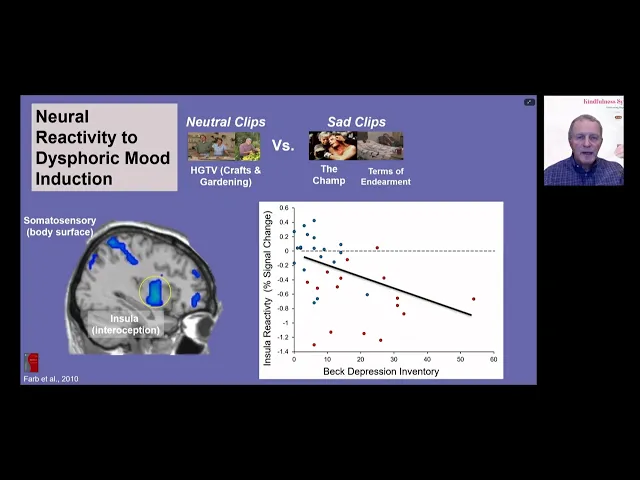
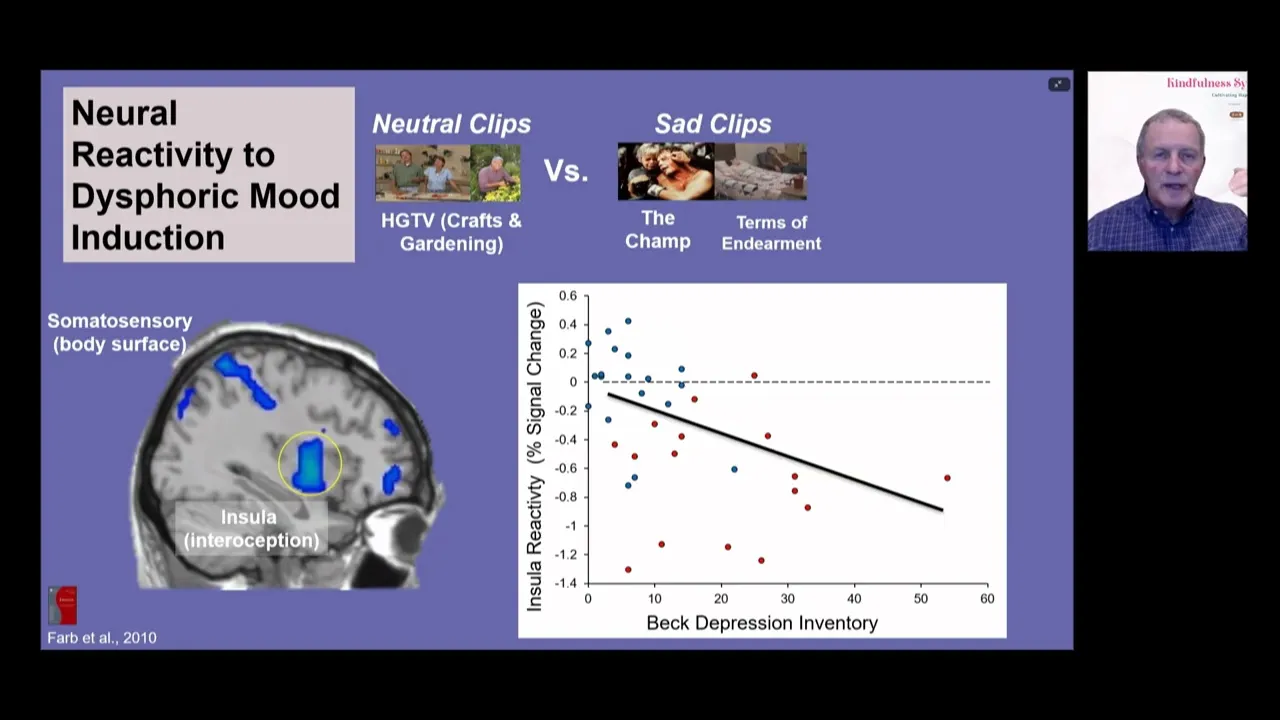
recovered from depression because small amounts of sadness can sometimes tip people into feeling more depressive symptoms or more depressive states of mind so in the first study that we did we had people in an fmri scanner and we asked them to watch different types of films we had brief film clips that were taken and edited from sad movies so a mom who was Ill a father who was injured and then we looked at brain regions that were active during the sad films and then we compare that to brain regions that were active during neutral films
so these are film clips about 10c film clips of people doing um Hobbies or gardening and one of the things that we found was that there were parts of the brain when people felt sad that were turned down people when they felt sad had less activation in these parts of the brain an important part of the brain here is the insula that seemed to be decreased in activity also this part of the brain which is the sensory motor strip was also much lower in Activation so it seemed as if sensation during moments of sadness was
being reduced people felt sad they were thinking they were problem solving they were asking themselves questions about what does this mean for me what do I need to do about it but they were doing that at the expense of allowing themselves to feel the sensations of sadness and when you actually look at the correlation between this shutdown of sensory regions in the brain and depression scores the greater the reduction of activity the more shutdown the less activity in the insula the higher the scores on the depression the Beck depression inventory so you had this relationship
between less sensation more Depression more depressive symptoms were being recorded now we published this study in 2010 so it's about 15 years ago and it was a study that didn't have a very large sample it had a large enough sample for the time and so we felt it was very important to to replicate it and to see if if these findings um you know really you know were very solid so we conducted a replication study um published it in 2022 same methods same uh methodology and what we did was as people watched these sad films
or the neutral films this time we had 84 patients who were scanned on two occasions and then we followed them for two years to see um how they did once again we got the same pattern of deactivation this is the blue during sadness and the parts of the brain very similar to what we found in our first study when people felt sad there was increased activity in the thinking parts of the brain medial prefrontal cortex right here and deactivation in the sensing parts of the brain so the sensory motor areas the insula areas that are
a little bit more on the side the back of the head the oipal regions here too less Activation so people feel sad thinking goes up sensing goes down and then when you use those data and you actually plot how much of this reaction people experienced and you put it into a surv IAL analysis to see who got depressed over two years because we assessed them in the F fmri right here and then we followed them for two years to see who got depressed and what we found was that people who were able to maintain some
level of sensation while they felt sad had a significantly higher rate of survival in other words they fewer of those people got depressed than the people who when they were sad shut down sensation and continued to use more frontal parts of their brain so this group here had significantly more episodes of depression returning compared to this group here so if we want to follow our findings if we want to follow what this suggests to us it suggests that when people feel stressed or when they feel sad they are robbed of Sensation that their understanding of
the emotion is very conceptual it's very thought-based it's not very somatic it's not very sensation based and so then the question is what happens if we can help people to try to recover sensation when they feel stressed what happens if we can help people to create a little bit of room for the body to allow its signals to be attended to for sensation to be something that people can shift their attention into not just to think about what they're feeling but actually shift attention into sensing would that help people and when you think about it
a lot of the training and mindfulness and in in all kinds of contemplative practices involve training in sensation when you feel the breath moving in and out of the body you're not thinking about breathing you're feeling the sensations that are caused by movement of the air and movement of body parts that are involved in respiration and breathing when you're walking during mocking meditation you're not thinking about where you're going or that you have a destination to get to the training invites you to feel the pressure in the bottom of your feet feel the heel lifting
off the floor or off the road feel the weight shifting and planting on the foot these are all invitations to come back to a sensory world when you're eating the eating meditation asks you to use all of your senses to explore and become curious about the food that's in your hand or on your spoon so these are already part of the practice of mind but remember it's just a narrow small group of people who are willing to continue to practice mindfulness what happens if we provide people with many more access for the practice of mindfulness
in which they can connect in the same way with the sensory world but it may not look like sitting meditation it may not look like walking meditation it may not look like eating meditation but it would still be training in shifting into sensing and so this is exactly what we've tried to do Norman farb and I Norman farb is the neuroscientist who was the first author on those two neuroimaging studies we wrote a book called better in every sense and it speaks exactly to this proposal that we can try to use shifting into the sensory
world as a way of helping us reclaim parts of our lives that get lost or shut out when the only thing that we do is focus on our experience through thinking and we've come up with a um a practice that we call sense foraging so what is sense foraging sense foraging is purposely shifting your attention from thinking to sensing with a receptivity to the sensory world and the willingness to be surprised so it is using attention but it's using attention to remind ourselves that there is an entire different mode that's available to us all we
need to do is shift into it and become curious about what we notice now the value of sense foraging is that sensory phenomena are always present and all around us so sense foraging is something that is literally right at our fingertips if you think about sensing your experience for example let's say you purchase um a new glove leather glove and you try the glove on you'll receive all kinds of sensory signals so part of what you're doing is you're allowing yourself to receive rather than create so let's say you put the glove on the first
principle of sense forging is you can't force something to happen you're merely observing the sensory information that's coming to you so you might notice tightness you might notice smoothness you might notice um softness you might notice roughness but you can't force what sensory information comes at you you can choose whether it's a glove or whether it's of smelling a flower whether it's putting something um bitter or sweet into your mouth you can choose that but then once you choose it you kind of let go and you receive the sensation the the third principle of sense
foraging is that sensation is ubiquitous it means it's all around us so we don't have to wait for Sensations to appear we can shift into them at any point the fourth principle is that sensation is sufficient when we receive sensory signals they are enough to let us know about what the nature of this experience is we don't need to add on to them we don't need them to be better or different this is what a glove feels like this is what a candy tastes like this is what um a flower smells like the fifth principle
of sense foraging is that Sensations are very concrete we're not thinking about something sweet we're actually tasting sweetness and noticing how it changes from moment to moment or whether it stays the same we're feeling something that's tight on our hands and so we're using these small details that are very concrete instead of having a thought or an idea about something the sixth principle is that sensation is immersive in other words you can let yourself go into it and just receive a lot of information the seventh principle of sense foraging if you decide to do it
is that you should do it in a way which is safe and um sort of understand what you're choosing to explore the eighth principle is that uh since foraging is something that you own you can design the experience that you're interested in forging for no one has to give you the permission to do it no one has to um provide you with rules for admission you can do it with anything and the fourth and the ninth the final principle is that um it's can feel awesome sometimes people who are able to look at nature scen
sometimes feel as if there's something bigger that they're part of um or people can be surprised by a taste or um seeing something for the first time that's always been there but seeing it almost with new eyes and can feel that they're plugging into something much more powerful so with sense foraging what this does is it opens up many many more access points it's not just meditation you can engage in the same sense foraging exercises when you exercise you can exercise and be on automatic pilot and do you know think about three different things while
you're on a treadmill or while you're doing yoga or you can use moments inside the practice of exercise to feel muscles to feel effort to feel tension going out for a walk in nature you can be walking but thinking about all kinds of different things or you can use it as an opportunity to maybe identify five new colors that you've seen or five different sounds or what it feels like to inhale and exhale deeply going and appreciating art is another access point therapy is another access point for sensory experiences psychedelics are another access point and
of course these are the things that you know we want to take very seriously when we say you have to think about doing them with safety so when we think about sense foraging and access points we can divide them in a 2 by two table we can talk about sense foraging exercises that are autonomous or supported things you can do on your own or things that you need the support of someone to do with you and we can think of those that are very very easy to access and um also financially uh very economical or
we can think about activities that are um harder to access and perhaps a a little bit more financially um expensive so if we just take a look at sense foraging access points in nature exercise art travel meditation or psychedelics we can engage in activities ourselves so say take nature High access activity would be taking a savoring walk in the park just going for a walk and noticing things as you walk to feed the sensations of the activity with new details with new information as opposed to taking a walk but being entirely in your head and
missing these details a low access nature sense foraging activity might be mountain climbing not everyone can get to this a supported nature sense foraging activity could be touring a botanical garden and a low access more expensive or um more con more restricted sense foraging activity could be going with a guide to forage for mushrooms exercise also lends itself in the same way high axis taking a brisk walk in the park low AIS surfing supported sense foraging activities a neighborhood running group or working out with a personal trainer art also lends itself to sense foraging thinking
about if you just want to do something on your own and focus in on Art you could buy an ad coloring book and have that immersive experience low access go to Paris visit the Louver look at great works of art supported work with others poetry wine tasting classes or an in-person master class with your own teacher so I don't need to go through all of these I think the point that I'm trying to make is that we are trying to balance between the ability to live our lives use habits that are helpful but not at
the cost of shutting out sensation for us to truly flourish we want to be able to balance habit and and sensation we want to be able to balance thinking and also being able to shift into sensation when we need to as a way of providing us with access to a different experience and together I think strike a balance where we're not missing out on so much of our work and so I think in closing what I would say is that these are some of the insights that have come from the neuroimaging studies and we feel
that in time um we hope that there's research that will actually examine does sense foraging make a difference does shifting from thinking into sensing allow people to do for themselves what some of the mindfulness practices can teach people to do during the 8we nbct groups but that very few people continue with the really important question is if people commit to sense forging will they continue to practice sense forging in in all of these different ways and will that allow that will that allow them to continue in lives that have greater balance of their moods and
greater balance for their interpersonal relationships thank you very much