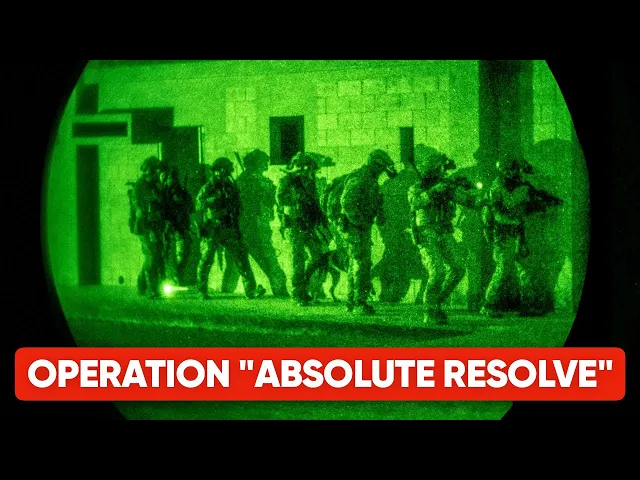
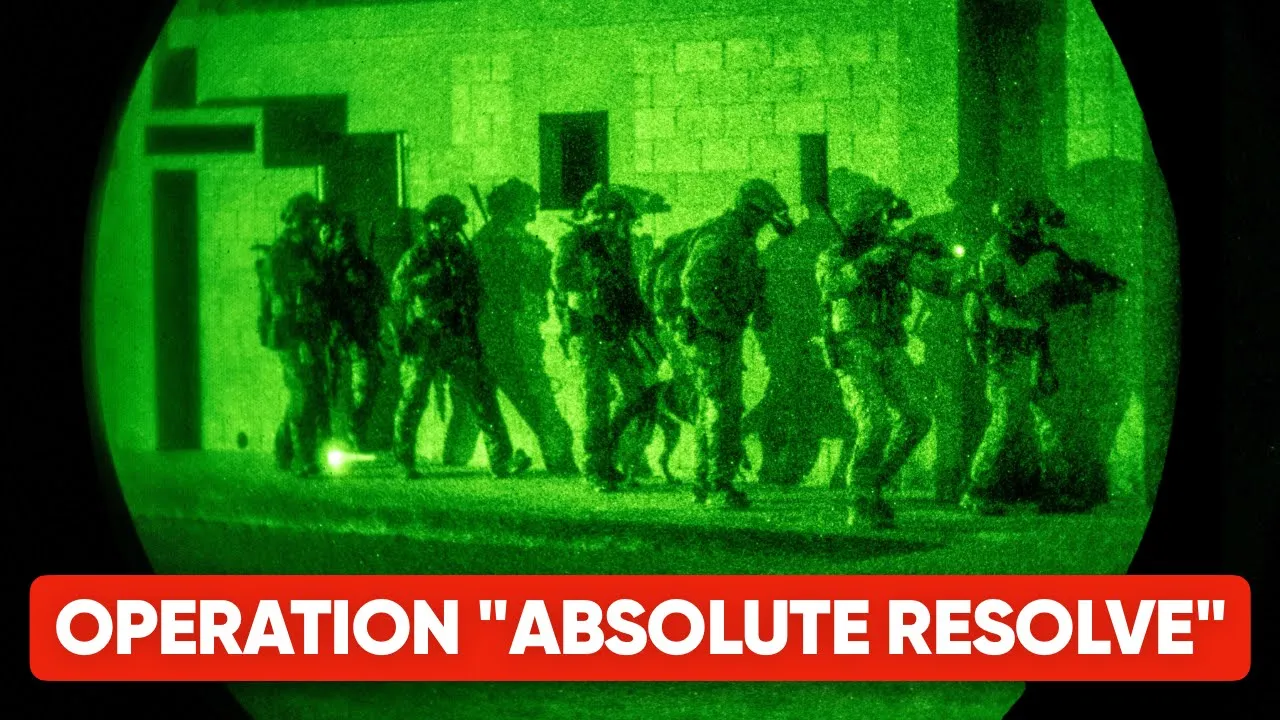
Before sunrise on January 3rd, 2026, Nicholas Maduro was no longer in Venezuela. Within hours, he would be aboard a US amphibious assault ship, the USS Ewima, surrounded by military personnel far from Caracus and heading out of the region. But to understand how he ended up there, we have to go back to the beginning of that night to an operation known as Operation Absolute Resolve.
An operation that brought together some of the most advanced aircraft in the US arsenal. Platforms like F-22 Raptors, B1 bombers, and even stealth reconnaissance assets such as the RQ170 Sentinel operating quietly in the background. Because this operation didn't start on the ground.
It didn't begin at the gates of a compound. It started in the sky. In the early hours of January 3rd, 2026, a highstakes military operation unfolded over Caracus, stunning residents and observers around the world.
According to US officials, the mission to capture Nicolas Maduro had been months in the planning. Every detail was rehearsed, coordinated, and timed down to the minute. The final order to proceed was given at 10:46 p.
m. Eastern time. From that moment on, there was no turning back.
Over the next 5 hours, one of the most complex air operations in recent history would unfold across the Western Hemisphere. At around 2:00 a. m.
local time in Caracus, loud explosions echoed across parts of the city. Almost simultaneously, aircraft began appearing in Venezuelan airspace in coordinated patterns, moving with precision and purpose. This was not a single strike.
It was not an isolated action. It was a fully integrated multi-dommain operation designed to overwhelm defenses, maintain surprise, and create a secure corridor for the force moving in below. So, what exactly was flying overhead that night?
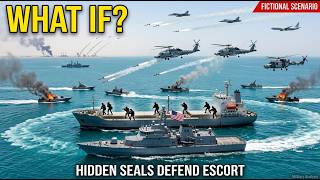
According to General Kaine, more than 150 aircraft were involved in Operation Absolute Resolve. Aircraft launched from over 20 different bases, both on land and at sea, spread across the Western Hemisphere. fighters, bombers, surveillance platforms, electronic warfare aircraft, drones, and helicopters were all airborne at the same time.
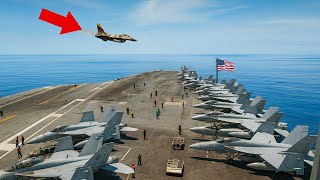
As he described it, thousands upon thousands of flight hours were in the air that night. Among the aircraft involved were F-22 Raptors providing air dominance and protection at the highest level. F-35s operating deep inside contested airspace, detecting threats and clearing pathways.
F18s delivering strike and escort capabilities. E A18 Growlers conducting electronic warfare to disrupt sensors and communications. E2 Hawkeyes acting as airborne command and control nodes, coordinating movements in real time.
and B1 bombers providing long range strike and deterrence capability. Alongside them were numerous remotely piloted aircraft quietly watching everything from above. This wasn't about firepower alone.
It was about integration. Air, cyber, space, intelligence, and ground forces all working together as a single system. As Cain put it, this was an operation that only the United States could carry out.
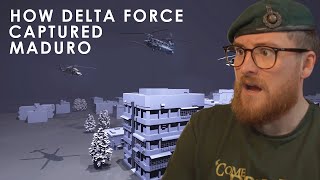
As the night progressed, the next phase began. Helicopters carrying the extraction force, including US military personnel and law enforcement officers, lifted off and began their long flight toward Venezuela. They flew low over the water at approximately 100 ft, minimizing detection as they approached the coast.
At the same time, effects from US space command, Cyber Command, and other inter agency elements were layered in to create a protected pathway overhead. The helicopters were not flying alone. They were shielded by aircraft from the US Air Force Navy, Marine Corps, and Air National Guard, forming a moving protective bubble.
As the force pushed inland, as the helicopters approached Venezuelan shores, the joint air component began systematically disabling air defense systems, ensuring safe passage for the aircraft below. The goal was simple and absolute. Protect the helicopters, protect the ground force, get them to the target, and get them home.
As the force crossed the last area of high terrain outside Caracus, commanders assessed that total tactical surprise had been maintained. The helicopters continued their low-level approach. And at 10:01 a.
m. Eastern time, 2001 a. m.
in Caracus, they reached the target. The apprehension force descended into Maduro's compound and moved with speed, precision, and discipline. The area was isolated to ensure the safety of the ground force while the operation unfolded.
As the helicopters arrived, they came under fire and responded in self-defense with overwhelming force. One aircraft was hit but remained flyable and all aircraft ultimately returned safely. Throughout the operation, air and ground intelligence teams provided real-time updates, allowing forces on the ground to navigate a complex environment without unnecessary risk.
Overhead, tactical aviation never left. Within the compound, Nicholas Maduro and his wife Celia Flores attempted to reach a reinforced safe room. According to US officials, they were intercepted before they could reach it.
They surrendered and were taken into custody. The mission objective had been achieved, but the operation wasn't over yet. Once the detainees were secured, the focus immediately shifted to extraction.
Helicopters were called back in. Fighter aircraft and remotely piloted platforms provided continuous overhead coverage as the force prepared to withdraw. As the helicopters lifted off, there were multiple self-defense engagements during the exit phase.
All handled under the protective umbrella of the air component. By 3:29 a. m.
Eastern time, the force was back over the water. Nicolas Maduro and his wife were now aboard US aircraft on route offshore. Waiting for them was the USS Ewima, a floating base, a secure platform.
The final stage of Operation Absolute Resolve. Helicopters landed on deck. The detainees were transferred aboard and the ship departed the area heading away from Venezuelan waters.
From that moment on, the operation was complete. An operation that began with more than 150 aircraft launching across the hemisphere had ended on the deck of a single ship. So that's where things stand.
An operation months in the making, executed over 5 hours, involving some of the most advanced aircraft in the world, has brought Nicolas Maduro from Caracus to the USS Ewima. The big question now is this. Will someone aligned with Maduro step in to take his place?
Or does this moment mark the beginning of a completely new chapter for Venezuela? That answer isn't clear yet. But one thing is, this was not just a capture.
It was a demonstration of coordination, reach, and precision on a global scale. Thank you for watching. If you found this breakdown useful, don't forget to like the video, subscribe to the channel, and share your thoughts in the comments because this story is far from over.
I'll see you in the next one.