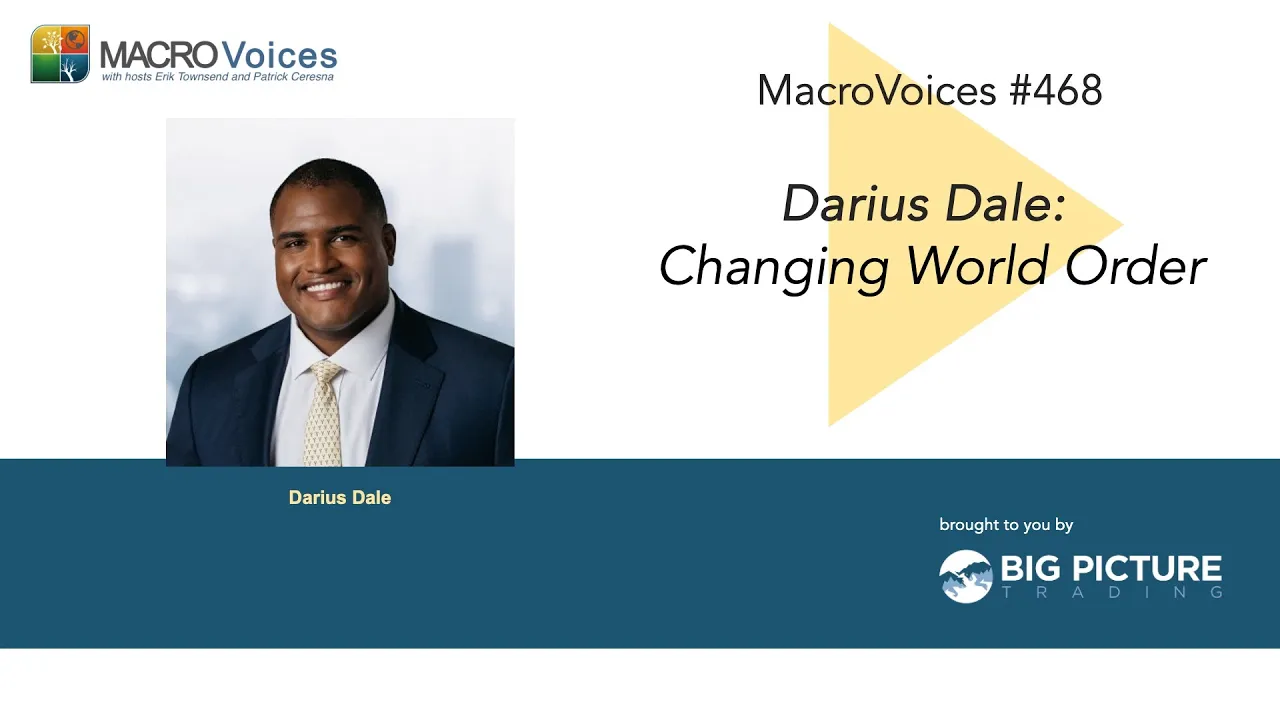
[Music] this is macro voices the free weekly Financial podcast targeting professional Finance High net worth individuals family offices and other sophisticated investors macro voices is all about the brightest Minds in the world of finance and macroeconomics telling it like it is bullish or bearish No Holds Barred now here are your hosts Eric Townsen and Patrick Cesna macro voices episode 468 was produced on February 20th 2025 I'm Eric townzen 42 macro founder Darius Dale returns as this week's feature interview guest Darius is a regular macro voices listener and he requested that we start his interview this
week with darius's reactions to last week's interview with Jim biano Darius thinks Jim's on to something important with the mara Lago Accord hypothesis and I agree then we'll dive into the data intensive slide deck That Darius is best known for and talk about everything from sticky inflation to the growth Outlook and I'm Patrick cesna with the macro scoreboard week over week as of the close of Wednesday February 19th 2025 the S&P 500 Index up 152 basis points trading at 6144 Market trading along oldtime highs asking the question if next week we see a bullish breakout
we will take a closer look at that chart and the key technical Levels to watch in the postgame segment the US dollar Index down 67 basis points trading at 10716 remains in consolidation but the bigger question is the bull market still intact or are we seeing a top the April WTI Crude oil contract up 121 basis points trading at 7210 the April rbob gasoline up 43 basis points tra at 232 the April gold contract up 27 basis points trading at 2936 working alltime new highs each week Asking the question will we see 3,000 soon copper
down 298 basis points tring at 456 uranium down 397 basis points to 6530 the US 10-year treasury yield down 10 basis points trading at 452 and the key news to watch this Friday is The Flash manufacturing and services pmis and next week we have Invidia earnings the consumer confidence numbers and the core pce Price Index this week's feature interview guest is 42 macro founder Darius Dale Eric and Darius discuss Economic risks inflation and tail risks of government policy Eric's interview with Darius is coming up as macro voices continues right here at macro voices.com [Music] and
now with this week's special guest here's your host Eric Townsen joining me now is 42 macro founder Darius Dale for any new listeners who aren't familiar with darius's work he's known for his absolutely fantastic charts and graphs And uh extremely long and detailed chart books just so you know what to expect in the download that you'll find linked in your research Roundup email it will be a great big slide deck of oh boy what is it 160 or so slides you'll see that many of them are grayed out that's necessarily out of respect for darius's
paying subscribers they don't want all of his information given away for free so only the slides that we discuss in today's interview will be visible please Forgive the fact that the rest have to be grayed out Darius it's great to get you back on the show before we even dive into your famous slide deck you mentioned off the a that you really enjoyed my interview last week with our mutual friend Jim biano from Bianca research um let's talk a little bit about what if Jim's right and because president Trump is definitely an agent for Change
and we're in a fourth turning something you and I have discussed Before a time when the major rules of the game and the major institutions that Define the game tend to to get changed what if president Trump actually were to bring about a whole new monetary regime where what changes is the way that the US finances its foreign debt is instead of paying interest they start paying uh essentially Protection Services with the military to other governments that would fundamentally change the balance of flows the all the things that we're used To following tick reports and
so forth I think the analysis does it get thrown out the window or or how do you deal with the idea that something that big might happen and how does it affect your process oh great question and uh I just want to say thanks again for having me always a real pleasure to be here really did really enjoy uh Jim's presentation uh last week I thought he um you know you guys asked and answered some really important questions you know as it Relates to you know where we are in our in this in this great
time I mean as you and you and I have talked about over the last few years about how we are currently in a four turning and what that likely to entail from the perspective of economic risks monetary policy risk fiscal policy risk geopolitical risks Etc and as it relates to you know some of the ideas that Jim floated with respect to changing the geopolitical world order you know I Think that's something that we need to have a serious conversation about because as to your point Eric you know it could potentially have a significant influence over
how you know the US Treasury Market gets capitalized and ultimately how that impacts broader asset markets uh Eric I know you're familiar with our investing doing a for turning study you know a couple of years ago uh in the summer of 2023 we performed a deep dive empirical study Spanning you know dozens if not hundreds of of Time series to identify exactly what we should expect as investors throughout the duration of this for turning uh you know we don't have time to explain the for turning but you know for for those who maybe unfamiliar it's
a it's a time of great institutional and geopolitical change and understanding that we're going to have a lot of great institutional geopolitical change we need to have a thoughtful framework for How some of that change is likely to evolve so we broke down our you know our investing to a for turnning regime analysis into sort of four different categories there's number one fiscal policy risk because to me I think that's the most important Dynamic that could change in this four turning is the size of the US government How It ultimately gets capitalized and who ultimately
foots that bill so if you look at slide 107 in this presentation where we Summarize our investing during the forth attorney regime analysis specifically the fiscal policy section what we know is that you know historically in for turnings we typically see explosive growth and Sovereign deficits uh explosive growth in sovereign debt the size of the government and ultimately we see explosive growth in the cost to finance the government and so this is the Baseline this is what you should be expecting as an investor in a for Turning by the way this has already happened since
the for turning catalyzed itself back in 2008 and so I think we're just you know kind of on that path uh when we jump to monetary policy risk on slide 120 where we summarized the key risk there there it's Financial impression and monetary debasement right it's the it's the central bank it's the monetary Authority using its balance sheet to step in as a lender of Last Resort to the explosive growth in uh Sovereign debts and deficits with respect to economic risks and Slot 130 where we summarize our our analysis on the economic side you know
historically speaking we've seen structural uptrends in nominal GDP inflation wage growth and asset price inflation and forth turnings so I know we're talking about a lot of change here but historically these for turning Dynamics have seen faster rates of asset price inflation primarily as a function of the the the monetary Authorities response to fiscal dominance and then finally on slight 143 where we summarize the fort turning geopolitical risks you know the key risk in a for turning from a geopolitical standpoint are a structural downtrend and income inequality from a albe at extremely high level uh
you typically see declining birth rates increased trade protectionism and Total War and so these are the kinds of risk that we see on the table here as it relates to the balance This for turning which my former colleague and one of my mentors know how believes is likely to persist into the late 2020s or early 2030s and so going back to Jim's your discussion with Jim Eric uh you know there's a lot of stuff that's about to hit the tape over the next four to eight years and I think it's very important for us as
investors to have a framework to deal with this stuff Darius you work from a systematic macro framework that's driven by growth And inflation and what those uh two variables are doing is kind of the starting point for everything else with respect to growth I think we pretty much discussed your bullish views on the economy and so forth in your last interview pretty thoroughly but with respect to inflation I really want to focus on that in today's interview because uh you know you've been talking about sticky inflation as I have for a long time a lot
of people kind of rolled Their eyes they were really convinced that we had that wrong inflation was headed back to 2% it was all transitory story and it was it was coming out of the system I think maybe people are a little more receptive to the possibility that inflation really is sticky so why don't we start with why you think it's sticky why we're not headed back to 2% and what you do see on the horizon for inflation yeah great question Eric a little minor correction in terms of uh In terms of the pre there
you said we work from a macro framework that's uh focused primarily on growth and inflation and I would expand that growth and inflation are important cycles that we track in the context of our you know systematic research process but we just as important in our opinion our mon policy fiscal policy and our tracking of liquidity I think we're you know among the world's experts in tracking uh liquidity variables and forecasting them But the number one thing we do for our clients as we show in Slide Five when we introduce our macro risk management process is
we help them identify and position for the market regime that the most important thing we do and the best thing we do for our clients here at 42 macro is Trend following and now casting the market regime and having clients position for that in asset allocation and portfolio construction terms on the asset allocation side you can see where We are in terms of our kids portfolio construction process on slide 11 that's a three ETF process three ETF solution that dials up and dials down client exposures to the equity gold and Bitcoin markets on slide 12
that so that's a retail investor oriented product on slide 12 we have our discretionary management overlay which takes our Market regime now casting signal and creates proper trade recommendations across 70 different factors you know Looking at us equities us Equity factors Global equities fixed income sectors currencies Commodities and crypto and so you know that's in my opinion that that's what our process is focused on and everything we else we talk about today particularly when I'm in these you know interviews you know kind of outside of our pay wall most of the stuff I talk about
outside of our pay wall has nothing to do with how our clients are positioned or should be positioned it's Really just to talk about the full distribution of probable economic outcom so that you know clients and non-clients can have some sort of anticipation of how those Trend following signals are likely to evolve so I just want to make sure that we Hammer that point home before we kind of get too deep into the presentation on the inflation side I think it's a really important topic and you know this is probably where we're most Divergent from
consensus you know Here uh and in fact um if you look at slide 42 where we show our grid model for the US you can see where our model for core PC inflation has it bottoming in q1 and starting to Trend higher throughout 2025 you know with the trend really starting to accelerate kind of in mid to late Q2 that's very Conor to Bloomberg consensus which is Wall Street Economist consensus which is calling for core PC to me or lower throughout the year kind of on this very tardy you know Path back to 2% inflation
so let me answer the question uh that you asked uh Eric about why we think inflation is likely to remain sticky recall that we've been of the view that inflation is going to be sticky we've always thought the eager liberum inflation rate in this particular business cycle was higher than it much higher than it had been in in recent business cycles and so this concept this this kind of wonky academic concept of trying to get back 2% Inflation in our opinion that's a policy mistake Maybe turn out to be a grave policy mistake If the
Fed does not you know respond to some of these pressures in our in our opinion uh with a little bit more LAX monetary policy so on slide 65 so we so I'm gonna say performed an empirical Deep dive study several times today probably because that's kind of what we do here at 42 macro on the on the econometric side and one of the empirical Deep dive studies We performed Over the past couple of years is our business cycle analysis of which it taught us a lot of different things about the US business cycle uh an
empirical standpoint one of the more important things we learned from that study of which we analyzed hundreds of economic indicators to identify which indicators were leading lagging and and and and coincident indicators of the broader business cycle one of the most important things we determined from that Study which looked at all 12 of the post-war us business Cycles is that we determined that inflation is the most lagging indicator within the business cycle it's the most lagging cycle of the eight cycles that comprise the business cycle as you can see there on slide 65 on the
chart on the left inflation breaks down durably below TR Trend you know 12 to 15 months on average after recession on a median basis after recession again it's a median the path That the each of those um 12 Cycles has taken you know three years before and three years after recession has started with zero being the recession you can see it a little bit clearer on the chart on the right where we just show growth headline inflation and core inflation and you can see the stickiness of inflation persisting well into a recession well okay so
if you understand that okay inflation is a sticky process it typically doesn't break down dur a b Below Trend until well into a recession let's talk about well are we going to have a recession or not well if you look at slide 35 where we show the same chart on the left but the chart on the right on slide 35 shows the the the current data for the relative for each of those cycles that are represented by the chart on the left and what we find is that the chart on the right does not resemble
the chart on the Left Right historically what we've seen is policy tends to get Restrictive 12 you know it's called 15 18 months out of recession then the corporate profits break down durably below Trend around a year ahead of a recession then liquidity breaks down about 3/4 ahead of a recession then growth breaks down simultaneously with stocks around two quarter out of recession employment breaks down dribbly below Trend right around when the recession starts which makes sense that's the the NBR is looking at credit Breaks down breaks down our delinquencies in charge offs break out
this the charts Delta adjusted they break down durably below Trend say a quarter after recession then again inflation being the most lagging indicator of the business cycle breaks down durably below Trend 12 to 15 months after recession and so when you look at the chart on the right you see okay we don't have the leading indicators of these Cycles you know breaking down in That cascading fashion that we historically have seen so we should not anticipate a recession as a high probability outcome over medium-term time Horizon and that takes me back to where we started
with inflation if we don't have an inflation over medium-term time Horizon then we should not expect uh if you go to slide 66 headline CPI to break down durably below Trend without a recession on slide 67 we should not expect core cbii to break down durably Below Trend without a recession on Side 68 we should not expect PC inflation to break down durably below Trend uh with without a recession on size 69 you should not expect underlying inflation to break down durably below Trend without a recession and that's exactly what you're seeing in in in
each of these time series it's looking like we're bottoming at the prior Trends and starting to meander sideways Andor tick up higher uh in a lot of these Indicators and in my opinion that's um you know that's that's supportive of our our longer term thesis on on inflation so just to be clear you're not saying that you're expecting a recession because that's the predicate in order for those things to happen saying because you don't expect a recession you don't think those things are likely to happen correct yeah we do not expect a recession I recall
that we authored the resilient US economy theme back in the Summer of 2022 when everyone was concerned about a recession we maintained that theme we now see growth slowing but it's not it's unlikely to slow to a level that would even get anyone concerned about a recession I mean we could talk about growth but I think our views on growth are pretty align with consensus um certainly if you look at our forecast I don't think we have we're too Divergent there a lot of what happened a lot of what happened Since the summer of 2022
is consensus and both Wall Street and and investor consensus having to catch up to where we were on the Eon on the economy side of things now that they have caught up to where we were I don't think that's much of a market risk from here where we see Market risk is really on the inflation side and I got you know five reasons why we think inflation is likely to prove sticky here uh when we look into um you know the balance of 2025 so on slide 70 Number one the housing market is structurally tight
and so investors have to be careful not to straight line the Improvement in housing PC inflation like if you look at the household formation to existing home Inventory ratio that's currently 1.3 uh it's essentially a double where it trended at prior to co um in the 2015 and 2019 Trend so we have this really structurally tight housing market on a structurally lowlevel turnover as you can see there in the Bottom panel on that chart on slide 70 so in our opinion the housing Supply shortage has not been fixed and so as a as a function
of that a lot of the disinflation we've seen in the housing and shelter CPI statistics in my opinion is really just a lag of some of the dis of some of the tightness coming out of the market but we're likely to stabilize at a much tighter level that causes inflation to stabilize at a much higher level uh By the time it's all said and Done when we kind of Look Backwards on 2025 on number two the FED on slide 71 the FED has done a poor job of riging in liquidity since the regional banking crisis
uh but maybe that was the plan all along so if you just look at uh the FED balance sheet Contracting the fed's balance sheet has not you know to drain liquidity from a money supply perspective in fact money supply kind of bottomed during the regional banking crisis when the FED started you know Implementing its alphabet soup of of liquidity provision um instruments facilities uh and then the treasury started to you know concentrate issuance on the short end of the curve uh to start to you know free up some of that trap liquidity in the fed's
reverse repo facility almost two two plus trillion dollars have come out of the re reverse repo facility since then and so you know we've seen liquidity broadly you know actually start to Trend higher again Despite the f quot quote shrinking its balance sheet with quote unquote quantitative tightening but we know they're not actually selling bonds to the market uh number three on slide 72 domestic credit growth is now trending higher and Global Credit growth is on the precipice of an uptrend you know we got the January senior loan officer survey data the other week uh
and that was consistent with you know a positive trend and in Credit growth uh here in The United States you know we continue to see you know the percentage of respondents you know tightening policy ease at the margins we're seeing more demand for loans so things like that continue to give us signal that you know the the credit machine here in the United States is uh alive and well and then I would say the the fourth thing to me is one of the most important dynamics that I don't see hear enough people talking about because
it's hard to Quantify but it's important for us to at least attempt to quantify which is what happens when we turn off the positive labor Supply shock so on slide 73 you know we had millions of illegal migrants into enter the country I want to say if you look at the you know the duration of Biden's presidency on a tring 48 month basis we grew the labor Supply by 11 million bodies which is essentially an all-time all-time high nominal rate over tring 48 month uh time frame so there Was a lot of you know sort
of lowcost Labor Supply entering into our labor market which had the impact of deflating wage growth pretty substantially if you look at slide 74 uh where we show the private sector employment cost index that peaked at about 6% in the middle of 2022 and it decelerated 300 basis points to 2.9% uh in 3Q 23 now that we've sort of been a quarter or two since Biden kind of tightened the screws in the Border obviously Trump took it a step Further with his executive orders uh last month now that we're sort of on the other side
of all that we're now starting to see private sector employment costs and unit labor costs re accelerate we're now at 3.4% quarter of quarter SAR in terms of private sector employment costs a unit labor cost backed up from basically 1% to you know 3% uh currently and so unless you have a big boom in productivity growth which it's hard to forecast you know I'm not Smart enough to forecast I don't think anybody's smart enough to forecast productivity growth to be quite honest uh but unless you have a big boom in productivity growth the tightening of
the labor market from a lack of incremental Supply is going to cause wage growth to stabilize at a much higher level than the prior Trend which ultimately is likely to cause inflation to stabilize at a much higher level uh than the prior Trend and this is um you Can kind of see this on side 75 when you think about trends like this to companies so in the chart on side 75 we show the the our Pro corporate profitability model which is nominal GDP the growth rate nominal GDP minus the spread between unit labor cost inflation
and productivity growth and as you can see that that that metric tracks the corporate profits um like a glove and has since you know the late the early late 1940s and so what we find is that Now that unit labor cost inflation is starting to accelerate and we have Topline growth slowing because nominal GDP growth is slowing you now have more pressure on corporate margins than you had let's say last year when inflation was persistently decelerating and companies didn't feel the need or the urge toay pass on prices so that now that Dynamic is reversed
so you have companies that are going to just feel more confident or more out of necessity To to protect margins they're going to start to feel pressure to raise prices and then finally slide 76 where we show leading indicators are supporting our hawkish uh next 12-month outlook for inflation if you look at core PPI uh which a lot of the core PPI indicators find their way into core pce but ultimately core PC is lagged um as this core CPI because of the shelter components the Blue Line bottomed at a level that is wildly inconsistent with
2% uh inflation in this particular cycle and by the way the blue line was leading the deceleration in the red and black lines by you know a year and a half and it's been accelerating in an uptrend for about a year plus now and so it's our belief that the red line and the black line in this chart which are again core CBI and core PC deflator are going to bottom at levels that are wildly inconsistent with 2% inflation and start to either Meander side ways a trend Higher over the medium- term so in our
opinion there's five reasons fundamental standpoint from a first principal standpoint why inflation is likely to firm up at a level that is inconsistent with the fed's you know in my opinion at this point ridiculous 2% inflation Target and and if they don't do anything about that inflation Target or you know just allow themselves more time to get to 2% inflation which is the choice they they've made thus far we're going to Have problems in asset markets because it ultimately means that they're not going to be able to you know use their balance sheet to to
perform the the necessary monetary debasement and financial oppression that is required by the central by the monetary Authority in a fiscally dominant regime which for turning calls for okay so your call has been for sticky inflation the word sticky just means it's not going away but it doesn't imply anything about Whether it's getting a lot bigger from here so is your call that uh inflation is just going to stabilize around the current level or do you think that it's just bottoming and about to Trend significantly higher and if so how much higher is significantly higher
yeah great question so in slide 78 where we show the key takeaway from this kind of aspect of our thicky inflation theme we have our forecast for core PC inflation down there in the bottom right of the Chart so the black line is uh the realized uh data the blue line is our our our forecast and the red line are the Bloomberg consensus forecast which are Wall Street Economist consensus and as you can see we have core PC inflation bottoming in January 2.6% trending sideways roughly at at 2.7% for February through April climbing to 2.8%
in May and then climbing to 2.9% in June and then climbing to 3% in August and and kind of Meandering higher from there so We're not calling for a substantial re acceleration in inflation we're just calling for inflation to bottom in q1 and start to move in the wrong direction throughout the balance of 2025 as those you know five factors really start to culminate and and and and push inflation pressure higher uh in the system and one thing I will say on this um on this whole entire topic of inflation to me what I think
is is kind of missing from the you know when we listen and and one Of the things I love about you know programs like macro voices and and you are among the first in the world to you know kind of put us onto this which is the quality of discussion that's being had away from mainstream Financial media is significantly higher at this point because you have guys like myself coming on and talking and unpacking slide decks for 30 45 minutes as opposed to these you know one or two minute sound bites of this and that
and you can't get to You know unpacking slide 77 like we're about to where we show our secular inflation model and and so this this is what I think is missing from the mainstream narrative around inflation and it's obviously missing from the Fed narrative because they very clearly don't agree with this which is our model suggests the equilibrium rate of core PC inflation is in the high twos and low threes and it has ever since we built the model in January of 2022 you know There's been some variance throughout the way we refresh this model
every time we get a important data point for our clients but you know on the low end of the variance has been about you know kind of 26 27 on the high end of the variance is somewhere around 32 or 33 and so for three years our model has consistently said when you're looking at you know roughly 20 indicators that have all been proven by academic research to be co-integrated or correlated with Inflation they're all suggesting that there is a significantly higher level of inflation pressure in the US economy and and by the way the
equilibrium level of core PC inflation in the prior cycle was around 1.6% we're so we're talking High twos low threes it's almost a double uh when you look at some of the factors that our is both weighted and unweighted um they kind of arrive at the same conclusion when you look at the factors that are weighted you know de Globalization is contributing a a modest amount of inflationary pressure demographics is contributing a modest amount of disinflationary pressure fiscal policies contributing a modest amount of inflationary pressure uh housing supplies is contributing a meaningful amount of disinflationary
or of inflationary pressure rather productivity is contributing a modest amount of disinflationary pressure technology is contributing a meaningful Amount of disinflationary pressure but on the offsetting that are wages which are contributing a meaningful amount of dis or inflationary pressure rather and then our what we call our West Village Monto effect which is just the supply of you know spendable cash that's on household sector balance sheets is at this you know record high both in nominal and as a share of total assets and that's contributing a you know just a gargantuan amount of inflationary Pressure I
mean you know if you think about simplistically boiling down inflation to too much money chasing too few goods and services you know there's a lot more money in the economy that can be spent on goods and services relative to the starting point prior to the pandemic so in our opinion until the FED acknowledges that you know we are living in a two and a half to three% Trend core PC type World perhaps even maybe a touch higher Jen was saying is somewhere Between three and four our model saying it's high twos low threes until the
FED acknowledges that they're not going to be able to meaningfully expand their balance sheet in ways that I think will you know ultimately you know kind of extend the business cycle and ultimately appease the treasury market and and keep the financial stability concerns from creeping back into the treasury market like what we saw back in the regional banking crisis Darius one more inflation Question before we move on it seems to me given your outlook one of three scenarios has to play out let's start with scenario 2 that's the one where the FED says okay we
got to get to 2% we're going to do whatever it takes we're going to change policy in order to get there because what we're doing isn't working what would they do and what would the consequence of that be for markets well look I mean that's gonna be that's that's the scenario where we talk Put rate hikes back on the table right right now if you look at um slide 45 where we show The fed's Dot Plot relative to Market based estimates of the FED funds rate and you know over various time Horizons we see that
you know the fed the median fomc member thinks the neutral rate is 3% and they are 150 basis points currently above neutral with a bias to ease that would be very wrong in a scenario where the FED ultimately decides it has to do more Because with that that's a two-step process where why they have to revise up their longer run estimate of the neutral rate to something that's a lot closer to where we currently are and then potentially think about making policy more restrictive and so though that two-step process in our opinion is to potentially
cause some serious problems uh in the bond market and broader asset markets because what you're going to do in that process is ultimately increase The risk of a increase the probability of a hard landing and also cause you know more um you know pain in the fixed income markets and and the fixed income volatility would be a negative for liquidity okay and scenario number three is the one where the fed capitulates and says okay we didn't really mean 2% it's actually three and a half perc that's our new Target what would that mean for markets
oh boy that's so bullish and and again that is our long-term Expectation um you know we've been of the view that ever since we performed our investing during a for attorney regime analysis uh in the summer of 2023 again one of the key conclusions is that the monetary Authority will be dragged along for the ride whether they kicking a screaming or not to capitalize Uncle Sam in in in this throughout the duration of this fourth turning regime in fact if you go to slide 127 where we show various cohorts of the marketable Treasury market from
an investor standpoint uh we see that you know the FED has been reducing it its share or you know the FED has been you know allowing treasuries to roll off its balance sheet and so as a function of that it's been reducing its share now owns about 15% of the marketable Treasury Market Commercial Banks you know up until you know essentially the up until late q23 they they've been losing share as well they kind of Stabilized at around 15% foreign central banks which is the black line they've been shrinking their share of the marketable treasury
market significantly since peaking out in in middle of 2008 uh they peaked out around 40% now they're about 14% currently and so offsetting that is us the private sector you know various investor cohorts agents we're all kind of lumped together one bucket here you know we've grown our share of the marketable treasury market From 36% to 56% and so ultimately what you know what's happened in the last you know few years particularly from 2020 through 2022 to the highs and yields that we saw in the summer of 20123 was the market repricing because ultimately we
were replacing a lot of these economic Ally insensitive buyers you know people who are buying for either policy purposes or for regulatory purposes like bosel 3 dodf Frank Etc we're replacing those in price and Sensitive buyers with price sensitive buyers investors that want X Ane units of return for taking risk in their portfolios and as a function of that we've seen a significant repricing of yields Etc in the treasury market and so it's our view that if the FED comes around to where we've been since January of 2022 which is you got to get that
inflation Target higher if they get that inflation Target higher it's going to allow them to alleviate that pressure That we see on the treasury market from the the pink line in this chart of 127 going higher which is which is us the private sector now owning by far the line share of marketable Treasury Securities at 56% of the total uh and one final thing I'll say is that you know we you know on slite 128 you know investors should expect incremental Financial repression because commercial banks have apple capacity to lend to the treasury market right
on one side you're Going to have incremental monetary debasement because the FED in our opinion where we think this is headed it might not be headed there to 2025 But ultimately the FED will capitulate to our to our view that you know the equilibrium core PC inflation rate is much higher in this business cycle and they're going to have to just acknowledge that and and move on quite frankly from this ridiculous 2% Target that's quite frankly made up uh and so If you think about the FED being able to flex its muscle in terms of
on the regulatory side you know you go back to the last four turning if you look at this panel the panel three on site 128 on last fourth turning commercial Banks owned about 50% of Commercial Bank assets uh were in um Treasury Securities right now it's only about 19% so there's a lot more upside there from the FED in terms of the fed's balance sheet and in terms of how the fed and other Government governmental agencies can regulate commercial Banks uh into the treasury market to take some pressure off of us investors because ultimately they
need to take pressure off of us investors Eric I one final try I'll show you on this on this um topic which is slide 102 where we show uh ter Premia in the top panel there at about 33 basis points wide well shy of the long run mean of about 150 basis points when you subtract the deviation from the long run Mean of term premum from the current level of the treasury yield to just see you know what a normalized treasury yield would be if you had a quote unquote normal level term premum you're talking
about a treasury yield today that has a fair value of 5.68% on the tenure right 5.68% on the tenure up from 4.54% right now you know that if you if you you had that and didn't have any change to real interest rates um then you're talking about you know inflation Break Even pricing of about 3.6% as opposed to opposed to the current 2.46% in our opinion this is that's what the bond market should look like as a function of the structural shift in you know the investor uh you know the investor participation in the in
the bond market in terms of that changing the changing ratios in terms of uh who owns what in the treasury bond market we should have a much higher level of term premium uh there's a variety of reasons Why term premium should be wider right now but among them is the fact that we have higher inflation higher inflation volatility positive excess inflation relative to the fed's Target which means ultimately they're unable to gobble up as many bonds as they were able to in the prior uh cycle you know there's a lot of reasons why we should
have a quote unquote normal level of ter premum I can make the case from a just a statistical standpoint that we could we Should probably have slightly higher than normal level of term premum so in our opinion the bond market is mispriced and the only IND in the world with a balance sheet big enough uh to to undo that mispricing or to make that pricing process you know kind of go smoothly to get it back to a normal level of price uh is the Fed uh and how they influence commercial banks with um with regulation
let's go all the way back to page seven in the deck where you summarize your Fundamental research Outlook views uh we've talked about the first three of them either in this interview or in previous interviews but you've got a new one that you added in November of 24 I think that was after our last interview you call the triple s's uh what what does Trip s stand for and what's the Outlook yeah great question Eric so Trip s is is just really an acknowledgement that you know from the starting point uh very a symmetric bullish
positioning When you look at some of the structural bullish positioning indicators in our positioning model we have this sort of crowded asymmetric bullish positioning but we also have a lot of change coming down the pike and those two thrings historically have been in congruent you know historically whenever you've had a lot of you know that crowded bullish position was built for a reason and so anytime you interject a lot of change from a fiscal regulatory trade policy Perspective the risk is that that positioning unwinds and so what our trip s's theme aims to sort of
um unpack is the ways in which that crowded bullish positioning uh can unwind and so if you on one side if you think about President Trump's economic agenda there's sort of five main cohorts tenant of that agenda on the negative side that may result in a negative Supply shock in the economy and asset markets uh you have you know the Tariff policy and then you have Securing the border which we've alluded briefly alluded to on the positive side you have you know tax cuts deregulation and and the Doge budget cuts you know which should contributed
to a positive Supply shock uh in the economy particularly from a perspective of capital um and so those things are positive at the margin and so you know when you think about kind of how does it all net out one I don't think we know I don't think anybody in the Administration understands how it all going to net out because Congress is going to play a significant factor in determining all that um but ultimately how it all Nets out could potentially cause some problems for asset markets not to mention the sequence of it all as
well you could get the negative stuff first in fact we have already gotten a lot of the negative stuff first right we've gotten the Tariff headlines president Trump was floating another Tariff headline this afternoon on autos and and far tical Imports and and semiconductors you know so we're getting a lot of the negativity first front loaded and ultimately the positive stuff you think about tax cuts deregulation and Doge budget cuts you those that stuff could come you know quite late in the process which could you know potentially create like a air pocket and asset markets
until we ultimately get kind of get till president Trump saves Us saves the market with with with the elixir of of his policy so that's sort of the key takeaway for the theme there's a a few aspects of the theme that I think are worthy of discussing that we kind of gotten critical updates on uh recently so on one side I will start by saying the reciprocal trade policy or reciprocal tariff policy in our opinion reduces the risk that we get a too strong US dollar uh as a function of those tariffs historically speaking What
we've seen uh and what we've observed just from you know academic studies is that countries that get tariffs leved upon them tend to offset tariffs to a significant degree in the currency Market particularly China if you go back and you look at the last couple of you know trade spats we have with China uh we've seen the Chinese yuand devalue by you know let's call it 12 to 15% in the in those two instances and what we've seen historically is that We've seen a lot of sympathy devaluation in major currencies to match the you the
incremental competitiveness that's gained from you know Yuan devaluation and so ultimately you wind up with this US dollar that gets way too strong and a dollar that gets way too strong is a direct headwind for Global liquidity uh as we show on slide 80 on slide 80 uh we see the the yearv rate of change of our Global liquidity proxy which is the aggregated sum of the 10 major economy Central banks uh they broad money supply from their economies and then their F FX reserves and then we show that on a year- your rate of
change basis in the black line the green line in the chart on the left is the US Dollars real effective exchange rate on a year rate exchange basis as you can see very inversely correlated to liquidity uh the green line in the chart on the right is the currency volatility which is also inversely correlated to liquidity Historically speaking the dollar has been highly correlated with currency volatility so that's uh that's one Dynamic that could be an issue and the reason that's an issue is because on slide 79 we know Global liquidity is a the key
driver of asset Market so on the chart on the right we these charts show that the black lines in the charts on 79 are the same black lines from the chart on 70 on slide 80 it's already the over your rate of change of our Global Liquidity proxy and the blue line in the chart on the left uh is uh the yearv rate of change of global Equity market capitalization and then the Bitcoin Orange Line in the chart on the right is the Bitcoin price on a year rated change basis and as you can see
our Global liquidity proxy is incredibly correlated with you know the rate of change of asset markets incredibly Corr very very tight correlations over you know know decade Plus and so you know in our Opinion if we got a dollar that just got too strong as a function of tariffs that would be a big issue but in our opinion the reciprocal tariff strategy to the extent he can stick to it I'm not sure he can but if he sticks to it yeah I think that would reduce a little bit of pressure uh from the system another
thing that could reduce a little bit of pressure from the system in terms of the sequence of it all is the fact that treasury secretary Scott Besson who I've Known for you know many years as a longtime client you know very bright man is going to do some great things for our country uh one of he's already made a very smart choice in terms of uh keeping issuance on the quarterly refunding side pretty stable you know recall that he was hypercritical of of outgoing treasury secretary Janet yellen's net financing policy in terms of concentrating issuance
on the bill in the bill Market which I believe she did For two reasons one to to kind of make sure the regional banking crisis then turned to a global financial crisis uh and two to free up a lot of that excess liquidity that was trapped on the fed's balance sheet in the form of the r Supermarket right that but that money was there because it was looking for short duration instruments and there were not enough of them and so ultimately you know the the young satisfied that demand uh that market Demand for short duration
instruments uh and it was kind of a win-win for both the economy and asset markets and so Tre Scot B when now that he's in the seat I think he recognizes what I just said and has ultimately decided to at least for now or at least quote unquote for the next several quarters stick with that policy couple things I would say on this um on this on with respect to the trip s's process is that for now things should be pretty good in terms of the Treasury's uh net impact on liquidity and asset markets right
now you over $800 billion dollar of of money in the treasury general account balance that's likely to get spent uh into the economy I would say some upwards of $500 billion doar of that is likely to get spent uh into um the economy and asset markets over the next let's call it three to five months uh just depending on how long it takes them to uh get the uh debt liming lifted Andor punted uh in terms Of the reconciliation process if they go with a one bill solution it's going to take longer than a two
Bill solution but it seems like the house is is Full Speed Ahead on a one bill solution so that's great for asset markets because also it means we're going to get more TJ spend down not less and right now the treasury is not you know really even a factor if you think about the fact that we've already hit the debt limit you know they were trying to take they were they going To issue $816 billion doll of net new borrowing uh here in q1 that's $816 billion that's not going to capitalize the US government now
it can either stay where it was in asset markets or go capitalize you know go further out on the risk vetum and capitalize you know risk assets so those are all positive dynamics that are likely you know get worse as we move forward in time but at least for the next quarter or two those things are supportive on the I wouldn't Say negative side yet but I do believe it's going to become NE a negative factor for asset markets when it's all said and done we've been on this view we've had this View kind of
going back to where we started the conversation Eric that us fiscal policy is on a very unsustainable path and and in our opinion that's very part and partial with the four turning if you look at slide 98 where we show the trailing fiveyear moving average of US nomal GDP That's the Blue Line in the top panel it's at 6 6.4% currently the Shing 5-year average of The Sovereign the budget deficit GDP ratio uh is is 88.6% and so you know if you see you know basically once we went into the for turning with the GFC
since then we've largely been tracking at a a at a positive spread in terms of our you know trailing five-year budget deficit GDP ratio relative to our trailing 5year nominal GDP so we are accumulating debt At a very very unsustainable ably fast rate and again this is very consistent with how the economy and asset where the economy is evolved fiscal policy is evolved uh in historical for turning episodes again de cting that that study that we we highlighted at the beginning of this discussion with data going all the way back to 1800 so uh any
of those um if someone wants to kind of get their hands on that that study just just sign up and and buy the presentation it's not Not very expensive but um you know the thing I would say on this is that I think there's a big risk that the Doge process did disappoints asset markets and right now it's it's a positive for asset markets because right now we have this kind of un you know we we don't really know how much the bite of the how how big of a bite of the Apple they're going
to they're going to take as it relates to potential deficit reduction in this process in our opinion doge is Likely to be very disappointing with respect to deficit reduction because ultimately there's a couple of things that are that are causing that one is political they've ring fenced uh very large categories from the Doge process when you think about Medicare National Defense Social Security and obviously net interest they they they're kind of powerless to to to do anything about uh and then you're also layering on the uh extension and expansion of the Trump Taas Cuts so
even though we're on record saying that doge is likely to achieve somewhere between 500 billion and a trillion dollars in Cuts just as a function of their that process it's unlikely to have to have a m significant impact on the deficit when you factor in the reduction uh relative to Baseline of current law the reduction in revenues uh and ultimately the fact that we're ring fencing and on the ring fencing and I'll shut up After this but I got to put make this point when you ring fence two3 of the federal budget from the Doge
process you're going to wind up with a result that is disappointing right if you think about those four categories again Medicare National Defense Net interest and Social Security Eric those categories are roughly about5 trillion doll on a calendar annualized year-to dat basis uh again we have one one month of data but in terms of 2025 but it's About $5 trillion two-third the federal budget 14% of nominal GDP and those five those four categories on an aggregate basis have compounded at plus 15% on a trailing threeyear C basis again these category this is two-thirds of the
federal budget compounding at plus 15% on a trailing three-year ker basis and we know it's going to continue to go up Medicare and Social Security are going to continue to rise if you look at the chart of the right uh slide 100 the US's Old age dependency ratio is going to go from let's call it 85% to you know 110% over the next decade or so or sorry from 95% to 115% over the next decade or so so we know Medicare and Social Security going to continue to go up we know net interest has to
go up you know we're talking about refinancing around $9.5 trillion doar uh just over the next 12 months into a higher interest rate regime that will cost us about 1251 130 Billion do of additional net interest expense uh and then National Defense they've already outlined that they want to raise that by2 to $300 billion so again 2third of the fiscal the Federal deficit two3 of the federal budget are compounding it on a triling threee k basis of plus 15% and that number may actually go up so doge is going to have to take a gigantic
chainsaw to everything else in my opinion I don't think it's politically palatable for Them to do that because you're talking about pissing off a lot of uh lawmakers uh down in DC on even on the Republican side especially uh in the Senate so in our opinion I think when we get to this process when it's all said and done there is upside risk to bond yields as a function of a received significant widening of the deficit relative to current expectations that they're going to at least try to get our fiscal housing let's talk a little
bit more About the left and right tail risks that I think are presented by uncertainty risk in the outcome of this Doge process because the way I see it it's very clear that President Trump and Elon Musk are reaching for really big headlines they're in a PR war with their uh political opponents where they're saying look millions of people in the Social Security System who are over 140 years old and supposedly eligible for benefits You know this is massive corruption it has to be fixed it's uh and they've got a number of other things uh
that they're pushing massive uh fraud in the usaid system and other Nos and so forth I could see this going One Direction which is those uh exposes on major government uh corruption and and misuse of taxpayer money leads to huge populist support and the Doge thing really takes on a life of its own and gets bigger I could also see President Trump's political opponents Being successful in uh the judicial system and potentially the Supreme Court just says okay we're slamming the gavel down Elon is not a legitimate uh elected official he has no authority to
do any of this we're shutting Doge down by by order of the Supreme Court you know no more uh take those two extreme outcomes of either Doge gets much bigger from here or Doge gets shut down what are the market implications because I think either of those outcomes is possible Yeah great question and uh I I think the probability that Doge gets more popular from here is greater than the probability that it gets less popular like again I I feel like I I took a lot of heat back in December when we first made the
call that hey they're not going to get anywhere near $2 trillion expenditure reduction here's all the reasons why uh you know you got a A very horny contingent of Elon Musk Fanboys on Twitter so took some heat on that but it Looks like we're going to be right on that uh but ultimately I you know I I do want to make the K point that doge is a very necessary process to prevent the risk of a US fiscal crisis here in this for turning and the potential loss of of of you know our exorbitant privilege
which in my opinion I think would very much lead to World War II because we're not going to lay down and give that up nobody no country has ever laid down and gave up exorbitant privilege so uh in Our opinion I think it's a very necessary process I applaud Elon for what he's trying to do but ultimately this is a more of a political process statement our our analysis is political we we understand that you're not going to be able to cut the remaining third of the federal budget by 30 plus percent in order to
just stabilize the growth rate of expenditures which is what needs to happen you know that's not going to be nobody no one in Congress is going to be Allow that to happen so we're going to cut around the margins and and and then perhaps you know pretty meaningfully but again it's not going to result in in a significant deficit reduction because again not not only are you not not only are you cutting less than the the growth rate of the main categories that are causing the budget deficit you're also allowing for the extension and expansion
of trump tax cuts to you know to reduce revenues relative to the Baseline of Current law which adds additional deficits from the perspective of treasury bond market supply they're going to try to use this process where they can Benchmark the reconciliation Pro program or process to current policy as opposed to current law current law has the Trump tax cuts expiring at the end of this year current policy obviously does not so the headline figure in terms of the deficit impact would be lower but the incremental Treasury Supply will be the same and so that's the
risk is that the bond market is smart enough not to to fall for that accounting gimmickry on the other side uh Eric you were saying that the the Democrats or the Trump's political opponents would make enough stink in the courts to cause the Doge process to to disappear I mean I think that's kind I don't think that's where we're headed I don't think that you know doge is going to get pushed back enough in court to to To kind of you know to cause Elon to get out of DC and go back and do what
he was doing prior but I ultimately do think that again they're not going to be able to cut enough of the rest of the federal budget to really achieve significant deficit reduction in the context of extending and expanding the Trump tax cuts and in the context of uh our friend Luke Roman's um you know sort of n true is expense metric compounding at plus 15% per year so I I I think the Probability of the Court situation is lower than the probability that this gets very popular but either outcomes in my opinion I think the
highest probability outcome is that Doge Cuts 500 billion to a trillion out of the deficit or out of the federal expenditures we replace that with more Revenue reduction uh and ultimately you know the the categories that Doge uh really isn't able to take a big chainsaw to uh continue to compound at double- Digit rates well Darius I can't thank you enough for another terrific interview before we let you go tell us a little more about what you do at 42 macro what services are on offer how people can find out more and follow your work
yeah appreciate you Eric always a pleasure to be here our ethos at 42 macro is narrowing the information a s retriever between our Institutional Investor clients we have many across Global Wall Street and our retail Investor clients um so we build solutions to help them both stay on the right side of Market risk as we talked about earlier at the beginning of this presentation on slide 11 slide 10 and 11 where we show our casol construction process you know that's the solution that we built for retail investors to stay on the right side of Market
risk we have thousands of very happy retail investor clients that have participated uh in these Raging Bull markets over the Past couple of years uh in part because of this this system and also uh they've had the confidence to participate in the system because of our bullish fundamental uh uh views uh and then on slide 12 where we show our discretionary risk management overlay AKA Dr Mo our institutional clients and our sophisticated retail Trader clients uh use this as a market timing and position sizing guy for their Factor long short bets and so I would
say again as I said At the beginning of this this talk the most important thing that we do that we are among the world's best at is now casting the market regime and sending out very timely signals for when the market regime changes from risk on to risk off from risk on with the inflationary bias to risk on with the disinflationary bias to risk off with an inflationary bias or to risk on with an inflationary bias and then that's when this this this model here this Dr Mo Table will start to change its proper trade
recommendations for the various factors that you know any Institutional Investor or retail Trader could be long or short at any given time and so what we're ultimately trying to do is make sure our clients are constantly compounding returns and staying on the right side of market rate as opposed to what I think a lot of other investors are doing and I what I used to do which you know worked for a While but I certainly don't think it's working for most people uh in this postco environment which is predict something and put on a position
and hope that the prediction comes true like there's a better way to invest you can actually just nowcast what's happening in the markets and participate in what's happening in the markets with systems like our kiss butf construction process and our discretionary risk management over a Dr Mo so if folks want to stay on The right side of Market risk irrespective of how what we think about growth inflation policy liquidity of which check my track record on this program I think we have some of the best views on that stuff as anyone but that in my
opinion I don't think that's uh relevant for investing I think what's relevant for investing is making sure that you're responding to the market and and and ultimately participating in what the Market's trying to pric in so come check us out at 42 macro if that's uh if that sounds good to you Patrick cesna and I will be back as macrovoices continues right here at macrovoices [Music] docomo Eric Townsen and Patrick cesna Eric it was great to have Darius back on the show now let's get to that chart deck listeners you're going to find the download
link for the postgame chart deck in your research Roundup Email if you don't have a research Roundup email that means you have not yet registered at macro voices.com just go to our homepage macro voices.com and click on the red button over darius's picture saying looking for the downloads okay Eric what are your thoughts on Equity markets here well once again and we're flirting with all-time highs and I think it's just more confirmation that Trump's policies are gaining traction and popularity with the American people Despite the media's Constitutional crisis Tantrums which as far as I can
tell the public is finally starting to wake up to for the nonsense that they truly are okay Eric well on page two I have the chart of the S&P 500 and we can see it's trading along 52e highs the big question does it break out I think there's lots of room for it to break out the bigger question is is it a sustainable breakout and in my mind there are only two things that can Happen that is going to make the breakout sustainable otherwise it will be a fake out breakout that maybe we have a
quick punch to 62 to 6,300 on the upside and immediately it fades all all the way back down so one of the first things is uh that it would need to have a widening of Market breath on page three I have just a percentage of stocks trading above their 50-day moving average in the S&P 500 and we've been pinned in this 50 to 60% range for a Month now U basically when you look at something like the equal weight S&P 500 uh is nowhere near its high the way the S&P 500 itself is and so
we would need a broadening of the market in order for this have to have a sustainable move where we'd go into 80 85% of the stock market participating and that broadening of the market sees a sustainable bullet advance I could see let's say 64 6600 uh the alternative to the widening of the breath on page four I have the Magnificent 7 ETF which is talking about the mag stocks and they simply have been huge laggards over the last two months they simply have not broken out not had any momentum uh and uh and many of
them are rolling over and um so if uh you don't have a broadening of the whole market then you need the mag 7 to regain their leadership and if the one of these two doesn't happen then you can't trust an S&P breakout and uh in my mind uh the S&P will potentially hear a spark out a Quick breakout that is gets the attention of the media but if we don't see the underpinning conditions confirming that then I would be fading that breakout uh if we did see that fade happen where it wasn't confirmed what would
be the first warning signs well if a breakout Fades and gets down to like the 6,000 level on the S&P and a you know quick 5% Market correction if we see that kind of damage done then I would be start to speculate that the First quarter high is not only in but then that they're actually is room for a bigger or deeper Market correction now before we talk Market correction I want to first see that the Bulls fail to hold these gains and so right now we're going to give the Bulls the benefit of the
doubt they just need to prove that this thing is real if we don't see that then uh I will quickly uh uh flip uh to the short side okay let's move on to the dollar here Eric what's your thoughts The prior consolidation range was 107 to 110 we saw a multi-day breakdown below that range this week but we just closed over 107 on Wednesday so the question now is whether we re-enter the consolidation Zone and stay above 107 or if the selloff is going to continue below 106.5 which is the low we put in just
a couple of days ago Patrick I'm leaning toward a continued selloff on continued speculation about the maralago Accord thesis which Jim biano described In last week's macro voices and which Zero Hedge has since picked up and begun reporting on actually they're reporting on the gold revaluation hypothesis they haven't quite got to the zultan bonds yet but I'm sure they'll get that story too from a technical analysis perspective it's still early to call a new downtrend in the dollar but I have a feeling that's where we're headed well Eric there are an increasingly large amount of
people starting to talk about The idea that the US dollar top could be in based on the fact that the administration wants a weaker dollar I'm not so sure I'm ready to uh flip to that camp yet uh as far as I'm concerned we had an extraordinary Bull Run on the upside of the dollar and as seen on that chart and we broke out of that 2-year trade range bullishly on the upside and we're now approaching what were the previous highs where they potentially can act as support uh with the fiber Trement zones down here
I think dollar could easily still consolidate one or two more points down to this 105 to 107 range and still turn around and be bullish and so to me uh I want to first see uh uh whether supports come in here and whether Bulls can sustain a rally on the other side if we see that the dollar rallies start getting heavy fail to fall follow through and start rolling over I I'll start entertaining a more bearish thesis then but right now I'm giving the Bulls the benefit of the doubt that they're going to hold the
line somewhere in here and we're going to see a meaningful rally back up towards the highs all right Eric let's move on to crude oil well we saw a brief test of that critical 100 day moving average at 70 spot 11 on WTI which I emphasized in last week's podcast that was followed by a nice bounce all the way up to the 200 day moving average at 72 spot 66 and now we're retracing back to the downside It's not clear uh how far we're going to go but keep in mind the entire Arab world is
in shock over president Trump's messaging about annexing Gaza so there's definitely room for an upside price spike induced by geopolitics if the ceasefire doesn't hold well Eric I'm in the camp where I do believe that the low end of crude oil has been established and we have now gravitated toward the bottom end of that range is there a few more dollars downside risk to oil that Could potentially materialize sure but generally I think that we're at a level where there is still a symmetry where I don't think that there's a room for a big breakdown
in oil and ultimately just some new Catalyst has to be introduced that potentially could start up a move towards the top end of its range now I'm not super bullish oil where I think you know in the next year or two we're going to see 100 or 120 on the upside but could we see us gravitate back into the Mid 80s to the top end of the range we've seen over the last couple years uh I think that's entirely plausible so while we haven't seen a bull breakout here uh that that is really showing the
next move I do think that we are at very key support lines that are likely to hold now let's talk gold well as I explained last week the technical setup was ripe for the market to roll over and it was a good setup for maybe a multi correction because we were massively Massively overbought well that's exactly what started to happen on Friday we painted a massive red candle dumping $80 in a single day boy it sure looked like that market was rolling over and maybe headed several hundred dollars lower but I traded emails with Jim
Bianco over the weekend and based on Jim's gold revaluation hypothesis expressed in last week's podcast Jim and I both agreed that this dip was likely to be bought sooner than later and that's exactly What happened from the Sunday Futures open right out of the gate there was a very very brief Spike down for a new undercut low below Friday's low but that didn't last and from there the retracement higher was underway within minutes and by Tuesday afternoon we were once again flirting with all-time highs so despite that the technicals still very much suggest that we're
still overbought here maybe not extreme overbought like we were on Thursday uh There's definitely room for a ongoing correction several hundred lower but the thing is all of these dips keep getting bought faster than anyone expects bottom line I'm leaning toward an upside breakout to new all-time highs and above the price channel that began in October 23 I think that's more likely at this point than the technicals would seem to admit there are two reasons for my extreme bullishness here number one these dips just keep getting bought Faster than makes sense in a normal Market
as if there's something more going on behind the scenes in this picture and number two the rapidly growing popularity of the gold revaluation hypothesis that you heard about first from Jim biano on last week's macro voices podcast now all of that said even if we did get a $200 downside correction from here which is still possible that wouldn't invalidate the uptrend Channel support is just Above 2700 now so it would take sustained action below that level to invalidate the uptrend yeah Eric that completely all makes sense we we are very overbought on the short term
some of my uh upper Target zones are in this 3,000 to 3050 area on the upside and at some point here we are going to uh bump our head on the upper end of gold and begin some sort of mean reversion and correction and like you were suggesting you even a $200 pullback which is Actually quite typical in Gold uh wouldn't be a break of the primary uptrend it would simply be a consolidation of the advance and could be the base from which continuation patterns will occur in the second quarter of the year at this
moment it's hard to justify this is a new Tactical entry level of gold uh but at this point the trend is primarily your friend it we continue to have higher highs sequentially each day you want to Respect this upper Trend recognizing though feels very eighth ninth inning of this part of the advance and at some point uh gold will go through a profit taking cycle of some sort uh but that wouldn't be something that would shake me out of the trade and finally Eric let's just touch on uranium what do you think here of uh
the way that it's behaving well it's been another week of mostly bullish nuclear news flow and another week of spot uranium and uranium Miners Plumbing new cycle lows defying the bullish fundamentals the uranium Market seems to be puking over president Trump's nuclear disarmament comments when he suggested that both Russia and the United States don't need as many nuclear warheads as they both have that led to what I think is completely misplaced speculation about maybe a version two of the megatons to megawatts program which uh dramatically reduced the excess inventory of higher enriched Uranium that Russia
was holding back in the 1990s look it's a completely different situation now that was at the end of the Cold War that the original megatons to megawatts was negotiated at that time Russia and the United States both had tens of thousands more Warheads than they do today also that was not really about disarming and dismantling Warheads the way most people think it was what the what megatons to megawatts program was actually about was Russia's Agreement to sell 500 tons of surplus High enriched uranium it wasn't that they disassembled 20,000 Warheads it was that they took
20,000 Warheads worth of surplus high-enriched uranium about 500 metric tons of high enriched uranium that they had in Surplus and sold that to the United States now if that something like that were to happen again which is frankly unlikely in the first place if it did happen then it would be a smaller number it wouldn't be 500 tons Cuz I I I think they've got more than that but they don't have anything close to what they used to whatever did happen it would make exactly zero sense uh for anyone to even think about down blending
it all the way to low-enriched uranium what we need right now is Halo that's the hight test uranium fuel for the new generation of reactors that are just starting to to be built from an economic standpoint it makes no sense to down blend all the way down from high Enriched uranium to low-enriched uranium when it makes so much more sense to stop not quite a little more than halfway uh down that path at Halo which is about 19 and 3/4% enriched as opposed to 5% enriched low enriched uranium the point is if there was any
kind of megatons to megawatts 2.0 it would be to make Halo that would go into reactors that haven't even been built yet and that are not part of the equation for evaluating the current market and and all of the Deficits that people have projected in other words it's just not going to matter the bottom line for actual uranium consumption is that we're going to consume as much u308 as we have capacity to convert and enrich that's what is throttling u308 Demand right now is limited capacity for enrichment and conversion if they were to down blend
a bunch of hu in order to make Halo or in order even to make Leu which doesn't make any sense it still wouldn't change The fact that we need more Leu and therefore they're going to continue to convert and enrich as much as we have conversion and enrichment capacity for so it's not going to affect u308 demand even if it happened and frankly I don't think it's going to happen but the retail freakout that occurred in reaction to those comments definitely underscores the fragility of this Market on Wednesday urm dumped to extreme oversold all the
way down to an 18 RSI While Ur dumped to oversold with a 31 RSI just to teetering on Extreme oversold there uh both of those are still pointed down suggesting even lower numbers may still be to come into next week so it's definitely time to be buying here not selling remember folks the idea is to buy low and sell High we're definitely into oversold if not extreme oversold uh territory here on most of these issues but I still have reservations about all the experts that Are making the call saying okay the retail capitulation is now
in that means that it's definitely time to make your big buy because it's not going any lower than here look there's so much retail participation in this market because institutional investors were locked out of uranium for ESG mandate reasons and have only just begun to dip their toe in this market so it's completely dominated by retail investors who are famous for doing the stupidest things at the Stupidest times so if we continue to get news flow I as much as I don't think there's going to be a meaningful megatons to megawatts 2.0 that doesn't mean
president Trump is not going to say we're going to have some massive megatons to megawatts program that's going to it's going to be fabulous it's going to be be tremendous uh if he starts saying things like that I think it's going to freak retail investors out and you could see a fullscale Capitulation at that point that would be the time to really start buying Handover fist uh now it's only time to be buying hand overand in my opinion I think the Handover fist buying opportunity might still be to come we'll see what happens at the
end of the day though one of two things must happen here must happen either all these new nuclear plant builds and all the nuclear plant restarts and all the nuclear plant life extensions that have been announced in The last few weeks and months either they all get scrapped and that whole plan gets completely totally reversed and that would probably take World War III in order to reverse all of those things or they're eventually not sure when but eventually going to have to start buying fuel for all those reactors both the old ones that are coming
back online that were not budgeted fuel for as well as the new ones that are being built so it's one or the other either All of this entire nuclear Renaissance news flow that we've been hearing gets completely totally reversed despite the fact that Chris Wright and president Trump and JD Vance and everybody else are all saying that the US government is now completely behind it it all gets scrapped and the whole thing goes in the other direction or sooner or later they've got to buy uranium now that doesn't mean we can't have a retail capitulation
freak out between now and Then maybe there's going to be even better buying opportunities but right now the buying opportunities are strong if you're not positioned at all in uranium it's a great time to be buying on page eight I have the sprot physical uranium trust uh chart up and the chart just looks awful in a sense that it's being regularly distributed here lower highs lower lows uh on the downside and uh and just being unloaded overall I do actually think there's a very important Target zone right here in this 20 to $21 range uh
where uh we could see that selling at least subside but uh whether or not we find start finding support lines or bases it's very likely here that this is going to go deep into March in consolidation of some sort before there's room for uh bullish turn up while I do think that the bull thesis and uranium is still very much intact the bigger puzzle to solve is when will we start seeing buling again in this Space and that currently is not evident and you have to at least anticipate a few more weeks if not a
month of uh basing to have to establish a key turn point of where this can technically start to turn up folks if you enjoy Patrick's chart decks you can get them every single day of the week with a free trial of big picture trading the details are on the last pages of the slide deck or just go to bigp pictur trading.com Patrick tell them what they can expect To find in this week's research Roundup well in this week's research Roundup you're going to find the transcript for today's interview as well as uh darius's slide deck
and the chart book we just discussed here in the post game including a link to a number of articles that we found interesting you're going to find this and so much more in this week's research Roundup that does it for this week's episode we appreciate all the feedback and support we get from our Listeners and we're always looking for suggestions on how we can make this program even better now for those of our listeners that write or blog about the markets and would like to share that content with our listeners send us an email at
researchr Roundup macrovoices decom and we will consider it for our weekly distributions if you have not already follow our main account on X macrovoices for all the most recent updates and releases you can also follow Eric onx at Eric s Townson that's Eric spelt with a K as well you can follow me at Patrick cesna on behalf of Eric Townson and myself thank you for listening and we'll see you all next [Music] week that concludes this edition of macro voices be sure to tune in each week to hear feature interviews with the brightest Minds in
finance and macroeconomics macro voices is made possible by sponsorship from bigp pictur Trading.com the internet's Premier Source of online education for Traders please visit bigp pictur trading.com for more information please register your free account at macrovoices doccom once registered you'll receive our free weekly research Roundup email containing links to supporting documents from our featured guests and the very best free financial content our volunteer research team could find on the internet each week you'll also gain access to our free Listener discussion forums and research library and the more registered users we have the more we'll be
able to recruit high-profile feature interview guests for future programs so please register your free account today at macrovoices [Music] docomo on iTunes to have macro voices automatically delivered to your mobile device each week free of charge you can email questions for the program to mailbag macrovoices docomo answer your Questions on the air from time to time in our mailbag segment macro voices is presented for informational and entertainment purposes only the information presented on macro voices should not be construed as investment advice always consult a licensed investment professional before making investment decisions the views and opinions
expressed on macro voices are those of the participants and do not not necessarily reflect those of the show's Hosts or sponsors macro voices its producers sponsors and hosts Eric Townsen and Patrick cesna shall not be liable for losses resulting from investment decisions based on information or viewpoints presented on macro voices macro voices is made possible by sponsorship from bigp pictur trading.com and by funding from fourth turning Capital Management LLC for more information visit macrovoices com [Music]