Let's cover some basic concepts about the 200. The 200 period moving average is the granddaddy of all moving averages. It is the most powerful moving average of all.
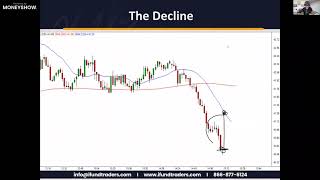
As we know, if a stock is above the 200 and drops to the 200, the 200 will tend to be at least temporary support. So there will tend to be some halt and rebound of some sort. And that is what you see here.
So we start from above the 200. we come down to the 200 and there is some reaction off of the 200. The 200 will tend to have some level of support if you're coming from above it.
Often times when you're coming from beneath it, it will tend to have some resistance and some reaction. Although it didn't do that very much here. Little bit, but not much.
The flatter the 200, the more powerful. You can tell kind of over on the left the 200 was sort of rising but it got flat here. The flat 200 period moving average for whatever reason is more powerful as a support and resistance item than a slightly rising or slightly declining.
But keep in mind the 200 is always powerful. I'm just talking about the flat 200 is its most powerful. I want you to also understand that the chart would have you believe that the 200 is very thin like that.
But in reality, the 200 is more like a zone. It's a support and resistance zone. So look at it more like a fence you can lean on or a trampoline you can bounce on or better yet boxing ropes you can lean against.
So this is not really a break of the 200 per se. It's a lean against the ropes and the ropes swing the stop back. So, we press up against the ropes and get thrown back a bit.
Guys, in order to get a flat 200, you must kind of have equal life above the 200 and equal price life below. Does that make sense? That's how you get a flat 200.
that like 50% of the stock's life in recent history was above the 200 and 50% of its life is below the 200. Yes. Okay.
That's how you get a flat moving average. Right. So your stock is basically neutral from a 200 perspective.
So it's important to understand that that in order remember a moving average is averaging out the price activity. So, if a moving average goes like that, that means 50% more or less has been above the 200 and 50% of the stock's life in recent history has been below. But that's based on the 200.
Now, here's something interesting. So, we've got this flat 200 here, which means that from the 200's perspective, the stock is flat. All right?
But from the 20 perspective, a shorter time frame, it's not flat here. And that's what we're going to really talk about today. We've covered the 200 being flat, being at its strongest, but also that it is not just a skinny line.
It is a zone, if you will. So, don't get confused and think that this is a true break of the 200. It's just a press up against the zone of the 200.
This is not a break of the 200. It's just a press up against the zone of the two. The 20 period moving average is in my opinion the most important shortterm moving average.
Now the 200 is a long-term moving average. The 20 is the short-term moving average. And whenever you're using a dual moving average system, you should be using a long and a short together.
not a short and a short together, but the two staples should be long and short, and that's what we have. So, the 20 is our short-term moving average. And the thing about the 20 is that it too is a zone.
So, don't think of little tiny breaks like this as breaks. This is just leaning up against the zone of the 20, right? It's not really breaking.
It's leaning up against the ropes. The ropes bend. Ropes have leeway and you can lean on the ropes without truly breaking them.
So keep that in mind. And also keep in mind that the 20 has support and resistance qualities as well. So when you are under a 20 period moving average and you move up to a 20 period moving average, there is a decent likelihood that there is some reaction off of it.
If you are above the 20 and you drop to the 20 period moving average, there is a decent probability that the 20 the stock has some reaction off of the 20 period moving average. This sets up some really wonderful trading opportunities. The other thing I want to mention about the 20 is that while the 200 is the most powerful when it is flat, the 20 is most powerful when it is rising or declining.
So the 20 period moving average is the most powerful here on the upside. And that is when its supported qualities are at its best. When the 20 is declining, it is also powerful.
And that is when its resistance qualities are at its best. So the 200's support and resistance qualities are at its best when the it's flat and the 20 period moving averages support and resistance qualities are at their best when it's trending up or down. This is what sets up sound market play traders.
If you can ensure that your most of your entries long or short or at or near are at or near that's important not at all the time but near at or near one of these two moving averages. you will radically improve your trading. This is very general.
Just every time you enter, almost almost every time you enter a stock, almost every time, let's say 80% of the time, if your every entry is near either the 20 or the 200, if you can do that, you can ensure that the vast majority are that way, you will radically improve your trading. That's number one. Number two, if you're playing near the 20, if you can ensure that not only that you're entering at or near the 20, but you're entering at or near the 20 in the direction of the trending 20, you're going to double your accuracy rate.
The 20 is like a river. When it is trending hard, it's like a strong current downstream or something. And if you just dive into that current, the current is usually so powerful it'll just take you away with it.
You can even enter wrong right there. That's wrong because you're entering too far away from the 20. And it still works because the current is so powerful.
these basic things based on these two moving averages. Making sure that most of your entries are at or near one of these moving averages. Making sure that if you're playing near the 20 that you're playing with the trend of the 20 and not against it.
Unless, right? Unless you're far and that's a different topic. This is far, which means the 20 is no longer relevant.
It's too far away. It's not far. We want to play with the 20.
Now, let's get to the main concept today. I want to talk to you about the 20 MA squeeze. I told you that when the 200 period moving average is flat, it is at its most powerful.
There is an exception when it actually will get run over in most cases by a freight train. And it's when the 200 is flat and the 20 is rising under the 200 narrowing the space. So wide less wide less wide less wide less.
Right? So the 200 is flat, the 20 is rising and the price is trapped between both. A pingpong ball.
If the 20, here's the key. If the 20 is containing the price activity, meaning it won't let the stock break, it's saying, "Nope, got to stay within my control. " If the 20 is controlling the price, it's going to throw the price above the 200.
It's going to overpower the 200. So, it's almost as if the 20 and the stop have joined forces together to overrun the 200. And the reason why this is important is because I need you to understand that a flat 200 is very powerful.
But I need you to understand when it's exception to the rule is when the 20 is rising back toward that 200 and it's controlling the price, 20 wins, not the 200. The 200's going to get overrun most of the time. Why is this important?
Because if you've got this scenario, let's say for instance, traders, this is one of your cards, a bull 180. Boom. So, we have a two, we have a a bull 180 scenario right there.
Boom. I mean, right up the 20. But you say, "Well, Oliver, why would I take that?
" Well, the 20's rising. Yeah, but Oliver, I'm under the 200. Why would I take that?
I'm in the trap zone. No. Why would I take that?
Because you've got this scenario. You've got the exception scenario. You've got the flat 200 above, but you've got the rising 20 period moving average that's that's giving you a buy signal and it's containing the price activity.
And so the 20 and the price are ganging up together to overrun the 200. So in this case, you wouldn't be afraid that there's resistance above, not in the 20 period moving average squeeze. Let's take a look at the 20 period moving average squeeze in reverse drop.
Boom. The 20 contains the rally just like the 20 contained the drop. It throws the stock back down.
Boom. I would dive right into that bare elephant bar. That's one of your cards.
Bare elephant bar. But Oliver, the tw the 200s there, aren't you afraid that it's going to be support? No, because the 20 is squeezing the stock between the 200 and the 20.
The stock and the 20 are ganging up together to crash through the 200. Jarina's asking, "Isn't this the same as the 20 MA halt? " Well, no, it's not because what if the 200's not there?
That's a 20 MA halt. But with the 200 there, it's something more. It's the 20 MA squeeze.
You could have a 20 MA halt with the 200 up here somewhere and that's just a plain 20 MA halt, right? And the 200 has nothing to do with that. But in this case, you got the 200 close.
And so a lot of traders miss opportunities because the 200 stops them. But I don't want it to stop you in this squeeze scenario.