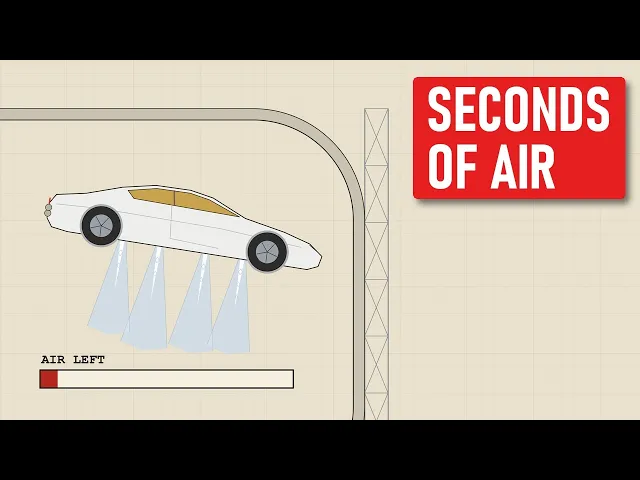
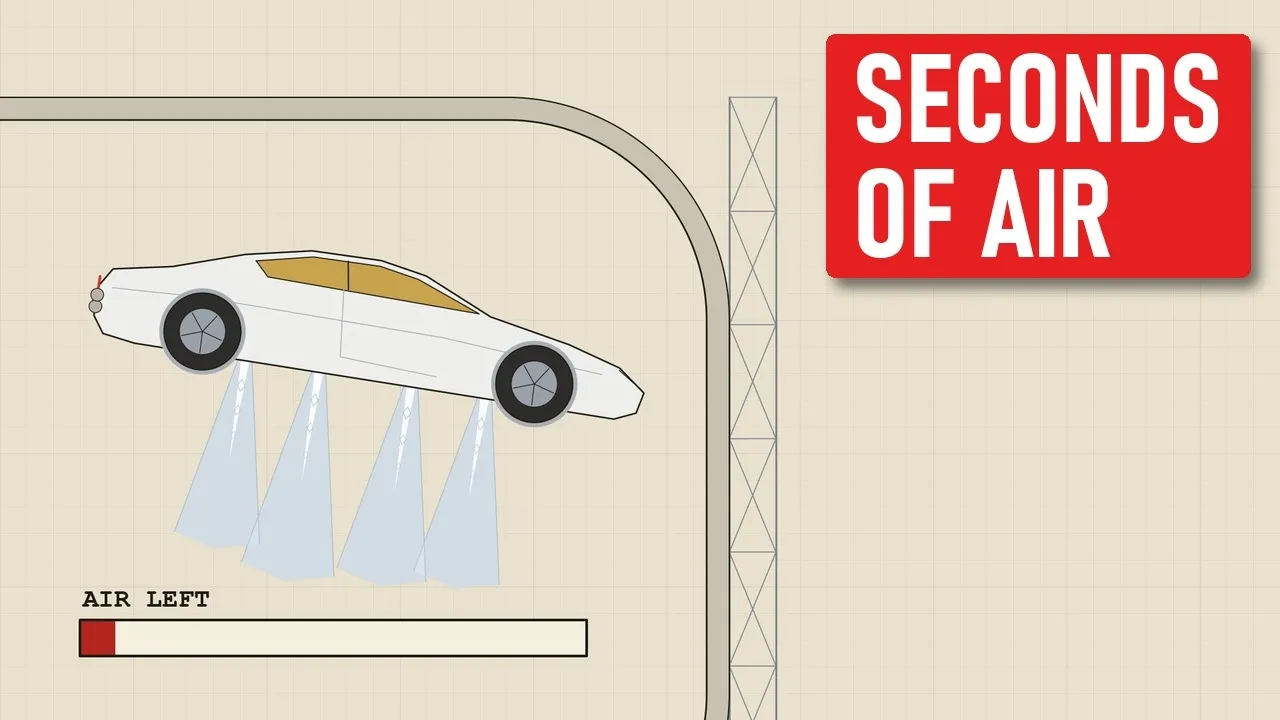
On Thursday night, at a SpaceX rocket test site in McGregor, Texas, Tesla's new Roadster drove up a curved ramp until it hung upside down. Then it let go, flipped in midair, and came down gently on jets of compressed air. Tesla also claimed it reached 60 miles per hour in 0.
81 seconds. The stunts were programmed, with a humanoid robot in the driver's seat just for show. So how does a car hang from a ceiling, how can air lift it, and how long can it stay up?
Every car's acceleration has a ceiling, and the tires set it. A tire can only push on the road as hard as its grip allows, and grip grows with how hard the car presses down on it. The Rimac Nevera, among the quickest cars on tires alone, reached 60 in a verified 1.
74 seconds, an average push of about 1. 6 times its weight. Tesla's 0.
81 seconds would take about 3. 4 times. Tesla's first trick is to press the car down harder.
Fans under the car pull air out from beneath a sealed floor. The air above keeps pressing with about ten tonnes on every square meter, so lowering the pressure underneath by just a few percent adds a force bigger than the car's own weight. Tesla says that is enough to hold the car upside down, even standing still.
Racing has used fans before. In 1978, Brabham's fan car won the only Grand Prix it raced, then was withdrawn. In 2025, a fan car built by McMurtry drove upside down on a rotating rig.
But grip still has a limit, so Tesla added a way to push the car without using the tires at all. That way is a cold-gas thruster, often called the simplest kind of rocket. Nothing burns.
Air, mostly nitrogen, is stored at very high pressure in a carbon-fiber-wrapped tank, a black sphere behind the seats. When a valve opens, the gas speeds up through a narrowing nozzle, reaches the speed of sound at the throat, and keeps accelerating as the nozzle widens. The thrust is the mass of gas thrown out each second, times its speed.
In 1984, astronaut Bruce McCandless flew untethered in space on a backpack with 24 small nitrogen thrusters. SpaceX uses larger ones to steer Falcon 9 boosters as they return to land. Tesla says the Roadster's thrusters push four to five times harder than the tires can, and that making them work in air, not in a vacuum, took new hardware and controls.
Balance matters too. Tesla's vehicle engineering head, Lars Moravy, said the pipes from the tank to the rear nozzles must all be exactly the same length. If one side got its gas sooner, the car would twist sideways.
Electric actuators drive the valves, making what Tesla calls micro adjustments within a fraction of a second. Flying takes far more gas. At the event, Moravy said the flying car carries 600 liters of compressed air, and Tesla puts it at about 250 kilograms, packed until it is nearly half as dense as water.
Ten thrusters let it lift, roll and turn. To hover, the jets must push up as hard as the car weighs. Good nitrogen thrusters throw out their gas at about 720 meters per second, and that is in a vacuum.
Tesla has not given the car's weight, but estimates run from about 1. 7 to 2 tonnes. Hovering that would burn about 25 kilograms of air every second, so a full load lasts about ten seconds, at best.
At the full 80 kilonewtons of thrust Musk quoted, it would all be gone in about two seconds. That is the catch, and Tesla used a different car for each demo. A drone flies on air it borrows, pushing a lot of it slowly.
This car flies on air it carries, thrown out very fast. Tesla says the car can refill its own tanks, but squeezing 250 kilograms of air that hard takes more than 30 kilowatt-hours of work, even with a perfect compressor. Tesla first showed a new Roadster in 2017, promising 0 to 60 in 1.
9 seconds, 620 miles of range, and deliveries in 2020. In 2018, Elon Musk tweeted that a SpaceX option package would add about ten small rocket thrusters. Tesla has missed every delivery date since.
Now there are three versions. Performance uses the fans and claims under 1. 6 seconds.
Thrust adds rear thrusters for under 0. 9 seconds. Rocket adds thrusters all around for flight, seats one, and is not approved for public roads.
Musk himself said it is not necessarily a safety-optimized car. Musk says production starts in 2028. There is still no price, and no official weight.
The engineering is real, but the physics sets the terms: a full tank of air buys seconds of flight, not minutes. If you liked this and want to see more, subscribe to the channel.