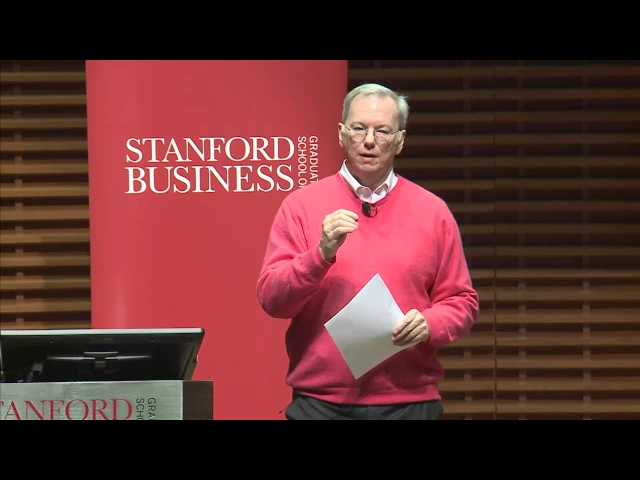
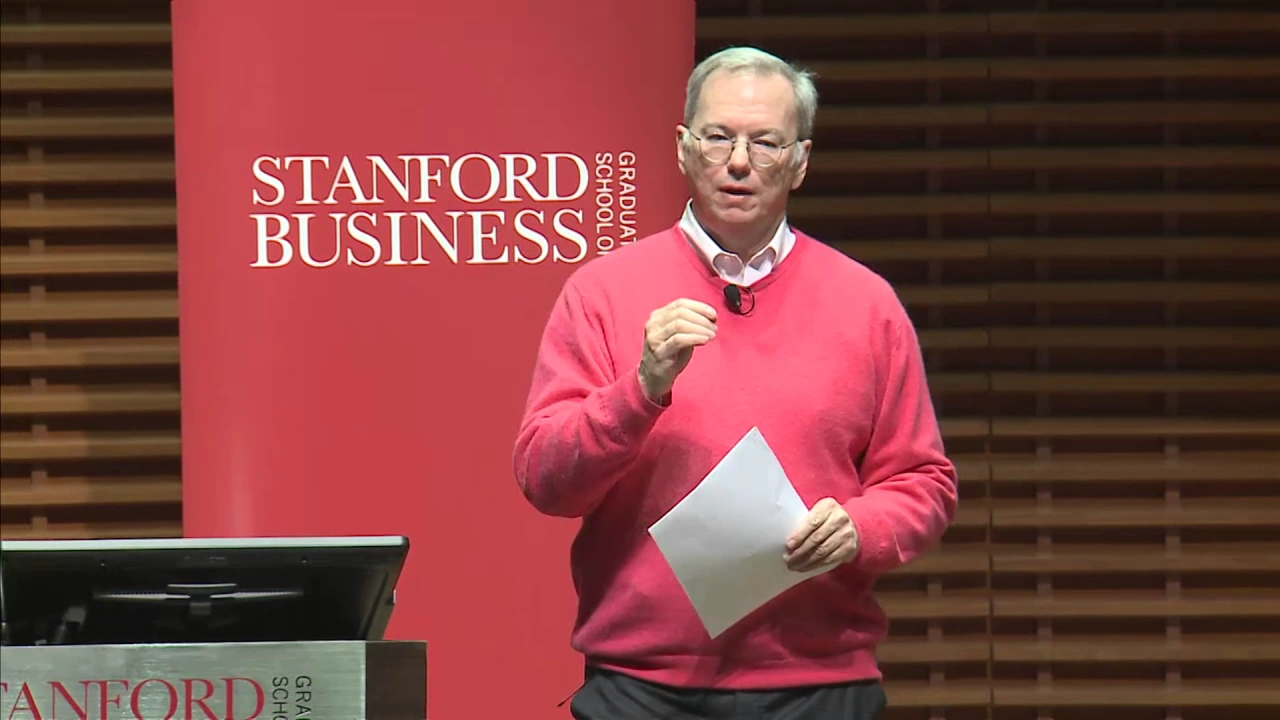
[Music] um it's it's great to be back um wearing my almost Stanford red and uh uh I'm excited for you all to graduate and I'm excited for the first years to make it to the second year and it's just wonderful to be here I will tell you that in the 14 years I've been teaching here The Faculty I think has been pretty much the same and the students just getting are getting more impressive right so you really are the best and my guess is that 10 years from now the students will be even stronger that's
extraordinary for the statement of what Stanford can has been able to do what I wanted to do is talk for a few minutes about the age that we're in and the age we're going to and then I thought since I've been here so long and because we talk a lot about these things talk a little bit about sort of Life advice some of the things that we talk about in our class and maybe you can debate and disc agree or agree on this or anything else or perhaps present your latest startup idea um and see
how well you do in front of your peers I'm convinced we're actually entering an age of abundance and that age of abundance is defined by too much information right we had the first thing was turn off your Twitter feed so that you could actually focus on something um whenever people say turn off your phone I always say don't turn off your phone we're in the phone business you you get the idea we clearly have too much food right the world is not only capable of food of feeding itself but in fact uh obesity and weight
gain and so forth are becoming major Healthcare issues around the world there are startups and Industrial processes that will solve the many of the housing problems we have worldwide and we're going to have abundant housing of relatively high quality and it looks like we're going to have pretty ubiquitous Transportation as a service high quality also as well so a lot of the things that we've talked about as we arrive in this age of abundance look pretty good but at the same thing time it's pretty clear to me that while we're going to have sort of
material things in great Supply we're still going to have religious nationalistic and personal conflicts to look forward to right I think that's the reality right and speaking as your local technology Optimist we haven't been able to quite fix those problems yet people too much in others worlds too much regulation too much anxiety a loss of egalitarianism we sort of forgotten the benefits of of of uh integration and tolerance right we seem to be sort of backtracking on some of the core values that have gotten us to this August state that Stanford and we all are
here today and it's funny when you look back at the at the election who would have thought that the KGB would be back through Twitter and Facebook I mean that's not the prediction we made a year ago here at the school right and yet it's very real so how are we going to react to this are we going to react to this in terms of Regulation and uh suppression and so forth are we going to end up in the equivalent of suburban culde acts that are highly protected from this abundance how are we going to
sort this out I don't think Society has figured this out the principles that I've been operating under which I would encourage you to to operate under are personal freedom and economic freedom right and if you look at the history of the world and you look at where we've all come from right the fact that we got here is because we have those two things and in fact it's interesting I looked this up at no point in history of you you had had have you all had a better uh likelihood of living a long and fruitful
life just on average and in specific very interesting right after all the complaining your expected outcome is higher in almost every category um I don't know it's interesting a child born today is expected to live about 90 years right children born by the mid-century are expected to live at least 100 years it's pretty good news that's average right we all understand averages um and and by the way when you when you have such a long expectancy my my core advice is that you need to brush your teeth because you're going to need them right so
so you know let's establish some basic rules here you have to think about these things so so and the world has this interesting way of changing so when I graduated from college in the 1970s I graduated as a as an engineer and electrical engineer and there were lengthy studies of the fact that there would never be jobs for engineers in the future and in fact I was going into a job market where it was not obvious that Engineers would have jobs at all we might be doing other things of course we wanted to be Engineers
but I pressed forward the computer that I used in college has as its replacement in roughly the same building a computer that is 100 million times more powerful I went to visit it right that's a lot of change right in that period of time so so if if we're in this sort of age of of abundance that I'm describing now what happens after this how does this transition and I'm convinced that the age of abundance leads to the age of intelligence and I'll tell you why it has a lot of implications probably the defining thing
for your business careers and perhaps for your personal lives as well the technological boom that the parts that that many of us have involved with people here in the room and myself obviously have produced The Following facts computer vision is now better than human Vision even if you're drunk right it's still better that's a pretty big deal um the analytical systems that are being built now Can Do Better plan planning and Analysis for any system that has variable inputs that is variable Supply and variable demanders right much of the business and dynamic world does that
and you say well why is he talking about this because that will underpin many much of what you do in medicine it turns out shockingly we're all the same right all of us all human beings right if you get enough of us and you do enough uh analysis of our Healthcare outcomes you can materially improve Healthcare whether it's Precision medicine or better drug Discovery the Technologies such as the technology that alphago for example represents which is the the reinforcement learning that won the game against go for those of you who don't know it's a very
big deal um is analogous to the kind of Technology you would use to look at candidates for doing protein folding to apply to generate new drugs so you go from winning a game to perhaps winning the real game which is making us healthier and solving diseases so what does this mean for you all well let's talk about cars right how many of you know someone who's had a tragic family loss somebody died on a car accident I think that in your lifetimes and perhaps sooner we'll get to the point where cars are as safe as
flying on commercial airliners I won't make a joke about that um the in terms of accidents in the air right basically when you get on a commercial airliner today it's safer than it is driving to the airport in your car so the engineering and the capability and the ability to do do computer vision and so forth will in fact take something that is really one a crude way of saying it is that 90 people are scheduled to die today driving cars we just don't know who yet it's a horrific thing to say isn't it but
those are the numbers and by the way they're going up right for various reasons we need to fix this and it'll get fixed very soon in the next few years the process will really begin so if you think about vision is a solved problem then what does that do for radiology and pathology so when you go to the dermatologist you really want the dermatologist to use a computer assistant way of looking at your skin to make the diagnosis to help you get healthy and so forth why because the computer can see more skin than the
opthalmologist it can literally see more eyes if it's diabetic retinopathy so I am convinced that these technologies that I'm describing are so profoundly powerful that they will underpin the creation of some fantastic large new corporations that are just in the process of being founded it's always been true in my career now this is my fifth or sixth cycle doing this that when you get a wave like this the kind of things that I'm talking about that the great new corporations get get founded right by entrepreneurs who take advantage of the things that we've learned here
and the principles of open markets and the capital investment and so forth we wrote a book about this so so when I think about it what is the emerging Tech model of success it's no longer slow product Cycles it's fast iteration learning your product your app changes every week um extremely deep sensing and Telemetry data on everything that you care about in your business um making the customer or using the customers information to educate you and learning from them remember if you've got a million customers educating you and you use machine learning you can learn
from them and become better than any single one of them you make them better and you get the benefit of their training of you so any solution where there's a large training set a large uh a large community these technologies will transform the economics the potential the brands and the impact that they have and and to do this of course you'd put everything into the Google cloud or perhaps Amazon if not us um and you'd use tensorflow which is a new library that that we release to do this and I think that it's possible that
these next generation of companies the ones that you and others will found can get to 90% market share models right because you move so quickly that success model has not slowed down right you read the press and everybody goes oh well you know this's this big company and that big company there's never been more opportunity then now to create these companies because the barriers to entry are so low the tools are so powerful and the need is so great and we can talk about this some more with questions and comments so I thought I would
talk a little bit about being a student here right being a graduate being being what you will be um and and I thought about it for a while and I thought this is a great year to be you right you managed to get here and you're managed you're either about to graduate or about to graduate in a year and and I would strongly encourage you to not succumb to the anxiety that everyone else seems to have but rather to carefully go through through the capability of the disruptions all around you and figure out how you
can solve a new problem you know simplify your life in this case focus on the things that you care about family relationships changing the world making money whatever it is it's okay but get focused on that don't be distracted most people that I know especially in your generation spend too much time on things which are distracting rather than focusing and often they're things that um that they really can't change anyway stop worrying about things that you can't control and try to make your own luck now you say well how do I make my own luck
well first you've been pretty lucky to get here good answer right and I consider myself the same um I'll tell you the story of my very close friend Eric Lander he was teaching uh I guess he was teaching at a business school and he thought I want to do something new and he decided to move to Boston because he figured that that was the highest number of interactions that would be that would occur per unit of time in the areas that he cared about he knew nothing about genetics he shows up he wanders around he
meets a faculty member who turns out to be a brilliant geneticist and working with him becomes a brilliant geneticist himself one of the most famous in the country but he had to move to Boston because that's where the target was and then he was willing to accept the risk so sometimes life works that way right that you move there and you but he made the luck happen um and in fact when I say this remember that almost everything that happens to you happens because of the people that you're with right every single success that I've
had has been because I was surrounded by these incredibly interesting and successful people this a technical person as a PhD you know in my career and so forth and so on but force yourself to take advantage of all of this don't just sit at home uh you know live your life to the fullest the most successful people work hard and play hard which means you should not watch television you should watch YouTube right it's very clear you know this sort of change we can believe in is in fact you right your ability to adapt to
this environment around I I would I would also suggest that you develop a at least a fake charm if you don't have any um sorry um take a picture of someone's child and send it to the parent explain to someone's parent how valuable their employees by the way it works every time right trust me don't say nice hairo which what I would say say love your new hair and the combination with that jewelry is Sublime right that's fake charm it works very well um when you're asked what your favorite number is always say 17 shows
you understand prime numbers right I mean you need a leg up you went to Stanford um the best prefix in a sentence is the word imagine if I say imagine to you right that means I'm talking to you I'm getting you to think I'm getting you to be curious that you're hopeful seek meaning versus novelty it's fun to have novelty but meaning is really how you get your life how you make your life happen right a as you AC as you create accomplishments it's the meaning and the impact that you have in the people that
you worked with which will provide this incredible incredible satisfaction one of the my my sort of pet peeve with strategy is that it's always taught in a short time frame but in fact the best strategies have longer time frame Horizons uh there there are always there's these traditional sayings which I like which are we tend to overestimate what can be done in 18 months and underestimate what can be done in 10 years watch a movie from 10 years ago or an interview in the technology space from 10 years ago and see how much has changed
starting with your mobile phone to make the point but almost all of the strategies if you don't think about them right fail within a 5year period so have a five-year plan and of course do it not just for your business but also for yourself personally be extraordinarily curious and and don't don't assume the status quo is unchangeable I learned this from Larry and Sergey um who basically just ued tradition because I was sort of a traditionalist and what do we have today publicly we have Trump and brexit uh all of these things almost all all
of the emerging Tech startups are essentially disruptive in the in the economic sense and the political sense and they were unexpected you should expect the unexpected as a result and success then is determined by persistence that is grit as well as curiosity and you have to combine both you have to be willing to do both so so to the way to be happy then you put all this together is to have meaning to your life is literally to serve others in what you do right that ultimately that's the thing that will matter the most it's
why I teach here it's why many of you will come back and honor the university that you're a part of um but if I make a list I think stay open to new things and unlock more happiness be happy surround yourself with new things new ideas avoid preconception and know more truths right no literally know things but it seems to me that in order to be disciplined so in order to get this that is to have your own Freedom you have to have enough self-discipline right and enough sort of uh Focus persistence if you will
to get what you want so it's almost a a an oxymoron but it works now you sit there and you go at the end of the day what's your proof Eric well poverty $1 a day changed 80% in my lifetime plunged right so if you think that I I was sitting in a meeting a couple days ago with somebody who said oh know things are terrible in the developing world and I said they've always been terrible and they're less terrible right those are the facts right my father took pictures when he was uh roughly you
guys's age he was traveling around Africa and you look at the pictures of Africa then versus the Africa now it's still poor but it's a lot less poor to the credit of the people who built that I think to finish with this and go to your questions I would say I think you should recognize that inequality is going to increase in the world in our current economic system and you need to be grateful that you're on this side of the inequality dispersion I don't think we know how to solve that problem as a society and
it's an important one to solve it's a problem and you're on the good side of that be grateful about it and I also think that as I said at the beginning we seem to have lost this egalitarian notion at least in the media and in the politics of our of many countries now not just in America I think you should recognize that diversity is a strength tolerance is a virtue that most people are doing what they think the world asks for them and that the essential human virtue is goodness right start there and then look
for the exceptions as opposed to the opposite and I'll finish by saying what I say to everybody that I meet who asks me sort of how to how to organize themselves what I do is I tell to say yes say yes to things just say yes say just say yes figure out a way to do it find a way to say yes to things say yes to invitations to a new country say yes to meet new friends say yes to learn something new yes is how you get your first job your next job your spouse
even your kids even if it's a bit edgy a bit out of your comfort zone saying yes means that you'll do something new meet someone new and make a difference yes let you stand out on a crowd be The Optimist see the glass full be the one that everyone comes to yes is what keeps us all young so with that thank you very much let's see um how are we going to do you have some mics comments or questions any topic is good um as we talked about before if you have a question just please
make yourself known to um Julie or or Ali and then stand up introduce yourself uh ask Eric directly um hi Steve R and MSX um I was interested in your concept of abundance and I that that obviously feels right one of the interesting things is that the societies where this abundance is occurring do appear to be becoming more unequal and I wonder how you think about that from a policy and Technology point of view and whether you think technology has any role to play I guess in the future and is this a risk to the
world so Jared Cohen and I wrote a book on this and we looked a lot at the basics of connectivity and my initial assumption was that connectivity would be uniformly improving for everyone in the world so one of the stories that we talk a lot about is the story of third world connectivity that is developing connectivity and the power of very very inexpensive smartphones and one of the things that I am proudest of and Google and Android play a major major role in this is that that phone when it arrives in the village is far
more important than the arrival of Television a while earlier because it's a source of entertainment of information of communication and of safety of Photography and all of that and it really has changed for much for the better and we're you know billions and billions of people we're going to go from roughly three billion people online to roughly five because of those phones but then we went back and we said well if that's such a great news right what's the math and the math is that while connectivity for those people is getting much better the bandwidth
to the developed world is increasing far greater right so if you take that simple dialogue which is uh capitalism global trade improves life at the bottom but the people at the upper crust are vastly more empowered with something as powerful as bandwidth that's a simple examp example of this it's obviously true of many other things so in Industries where you have declining costs which is Communications computer chips silk and that kind of thing I think the story is at least you can get it everywhere as long as and that's also going to be true of
food so remember food a lot of the food in the future will be essentially processed um manufactured in new ways right eventually certainly in your lifetimes some if not all of the meat you will eat will have been developed from real meat it'll be grown in it will be grown in the equivalent of a culture not in the equivalent of a of a cow and you sit there and say well that sounds like a terrible idea well it's it's going to have a lot fewer diseases it's going to be a lot healthier for you and
people will work that out so the economic answer is that you're better off letting trade happen and letting this inequality occur and then use redistributionist policies or other mechanisms right to support the less fortunate and I'm roughly in that camp I'm skeptical that the if you look at an aggregate basis we're probably better off doing the trade doing the investment creating the companies allowing it to become and then making the difference with policies of one C or another and you can do this with minimum wages you can do this with various other forms of subsidies
uh lots and lots of benefits that are needed to make up for the gap and I should say by the way that what I just said is completely politically unpalatable because of the hollowing out that's going on in Rural and Manufacturing areas around the world uh for example if you go in if you go in France right Paris is very dynamic as it always has been but there's a job problem outside of even in a socialist country outside of it because of all these changes go ahead um hello my name is Patrick Daniel uh thanks
so much for sharing insight I I really appreciate it um so I was wondering and to hear your thoughts on um you know sort of the Revolution that's happening with blockchain technology and um you know decentralized uh networks um I'm really curious to understand how you know 200 years from now when people look back at our time and the big turning points that will redefine Society you know our civilization um you know if we think about it like all these things are happening you highlighted some of them um and I'm just wondering how you think
about you know this whole clash between hierarchies centralization and and decentralization and you know all this stuff that's going on uh because you know as Edmund Burke the historian said like we have to have a contract between generations and a lot of people don't understand blockchain technology it's not very intuitive um so I'm just curious to understand how you see all these different decentralized Trends and distribute networks and how this affects Society because it's happening right now so your question is exactly at the center of what I I mentioned was I thought the dichotomy on
this issue because on the one one hand we're putting enormous power in the hands of individuals and at the same time we're terrified at the result of that in some cases by overreacting uh the specifics about blockchain are pretty straightforward which is that the um the general The Ledger that's part of blockchain is likely to be a fundamental computer science platform um the fact that you can have distributed ledgers that accurately keep uh information that's not not uh copiable or or fun fungible if you will is a major computer science Advance um but if you
look all the great optimists about blockchain and Bitcoin have been styed by the historic structures of banking which were erected after enormous Financial failures and they're not likely to be very liberal right it's just not who they they didn't hire liberals to do this by definition the Liberals were the ones who got them in the in trouble you know 50 years ago um if I you asked a question about 200 years and I think here is a build on how 200 years might look like for the next five to 10 years the AI stuff that
I'm talking about is incredibly obviously beneficial right so I mentioned health care I mentioned drug Discovery I mentioned basic science Transportation these kinds of things and it's happening so quickly I I don't think people understand how quickly Our Lives will change in the same sense that 10 years ago remember the iPhone came out in roughly 2007 right so that was roughly 10 years ago I don't think people understood the impact of having such a powerful supercomputer on your hand would have I think it' be the similar thing what happens after that a lot of people
in my community believe that we're going to be able to get to the point where computers can have aspects of human intelligent that look like intuition right that they have memory and then they have the ability to do the equivalent of dreaming I don't mean Soul likee dreaming I mean dreaming in the sense of imagining scenarios and putting interesting things together if that's true then at some point perhaps in my lifetime it should be possible to feed for example all of math into this computer and all of physics into this computer and behold some new
you know some new discoveries and and some real effect on timing it gets harder to see what happens after that right how does this emergent technology evolve in a 50-year period if you'd said I I mentioned that the computer that I used which was 40 years ago uh is a 100 million times slower than the one that is in its place today it's very difficult to imagine 50 years from now what that could be um eventually you have to assume that there will be the brain is a biological moment and eventually the brain will be
much much better understood and that there'll be greater connection between the brain and in these digital systems exactly how that will be achieved as As a matter of Science Fiction over there yes sir hi marki mb1 um somehow related to the previous question what do you think what do you believe are the biggest Mega Trends uh right now and especially what do you believe we should focus on like on which Trends we should focus on especially if you want to want to start our own startup and get on the Tailwind of those Mega Trends thank
you if I were a computer scientist at your age I would work on systems AI because that's I think where all the real power is going to be which is what I've been talking about um I'll give you an example in AI um one of the problems with the models that have been generators they can't figure out exactly how they work they work but they don't exactly understand and so there's research now in both under called attributive models where they can actually attribute a decision that was made to how the model learned because the systems
are about training one of the bizarre things about these systems is that you don't program them so if they come up with the wrong answer you can't just go in and change a little bit of code you have to retrain it and that's an important example um my my favorite example there is you're in the self-driving car and the self-driving car has been taught by the firm and it learned what humans do which is it did it sort of did a rolling stop at the stop sign and the policeman sees you and pulls you over
and the policeman says you um you you didn't stop at the stop sign and you say correctly officer I was not driving it's not my fault and the officer says who is driving the car and the car says I was driving and the officer says why did you run the red the stop sign and the car says I don't know and the car says who do I arrest now and every player is truthful in that scenario these problems will get solved um if I were not a computer scientist I'd be a biologist because taking the
analog world of biology to the digital world means answers that have beveled human Humanity for a thousand years and so that says you can make money in those those two areas literally in the next five years and the rate of in investment is is at a scale I've not seen in a decade maybe 20 years literally we're taking mathematicians and physicists who are brilliant and otherwise unemployed and retraining them on this stuff that's how powerful it really is more questions yes sir um I'm Paul Needum MBA 2 and to pick up on what you talked
about in your comments earlier with the question of really big companies and obviously we've all read in the papers recently about Monopoly questions and antitrust questions and obviously you don't think Google is a monopoly but when would you start to wonder about any company if antitrust intervention is necessary and like what are the signs you would be looking for where you would worry about Monopoly power as a general matter I obviously know a lot about this because I fought fought Microsoft and I've also testified on this and spent quite a bit of time the European
government with respect to the Google activities um the the US answer um is that which came out of um the Rockefeller age 100 years ago the standard is not set but basically whenever you're doing things which are anti-competitive which do not allow entrance to enter the market and certainly when I dealt with Microsoft the problem was Microsoft owned the Channel owned the distribution and they were the only place where the apps could be distributed whereas the internet has essentially eliminated that control over distribution so the good news about the internet is that and again we
just published a version of a book our latest book how Google works which talks a lot about this is that the internet is so competitive that your product really does have to be good and if it's really good you can raise the money you can get the distribution I just don't see the barriers to entry on at least on the internet side um at least for a while and that's and I think what I would say is if you look today there are depending on how you count at four or five companies that are defining
most of this and they are Apple Google Amazon Microsoft Facebook and that's roughly the order of the top five corporations in the American Stock Market in valuation so we're up to something right in the sense that that this is working they're Global businesses the competition is brutal and you get the benefit of that so the reason that your iPhone or Android phone is so incredibly powerful is not because we're so wonderful it's because the competition is the most brutal competition I've seen since the PC industry maybe even more so so that'd be sort of the
way I would answer it yes sir hi n gardenswartz uh mba1 um thanks so much for coming would you be willing to comment on the relationship as you see it between the Science and Technology communities on the one hand and government and politics on the other and what are some ways you might Envision um the two different sort of parties uh perhaps engaging more constructively with each other going forward well it's it's not getting better it's getting worse um a little bit of the history is that the NIH funding which funds the research for medical
stuff in the United States peaked around 2008 2009 is it fell roughly 30% in real dollars between then and um the end of the Obama Administration nonmedical in um research has been roughly flat as a percentage right and now the new Trump proposal um is a evisceration of those numbers and a significant reduction furthermore at NIH why you would want to speaking as a person with some self-interest into my own health why you would want to decrease the amount of investment in health research when you just have invented the Technologies like crisper that will cause
the breakthroughs that will solve these problems that have existed for thousands of years in humanity is beyond me right the only policy stupider is the H1B policy which is another discussion right I don't need to tell you about that one um so there's some weird mix of nativism lack of understanding scientific bias um so I'm not sure how to solve this problem but I would go through some things like this first science is true right and while there are debates within scientists the fact of the matter is the fact that you have to prove stuff
and that you're constantly being falsified keeps it roughly right climate change by the way is also true right it's actually happening right it's a fact you can choose to ignore it right a reasonable strategy for the Lites I got it okay but don't deny it right and don't be don't don't be a denier of basic facts I mean I I love these people who say well you know we're operating in a matrix okay well good okay take a knife put your hand out and put the knife into your hand and tell me if it hurts
okay does it matter whether you're in a matrix or not it still hurts right so let's deal with some facts um so this uh there's a community of people including myself who are working hard to try to get these messages through to people who spend their time denying science for political or material reasons but a simple rule is that often special interests in our system are paying them to believe falsehoods right that's a bad way to run a country it's a bad way to run it forever it's been it's not a new problem and it's
gotten worse so we need to fight it and we need to fight it hard um there are proposals to cut I can go on I'll stop there are proposals to cut basic research funding that goes to universities including to this University right think about the value of the product that is produced by this University you shouldn't cut it you should increase it right more questions yes hi Lam MSX originally from Israel I wanted to get your take on um how do we close the gender gap in the business and Tech World silon Valley has worked
hard hard on this and um there there was if you go through this like three phases so the first phase is the traditional prejudices sort of male only world and again watch a movie from 50 years ago to you'll see all those patterns I think those have largely been addressed the second one was trying to get um employment systems that would work for men as well as women and that especially involves focusing on Child Care uh equality of promotion that sort of stuff um and I think recently we figured out even to deal with some
of the pay Gap issues one of the secrets of what we do a story from 10 years ago is that when we interviewed women U I'll give you an example pay Gap we have studied this ex exhaustively and the way you solve the pay Gap since women come in with historical salaries lower than the men is don't base your salaries based on the historical salary and if you follow that as a basic principle you will solve the the compensation issue which we indeed believe we have done and we've issued lots of reports on that the
unconscious bias thing which everybody's focusing on now is very real if you talk to women they'll say I feel like I'm not heard I feel like I'm interrupted I feel like I'm tued over and corporations are now beginning to include training there's no evidence that the training is working yet but maybe they people have to go through multiple such trainings but I would say to you that it's smart to try to have every conceivably talented person in your company including all the men all the women all the gay people all the lesbians all the Russians
all the crazy people all the people who are like slightly insufferable right that you're kind of annoying to you right if they if they really are the best in the world you need them in your company which is why the H1B policy is so stupid and why the tech industry is so unified on this question about both equality but also the egalitarian and openness that we Aspire what I've discovered since I've been shocked by I'm always shocked by this I've been doing this for so long that American firms are mostly not like the tech firms
right I can't speak for Israel although I think Israel uh my wife and I did a a fund to promote um uh female scientists in is Israel to try to get them the funding for that crucial period when they uh go graduate and before they get tenure right so we're trying experiments like that I think this is a solvable problem more question over here yes yes sir yes ma'am excuse me hi I'm Kelsey page I'm actually in undergrad uh you talked a little bit about falsehoods earlier and um uh my question is especially considering uh
the recent election and Google having so much influence over uh the information people see on the internet and how they get that information what do you see as Google's role in maybe social responsibility in this um like uh realm and um uh elaborating more on how Google you see Google fighting falsehoods so um there's sort of two po two areas that we're focused on the first is improving our ranking so I want to say to you right up front that Google is full of a number of false statements that are not on the first page
right our job is to rank and our algorithms are pretty good at getting the truly idiotic crazy people who have no life and ranking them below right below the sort of the more legitimate debates and I'm very proud of that and and that only gets better in my view the second is that we have a team called jigsaw which which is working very hard to use um advances in language and understanding to look for um threatening speech and hate speech which is if you're familiar with gresham's law um that bad speech drives out good speech
um a lot of these communities are full of people who just pile on um in very distressing ways um simple simple and it's it's gotten worse because of automation so an example is I'll give you a stereotype you have a woman who is very thoughtful and she issues an impassionate statement on a social media and she is viciously attacked in personal sexist uh threatened in ways that are just terrifying and so she has lunch with her girlfriend uh after this and she says well frankly I just didn't know there were that many evil men in
the world and her girlfriend correctly says actually they weren't men they were Bots right that those attacks that that that sort of Relentless attack that you got the suppression of your speech was organized by evil people who were using automation to do so I think we can detect that with some work so I don't think we're ever going to have be able to detect you know legitimate group over here versus legitimate over group here that has a disagreement right that's a matter for for you know God and judges and politics and so forth the sort
out but if it's a a bad person over here uh write something this group takes it automates it makes it look like a huge phenomena press person over here writes it a huge new phenomena which serves the interest of no one I think we can detect that and that would be a big Improvement and it's if if we manage to pull it off which I hope we will as an industry now it will arrive just in time as the evil side will become more automated so if you look at the Russian attack on the election
which appears to have been done by humans not by computers all we can debate that um imagine four years from now with the power of the tools that I'm describing weaponizing that right and making your voting participation your confidence in the process less so so you're less likely to vote less likely to express your opinions as a citizen U that's not a good thing hey my name is Ben uh thanks for uh coming to speak today you had mentioned earlier um some comments around uh focusing in your career and related to that I'd like to
ask how you think about your role now and your role in the future in ensuring that technology is human centered and instead of like trying to create sort of behavior change around humans that's technology centered I I can talk about my personal thoughts on this I think that the the businesses that Tech represents are all working very hard to earn your trust and earn your attention and keep you involved and to monetize that in some way right that's why everybody's addicted to all the stuff um so I think that's that will continue in one form
or another if you imagine um the following scenario imagine we're so connected that we're all using these knowledge networks that are so smart that they help us every day which is part of our goal there's also a possibility that those knowledge networks can can enforce a certain in uniformity of view or a common view right in the same role that the three networks had when I was a young boy growing up in television and our principles need to be independent views independent access independent voices and not suppression of it and I worry that this adoption
of these platforms could lead to right a a commonality of view rather than looking for Divergent and listening to for the Curious new voices and I worry a lot about that because I think the the logic around the platforms means we want everyone in one place and by definition any such platform has its own language and its own structure and humans are more creative than that so and the answer of course is is not regulation but more competition more startups more ways of expressing yourself so so to me this next generation of AI and knowledge
systems will take advantage of this and produce new amazing insights and will provide some competition for the incumbents including for us yes sir hi uh James P nice to see you again how are you um so another article I read this weekend was about yourself and how Larry and Sergey when they would bring you on really cared about someone who could Foster group flow in an organization so they took you to Burning Man to see whether you had it so that that is an excellent article I suggest you not believe everything you read online I'm
I'm pleased and disppointed here it's fake news but my my question was really when we're making important people decisions in our life whether it's a senior hire uh backing a Founder choosing the Romantic partner to spend your life with what capabilities do you look for and where would you take them to see if they've got it uh well I I strongly suggest you go to Burning Man then um so I I had G I had been going before and they had also gone and so we found a kindred spirit there and that's how it really
happened um but I enjoy the the N the false narrative as much as anyone else um the there are people who have extraordinary skill in picking other people and I would suggest that that's something the dean and I were talking about things that could be added to the curriculum and so forth and the Judgment of this is the person I'm going to invest with so forth is not a simple one right so you need to be thorough but you need to be excited you need to sort of fall in love as well as be practical
just all of those things I don't think that's a solved problem I'll tell you what I do and what we did at Google is first we wanted people who were more than did more than did one thing so we wanted them to be curious and we wanted them to be accomplished in something so sergey's position was we should hire every person who was a rocket scientist we could find because they were clearly oddballs um and any and all of our salespeople should be um I don't know Olympics winners and I said okay well that's an
interesting approach to sales and he argued correctly that somebody who can win the Olympics has enormous discipline think about what it takes to do what they did he was very impressed with them so what I learned was when you interviewed people find out what they do that's not work rated and see if it's compelling if it's insightful tell me something I don't already know that usually produces a very good candidate and it's a pretty hard test if you develop that skill you'll do great in personal as well as in life more questions oh there was
one over here this gentleman there's one here here and there's a lady in the back good afternoon uh sorab saying MSX uh you yourself just mentioned that U Android has had a big impact on the cell phone smart cell phones penetrating into the world and the big aspect of that was the Android being distributed almost for free fre is always a good starting price great uh go going to autonomous technology on the on four-wheelers is that your intention going there as well or how do you see that percolating into the world and how do you
envision that different industrial structure different strategy we haven't really determined exactly how to do it we're just trying to get everything to work um so in phones the story is pretty straightforward um there were a number of initiatives underway um Apple's initiative very strong player clearly not licensable by its competitors right when you when you call Apple they wouldn't return the phone to license return the literally the phone sorry for the punt um uh to license the technology and so we were there with a solution that had the right price free and worked right and
it had and it didn't have the encumbrances that the other choices did and that's produced a platform that is well more than a billion users uh most of the studies indicate that it's a vast majority of all the smartphones in the world are using Android and we've now taken Android into other markets including television and cars and things like that I don't know how far we'll go into the other markets C uh leave us now so if you have any more questions well we have I think we have the lady in the back had a
question even better right there um why don't you why don't you have the why don't yes right in front why don't you have the last why don't you have the last question thank you my name is Tatiana Nunes and um from Mexico we are very excited about the Calico um research that you are that you are developing to help to enlarge the lifespan of humans and uh I'm more interested than you are because I'm older so that's uh very exciting and uh our question is about about um how if if there is if there is
a already a um business strategy around that and how are you planning to to have a revenue about this so the answer is not yet um Cal for those of you who who um haven't been following it Google has two large initiatives in the health area one is called ver which is not Calico and verly is about out today anyway about medical devices we did a fantastic um uh contact lens that could help you with blood glucose which is a problem that affects diabetics and others they've since announced many new products in the sort of
think of it as medical device medical instrumentation um and sort of everybody wants to partner with with verily they're doing very well uh Calico is more today of a research project try try to understand the underlying processes of Aging um I've been briefed on it but I could not accurately describe the science that they're doing even if I wanted to um but they have the labs they're looking at the various chemical and biological processes can they be slowed or affected by treatments new drugs that kind of thing if it works right which we'll know some
years from now it's a classic biotech um the economics would be the economics would be incredible right because this be like a a brand new drug that everyone would want to take right who doesn't want to live longer uh and if it doesn't work well we'll have tried valiantly and we'll have advanced the science and the research in that area in a material way that we recommend catching Eric at Burning Man at the end of AUST but but otherwise uh thank you so much Eric for coming thank you all please have a great spring okay
to you [Music]