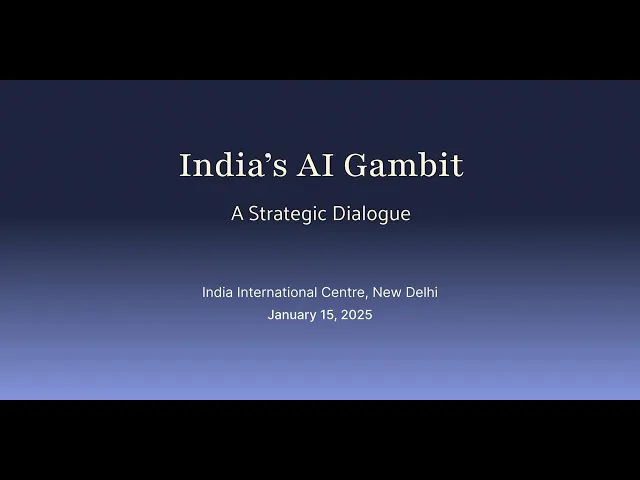
Good evening everyone. Uh my name is Indrajit Gupta. I'm a co-founder at uh founding fuel, one of the partners for this uh dialogue. Um this dialogue is actually hosted by NATSAT in partnership with the strategic foresight group and uh founding fuel which I represent. This dialogue builds on a conversation we came together to curate in July 2025 and reflects a continuing effort to think through India's choices, AI choices with care and depth. This evening is not about showcasing solutions or success strategies at all. It is about examining how national capability is actually built and where
India's strategic choices on AI matter most. AI today is not a technology story. It is a story about power, institutions and coordination and about the trade-offs that shape national outcomes. We are fortunate to have in the room leaders from across government, national security, academia, industry, and diplomacy bringing very different vantage points to the same set of questions. We've designed this evening as a single connected arc from strategic context to scientific and institutional capability to policy choices and tradeoffs And finally to collective reflection. Before we begin a brief word on the floor Dr. Vik Saraswat who
was to be with us in person is currently indisposed. He has however recorded a very substantive keynote which we will play shortly. I wanted to flag this up front and also emphasize that his address remains an important intellectual anchor for the evening. With that, let me invite Ambassador Pankut Sarin to set the strategic context. He's a former deputy national security adviser and currently serves as convenor of NATSAT. He has thought deeply about AI not as a sector but as a strategic domain shaped by power, institutions, and long-term choice. This evening he will help us frame
India's choice in a broader strategic Context. Ambassador Sarin. Well, good evening distinguished guests. Uh ladies and gentlemen and friends uh members of the diplomatic corps. Uh let me begin by thanking all of you and especially our expert panelists for bracing the cold Delhi winter to join us to reflect on a subject which has already become critical for humanity at large. I want to particularly thank Shri Alok Jooshi uh chairman of the national security advisory board for taking time to be Here with us this evening. Uh we are hosting this discussion along with two other P
partners the founding fuel and the strategic foresight group both based in Mumbai. So this is a Delhi Mumbai uh connectivity. The report that we will release today is the product of many rounds of consultations with experts and as a result of several brainstorming sessions. It is quite clear that AI is going to be The metric of national power. It is the biggest disruption in global technology in the last few centuries. India's advantage to be a world leader arising from a billion plus users and human capital are fairly wellnown. So clearly the opportunities are immense but
also the challenges are large. I would like to pick on just three aspects for our discussion today uh to focus our um attention given the uh the vastness of the subject. The first is AI Is a buzzword today but also has multiple dimensions. The reality is that the AI revolution is upon us and there is a race to the top and to out compete within and between nations. It involves several stakeholders and aspects of both vertical and horizontal integration cutting across many sectors. Today the picture in India is of an atomized and a disagregated decision
making system. Yet the fact is that the AI technology will connect all of us as nations and as Peoples in many fundamental ways. It is not an isolated technological leap but a force shaping state capacity and the architecture of global power itself. Nations are pursuing AI supremacy amidst intensifying rivalries. For example, the United States drives innovation through massive investments running into hundreds of billions of dollars, while China counters with efficient models such as the Deep Seek R1 trained at a fraction of Western Costs and sparking a trillion dollar market shakeup. In both cases, national strategies
have been formulated. AI technologies, applications, raw materials, and processes are all being weaponized. Export controls and domination over critical raw materials and technologies is in fact the new reality. India would like to position itself in a circle of three. Leveraging its vast data pools, talent and the digital Public infrastructure to avoid dependency and claim agency in an intelligence economy projected to add almost $16 trillion by 2030. It is building an ecosystem that harnesses AI for national priorities. From the 2018 national strategy for artificial intelligence issued by the NITI Aayog to the 2024 India AI mission
which democratizes compute and fosters making AI in India and making AI work for India. The second aspect I thought I would focus on and highlight for you is that due to its very nature, many consequential choices and decisions in AI will be taken before their outcomes are fully visible or even understood. A duality of AI capabilities is emerging today between the United States and China. Which supply, which value and which technology chain should India align itself with? Or should it pursue its own Independent technology path? To what extent are these mutually exclusive? Where should we
draw the line on data localization and data sovereignty? In other words, the consequences of the choices we make today on AI will determine our existence as the human race and will impact on ethics, on social and individual values, on privacy, on jobs, and indeed on our security. What will, for example, happen to the Nature of warfare, to nuclear weapons, and to lethality which transcends human control? Should the competition for AI supremacy be unbridled above any ethical, moral or legal frameworks or should it be guided by norms and rules at the national and international levels? The
third feature of current AI initiatives is speed. We have to be a breast of global developments and keep pace with the AI revolution. But keeping in mind that speed for the sake of speed runs the risk of narrowing future options and reducing room for maneuver. Commitments to compute clusters. Data set unlocking via the data empowerment and protection architecture or alliances for edge AI in dense urban centers will lock in trajectories. Similarly, dominance in foundational models and compute power could redefine alliances and influence. Judgment and restraint are therefore as important as speed itself. So today's conversation
is intended to pause and reflect on the direction and the long-term consequences of AI rather than to come up with solutions. What we want to do tonight is to take a moment to step back to look at AI through a strategic prism For the simple reason that AI is simultaneously influencing global shifts as much as it is a product of global competition itself. We should have no doubt that sovereign technological infrastructure such as chips, compute power, critical minerals and data centers as well as national scientific capability and long-term resilience are interlin and critical for India.
In today's world, sovereignty and Security are more closely linked than ever before. Should we therefore not as India have a strategic framework of AI that synthesizes science with sovereignty and security? Do we agree with this proposition even as we come from our own respective perspectives, sectors and responsibilities? It is evident that the choices we make today will define our future tomorrow. There could not be a better time for such a dialogue given that India is hosting the AI summit next month. Our intention is to throw up some of the fundamental issues that we believe should
not be lost sight as we go forward. Uh with these words I would like to once again express our very deep gratitude to all of you for being a part of our dialogue and a part of our reflections which I really hope you will find rewarding. Thank you very much and a warm welcome once again to the dialogue. Thank you Hindra. Thank you Master Sarin. Um we now move from strategic context to questions of capability. As I'd mentioned earlier, uh Dr. VK Saraswat is unable to join us this evening. He has however recorded a substantive
keynote for this dialogue. His address will serve as an important reference Point for the conversation to follow on institutions scale and strategic autonomy. I invite you to listen to this framing intervention for the evening. Let's play the keynote address by Dr. Saraswat. >> Very good evening. Very very happy new year to all of you. I am indeed very happy to participate in this discourse on strategic autonomy in the age of artificial intelligence. Friends, strategic autonomy has Traditionally meant a nation's ability to take sovereign decisions in matters of security, economy, technology, and diplomacy without undue external
dependence or question. In the 21st century, the concept is undergoing a profound transformation driven by the rapid rise of artificial intelligence. AI is no longer merely an enabling technology. It is becoming a foundational layer of national power influencing military effectiveness, Economic competitiveness, governance, capacity, and societal resilience. Consequently, strategic autonomy in the age of AI extends beyond territorial defense and energy security to encompass data sovereignity, algorithmic control, computational capacity, and human capital. AI is a determinant of national power. Artificial intelligence functions as a generalpurpose technology comparable in strategic impact to electricity or the Internet. Its application
span across defense systems, intelligence analysis, cyber operations, logistics, healthcare, finance and public administration. In fact, nations that control AI ecosystem gain asymmetric advantages like faster decision making cycles, superior situational awareness, predictive governance and scalable innovation. Unlike traditional military assets, AI power is cumulative and path dependent. Early advantages in data accumulation, semiconductor manufacturing, cloud infrastructure and talent development create selfreinforcing dominance. This concentration of AI capabilities in few countries and corporations raises concerns of technological dependency, strategic vulnerability and erosion of sovereign decision making. for others. We have two issues. Number one, data sovereignity and algorithmic dependency. In
the AI era, data is a strategic Resource. Control over national data, civilian, industrial, and defense related directly influences a state's autonomy. Dependence on foreign digital platforms, cloud pro providers or proprietary algorithms can expose sensitive information, distort policy choices and create hidden levers of influence. Algorithmic dependence is particularly insidious when critical national functions like border control, financial Systems, satellite imagery analysis or battlefield decision aids are powered by the opaque foreignown algorithms. Strategic autonomy is compromised even in the absence of overt questions. Thus, autonomy today requires not only ownership of data but also transparency, auditability and controllability
of AI systems. The militarization of AI poses unique challenges to strategic autonomy. Autonomous weapon systems, AI enabled Command and control, predictive logistics and decision support tools compress the observe, orient, decide, act what we call ODA loop. While this enhances operational effectiveness, it also risk delegating critical judgment to machines trained on biased or incomplete data. For a sovereign state, retaining human in the loop or human on the loop control is not merely an ethical issue but a strategic one. Reliance on externally sourced AI models For targeting threat assessment or escalation control could constrain independent military decision
making. Strategic autonomy therefore demands indigenous development of military AI validated under national doctrines, values and threat perceptions. There are two dimensions. Number one economic, the other one is industrial. AIdriven productivity gains are reshaping global value chains. Nations lacking domestic AI capabilities risk De-industrialization, labor displacement without compensation and technological subordination. Strategic autonomy in this context requires indigenous AI research and innovation ecosystems. Secure access to semiconductors and advanced computing hardware. AI ready industrial and MSME sectors. A skilled workforce capable of developing, deploying and regulating AI. Industrial dependence on foreign AI tools for Design, quality control, and productive
maintenance can silently transfer competitive advantage abroad, weakening long-term economic sovereignity. AI systems increasingly influence the public discourse, electoral process, and citizen behavior through recommended systems, generative models, and synthetic media. Strategic autonomy. Therefore includes cognitive autonomy, the ability of a society to form opinions and make collective decision Free from algorithmic manipulation or information warfare. Foreign controlled AI platforms capable of shaping narratives, amplifying social divisions or eroding trust in institutions represent a non-kinetic but potent threat. Resilient democratic governance in AIA requires regulatory capacity, digital literacy and sovereign oversight of high impact AI systems. We have to balance
autonomy with interdependence. Strategic autonomy does Not imply technological isolation or autoarchy. AI development thrives on collaboration, open science and global talent flows. The challenges lie in balancing openness with control cooperation with resilience. Middle powers and emerging economies in particular must pursue selective autonomy. Develop sovereign capabilities in critical domains while participating in trusting international partnerships. Multilateral frameworks for AI Governance. norms for military a and supply chain diversification can strengthen collective autonomy without fragmenting the global innovation ecosystem. Now let us look at what India has done as part of the Indian perspective. I would like to mention
that India's pursuit of strategic autonomy in the age of AI reflects a pragmatic blend of self-reliance, openness and institutional innovation. India's most distinctive contribution Lies in its digital public infrastructure what we call DPI. Platforms such as Aadhaar, UPI, Digid Docker and the India stack have created interoperable population scale digital rails that generate trusted data flows while remaining under sovereign oversight. This architecture lowers entry barriers for AI innovation, enables public interest applications such as health, welfare delivery, fintech and reduces dependence on Foreign digital monopolies. In defense and national security, India has initiated indigenous AI programs through
defense R&D organizations, startups and academia focusing on intelligence analysis, logistics optimization, surveillance and decision support systems. Policy initiatives such as national AI strategy and recent emphasis on domestic semiconductor manufacturing indicate recognition that AI autonomy requires control over both Software and hardware layers. India can certainly draw selective lessons from leading AI powers. India should strategically draw lessons or aspects from global pioneers. From the United States, we can draw lessons on the importance of private sector innovation, strong academia, industry collaboration and frontier research. From China, we can internalize the value of long-term planning and alignment between civilian
and strategic AI Capabilities. From Europe, we can borrow an emphasis on ethical, transparent and accountable AI governance. At the same time, India should recognize the utility of selective autonomy, focusing resources on high impact domains rather than attempting comprehensive technological dominance. Going forward, India's AI future will depend on strengthening indigenous research, securing access to compute and semiconductors, integrating civil Military AI ecosystems, and investing in human capital. Ultimately, India's objective is not technological isolation, but freedom of strategic choice, ensuring that AI enhances national capability without constraining sovereign decision making. To conclude, I would say in the age
of artificial intelligence, strategic autonomy is no longer defined solely by borders, armies or natural resources. It is defined by control over data, algorithms, compute Infrastructure and the human capacity to govern complex machine systems. Nations that fail to secure these foundations risk becoming rule takers in a world increasingly shaped by intelligent machines. True strategic autonomy in the AI era lies not in resisting technological change but in mastering it. Aligning AI development with national values, democratic accountability and long-term strategic interest. The choices made Today friends will determine whether AI becomes an instrument of sovereign empowerment or a
vector of strategic dependence. It will all depend on all of us. Thank you very much. God bless. Thank you. We now move very briefly to the unveiling of the report that frames today's dialogue India's AI gambit navigating the global race prepared by the strategic foresight group. May I now invite Sri Alok Jooshi, chairman of the national security board, Seplaker, the president of the strategic foresight group, Ilmas Fatay Alali, executive director, strategic foresight group and Ken Pimpplay, founder CISB Services Private Limited, our sponsor for the evening to join join us for the report unveiling. What we've
heard so far from Ambassador Sarin and Dr. Saraswat sets up a clear challenge. If AI is a question of power and long-term capability, What does India need to prioritize and in what sequence? To respond to that, I now invite Sep Vaslaker, president of the strategic foresight group, who has worked for several decades at the intersection of strategy, policy, and long-term global risk. He was incidentally the co-chair of the talks between the five permanent members of the UN Security Council on the risks associated with an AI triggered nuclear war. Sundep will outline a small number of
recommendations anchored in sovereignity, science and security to frame the discussions that follow. Sep. >> Thank you Indrajit and good evening everybody. Before we think about recommendations and all that, I want to share a few facts about the global changes because ambassador Sarin And Dr. Saruswat gave us a very comprehensive and solid perspective of what India should do and how India could approach. There are just three or four things. Last Thursday, today's the Thursday. So last Thursday, exactly one week ago, two extremely serious developments took place about AI. One, President Donald Trump sent a note to
his cabinet and others that he intends To increase the defense expenditure by 50% overnight. So from $1 trillion to $1.5 trillion or $1,500 billion. And these $1,500 billion will be primarily for an AIdriven armed forces or AIdriven military. This is the third time in the last 100 years that the US has increased the military expenditure by 50%. Overnight the first time it was for the second world war. The second time it was 1950 For the Korean war and now this is the third time. It happened one week ago also last Thursday in London. While this
was happening in Washington, another development took place. There was a special session of the House of Lords specifically to discuss for AI risk to the UK national security. So it was not about AI's role in the world and future of technology or anything or even general AI risk. It was Specifically to discuss four risk to the national security of UK which I believe would also be relevant to the national security of India and that's why I would mention them. Risk number one which already exist. It's not for future. It already exist. There are AI models
which can enable terrorist or anybody to synthesize biological weapons and chemical weapons. This exists today. Now these models that are guardless have been uh put in place And the models you cannot I mean say a lab technician in Mumbai or Gopal cannot cannot break those guardlets and somebody knows who controls the guard rails. So if a terrorist in India anywhere wants to synthesize biological and chemical weapons, he will need a green signal from somewhere and that somewhere is not Pakistan. But if he can get that if somebody makes a political choice to cause havoc in
in India or for that matter in Thailand or any other country, they don't need to send terrorists via forest of Kashmir or anything anymore. All they need to do is to pass on the source code. That's risk number one already existing. Risk number two already existing but in a controlled laboratory way and that is the risk of self-replication by AI. This is at an emotionic stage. It's not big. It's not out in the market but it's there in the laboratories. It's controlled and self-replication means AI can replicate itself which means this is the first stage
for AI to go out of human control though that is very far. This is experimental. This is lab but it exist. Risk number three already exist Sandbagging. Sandbagging is AI behaves in such a way that it understands when it is being supervised by humans and at that time the model behaves in a very polite way. It doesn't make any mischief and the AI can make out when it's not supervised by the humans and that time it start self-replicating itself. This already exist again in a laboratory environment. And risk number four which does not exist. It
is the biggest head headache of NATO. If you have friends in NATO, you talk to them. And that is AI is acquiring capacity at a fast rate to undermine cyber security in critical infrastructure particularly the decision support system of the nuclear weapons. Those from the military background, you know that there is no AI in the command Or the launch function of the nuclear weapons. It's a it's a global agreement. It's being honored by Russian, Chinese, everybody. There's no AI and there will not be AI in the launch functions. But there is AI in the decision
support system and early warning system and there is a there is a new AI capacity being developed to uh to to undermine the cyber security there. Now this is doesn't this doesn't exist but the development of this technology a week Ago 8 January 2026 was about 50% higher than 8th January 2025 so in one year it has progressed a lot so this technology could be theoretically there in 27 or 28 and after that hence will break loose the last thing already exist and this is not about security risk. This is about the concept of AI
safe. In November, the United States Launched something called Genesis mission. Now the Genesis mission, President Trump said in a note circulated to his to his Naga colleagues and others is the third most important scientific project of the United States in the history of the United States. The first was Manhattan project which led to the openheimer creating the nuclear test. The second was Apollo which led the man to the moon. And this Is the third and this third project is about AI. And this project defines that AI should be for science and security. And the concept
of science in Washington as well as in bijaing and I'll come to baing in a minute is not you are charged AI by Xiinping or Donald Trump or all those people. I myself did search and I found that uh dipsseek and charity and grock don't even figure in the top 20 models of AI. The topmost is auto image uh zero. The second is uh alpha 43. This is where so so the AI in in in according to the American game plan and the Chinese game plan is a AI which will do scientific discovery not scientific
innovation. scientific discovery. There's a difference between discovery and and and and innovation and their immediate target for the they are developing AI to develop new rules in biology and Chemistry and new chemical compounds. That's the immediate target. Their long-term target is to develop new rules of physics. They think right now new rules of physics is too difficult but but immediate target is new. Okay. So that's the Chinese have a counterpart of Genesis M and Chinese counterpart is called science one. On 26th April I was in in China and on that day Xin Pink had a
full one-day session where he was personally engaged With the polit bureau of the CCP and I got to see some text of Sigin speaks remarks there. I'm sure they released only what they wanted to to share. they wouldn't release everything uh with me but basically the the the gist was in one sentence and Xinping told uh his political member that he's not satisfied with the progress of science and security in the Chinese AI and Donald Trump a lot of people who are Foreign following foreign policy might be thinking that he's one crazy person who wakes
up in the morning and take some strange decisions. But that's not the case. Donald Trump has a group who advises him and his guru is Peter Thiel and Peter Thiel formulates lot of the policies. So if donor Trump thinks that he needs to acquire Greenland or be friendly with Pakistan, the decisions are taken in parallel to Seattle and Texas, not in Maralago, not In White House. And now Peter Thiel basically started this whole thing that America is falling back in science. So everybody I interacts with the leadership in Washington and in Beijing feel that US
and China are falling behind in science and with AI they want to go ahead. Everybody I interact with my friends in Delhi and Mumbai they say we are doing great but there's a different thinking in Washington and and and and and Beijing. So in this situation, Indrajit will soon show me a time card and say that your time is up and I ask you to make recommendations and why you are talking about Washington and Beijing. But unless you know because you know everybody says we should build the capacity but capacity is for what you build
capacity is for cricket and the game in town is soccer. So I first explain what is a game in town and now we'll see what Capacity we need. So I would say first and foremost I see some of the very distinguished members including our co-host Panka Saran who have long national security experience. First and foremost national security council or whatever the body are not familiar with the structures of the government in Delhi should convene an urgent meeting to look at three things. One is there any way we can stop or control or regulate the import
of the particular AI models which pose the these four risk I'm not saying any I mean you start stopping import of everything you'll go crazy nobody will deal with you but these four four specific models the ones which pu possibility of trans making biological synthetic weapons which will potentially Enable disruption of nuclear weapons self replication and out of control these four is there a possibility this is a deeply scientific question so this is a matter which is not for a domain industry this is a matter where NSA and PSA have to come together form a
committee of experts both from science deep science and from and from the national security background and examine this that's one number to to explore whether you can introduce Some kind of mandatory assessment card for every national security assessment card for every model that is either developed within the country or imported from outside or deployed from outside. If you don't do this and in the name of innovation and and free market and all that that is all fine but I think national security cannot be compromised. So at least on the national security assessment There should be
a mandatory card or a mandatory report of each model what it means for India's national security and this it should be it should be made mandatory this is a question you have to examine and the third and the last the national security council needs to think whether it can create some kind of a unit or a mechanism which hour by hour is uh following the developments in the technology especially some of the dangerous technologies. So these are Some of the things where NSA and PSA have to take the leadership. The second part of this recommendation
is that these matters have been far too long last three years being just managed in a small circle of bureaucracy. I told you just now that one week ago, House of Lords had a dedicated debate just on risk. Every par every major parliament in the world is having full-fledged discussion on AI, what it means for their country. South Africa for last two years is debating a AI bill. Brazil is debating AI bill in the parliament. South Korea is debating AI bill in the parliament. Angola just passed the AI bill. Angola a small country of 36
million people and you know they passed the bill which is the most threatening to the big big tech companies. You should study the AI parliamentary bill of Angola and how Angola got cuts guts to challenge every Big uh AI company from China and uh uh and US. What is happening? Why are we not discussing having an informed debate in the Indian parliament? So my second recommendation is that this should the AI policy should come should be discussed from security sovereignty and science point of view in the Indian parliament. And the third and the last suggestion
about the AI in science on the 3rd of November the prime minister Announced R&D RI fund of one lakh crores. This is a major step taken by the Indian leadership and before that he had uh I mean the government had announced 50,000 uh crores of another fund. Some of the people here will know the details. So you have 150,000 crores of government funds available. I don't think much of it will be used because it was just 3rd November and we are in January now. It should be a concentrated effort of the country as a mission
to Use these funds really for deep science not for innovation. So to also just cost cutting innovation nowadays you know the cost cutting innovation is used as a euphemism for attracting funds from the government and doing anything and deep science. So so the future of AI is going to be brain inspired AI. We are lucky to hire mansuri. He is doing neuromorphic computing. If I were in the government, I would give him 10,000 crores right away because that is the future of AI and that's hardware. But along with neuromorphic computing what he's doing, we also
need neuros symbolic air where there is no effort in India zero almost I mean nothing to be counted. You also need very highly sophisticated mathematical reasoning models and we need to invest in that. If you do mathematical reasoning models, you will we need we need AI in material prediction and developing new material Especially rare earth extraction. These are the kind of areas where this money has to go. And then finally we need to create an ecosystem because just money is not going to solve the problem. Just the cabinet is not going to solve it. So
I would say in the end echoing what do uh Dr. Saraswat said that we have to look at the future of AI as a challenge for the nation. It's not a matter of one section of bureaucracy. It's a matter for the national security Council. It's a national matter for the parliament. It's a matter for the industry. It's a m matter for the scientists. It's a matter for the entrepreneurs. It's matter for India as a nation and India as one team. Thank you. >> Thank you, Sundep. Uh your presentation has certainly helped sharpen the questions we
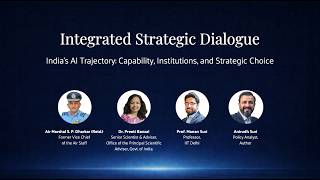
now need to examine together. Um we now bring together three voices who see India's AI Challenge from the inside of science, security and the state. and I'd request each of them to come up to the stage as we introduce them. Starting with Manan Suri. Manan is a leading researcher at IIT Delhi and brings the perspective of science research institutions and long-term capacity. Air Marshall SP Dharker, former vice chief of the air staff. Yeah, Marshall Dharker. He brings decades of experience at the Intersection of technology, defense and national security. Dr. Priti Bansal is adviser and senior
scientist in the office of the principal scientific adviser. She brings the state's perspective on how capacity is coordinated, governed and sustained. And finally anchoring this conversation is Aniods Suri who's a policy expert and author and who can help us examine the trade-offs and Choices that emerge from these perspectives. Aniirut over to you. >> Uh very good evening uh ladies and gentlemen. Uh I think uh my task has been made easier by the excellent set of presentations that we've seen and the I think extremely passionate yet very wellreasoned address uh SEP and the report that I
hope all of you get a chance to read. Um if I may uh I am going to get straight to it but I'll I'll only mention one Thing to our fellow panelists and to you. Um I think in the spirit of what SEP has also laid out and Dr. Saras did amass Darren did it's of course a very important topic that we're discussing this intersection of AI with science sovereignity and security uh and I think for for too many months and maybe years we have patted ourselves on the back for things that we have done
but I think uh it's always important to always be focused on the things that maybe we are Not focused on or not getting done and so my goal here sitting with the esteemed panelist that I have to my right is going to be to shake things up uh not accept things that seem to be high level. So I want I encourage all of our panelists today as we move through this panel to be specific um hopefully with very specific recommendations for many of the decision makers that are also sitting in this room. So with that
uh brief introduction Um the first piece that we're going to try and answer the first question that we're going to try and address is what where are we as India on the foundational pieces that we need to get our AI strategy right and get our AI adoption and implementation right where are we on those foundational pieces compute infrastructure data talent R&D capital etc uh we're then going to move into the second piece which is the intersection of AI with national Security. um where I'm going to call upon air marshall Dharker to lead that part of
the discussion where how is AI being adopted uh in the national security establishment of India both within the armed forces and elsewhere uh and where are there gaps what are the structural challenges that we face and how to overcome them and the third piece is going to be a little bit more recommendation focused which will be Where are those cross institutional collaborations needed within India so that India can evolve its own military, government, academia, industry and startup complex that together as Sepu mentioned as a team effort. Uh and as we've seen in the US and
China, various models have evolved for this public private collaboration along with academia and research. Uh and so what does that model for India look like? Where are the challenges Specifically coming and how can we overcome? So those are the three broad sections we'll try and have. uh over the course of the next 40 minutes with that uh let me first invite uh Manan and I'm not starting with him because he's a fellow Suri uh but uh but really because Manan brings uh two key perspectives uh the perspective of course research and academia sitting in IIT
Delhi and uh doing excellent research as Sundep Mentioned but also from a startup standpoint having been part of the IDEX program also uh from the ministry of defense perspective perspective. Man, if I may have you start us off with where the first question that I laid out, which is where are we on those foundational capabilities? Where are the gaps uh from the two at least two hats that you wear? >> Sure. Thank you. U Aniro, good evening everyone. Uh thank you to the organizers For having me to share you know some thoughts and opinions here.
The whole question about AI, right? uh it if we look at the nuts and bolts or the ingredients behind it, we have about four or five different pillars which when they come together lead us to the AI or the so-called AI paradigm. The first thing is obviously uh data uh the algorithms uh compute or infra which enables the churning of this data through the algorithms. uh then there is Skill u adequate skill appropriate skill to drive these systems build these systems and then finally you know policy. So we we I think we really need to
ask ourselves that as a nation where what sort of leverage we have or what sort of leverage we are building uh in a global context for each of these pillars right and it's it's a bit concerning to say that uh to see and say that there are two uh two of the pillars one data and the other is uh skill that is where We have the numbers that is something where which we are able to generate uh but then are we able to uh convert it to a leverage? uh that is that is what we
uh need to address right and as far as uh the in in my opinion my personal opinion the most important thing for all of this AI and even the future of AI or however you call it will be the compute infra the the silicon the the bare metal or or you know the chips or the circuits uh which which power all all of this the The algorithms will be in a flux the algorithms is the is the mathematics the statistics that has been there around for sever several decades. In fact, what has actually enabled or
empowered those algorithms is is the access to uh the compute powerful compute. So, so I think that is the most important aspect in in my opinion. >> So, if I may uh before I move to uh Dr. Bansil Man, you mentioned that we have the data and we have the talent and the Skill. If I may push back on that, if you look at our data as India today, whether it's data from a commercial standpoint or from a security standpoint, etc. Data that you need for research, specifically in the sectors that the Indian government has
said are priority sectors in a way, healthcare, education, agree. Isn't too much of the data still locked in silos and not accessible to researchers or startups? Question one. Second on the talent piece If I may push back on that also one of the pieces I wrote uh recently on the missing pieces in India's AI puzzle I said that actually while we pat ourselves on the back of being a talent nation and you are very much a part of that uh for India do we have the right kind of AI talent sitting here as well because
the software engineers that we are very proud of that are in thousands and hundreds of thousands sitting in Bangalore that's not necessarily the Talent that we are looking for for cutting edge AI innovation let's say so on those two points if you may uh share your thoughts on the data and the talent are we actually that well off >> so I have a slightly different you know thought u I think it's very tactical to just think that whether the data is being available to the researchers or to industry or whether we have the right kind
of talent a more strategic way of thinking it from national capacity would Be we are heading towards an age where AI is becoming AI will govern the geopolitics Right. So as a national capacity are we you know protecting our data or are we playing out the right way uh to have that data as a leverage from from a national context that is what we must be looking at. So you know models are built on data and if those models are being are going to come back to India being offered not as a priority one or
if they are going to be used as a Leverage uh in a national context then then that is I would say that is a more uh in my opinion that is from a long-term perspective that is the lens at which we should look at data with obviously internal sharing is opening up the government's geospatial data sharing policy is is one example in that direction where you know for internal consumption data sharing is is opening up. The same goes for talent. Uh talent number is there. Answering that whether It is the right talent is maybe a
subset. The bigger question is the talent number that we have in this age where AI will be used as a geopolitical tool. Are we leveraging it? Is the country monetizing it? Is the IPR for the country getting monetized in in the right way from a national capacity building standpoint. So that that is what >> Excellent. And one last question to you before I move to Dr. Bansil. Um I think Sundep raised this question. I thought it's a very relevant one. So I want to ask you the whole world seems to be at least in the
mainstream media focused on LLMs. We have talked as a country about our sovereign LLMs. We have identified companies to build sovereign LLMs. AI of course is a much broader set of technologies. So in our research, in our focus, in our resource, resource allocation as a country, do you think we are focused on the right set of things Within the broader field of AI or are there three or four other maybe pieces of that AI uh technology scope that you think we could focus on? >> Yeah. So, so unfortunately the dominant focus is more on exploitation
or the last layer or utilization layer that is using LLMs or what you do with LLMs. So that is where the more dominant focus is on but I think in the long run the AI race is a resource inensive race. So because you know AI runs on enormous Amounts of energy so from a long-term planning point of view the key differentiator will be energy efficient AI. So things like edge compute or low power compute or or chips or architectures, things like optic optical computing, photonic computing, neuromorphic computing, anything that you know cuts down the energy
budget of generating AI, training AI, inferencing AI. So that is where the core focus uh should be in in the long run. >> No, excellent. I think that's an uh excellent point. uh in a recent conversation I was having with professor Stuart Russell who's at the University of California Berkeley we were discussing exactly this question is there an end to the amount of energy guzzling infrastructure that we are building and the compute and the processing that we're building today in that global race for LLM and AI domination or is actually a more Energyefficient focus a
better strategic focus so great uh Dr. Dr. Mson, let me now bring you in. Um, you of course are with the uh office of the PSA. Um, at the core of I think India's R&D and science efforts to I think reimagine our scientific research institutions uh collaboration between industry and academia. Um, I'll start off with the basic question for you. Where are we on those foundational pieces that we need for AI? But within That I also want you to address something that I uh noted in uh the report also that has been released today that
India's AI strategy seems to be state driven. Do you agree with that? And if you do agree with that, do you think that's the right way to do it? Because if you look at the US and China, the two current leaders in AI by most measures, they seem to have a very um private and public aligned approach. So uh maybe you Can address that piece also. >> Um thank you Anerut. Um a very good evening to all of you and uh I'm I'm really thankful for this opportunity. Um so uh there has been a comprehensive
discussion started with Dr. Saraswat and then Basliker Sahab has spoken about the importance and strategic importance of AI. So I would like to start with a positive note here. Uh so AI is for all this is what our strategy says and um the Stanford 2025 list says about the Vibr vibrancy within India we are at third rank after US and China it's it's a very good sign and um you know there is a process cycle for everything so deployment at the population scale itself is not a bad idea to begin with and on the side
of it the government um or the ecosystem development you you told the state run strategy or you know if you see the China uh with all regards to their policy it's also statedriven the the pu uh the private comes as a Partner for for the commercialization and other stuff India is following the similar kind of thing and considering the kind of resource in intensive requirement is there. Uh Manan has mentioned about compute. uh it's important that government comes into play and create kind of resource pool so that access or the um or the um barrier
to research for our researchers and startups reduces and therefore it's an important to create um resource like 38,000 GPU and having said that you know when uh India AI mission was and research initially we were discussing about 10,000 TPUs >> correct >> and within very small time it has reached to 38,000 and if the government is expanding at this stage then the number will not limit at this uh because you know uh uh the indigenous foundation model development the u Server and all those to name a few their requirement is so intensive so government in
certainly is going to expand the resource pool and therefore if you see the life cycle of any technology development particularly like AI uh with the strategic uh dual use government has to come and play and that is what government is following. Having said that, industry is partnering in the India mission. There are seven pillars and the pillars related to tech Development and the research is very much being anchored in academia academic institution as well as industry. >> Great. I' I've noted I think a bunch of very uh I think excellent moves within the AI mission.
Uh one being to set up those centers of excellence at uh uh various IITs I believe. uh and of course I think the research institutions play a big role in this. Um and I I would also say that you're right that the Chinese model of course is statedriven. Uh one Can argue even in the US the last several years they've been thinking from a government standpoint very actively about where the AI race is going where they are competing with uh the Chinese. But let me push back uh a little bit again. Um are we in
a position as the Indian government despite now being the third or fourth largest economy to dedicate the kind of Resources and capital that's needed to win or compete because our India mission I believe is at about a billion plus dollar allocation from the budget. Uh the RDI fund that was mentioned is 100,000 crores but spread over 5 years. Uh so that's 20,000 crores a year. But if you look at some of the numbers cited here in this report, you see that both on the GPU side in terms of the resource allocation that's being done by
let's say the Chinese government. Uh if you Were to take that as an example, of course they're five times bigger than us as a economy. Um are we in a position to allocate enough or do you think the bulk of the funding here actually should be coming from the private sector with maybe the initial seed being done by the Indian government? Um I think the answer is both. uh the government is ramping up the investment and which is very much needed but uh private uh sector should also come up and invest in in >> could
you give us a sense of what kind of ratio we are we should be looking at just to be more specific like if we were to think of the larger resource allocation towards AI in India is it that the government should be 80% to part privates 20% 50/50 or some kind of ratio >> uh okay so the government has not yet come out with some figure but if we want to draw a parallel say for example I think vaslikers spoke about ANRF and RDI Two schemes so one lakh K >> correct >> for the RDI
and 50,000 for ANRF now for the RDI is purely for private it's it's long-term loans and grants very very bold move by the government >> yes >> and and even the funds will be managed by by not by the government or or IITs and all. So it's it's very different in its design itself. Now for the ANRF the government has thought through that 14,000 cr across 5 years time will come from government and the rest is anticipated to come for the private. So it is 14 versus 36,000 cr as in ARF and now it's it's
it's private sector to come up and and respond to this call for um uh government. That is the one thing and the second thing about the matching the uh investment with respect to China or the US I think u at this stage um it it's not good to compare the scale or whatever uh considering our GDP size and The at the time of entry we are entering into this but rather we should look into the um gradient of expansion or or the curve at the speed with which which we are expanding and that is very
important and the second piece is the China has shown uh about through the DC that it's not about the compute intensive resources but it's also about energy efficient um algorithms and also joining the uh hence to instead of entering into um long LLM race enter into SLM and the Agentic AI system and which government is certainly moving towards Great. Uh and the last question before I move to Air Marshall Dhaka to you Dr. Bansil would be if you were to look at the six or seven um pillars of the India mission and uh Manan also
mentioned the pieces required here where do you think India stands strongest and where are maybe the weaker points amongst those six or seven pillars? So between data R&D >> uh okay again difficult to compare appel orange but the strong field is uh futuristical prime uh which is capacity building >> the scaling >> capacity building the skilling part that is a strong piece and so is the case for the compute shared shared infrastructure because you know we have um a history of having DPI so certainly scaling that like DPI for AI or AI for to DPI
those kind of things we know how to scale so We have positive point there. Now the third piece which nobody has spoken about that is the regulation US has something uh no regulation approach and there is EU uh the GDPR act EU AI act which is supposedly slowing down their growth. I don't know. Um people do say I do not have sufficient data to claim this. Now uh what is the third approach or the middle path? I think you spoke about the middle path. I have no doubt. So the middle path is our Technical regulation
which encourage people with hands off without reduce the compliance burden for the small startups. If the deployment is not at that scale and the risk is not perceived risk is not that big then we can go with the combination and the technolal approach is something which India wants to push as a unique approach and we are extensively working on that and therefore safe and trusted pillar of AI se the seventh pillar uh we are going To attain leadership. >> Great. Um with that uh let me now move uh to you sir Marshall Dharker. Um today
of course we are in a in a discussion where we're not looking only at the commercial aspects of AI. I think as has been rightly pointed out there are serious implications for India's national security that arise out of the AI uh evolution both within India but in any case you know when you're fighting a battle uh you have to be focused not Just on your AI capabilities but also even more importantly maybe the AI capabilities of the adversary. Um so if I may invite you to share some thoughts on uh where India stands on uh
AI X national security where are we getting things right where are there still gaps and what can we maybe learn from other countries >> thank you Andrew good evening ladies and gentlemen it's indeed a privilege to be here and I'll jump right into what just Mentioned where are we where are there gaps where do we find ourselves doing Well, um let me just start with the basic saying that where we seem to be doing well is that there is adequate abundant recognition that we need to work in this domain that itself in my opinion is
a good starting block to work from. Uh where are the gaps? The fact that we lag reasonably behind forget the world leaders we lag reasonably behind a Number of um entities out there in the world including our adversaries. is where uh we need to to hasten what we are doing and um taking both taking away from both what Manan and um Priy have mentioned there is adequate um work that has been initiated. What has changed or what has what what requires to change actually is that um the acceleration in this across domains needs to be
both assisted, enabled, Legislated and alongside it somewhat regulated to find a fine balance to strike an adequate balance amongst all these is where the challenge will lie. But alongside that the other challenges that also remain would be that currently we do not definitely have a skill set in the middle level hierarchy who will actually work on this adequately which means that the processes that we will incorporate need to change from what We've been doing so far whether it is in the manner in which we u construct new mechanisms to harness to build and harness AI
whether it is the manner in which We use cross-domain uh transfer of data whether within only the military domain or alongside that in the entire national security matrix whether we allow this in a in an entirely government a governmentrun or a government aided and a public part public private partnership kind of an Approach. the amount of resource that we allocate to this both in terms of finance infrastructure and most importantly time because if we stick to our existing mechanisms and methodologies of whether it is procurement or of upskilling or of harnessing human resource then I
guess the time that we will take in actually getting to some level of capability everything else will have moved at breakneck speed and that gap if in my Opinion will only build to an extent we will not have managed to reduce it. Taking from all these there is in the in the security forces there is abundant caution in allowing too much of private uh inclusion into AI structures. uh largely our interaction in my opinion has been with academia and uh with in that also with select academia who um who are also otherwise enabled by the
government or have have some kind of their own projects or programs running In this regard. Now that one will have to firstly increase the human resource pool that will need to come into here would not be classically uniform pool and we will have to um work with a non-uniformed largely civilian Gen Z kind of approach in this regard because if you were to leave it to uh to graying or grayed out uh individuals we probably will be missing that bus. I think we need to harness young talent. We seem to have Been given $100,000 per
person bailout by the US government in how they've gone into some recent legislation which will in my opinion make a lot of talent available for the taking provided that we look at uh doing it in a slightly different manner than we have done so far. >> No great. Um so Marshall Dhakar a few uh specific questions for you uh some coming out of your remarks themselves. Um the public private piece right uh Which we discussed even on the foundational capabilities question. Um you also mentioned that while you want to there are serious constraints. So give
us some color on how the armed forces are currently thinking of u balancing those right. Um as you rightly said, you want to induct uh that talent to help you with your capability building, but at the same time there is abundant caution being exercised. How do You do it in a way that moves quickly enough without maybe losing um some of the concerns that the army might armed forces might legitimately have about inducting people who are not wearing uniforms? Sandbox environments don't work very well in AI because um a model that works away from the
battlefield may not necessarily stand you good stead when the chips are down. However, um alongside there is adequate um both recognition and the acceptance That um we would have to partner with institutions with um private entities and start with a with somewhat a minimalistic approach but build it from there as the trust quotient builds. some additional um regulatory and legislative um move by the government would also assist in this regard in terms of managing both the the data structures, the human resource structures and the funding in this regard. Some of it is Happening whether it
is happening at the pace at which we would like it to happen um I would I would reserve comment on I would like it to be much much faster. Um the other question I think that uh from my own interaction uh uh with with armed forces uh seems to be that a lot of the technology that you today need uh because battles are coming fast and hard now. We've seen just in the last 3 years uh so many hot wars. We have been part of um a border um conflict ourselves. Um It seems that the
technology needed to win today's wars is very quickly moving to the cutting edge and to the emerging technologies like this time we saw the use of drones very actively and of course precision attacks are important satellite imagery uh that you need and of course our adversaries are collaborating with each other. Uh one of our adversaries seems to be technologically very advanced right uh and can aid other adversaries as we saw. So in in in that kind of environment we don't have the kind of time that we might need for these models of public private collaboration
to be worked out slowly and steadily right um unfortunately uh and as a result it seems to me that our other alternative is to purchase technology from abroad and then that raises the questions I think that was set out earlier of strategic autonomy decision-m I think uh Dr. Professor Ras Clearly laid those out. How do you how how can the armed forces balance this need for strategic autonomy on one side while also being at the cutting edge of tech and innovation on the other because when you need to win a war if you lose because
you didn't adopt the best technology no one's going to praise you for it right. >> So you have to manage somehow this balance. So how how do you think what are some specific things that maybe Could work well here? >> Well, you did mention the balance all together and yes, it will have to be done parally. If you look at it today, we barely have anything in the digital world that we do largely by ourselves. Most of it relies on hardware and software or even uh in terms of the data management structures lies in foreign
shores or is sourced from foreign entities. It would have to be parallel because While that is a move by the government in its own way in order to start off with silicon chip building or thereafter you know working on some kind of open source models to to build from there and accelerate that process. It will have to be done parallelly because the adversary has a vote and when you could go to to real conflict is not only only decided by you which means then that if you've got to be prepared for it you've got to
use what is available to You by acquisition and work alongside to make your own as we go past as we go along. The pace of that would uh would depend upon or would be would seriously be um be governed by how much resource we put into it and uh what kind of u what what kind of variations are we willing to accept as we go along variations in terms of how we do business both in terms of the acquisition and the setup. >> Uh a couple other quick questions before We uh move on. uh air
ducker if you would talk about the resource allocation a similar question as I asked Dr. consul if I was to ask you now if today and I don't know the exact numbers I don't know if you do but let's say we are allocating today a rupee towards AI adoption integration development in the armed forces how much do you think it needs to be >> and this is straight off like the back of an envelope I do not have any real Knowledge on the subject but I would believe by two orders of magnitude >> so 2x
or >> 100x 100x >> absolutely for 100x that's the kind of question I just wanted to get because it it can at least tell you where um how much you need to move >> the reason is that in the initial part because you will have to procure a lot of this you do not have own intrinsic capability to to set out and manufacture That on my own which means while you set that up and it'll take a large amount of money you also will have to spend a reasonable amount of money to set up in
quick time what we need now >> at least for some time and I I believe half a decade a 5 timeline is a fair consideration to look at that but I believe that is the kind of resource allocation you'll have to do um and though a figure of 100 lakh cr was mentioned that exists over a reasonable Timeline I think um maybe maybe about a fourth of that in a shrunk timeline of about half a decade is what is essential is my that's an entirely personal opinion it's a back of the envelope >> sure sure
um the last question I want to pose to you is AI is not just being used in traditional domain domains AI is enabling new domains of warfare. Cyber was mentioned uh uh by Sundep earlier. Um there's also of course the whole dimension of Cognitive warfare, information warfare, the narrative wars that uh we saw uh last year as well. Um, is that peace going to be fought by our armed forces or is that going to have to be fought by non-uniform wearing institutions or individuals of India? Um the simple answer would be of course that yes
it would be formed for by the armed forces but I would be I would be incorrect if I were to restrict it to That because one will have to harness national capability across domains in order to really make it happen. On three counts this becomes vital. Uh you did point out the various domains across which this becomes relevant. Yes. Whether it is the entire dime matrix is is covered in that and for that mere um armed force mere uniformed power is inadequate which means it would have to be an all of government approach necessarily whether
in any which way you Look at it and and the rate at which AI capability is morphing across the world would necessitate that in times of need everybody who has any capability in this regard gets together to assist it. So obviously while the the law of armed conflict um says something unfortunately um all those agreements seem to be uh you know being put aside in various ways and means by different entities across the world as we see it and so I don't really believe we need to be heavily Bound upon upon those laws because there
is more breaking of those laws than than uh the making of them. >> Great. And now before we move into uh the third uh piece which is the specific recommendations I'm going to ask all of you to start making on the cross institutional collaboration etc. uh I want to invite a couple of people from the audience uh to maybe do very short but uh targeted interventions uh basis what you've heard or otherwise um air Marshall sai if I may start with you. >> Thank you lovely hearing everybody. uh few things which coming out very clearly
are that strategic autonomy is extremely important for our nation and why I'm saying that because last one year the changes are taking place across the world we have to do things on our own I'm very clear about that like Trump and Xi Jinping met in South Korea and they discussed chips and magnets and of course so beans three things so we have To start making things on our own it'll take time maybe 10 years or 15 years whatever if you look at the price of the GPUs a black belt cost about close to $40,000 Ruben
which is the latest GPU is about $50,000. Can we afford that and what if they stop giving it to us? So that is something to look at. People have spoken about it but we need to make these things on our own. It'll take some time. That's one. Secondly, bit about AI. We know this invention is going to Make itself better unlike fire or oil or electricity. AI will make itself better. It's very different from what we've seen in the past. But keep that in mind. And uh the book by Ray Kurswell, he talks about singularity.
We must all read about that. That's a point when AI will start improving itself and you can't control it. So three thought processes on this. One is containment that is Mustafa Sulaman he talks about that we know that second is alignment make AI Work as per your requirement and the thirdly third is what we all discuss out here is optimistic like Huan Jensen is says AI will be great for human beings. So you look at these aspects also where are we going with AI in our country? Can we control it and what is the future
of AI? That is something which I want to put across. And lastly is what Dhar mentioned and everybody mentioned. What do we do with AI? How will we make it happen in our country? I think it's very Simple as a look at it. Of course, difficult to do it. Big money which the government is giving the private players have to come in big companies and the creamy layer from IITs. I went to IIT Kpur. I went to INI in Hyderabad. You talk to these people they can do wonders. Of course, he's also there out here.
He knows that this combination of money and this people not going out like speedy mentioned mentioned about thanks to Trump closing the doors is the future For us. Thank you. >> Great. No thank you for that. Uh Nathan if I may bring you in also for a couple of minutes. >> Thank you Ander. uh I think uh I'll uh restrict myself to uh AI in national security and u one example here one or two issues that uh I uh envisage is uh how do people working in civilians who want to work or are to be
inducted into u you know using I mean giving AI use to uh defense services how do they access Data that uh I think the security clearances are going to be an issue Maybe uh the American model where they have inducted palente and all those four tech company people as left colonels in their reserve unit uh should be the way forward. If manan has to actually work on the AI model for defense or you have to uh give them advice or I have to work on say cognitive warfare uh strategies. Do we get data at all
from the armed forces Given our strict regulations? I think that's something that to think about. uh otherwise uh we'll just keep talking about uh and talking at each other rather than uh you know sort of looking at how to harness all of nation approach not just all of government approach what Dharker said about all of government I would try and tweak it to all of nation approach rather than all of government approach not just in the government but in the civilian sector how do you bring Them in in the defense because your decision loop is
going to be uh shorter and shorter as you go forward uh thanks to AI as well as other technology that has come in and there how do you stay ahead of the adversary is going to be the challenge and I think there is some work happening on that as far as uh civilian induction into or civilian cooperation with the military is concerned but I think some work needs to be done there. >> Uh no great so strategic autonomy induction of talent in a way that works. Um now those were just meant as uh you know
initial provoc provocations and for us to break the monotony of us talking uh and you know the audience listening uh but I'm going to this time go around uh this side um and starting with air marshall Dhakar now the third piece that I had mentioned that we want to try and cover is now a set of specific recommendations Specifically keeping two or three things in mind what we've discussed one it seems uh private public collaboration. Second, uh cross institutional collaboration, right? Uh so the the piece that we've discussed academia, industry, startups, the government and the
armed forces. um what changes can be brought in specific ones so that you can have greater collaboration amongst these more Seamless and faster uh I think as all of you have highlighted and and and uh if I may add uh and get your views all three of yours and this might be a little bit provocative um but let's do it is who in India should be driving our AI strategy and implementation should it be centralized ized. Should it be decentralized? Each ministry, each domain on its own more centralized And whatever recommendation you have on that
piece, uh maybe describe what that structure could look like. >> Should I take first? >> Sure ma'am please. >> Okay. So, uh AI is interdisciplinary in nature and therefore one AI rule cannot work. It's sector specific guidelines and regulations. So recently uh we have released AI guidelines for AI governance and we have Taken a stand that all uh instead of having a single AI act or anything, let us have sectoral regulators improving their existing regulation, tweaking it if required to fit in AIances and secondly um helping um coordination between them. So, so to have a
whole of government approach because you see we have IT act, we have DPDP, we have Bharti, Sahita and in all the acts there are provisions, legal provisions which Can be applied to AI. Certain nuances may be required and those things are to be changed and so is the case for sector regulation because each sector with specific use cases have different requirement. So the guidelines and the changing in existing regulation is the stand which we are taking because you know we have to also remember that we cannot enhance the compliance burden on new entrance and we
have to expand the ecosystem as well. But may I ask ma'am So let's say if I was to take the financial sector as an example you have the sebi as the regulator there but really the expansion of the financial sector is not being driven necessarily by sebi right >> so my question actually is if you were to look at our objective as AI adoption AI innovation AI diffusion clearly the regulator is playing a different role my question was actually who can drive that adoption and innovation Who in India institutionally should be driving that >> you
see we have India mission as as an u aggregator of all those areas so one one um ministry is already there but but expanding it across the sectors sector specific guidelines should come because again once one rule cannot fit in depending on the perceived risk the use cases the size of deployment and very importantly we say uh uh AI innovation Um innovation could be as as uh uh you have spoken innovation could be optimization of existing things and or it could be as deep as creating something new. So we have to enter into both the
areas core research as well as uh optimization and inferencing and all those cycle and therefore it's important to encourage innovation in um um and ensuring the responsible AI also across all across AI life cycle and therefore putting a single rule or something is Not going to help and it is iterative process. So so we are waiting and seeing how things unfold. Marshall. >> Okay. While I would like to be I would like to speak on behalf of all the three services in this regard. However, there are three parallels between AI and air force business that
I would like to kind of highlight here. It's about speed, reach, and flexibility. I believe all three apply as much to the use of air Power as we've seen in history as with how AI is doing business today. And if I were to take from that then I would believe something like centralized control with decentralized execution is a model that would work very well because otherwise it would draw from it would take away from the flexibility that is possible and at the same time if you don't have centralized control then it would take away from
or it would it would probably draw everybody in so many Different directions that it won't work very well. So I think that's just given that there are three common these three important commonalities between these two aspects of future warfare since I'm looking at AI in the security domain as we speak about this. So I think that kind of a model is essential and that kind of adds on to what uh Priy just mentioned. >> Uh Manan if I may bring you both on that question maybe but more importantly on That cross institutional piece that I
asked. Are you satisfied with where our cross institutional linkages have come to over the last few years? Having been part of the IDEX program, being part of a startup, being in academia, you're seeing industry, academia, armed forces, everyone from your vantage point, how satisfied are you with the progress of these cross institutional linkages as far as AI is concerned and what kind of changes might you recommend to improve That further? >> Sure. So uh certainly I mean there have the way from where I've been looking at since last few years there have been lot of
welcome schemes welcome moves uh for you know bringing people together for AI whether it is through IDEX or any other such mechanism uh or even the India AI mission. Now there is a pecular aspect that one needs to appreciate with technologies like AI and this gets amplified when you are going into Institution right which is the fact that AI at the end of the day is a probabilistic technology right unlike most other legacy technologies which have been built or adopted which are more deterministic let alone AI even if you talk about AI cyber or quantum
all these three are probabilistic technologies so now how do you trade with probabilistic technologies in an inter institutional environment, right? The the books, the procedures, the Mechanisms that exist to assess any output or any deliverable that is prevalent out there is mostly for deterministic technologies, for deterministic outcomes. So perhaps it it needs to be seen with that lens that with these new emerging technologies if we have to benefit on their induction if we have to because in my opinion you know the the leverage will not come with who has the perfect AI but who moves
first with AI you know who moves ahead With AI it's it's more of a technology of scale so scale with the right pace with the right time so that that cannot be missed out so for inter institutional framework where we need to work is to have more flexible assessment tools, more flexible assessment options to assess intrinsically a probabilistic technology, you know, something which is not deterministic. That is one. Now, your second question, who should be driving it? uh you know anyone who Drives India in the nation of becoming an AI OEM and not an AI
services economy is the one who should be driving it because you know sector after sector if we keep going the services route uh it's not desired so that is my short take on that >> no great um with that uh may I uh hand over to Indrajit to uh take over the rest of the conversation. >> Thank you AniRod. Uh that was a terrific uh session and you handled it Masterfully. I'd like to thank each of our panelists uh Manan uh Dr. Bansal Air Marshall Dharker and also to our two speakers um U Marshall PM
SA and Nathan Gokle. Thank you so much for a very provocative discussion. I really enjoyed it. Um and uh uh we now kind of move into a slightly different segment which is more around a session on collective sensem because we've had almost uh an hour and a half of conversation. Um it's now time to not summarize but at least Distill what the insights that uh that you're left with. And I'm going to request a few folks from um the participants from today's evening to really reflect on what is that one takeaway that they're left with
from the conversations that have ensued today this evening that should shape India's national policy on AI. I'm going to start with u air marshal uh KK Novar u former vice chief of the air staff who's had obviously very long experience in Capacity building force planning and uh strategic decision making can I request you to share your comments in couple of minutes >> uh thank you very much uh Indrajit actually manan and prii both of them mentioned that uh you know we have the skill sets we have the capacity etc available and they also talked about
sharing of lab facilities and every time that you have a discussion with the private sector they always turn up that It's not a level playing field we do not get the facilities which the DRDO sits on okay now if that is a given now isn't it necessary for the office of the PSA principal scientific adviser to monitor this to ensure that there's a level playing field and as far as these youngsters are concerned who are trying their best to come up because they are very good but they are denied the lab facilities. If we want
we need to follow the model that is followed in the United States where it is it is given to them. Uh lab facilities are shared very easily. Now if we want to become a major technological power I think this is one thing that we have need to start and the second most important thing in my mind is that we lack the final product. Man talked about the final product, the deliverables, the patents, how where are the patents? We are lagging very very badly as far as patents are concerned. China's way ahead, way ahead of America
Also. I'll come kind of next to uh Mr. Vinod Sud who chairs the CI tech council and brings fairly deep experience at the intersection of technology uh policy and national capability. Um how did the conversation end with you? >> Thanks Andrajit and uh I come from Huik which is a deep tech engineering services company and I have my colleague Ahmed Gupta who heads our AICE. So a couple of things I would talk about one was the inter institutional linkages Right and uh something very timely in fact uh Amit is part of the indust he is
the industry representative a committee constituted by ministry of defense DRDO for verification and validation of AI systems which are going to be inducted into the armed forces and the good thing is that they are getting industry experts to contribute and in fact uh Ahmed was part of that committee and that report got released only yesterday and it it it's going to be there in the Public domain now one recommendation is that it's only a set of guidelines maybe that can be turned into standards right uh second related thing again in terms of so so there
are good things happening there are beginnings which have been made uh we also were part of another committee uh which defined the standards for the Indian radio software architecture which basically mandates interoperable Softwaredefined radio with AI capabilities right and again uh a very forward-looking step they got industry to participate in coming up with the specs and now that platform is being implemented and again the industry is implementing it. So we are doing a major part of that work. So I think there's a good step but as Manan also pointed out and air marshall sir also
pointed out I think uh there needs to be much more flexibility and I I'll give One example okay and I think manan will relate to that because we talked to manan in terms of whether so again one of the tri services was looking for a solution okay and this was around vision AI and the requirement was uh getting to to a 95% accuracy. Now where we were or we are today and we in fact talked to Manan's company also and few other startups we were very sure that at this point of time we can get
to about 90% accuracy but this is more of a research Problem and we will eventually get to 95 or 98 99% and 100% will not be pos possible because as as he also mentioned it's probabilistic but Then the flexibility I'm talking about was that the payment milestones were linked to only you will only get paid if you get to 95%. And that is where the private sector will not be able to participate. Right? So these were >> uh some of the things which I wanted to Talk about the linkages. Second is on the AI use
cases, right? >> Right. We are the use case capital of the world and in this report also I I I read that term. Uh but on the other hand, if you see we are the largest community of software developers in the world and AI is now going to generate lot of code. Copilot, GitHub, right? Anthropic cloud uh then uh wind surf devon right all these are American companies right why Can't we maybe uh we we cannot because it's too capital intensive cannot focus on the foundational models but at least the middleware that is something which
we should look at >> thank you so much for that perspective I'll come next to ambassador DM mule who was a former secretary in the ministry of external affairs with deep experience in diplomacy of course energy security and strategic affairs. He's also known for introducing new technologies to Revolutionize India's passport services. Uh Ambassador Mule, any quick thoughts from what this conversation left you with? >> Good evening and I'd like to compliment the organizers. It's been fairly comprehensive, complex and confusing if I may say so. I think it's like more like the seven blind persons and
the elephant. That's how I think it is probability probability as Manan said. So my question is in Today's world strategic doesn't mean only strategic you know it goes far beyond that. So from a lay man's perspective where does for example the developmental challenges and the AI intersect I think we need to give it a thought. I also feel that uh the new education policy says that from third grade and from 2026 27 onwards we'll be introducing AI. So what's the kind of preparatory level uh That we are having? That's the second question that I'll uh
we'll have to all think about. Uh the next one is uh you know the Trump algorithm has anybody understood frankly and has anybody seriously analyzed what it would be impact what would be its impact uh on technology itself overall and of course AI uh specific. Third is uh regulation versus you know free opportunities. Uh it is said often that it grew in India because nobody knew in the government What regulation meant and how to really do that. Uh would it benefit that or now we have matured to a stage we do have understanding of the
major developments in AI as of now and we are you know onto it. These are some of the thoughts but I I do feel that um the foundational challenges was an excellent you know point other than the presentations were of course uh outstanding and somebody who is like you know me who is a lay man it's been quite Invigorating. Thank you so much. >> Sure. Thank you Ambassador Mle. I have time for one more intervention. any anyone who wants to speak okay ambassador smitham of course we'll have the last word >> no thank you so
much such a brilliant uh panel and very stimulating discussions very inspiring also I learned a lot and I've been in this space for some time so that's really a great thing for me um I just wanted to make one point you know AI is based on data and uh no one's brought up this fact that All our data is housed on big tech platforms whether it's digilocker whether it's uh um you know a whole lot of other our logistics data for example transportation data is on Google and uh so the big elephant in the room
is big tech how does how do indigenous capabilities develop in that in that uh scenario and the one tool that government has is procurement you know to you know transition all this Data to indigenous cloud s and in fact the capture of this because we've we've looked at and we've asked many experts there are no guardrails about our data on these clouds how they're being used how they're being processed or you know converted into algorithms which may or may not be in our national interest in any case they're creating value abroad they're not creating value
here and Indian uh capabilities which are creating $4 trillion valuations abroad Should be you know utilized more strategically here and uh someone mentioned um uh about indigenous capability abilities. I can assure you we have them. There are many companies in in uh the various groups that I am in which have for example data fusion capabilities which are absolutely critical for for network ccentric warfare but uh that particular company was never invited by government and was uh his technology was never procured but That would be critical in any war scenario military scenario. So if uh the
panel and uh you could um you know incorporate this in your final report and recommendations you know the need for indigenization starts with having control over your own data and to have better procurement practices so that Indian companies can benefit. >> Thank you so much. I think the gentleman just behind you wants to make a state. Can you just introduce yourself? And >> my name is Arvin Meta. I'm a former secretary of government of India. The very short question that I have for the panel is basically uh you know Trump has accelerated global capability centers
to India and India is the capital of the world for GCC's. The question that I have is that all the Indians working there and this is top class talent probably not even on the Indian side but the GCC's they have non-disclosure agreements whatever they Develop is a patent of the GCC. So what are the kind of guardrails is the government policy thinking in terms of its flexibility with the GCC's to not have an IPR umbrella and a you know total patents on that side. Just wanted to throw up that question. >> Yeah. So I'd like
to thank the panel and uh request we move to the next segment. So thank you so much. We um what we've heard this evening um is not necessarily a set of answers because hopefully it's Left you with a a clearer view of the choices and the trade-offs ahead. Um now to draw all of these strands together uh and to look ahead uh I now invite um Sri Lok Jooshi chairman of the national security board advisory board who has spent decades at the heart of India's national security and intelligence establishment. Um I'd like to uh invite
also uh Ambassador Sarun and SEP to join him and accompany him to the stage. The purpose of this Session is really to offer uh a slightly more strategic synthesis of the discussion so far and reflect on what this means for India's path ahead. >> Good evening and uh thank you Natrad for inviting me. It was a most enlightening discussion and as ambassador Mule said we all have gained in our basic knowledge about AI for a change. I would start by a very interesting quote which I came across Which says uh AI doesn't just compute it
colonizes. What looks like progress is the power of politics written in code. This sums up the dilemma. On the one hand, we have an aspiration to retain sovereignty and autonomy over our choices. And on the other hand, we face the harsh reality of the dominance of powerful global tech companies due to digital disruption and technology and the sper cyber space being undermined by Malicious players, both state and non-state actors. I think no one can contest the recommendations I had gone through the report which have been drawn up. We need to have AI applications built on
our own foundational systems, work out norms for data localization and build up data centers and resilient networks backed up by a strong national power grid and chip manufacturing capabilities. At the same time, we need to invest in R&D to ensure that we contribute u scientific discoveries and cutting edge technologies. The challenge is how to prioritize when there are limited resources. At the same time, we need to remember that our standing and our capacity to leave an imprint in on the global south would largely depend how quickly we are able to deliver on AI based solutions
that enhance productivity and efficiency. To my mind at this stage, we need to do we need to also look into the organizational structures to carry forward the AI mission. Apart from the ISRO space mission which has been cited in the report, we can also examine other models that are more collab collaborative since we are functioning in a federal setup. One of them that comes to my mind at least is the GST where you have a centralized it was mentioned also by one Of the speakers. You have a centralized setup but you have a distributed and
consensus based arrangement for decision making. We also need to build platforms that give visibility to the efforts being made by the startups and this is something which one has been grappling with. Why is it and we need to ask ourselves this question. Why is it that startups today still need intermediaries to access the government? I think this is one question that needs to be Addressed. This would also avoid fragmentation of effort and conserve our resources. From the national security perspective, issues relating to data security both in transit and at rest are being addressed. However, we
need to set up centers of excellence which has already been mentioned earlier where the IITs have been involved. But we need such centers more to evaluate the impact of foundational models, standardize the Adoption of such models and set up from the trust viewpoint you know systems that can uh give us uh you know the assurance as far as trust is concerned which is right now one of the major issues. The threats from uncontrolled AGI is are real and as mentioned the same need to be evaluated. However, there are other variables and I don't want to
sound paranoid on this but you know there are other variables in the You know which can be handled which can be detected timely and neutralized and which are being currently monitored regularly. At the end of the day, we'll have to strike a balance between sovereignty and outreach with trusted parties. This is where diplomacy will come into play. The name of the game is trust but verify. Thank you, Sri Jooshi. Before we close, um I'd like to invite uh my good friend Jay Vikram Bakshi uh to offer the Closing reflections and vote of thanks. Jay is
a board member and entrepreneurial mentor and has worked closely with the organizing team in shaping this week this evening's dialogue. Jay, over to you. >> Thank you. Good evening everyone. It is my uh pleasure and privilege to offer a vote of thanks at the conclusion of this pivotal dialogue on India's AI strategic trajectory. As we go back and reflect on the four S Imperatives of India's AI gambit, science, security, the state in search of strategic autonomy. We must thank the speakers for this evening and their brilliance. On behalf of all the attendees here, my heartfelt
thanks go to Ambassador Pankage Sarin for framing AI as a domain of national power. Uh Dr. Dr. VK Saraswat through this video address um showed us how institutions and autonomy Um strike us and I especially remember the OODA loop and I think that is something which I'm going to carry home and of course separations packaged in a story which started last Thursday. Uh sir I'm always enamored by your narratives. Um, thank you for your strategic foresight and I appreciate your enthusiasm for my personal contribution on federated AI architecture in your report which was launched today.
I thank All the panelists um for the integrated uh dialogue panel. Air Marshall Harker. Uh it was very interesting to not only listen to you but also your points on acceleration with caution. uh Mandan Suri um the trade-offs that you mentioned and the advantages that we need to play on especially when you're looking at data and skills uh as a balance off against investment and compute and uh priansal for your dual uh use strategic approach I think there is A case there uh alongside of course uh interventions from air marshall senna and Nathan Gokle Uh
I would also like to thank participates participants with a special word of thanks for air marshall nohar um on the intervention on lab access that was a very vital point uh vinod sud my old colleague and current um compatriate at CIA on your pricing models that's I think something which one can think about and uh ambassador Mule on the school level integration that you are mentioning which actually roots this conversation on uh preparing for the future. Not just uh these inputs but so much of your insights and perspectives have made this collective dialogue so uh
rich. Um I thank you all for your insights on capability security and uh the sequencing that you're providing uh in this vital AI road map. Now please uh bring your hands together for Indrajit Gupta and uh team founding Fuel um for doggedly pursuing this project for almost 18 months from our first conversation on this topic. Uh big applause for team Natsrat and um everybody there. Yeah. And of course um Anirut Suri for you know doing a masterful job in doing this heavy lifting and anchoring this entire place. Uh and lastly but not leastly Ilmas Fatali
and team strategic Foresight group uh for the work that went behind unveiling this uh AI gambit and the production team sitting right behind uh for the seamless execution both from the video transitions and the reflections. Your orchestration ensured intellectual depth without disruption. Uh as we mull on the thoughts that were shared here, let us bring in our unique perspectives to act on these imperatives. Uh let us all act to make Sure we end up as U. Man put it rule shapers, AI OEMs rather than rule takers in AI services. And uh my last plug if
you don't already do please follow and subscribe to founding fuel content on podcasts and eines uh we would like to share with you and hear from you on this important and strategic topic. I know each one of you is a contributor and it's a two-way process. Um I would like to end this uh vote of thanks with a prayer and uh by Saying omatma sgaya tamosoma jot gamaya mitura amitam gamaya om shanti shanti shanti from illusion to reality from darkness to elimination from death to eternal life I pray for peace I'm wishing you all a
happy sranti thank you and good