record sorry jumped ahead um and so on my screen you see three photos the first one is and I'm sure a lot of people can recognize this in their in themselves that they might be eating while they're doing a lot of other things and that might take away from the satisfaction that you have from eating it may make you not aware that you've just eaten and then suddenly later you want to eat again um and so mindful eating is eating and that is really all you're doing is eating so I first want to talk a
little bit about what mindfulness is and I love the photo that's over in the corner um is my mind full or am I mind full so in mindfulness we like to think about that we have something that we call a traveling mind or a Wandering mind and it'll wander to the Past it'll wander to the Future um but it really doesn't focus a lot on what's being what's being done in the present and in fact you have to train your mind to want to be in the present so our friend here I still don't know
if it's a boy or a girl um is walking their dog and if they're walking their dog and they're thinking about all the different things that maybe they had an argument with a friend and that's on their mind um and then so they're traveling into the past um maybe they're thinking about something that they have to do in the future you know thinking about their to-do list then they're not really engaged in the activity and so when we're thinking about being mindful we're thinking about being fully engaged in the activity um utilizing all of our
senses so a mindful walk might be that I notice how the sun feels on me and how it's making me feel I may notice the smell that's in the air maybe it's the gentleman's mindful grilling that is going on in my neighborhood or um maybe it's just the smell of a certain flower um I might notice everything in my visual path um Joe needs to cut his bushes that looks beautiful um but I'm really in the moment and I'm really feeling it um I often notice the pace at which I'm walking I'll notice how my
feet hit the ground as well I'll take note of my posture and how I'm moving as I'm moving my body from foot to foot all of those things are kind of me being intentional in that moment so I'm observing I'm describing and I'm participating in that very moment and it's a very intentional thing if I take my intention off of it my mind will probably start to wander if I bring it back then I'm back in the in the moment so it's kind of like an Eyes Wide Open kind of having an experience um and
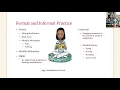
the other thing about mindfulness is that you don't want to judge so I don't want to judge this experience of walking my dog with other experiences of walking my dog I want to have a new Moment In Time and so this is a these are the basic concepts of mindfulness so in mindfulness we often talk about our formal practice and our informal practice our formal practice um is a time that we set aside to do some form of meditation and so you may be doing sitting meditation what we call body scan or mindful movement so
I want everybody and I can't see anybody so I don't know what's going on but I want everybody to um engage for a minute in sitting meditation and so I want you to think about somebody taking a string and pulling your head up and then I want you to drop your shoulders down so you should feel kind of like a release in your neck and all that energy and tension that sometimes you get in your neck it should just kind of be going away would both feet on the ground and then you can decide what
you want to do with your arms mine I have a chair that I have an arm rest so I'm just gonna put my arms right there um if you don't you can put your arms in your lap and then I want you to close your eyes so in meditation you have some kind of formal focal point and in mindful meditation it's your breath now we're not trying to do deep breathing we're just trying to notice our breath so every time your mind starts to wander you want to bring it back and just notice your breath
so as you do this you want to also engage all your senses so hearing I hear the air conditioner in my room right now probably should turn it on because it's a little chilly how do your feet feel against the floor how do your arms feel against the chair noting when your mind starts to wander back and forth and then pulling it back to the present you may know whether or not the air that's coming in to your nose is cold warm when you breathe in what happens in your neck in your chest your shoulders
so now that we feel very calm and this is usually how I feel um sometimes I have to and I'm coming back out of meditating I have to open my eyes very slowly before I open my eyes I might think about what the room's gonna look like sometimes when I've meditated for over 30 minutes I feel like I'm in some kind of altered state and so coming back to the room I have to kind of help myself remember what the room looks like before I open up my eyes so everybody should have their eyes open
now hopefully um feeling a little bit more calm so there's so there's sitting meditation and that's one that we just did um there's multiple different kinds of sitting meditation um there's what I call the mindful minute sometimes I do that right before I eat just take a moment relax look at the plight think about what I'm going to eat um I also love to engage in a meditation called Mountain and I also very very much love one that's called loving kindness Down Below on on my screen here you see that I'm recommending the app called
the mindfulness coach this is a free app that you can get at the App Store um it was made by the VA and you can download um probably around 20 different meditations and there's a timer to it and you can set it for as long as you would like if you're new to meditation I'd say try to go one to two minutes and then build up from there um because it takes a while for you to start to control your kind of wandering mind body scan is trying to understand what's going on in your body
and you may start with and again it's a meditation so you might start with your left foot and you're just thinking about your left foot all of your toes the bottom of your foot and you're just trying to describe how that small piece of your body feels at this moment is it cold is it hot is it wet um and then you just move up one leg then you go to the next leg you move up the next leg you move up through your torso through both arms your neck and then your head good body
scan takes anywhere between 30 and 45 minutes most of the time I fall asleep before I get to my neck and I move up to my head because I find it to be one of the most relaxing things and a lot of times I'll do it in bed um trying to get my wandering mind calm down so that I can sleep so that's the body skin and you're usually not moving so this is how your body feels when you're not moving then there's mindful movement which can include yoga um Tai Chi or mindful walking the
mindfulness coach app has some really great instructions on how to do mindful walking um but all of these kinds of things are helping you to be aware of how your body feels as you're moving in space and if you're really interested in a very long version of a of a very very good program there's mindfulness-based stress reduction and there are folks that um aren't qualified to teach this and it's an eight-week program and it there's extensive research to it um showing that it helps with a lot of different Health ailments so this is the formal
the informal is trying to pull yourself to um being kind of in the moment when you're doing certain things so this could be applied to eating to driving to shopping whatever kind of activity that you want to try to be more engaged in and when you do the formal type of meditation or when you when you engage in a formal practice it helps you kind of pull yourself into that moment much more quickly in the informal areas of practice so some of the benefits of using mindfulness-based stress reduction um it reduces stress feelings of well-being
or it improves feelings of well-being um negative emotions um it's been used extensively with hypertension anxiety um it's helped with Sleep Disorders there's a large number of studies being done using mindfulness-based stress stress reduction the eight week program and chronic pain management at the moment to see if it would help um also it's been used with substance abuse and for my area it's been used to try to help people with their um eating disorder and mindfulness-based stress reduction has been altered into a mindful eating program um and the first purpose for that was to help
people who had an eating disorder kind of get back and engage um with food rather than all of the cognitive um messaging that they would have about food but people have tried to use this with people who are just trying to lose weight and some people may gain weight usually those are what I call your high restrictors they have been doing very restrictive diets for a very long period of time they are so out of sync with what their body truly needs that when they do start to realize I'm hungry and I want to eat
um many times they'll start to gain just because they've been restricting and maybe restricting way past what would be an appropriate body weight for them um and then there are people who are really overweight who use it and find that they lose um my big note here is the number of hours that you spend in formal practice is highly correlated with greater changes in health in any of the health problems that are listed over there and I found that true um in terms of mindful eating as well so it's more of a holistic approach and
it's not about what you eat and I love that message eat whatever you want but um it's really more about how you eat and so it's about noticing when you're hungry noticing when you're full really taking notice of what you're eating as you're eating it um and then noticing how you're feeling as you're eating as well so the owl here is trying to get at your inner wisdom about what you should be eating and so there's a lot of reasons why we eat we see something then we decide that somehow that visual cue makes us
want to eat um we have lots of rules that we have about eating um many of us who have been dieters for many many years may have lots of different rules I have to eat at this time Etc um some people eat for emotional reasons or eat because they're stressed um but many times we're not eating for what I call stomach hunger and that grumbling in your stomach truly your body is hungry or you notice like your blood sugar is dropping or you notice that you're feeling um a little lightheaded those are kind of the
cues your biological cues that it's time to eat so your body has kind of like this inner wisdom kind of like a thermostat if you would like to think of it in this way um and it regulates your hunger and it regulates your fullness and so so in hunger as you get more hungry the signal gets a little bit more um stronger or it should um if you ignore that signal like a lot of people who diet do um you need to try to relearn what the signal feels like for you specifically and when I've
when I talk about this in um the group projects that we do in my lab I often find that people don't know what they're hunger signals are anymore they've ignored them for so long that they need to relearn them and then fullness is also something that we can think about in terms of a thermostat and both hunger and fullness we can easily override them by the cues that we have to eat so these are all the outer experiences that sometimes cause us to eat rather than the internal cue of hunger and satiety um so we
might Seafood want to eat it like Pavlov's dogs if you've taken a psychology class you know all about them um it might be that you're eating and you're eating in such a distracted way that you're overeating and you're not even realizing what you're eating or how much you're eating um it could be that your eating patterns have become so habitual that it's almost unconscious so you see the cue it's noon time to eat lunch don't know if I'm hungry or not but I do that or I'm driving past the McDonald's I see the golden arches
I think french fries and suddenly I'm in the drive-through and um many times highly palatable foods make us feel really good like foods that are high in fat and high in sugar they give us kind of like a little bit of like um a boost in what we call our neurotransmitters and that's enough to make us go oh we feel better or maybe my cue is I have no time so I stop at McDonald's and the next and the reward is I've saved some time so habits um are probably the most difficult thing to try
to change because you after a bit you don't realize that you are just going to the routine every time you see the queue an emotional eating is the same way I feel sad I eat now I feel Comfort um and next time I feel sad I eat I comfort myself with food so a lot of reasons that we eat that don't have anything to do with Hunger or satiety so my first mindful eating tip is we can think about um is to really get to know when we're hungry and get to know when we are
getting close to being feeling good or feeling satisfied so we don't we want to stay away from the red being very very hungry um when we're really really really really hungry that is when we really just don't have a lot of control in what we're eating and we lose the intentionality of what we're of what we're doing when we're eating so we may eat very fast because we're very very hungry and we didn't realize that awesome we've eaten a full plate of pasta when we really didn't we probably shouldn't have been eating that much so
we want to eat when we start to feel hungry so we want to understand what this feels like this kind of um a yellow version of The Hunger um and then we want to stop not when we're full I think in our language here we constantly are using the word full but what we really want to do is be feeling good or satisfied So Satisfied with the types of foods we ate the textures of the foods that we ate um the colors of the foods that we ate um the engagement that we had how it
made us feel we want to be in here we want to be satisfied and one way it takes a bit for your body to know and start to know when you're eating and start giving you that sign to stop so it can work so getting in touch with your body can work but you're going to have to eat very slowly in order to be able to do that so my next tip here is putting your utensils down a lot of people do not do this they go but french fries boom boom boom boom um put
your utensils down even though your utensils are your fingers stop for a minute look at what you're about to eat think about it then start eating if you're having a beverage that's high in calories enjoy it some people slurp beverages and if it's a cola that has 150 calories for 12 ounces that's a lot of calories that you can get in a very quick period um and you want to at least enjoy them if I mean if I'm having a milkshake I'm gonna really think about I mean that's 400 calories in a 12 ounce milkshake
I'm gonna sit there and really enjoy it I'm so sip them slowly and Savor them as well as savoring your food some point during a meal before you get to about halfway through your plate stop for a minute and think is this still emotionally satisfying am I starting to get full where am I so being very intentional about how much you're going to eat so my next thought is to eat like a chef and so I am a trained chef and I've gone to cooking school and so when they were training us they talked about
like the very best bite of food that you could have and they often talked also about really having a full understanding of what the plate looks like how things are arranged on the plate what's the smell of the food what's the taste of the food you see my little character tasting it to see if it's just right um before it's being served so in mindful eating and I have so this is where I've asked you to bring your items so in mindful eating um we do this eating with awareness activity so the first thing I
want you to do is whatever you've brought we're going to see what Miranda has brought I have a cherry tomato and so the first thing that I want to do is I want to focus on it and I want to describe it it's red it's round it's hard on the outside my next thought here is I want to think about expectations how do I think it's going to taste um and I want to discard any expectations that I've had about cherry tomatoes previously I've been eating them out of my garden all summer but these I
bought in the grocery store so I want to just have a moment where I'm not thinking about all those cherry tomatoes that I've eaten previously but now I'm going to eat this cherry tomato and if you think I don't like cherry tomatoes when I do this activity in person with folks a lot of people will be like no I do not like that food that you're about to make me eat and I'm like well that's a previous experience with the food this is a new experience with the food and so the first thing I'm going
to do is I'm going to put it to my lips but I'm not going to eat it and I want to describe the texture of the item is it okay to chat about this of course okay so in the chat we might want to talk about what we're trying to eat and how does it feel when it comes up against your lips I brought some raisins for my dried fruit so uh this one's always done with raisins and I don't I just had it in my pantry this morning before I left the house and I
was like I can use these I'm not seeing anything in the chat so yeah um somebody has a dried pineapple dried mango sounds good okay so if I'm putting cherries so if I'm putting like a raisin up against my lips how does it feel kind of rough so rough would be mine is very smooth the cherry tomato is very very smooth I just got it out of the ice box so it's cold as well somebody said dance or room temp okay um the next thing you want to do is smell it I don't think I'll
have a smell so I have absolutely no smell coming from the cherry tomato how about others any smell um so let's see um somebody who had the pineapple says it doesn't smell like a pineapple at all okay let's see what this person banana chips but it doesn't smells just like a banana Olive that's smooth okay so do you want to smell it now the next thing is if it's something that you can put in your mouth fully put it in your mouth and begin to understand the taste of it don't you yet begin to understand
the taste of it note how it tastes and then note how it tastes when you start chewing it so if you haven't started chewing yet start chewing and then the last thing before you swallow it notice how it tastes as it's going down and you can notice the taste you can notice the texture how is your raisin Miranda I didn't taste anything until I started chewing it true but had a like a very funky texture in your mouth definitely it's not something I normally eat so it was different and until you started chewing it you
just didn't really realize how sweet it was how about our pineapple eater and our Olive eater let's see one said sweet mild chewing sharper almost citrusy um somebody said soft crunchy um tastes more like candy than pineapple but the texture is Gummy sweet condensed flavor loves olives I anticipated good okay now I also asked you to bring some kind of processed food got a cracker okay so Miranda's got a cracker what do other folks have Wheat Thins Chex Mix crackers a biscuit okay so let's do the same thing again where we bring it to our
lips and we think about just how it feels up against our lip [Music] soft it feels salty to you salty yeah soft almost fluffy rough okay reading comments okay and now that chat's really going well I feel like I'm interacting with the audience that I can't see [Laughter] um somebody said sweet and rough smoother than I expected okay the next thing you want to do is smell it hmm so what does it smell like almost like like a bread like a like a bread factory I guess cinnamon RC okay so now for this one if
it's something that can be done like this I want to take a bite and let it sit in your mouth and dissolve and think about how it tastes at the beginning how it tastes in the middle and how it tastes going down but let it dissolve a little bit and then tell me a little bit about how um how this might be different how the taste of the beginning is different than the taste at the end it tastes definitely like went away like after it started dissolving there's no taste um feels like dough or flower
in the middle as compared to the initial sweet feeling stronger taste at the beginning got smoother at the end tastes faded over time salty in the beginning very little taste at the end okay and that is typical for processed foods because they want to engage your tongue really quickly and um hope you swallow before you notice that that food really didn't have any taste outside of um some of the preservatives that were put on it some of the salt that was put in it some of the sugar that was put on it um Etc foreign
hopefully you the manufacturer these of these types of things chips and cookies and things like that are hoping you're not noticing how the food tastes um you're just putting them in in a in a Mindless way so the moment you start really truly noticing a lot about how your food tastes many times you're drawn to more you're drawn to foods that are more fresh I tend to find that um and the things that are less that are more processed you start to get turned off by it so the longer you do this and practice mindful
eating you may see kind of a change in the kinds of things that you liked and the things that you don't like I got a couple of interestings in the chat from that oh okay and eating like a chef also um there are different kinds of flavors in Foods sweet salty sour bitter and something called Umami which is kind of the meaty flavor like a meaty flavor of mushroom or tomato paste or beef stock um and your tongue measures all of these different flavors as well and so um you may also want to think about
taste satisfaction so if you can't steal how full you are before you stop there's a point at which your taste buds that are tasting sweet get tired and they stop tasting so if you can think about like a great food that you've eaten like say your best steak dinner in a nice restaurant that first bite was just like you're hungry and that first bite is delicious the second bite still delicious third fourth fifth it starts to get if you're really really thinking about it and you're really noticing there comes a point where that satisfaction that
you have from that bite kind of goes away and that's because the flavor meter is going down your taste buds they were all excited about getting a chance to eat the food and now that they're eating they're a little bit less excited and so this is another way of saying I'm not really enjoying this as much as I had been at the beginning maybe this is my place where I'm slowing down or maybe this is my place where I put this away um which can help folks who will like want to have a chip want
to have a chip want to have a chip this is all you can think you know sometimes you get like a idea in your head of something that you want to eat and if you eat it slowly and you really think about eating it after a couple of chips you're not going to want to have another chip because you're really done with that flavor here's my next tip if I live in a in a house of cookies I will eat cookies so what is my environment look like and how am I shaping my food environment
to shape the cues that I have around food and so if I build a butter food environment that I may not eat as much of those items or if I just put those Foods away into the cabinets I won't keep walking past them and be queued again and again and this will help me eat when I'm hungry and stop when I'm satisfied and then eating in terms of emotions and stress so I showed you the little cue and then I have a routine that I do when I have that cue and then I feel better
so what I need to do is when I have the cue of having a bad day um having a stressful day I change my routine and I make it something that's satisfying that does not have to do with food so maybe I'm tense I'm stressed instead I meditate for five minutes now I feel better so instead of using food as my coping mechanism for my stress-related eating or my emotional eating I am using um something else beside food so taking a walk meditating sitting down to read a book for a few minutes doing something with
your kids like going to the park and having some kind something that is enjoyable that pulls your stress levels down but doesn't have to do with food so what does the science say about mindful eating um lots of Studies have been done so far and I am one of those people who are doing some of those studies um that it really does help in terms of making impulsive food choices so when you're trying to be more I mean it makes sense when you're trying to be more intentional of course it's gonna it's gonna have something
to do with how impulsive reducing your impulsive food choices um some people have found that it helps um rid them of a lot of their dieting rules and they have more control again with what they're eating and some people find that it helps in terms of their confidence and making better choices in our studies we found that people who mindfully eat consume a lot less consume around 200 calories less per day um then what they were consuming before they started our program and um for men it seems to work a whole lot better for men
than it does for women um not sure how that happens um in a lot of weight control studies that is that always happens that men do better than the women um and it's helped with blood sugar control and a lot of people think that um people with diabetes sometimes when they're very stressed their blood sugars go up and so some people who've done the mindful eating with the meditation who have diabetes have found that they didn't change their diet in any way but the meditation actually did help to lower their stress levels and therefore their
blood sugar it's not something that you do to try to lose weight for the wedding on Saturday um it's something that you do to really focus in on changing behaviors that you probably never noticed such as how fast you eat or that you eat and you don't notice what you're doing when you're eating or that you're eating in a paired activity with something that you know you're eating at your computer while you're working um it's becoming just more intentional the interesting thing about the weight control studies that have been done in mindful eating is that
when people finish the eight week program they usually continue if they continue to engage in the behaviors they typically continue to lose weight where in your traditional diet like low carb low fat um diet studies that have been done when people discontinue the program they usually kind of start to drift back to the normal way that they had been eating previously and they start to gain back so kind of a little bit of difference between the two so my current research I have something that I call Project me which is the mindful eating and exercise
program um we are now trying to take that program and we are trying to do something where we look at whether or not it can be taught um the project made project that we've been doing has been in group and I really enjoy sitting with the group and actually seeing and interacting with the group we want to try to do that by teleconferencing and see if it works in the same way as it would in person so that's a new study that we're going to start in January so if you want to be involved in
that study um shoot me an email and um I'll let you know when we're about to start recruiting and and we can go from there we're doing a study called the snack study and this one is one where we're trying to um figure out what kind of messages people need by text and then my last study is I'm also training Healthcare Professionals in the use of mindful eating and how they can use it with their patients so I hope you enjoyed this it's very good uh do I have any questions before we close up that
was very good oh thank you I love that you're um working with Healthcare Professionals for mindful eating too that's very good yeah we'll be um yeah we I have some funding to do that and we'll be doing our first kind of pilot education um coming up in November I'll let you know Miranda if you want to come yeah um is there a way we can make the PowerPoint available if you I can email it to everyone if that's okay with you sure okay we can email that out to everybody who attended and stop