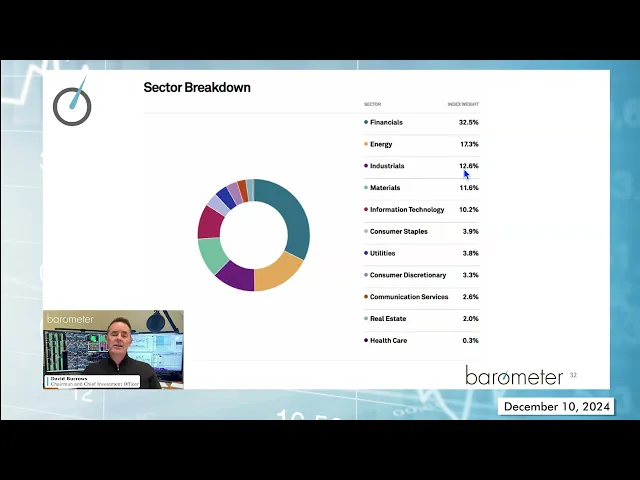
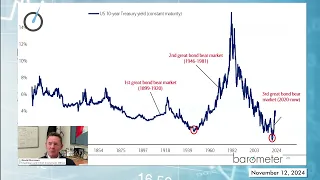
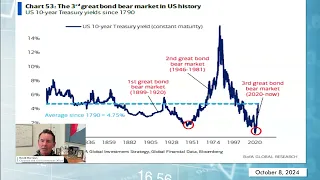
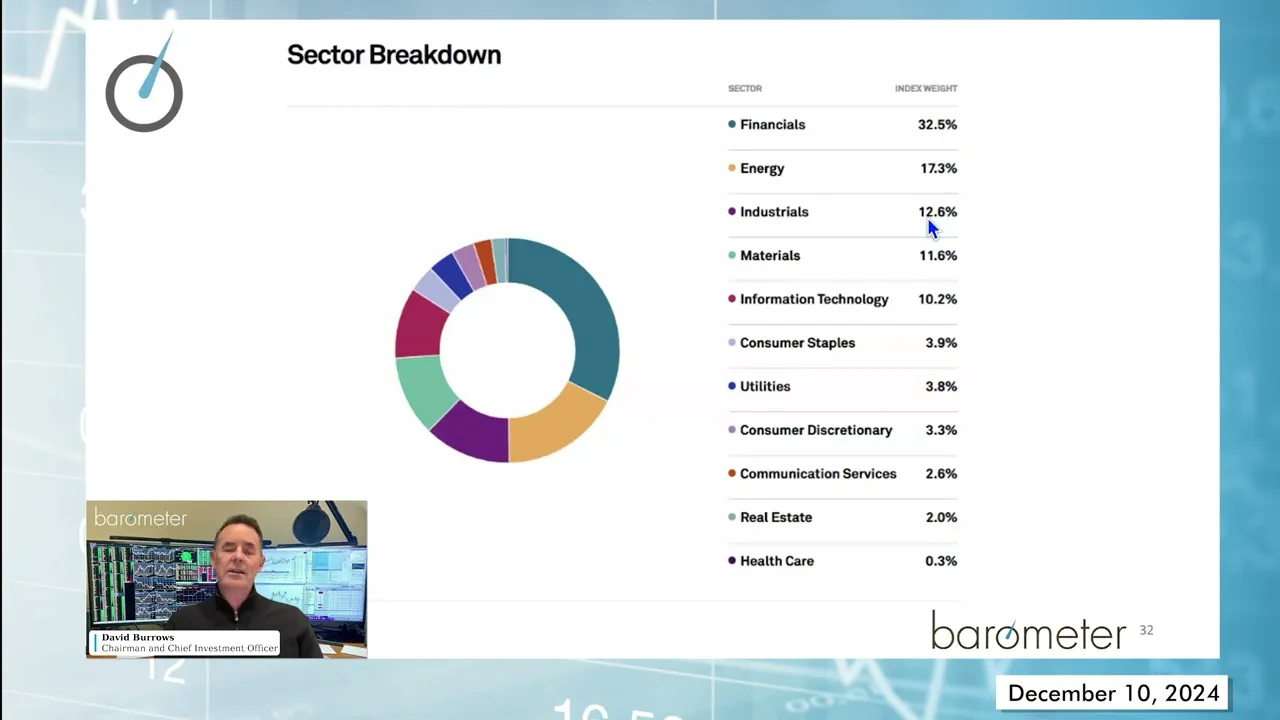
[Music] hey folks welcome to the barometer Capital Management barometer readings webcast is Tuesday uh December the 10th my brother-in-law's 60th birthday so uh we're going to be a little bit quick today uh I promised to surprise at a party at at 4:30 EST so so we'll move fairly fast um so I want to thank Emma Josie for jumping in today we're going to talk a little bit about the Canadian Bank earnings over the past week finances are a big weight for us and have been all year long so I won really want to make make sure we touch on that um but just from the top as as we've talked about for some time now we're in a long-term structural bow Market that started when we exited this sideways period from 2000 to 2013 and along the way we've had some interruptions the most recent one came to an end in January of this year where we exceeded the highs from December of 21 and we're now into our 12th month working our way higher and while it's been a great 12 months very often it can be three to five years before we get to the next significant correction uh we'll have to wait and see but as we've been moving along here markets have been broadening out been pretty healthy the S&P made its low in 2020 to October and again with fits and starts has been moving its way higher and in the past week we did make another all-time high and we did same for the NASDAQ 100 which is which is certainly notable um now when we came into December because November was a very strong month up over 5% there was a lot of stock for sale uh generally when you have a month where equities have done as well as they have there's some rebalancing to do in Pension funds so we've been working our way through about 50 billion dollars worth of equity for sale and frankly you know the markets absorbed it pretty well a lot of it has come in some of the very high momentum stocks so we've seen little pullback sort of across the board uh but again uh the the market has continued to be pretty friendly uh if we look at the advanced decline line cumulative Advanced decline line for the nysse it continues to show a very broad Market uh and we've seen that in our bread indicators as well we move outside the US you know know the Niki after consolidating here for about 10 months is starting to move up and out of that consolidation which is relevant uh India which had pulled back to the 50 uh 50 week moving average or 200 day uh held and has been working its way back higher again and we've seen strength in a bunch of countries now the reason that we talk about global stocks over the last a while when most of us all have our money here in North America is it's relevant when we look at valuation so if you take a look at the msci all World xus index it's about 895 companies we can see when we compare it to the msci US index on a bunch of measures it's it's much less expensive now arguably you know there are some World beater companies in the US that you just can't replicate outside but the differential between the two in valuation is significant whereas the PE on a trailing basis is about 15 times globally close to 30 times in the US uh if we look at versus the average fiveyear uh at 18 times versus the T the S&P at 35 times if we look at price to cash flow at 9. 9 times versus 20 times you can see a bunch of these measures are basically doubles or more Price to Book at 1. 92 times versus The Price to Book uh in the NY in the msci US index at five times Price to Book so uh we watch this because it's really important to catch structural shifts and to be able to diversify and while the US was the only game in town for a long time there have been lots of interesting opportunities you know we launched our Global Equity Fund a year ago uh it's up close to 30% over the course of the year uh and this is a completely different list of companies than what we're seeing in our North American portfolios so really happy with that so you know whether it's Taiwan or whether it's Argentina um there's there's things going on in other parts of the world that we want to sit up and take notice of and especially when the lagging Market the Chinese market uh has just recently reversed its long-term downtrend and we now have 90% of the 2200 companies in that index above their 200 day moving average so that's a big shift um and I think is notable certainly you know it went straight up off the initial stimulus this week we got no more news under the poit bureau talking about um a shift to an easy monetary stance in 20125 that's a big change you know they've had a tight monetary stance since 2013 worried about inflation that's 11 years and again we always say you don't fight the fed or you don't fight central banks liquidity makes a big difference in markets now in our Global fund we're close to 30% in China and that's relatively new over the last 3 months and we've had a lot of folks say are you sure you want to have that kind of exposure there and listen I I see all of the problems just like I saw the problems in the US Stock Market in 2009 But ultimately at some point you get a clearing event and it can change the calculus so it's not for us to say that the market is wrong um there are in that Universe of companies some very good companies and certainly as a diversifi fire it doesn't hurt to have some exposure so I recognize it's a lightning rod uh but when you started with the US market breaking out to new highs in 2013 and one by one markets joining the rally and now the lagard of the bunch uh getting a little bit better it's significant and not bearish for equities it's important to note even the TSX Composite Index the Canadian stock market after a long period of underperformance is performing really well in fact they were performing the S&P since July that has something to do with the sector exposures in the Canadian Market frankly in global markets relative to the us when we look at the Canadian Market 32% of the index is financials 177% energy 12% Industrials 11% materials that's a completely different makeup than what you see in the US which is dominated by technology at 30% uh consumer discretionary in healthcare which is almost non-existent uh in our home market so um when you get these sector moves it's relevant it's important to recognize the change is can go on for a long time and so it's something that we certainly want to track just like we wanted to track the shift in interest rates that took place now almost four years ago in 2020 and since then we've been seeing the 10-year treasury bond in the fiveyear and the 30-year marked their way higher uh in yields as we moved into a more inflationary world and so so for uh investors in disinflation during falling rates the great hedge is fixed income fixed income and a world of falling falling rates on the other hand when you move into a world of more inflationary assets a different type of asset does well now arguably CPI has come down here over the last few months we're going to get CPI data in the US tomorrow and PPI on Thursday it's important to note that historically when you got into an inflationary cycle after a sort of den Mall you had a second wave and so it's something that's relevant the expectation is that inflation will come in year-over-year at about 3.
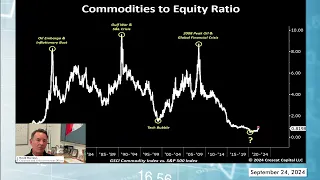
3% over the last few weeks globally a number of inflation data points have come in a little more sticky than people had hoped for uh and we talked last week about the fact that often once you eventually break out of a range when you do come back you test the top of the range and here at 3. 3% the expectations are now ticking a little higher so just as we talked about last week inflation has pulled back but basically to the top end of the range it was in for several years something to keep an eye on so when we look at this what does this tell us that the greater risk to investors is inflation eats your money and if that's the case we have to be cognizant of what it is that Hedges against those risks so certainly stocks versus bonds has been outperforming S&P versus long-term treasury bond steady March higher right companies have the ability to set price if they're the right companies and dividend growth has outperformed bonds as well and frankly dividend growth has outperformed high dividend stocks which act a lot like like like the bond market but the other way to hedge is with harder assets and this is the index of Commodities and it had a first move higher starting in 2020 we went through a tightening cycle which frankly didn't move commodity prices down very much and you can see all of the moving averages have turned and are now working their way higher and over the last four months 1 two 3 4 they're starting to March their way higher again so this is probably an indication of what we should expect commodity prices firming that sort of goes along with a more inflationary environment and certainly one we want to take take take note of now in the S&P materials are three and a half% of the S&P and energy is about 4% so why do we care because it has historically become much a bigger part of the index as a commodity cycle goes on you know energy has been up between 15 in 20% of the index historically so it's something that we want to keep an eye on now gold is the obvious one after this long bear Market it broke out and it's been just marging its way higher as one of the very best performing assets on the year had a little pull back in the month of November now firming back up in December silver similarly after breaking out pulled back into this breakout point and now working its way higher again so these are I think important things to keep our eyes on so we compared stocks to bonds stocks is our preference We compare Commodities the usci Commodities index to the bond aggregate aggregate Bond index again very clearly you know Commodities out performing so why this week were they a little stronger well first the Chinese announced looser monetary policy the first time since 2013 uh in the gold market China resumed its Central Bank purchases of gold for their for their foreign Reser NES uh and of course there has been some geopolitical change in the Middle East in in Syria and I won't try and analyze that other than to say probably the Middle East is more unstable today than it was a week ago uh and we're likely to see change and so certainly for people in that region there would be a reason to want to own an asset like gold so look we don't have to be everywhere and I I say this every week our job is to try to identify opportunities and the key themes that are leading the market and these themes change you know we have to be aware that what has been working doesn't necessarily continue to work so we got to watch for Shi watch for shifts and in the absence of leadership have a willingness to play defense no you know as it is right now we've been pretty fully invested and we come at it top down looking for the sectors and themes that are benefiting in the current economic backdrop and it's not everywhere but we want to identify leadership and then we want to find Securities from the broad Universe of public Securities that meet our tests and help us express our view we're looking for uh investment opportunities in areas well where breadth is expanding where over time more and more Securities are participating so good that the US was performing well better that more markets are performing well it means Equity asset class is healthy and when we see deterioration in bread they cause to be more cautious so in these areas that are leadership we want to find the companies that are good getting better companies that have strong fundamental characteristics that aren't just getting better but accelerating second derivative change in the rate of change and where prices support the view where prices are doing what we would hope they are doing given our positive view so technically sound and fundamentally sound and we can find Securities and parts of the market that meet our tests well that's where our portfolio should live and then finally when we do see negative change that causes us to start stepping away from a group okay so let's just talk uh from a broad base uh last week we had a bunch of short-term indicators that were negative um as we sit today oh didn't come up uh as we sit today our percent of stocks trading above the 50-day moving average percent of stocks with positive weekly momentum have turned back positive so we now have four short-term indicators in in the US that are positive all of the long-term indicators are positive and we are into a month where there's a little bit less liquidity a little bit less going on for a lot of people the year is almost done uh so we just want to watch for big changes so without getting too granular financials continue to March along they had a big month in November they pulled back a couple of percent over the course of this month we're going to talk this week about what's happened in Canada because we do have a sizable Bank weight in our Canadian portfolios uh and this is the ZB which is an equally weighted basket of banks in Canada now Canada's unusual Marketplace five big Banks dominate the landscape and they're all different I've asked AMT Joi to come on today to talk through a little bit some of the data that came out over the course of the earnings period because you can see that performance varied TD Bank on the Bott bottom end CIBC on the top end and a mixture in between so EMT maybe you can just give us some high level thoughts on who was winning and who was losing uh and some of the things that we're looking at sure definitely thanks Dave um you know just to highlight and kind of bring it back to the comment that you made when we're looking at companies to invest in we're looking at good companies that are getting better and that's the same lens that we've looked at the Canadian Banks throughout the course of the year um within our uh our focus of the banks that we own that have a more domestic um exposure so Banks like CIBC Royal Bank and National Bank all three of these banks have been the El performers consider uh as compared to their Canadian peers um and have been you know right in that theme of good banks that are getting better Royal Bank is is is the most Diversified of of the Canadian Banks uh as per all the different business lines that they operate in and usually a number one or number two market share leader in all those business lines CABC is uh the most domestically focused Bank um has some us presence but not as much as their um as their Canadian exposure and they have been turning that business around and and same with National Bank and both National Bank and Royal Bank have actually been doubling down in the domestic market and have both made Acquisitions in Canada uh to further their strength in those markets when we look at the quarter itself um I think it's interesting to see the domestically focused Banks such as Commerce uh Royal and National Bank were the only three that actually beat um consensus estimates on earnings per share whereas Scotia Bank and uh and TD uh all missed on that uh metric so that's something that we're proud of uh from our fundamental work you know we've tried to avoid um the specific banks that have company specific issues uh be it their exposure in the US uh with with credit issues or underwriting issues or TD with their AML issues so we feel pretty good about that we've got a good read through uh in terms of capital levels for the banks over the quarter and all of them look great and uh the metric of operating leverage which is something we like to see although we saw that tick up higher for the quarter for CIBC National Royal this is them reinvesting into the business after being very strong in terms of expense management over the course of the year so seeing them kind of drive that a bit higher in terms of marketing spend or compensation is is not too surprising um and you know I'd point to that last column there just the premium or discount to historical uh metrics um you know this is right bang on in terms of good getting better these Banks warrant a higher valuation for their execution for the Excellence that they've shown over the course of the year um and we don't shy away from owning that and uh you know usually when there is a bank that's trading at a large discount to its uh its historical average there's some underlying issues there and um you know for us the focus has been sticking to the banks that are working and uh focused on their domestic markets and have been uh showing some excellence in terms of their operations and and management I always find it interesting that you know the leading companies in an industry have easier time hiring the best employees they have an easier time raising Capital they have an easier time remaining leader and while I know that Scotia is going through some significant machinations to change some of their operating models and it may well be successful it's still an unknown and certainly TD is is is at a point where you know it's it's it's really having difficulty and you see it in the share price I mean um after after Ernie's release you know Royal going and trading at a new absolute and relative new high Commerce doing the exact same thing and I compare that to TD and I've been asked a number of times when is it time to buy TD I have to be honest that is not our expertise but we are never going to try and step in front of pickup times in front of a bulldozer trying to figure out where the where the turn is so um some really Stark differential between them thanks very much for jumping on AMT I I really appreciate it today no problem at all thank you um moving on uh you know we've had great uh a performance in Industrials all through the year you can see over the last few days we've been pulling back and testing these Rising 50 day moving average and we're seeing that as we've been seeing some of that pension fund rebalancing uh if you look at the longer term picture you know this is just working its way higher after coming out of several years of sideways trading uh and uh and you know lots of great companies in there internally the percent of stocks trading in uptrends is almost 90% so we will always watch to see some sign that there is deterioration but certainly stocks pull back within Trend materials same thing been sort of trading sideways although I do think it's important that the metals and Mining uh ETF broke out to a new alltime high in the month of November and as often you do you pull back and test that breakout point I think that's quite favorable we seen a really nice bounce after pull back in the golds ago trading right back to the highs uh camoo pulled back a little off the highs but again these are these are big changes from the world that they've been living in and so we want to recognize those changes put positions on in the strongest stocks Within These groups and be there because we move forward pretty soon it's 2025 then it's 2026 and if we're in an inflationary environment these things do well we talked last week about the fact that the copper stocks had pulled back to an important area of support uh at this Rising 50 we moving average so far they've held nicely and bounced off it they certainly had bit of a positive response to the Chinese news as well uh and the energy producers you know the big longli energy producers continue to perform well there are some us producers that are having a harder time because frankly the the growth in their production is not as strong and the asset life is not as long um we like what's happening in companies like Imperial oil these are monthly bars just merging their way higher we're getting great dividends great dividend growth over 20% dividend growth and we think that that will fuel us going forward and that's a great hedge against inflation seasonally as we've talked about early December is when you get a seasonal bottom and then generally January February March April May June it's very strong for the for the for energy so uh we like our positioning there consumer sorry um Communications Communications over the last couple of months there's two groups that have stood out of the last couple of months that have really gained some traction communication services and that's really you know meta in particular uh but meta alphabet and Netflix certainly acting better and the consumer discretionary group now we've talked about three weeks in a row really is on a bit of a tear just to put it in perspective if we take the equally weighted consumer discretionary sector taking out the impact of the biggest companies the obvious ones Amazon and Tesla you can see that consumer discretionary relative to the S&P 500 over the last month has broken its downtrend relative to the S&P so we always talk about recognizing change and so over the last week we've been adding selectively uh We've added some Amazon we probably got more to go uh but Amazon really standing out if we look at consumer discretionary the percent of stocks and uptrends it's over 75% and if you look at Amazon versus the S&P it's making a new relative High versus the S&P as is Tesla making a new relative High versus the S&P so our our companies Costco lbls Dollarama continue to perform really well but it is clear that Amazon is a major winner when we look at the traffic numbers that came out of black mon Black Friday uh obviously and Cyber Monday very very strong uh and we think that Amazon's going to be a big winner in the holiday season so in simple terms consumer discretionary equally weighted is making a new all-time high and relative to Consumer Staples offense versus defense making new relative High speaks well to the economy uh and to the consumer things that aren't doing so well Consumer Staples continue to relatively underperform uh healthc care continues to relatively underperform not much to do there Reit pretty defensive but not much to do there low volum volatility or high dividend stocks in general underperforming so there are halves and have knots in this market technology continues to relatively underperform and has since June if I look at the semiconductor index and I know I've talked about this a bit but I am a little worried about this group it's a leading group in the market uh and is now trading below all of the moving averages today was down about 2. 5% making a relative new low vers of the market Market it's an important part of the index it's one of the reasons we don't really believe in owning the market cap weighted indices because there are some lot of stocks in there that are big weights that that may not be ones we want to own I think you might find this interesting if I compare the semiconductor index uh to the Canadian large cap energy index and here we're going back to 2014 long out performance by semiconductors there was a a period in 200 21 where energy got going we went through the tightening cycle semiconductors came back but here we are breaking to the downside semis versus energy so frankly this is why we have more energy weight than we do technology weight so when we put this stuff together and we look at the sector exposures we can see that on our distribution curve it continues to be that the broadest strongest sectors in the market continue to be dominated by financials and and Industrials on the other end of the spectrum we're seeing healthc care continue to be very weak we've seen some improvement in consumer so Leisure for instance has moved higher um and then a lot of sectors sort of stacked here in the middle but breadth for the week was down about 3 of 1% of the average sector just below 50% of stocks and uptrends 49.