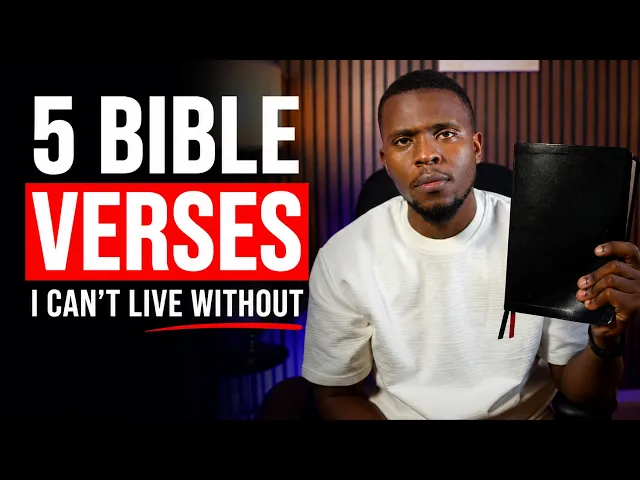
Welcome to another episode. Today, I want to share five Bible verses that have fueled my faith. [music] Some of them have completely changed the way I pray.
Some have changed the way I wait. Others have changed the [music] way I look at delays, disappointment, and seasons that seem barren in my life. And my prayer is that before the end of this video, one of these verses becomes your verse, the one God uses to carry you into your next season.
So, maybe grab your Bible, grab your notebook, and let's begin [music] with one of the most overlooked Bible verses. It is found in the book that many people only return when they need encouragement. Job chapter 14, verses 7 to 8.
The Bible says, "For there is hope of a tree, if it be cut down, that it will sprout again, and that the tender branch thereof will not cease. Though the root thereof works old in the earth, and the stock thereof die in the ground, yet through the scent of water, it will bud and bring forth bows like a plant. " I want you to notice how hopeless this picture is.
This is not a healthy tree. It has been cut down. Its roots are old.
Its stump is buried in the ground. If you walked past it, it would probably conclude it is over. It is dead.
Nothing good can come from this. But then, comes one of the most beautiful phrases in the entire Bible. Through the scent of water.
Now, notice, not the touch of water, not a flood, not heavy rain, just the scent. That phrase has stayed with me for years because it tells me something about God. Sometimes what looks dead is not actually dead.
It is just too far from the water. Think about that. The tree does not come back because someone glued the branches together.
It does not recover because people encouraged it. It revives because it got close enough to the source of life. And sometimes God does not immediately change your situation or your circumstances.
He just changes your proximity because proximity changes possibility. The stump does not need a miracle first. It needs to get near the water.
I wonder how many dreams we have buried too early. How many prayers we have stopped praying. How many promises we have concluded that [music] they are finished when heaven is saying, "Bring them close, closer to my presence, closer to my word, closer to my voice.
" Because there are some things that don't need another strategy. They need another encounter with God. The verse does not say the tree produced fruit immediately.
It says it will bud. Do you know what a bud is? It is evidence that life has returned.
Before the harvest arrives, sometimes we are praying for the fruit while God is celebrating the bud. The bud b u d, you know, you're looking for the finished miracle. God is pointing to the first sign of life.
Maybe your prayer life has started again. That's a bud. Maybe your passion for God's word is returning.
That's a bud. Maybe hope has come back after months of discouragement. That is a bud.
Don't despise small signs of life. They are often the first evidence that resurrection has already begun. Here's what this verse has taught me.
A stump near the water has more hope than a flourishing tree that has drifted away from the source. Your future is not determined by how badly you've been cut. It is determined by how close you stay to Christ because the presence of God has a fragrance.
And sometimes the scent of his presence is enough to awaken what you thought was dead. That is why this verse fuels my faith. Whenever something in my life feels beyond recovery, I don't immediately ask, "How can I fix this?
" I ask, "How can I get closer to Jesus at this moment? " Because I've learned something. Resurrection begins with proximity.
And if a dead stump can live again >> [music] >> through the scent of water as we read in Job, then there is hope for every area of your life that you have been tempted to give up on. Please, don't spend all your energy trying to resurrect what is dead. Spend energy getting closer to the river.
Life always flows from the source. Now, the second one is Haggai chapter 2 verse 19. I constantly return to this, and it is found in the shortest book in the Bible.
Yet, every time I read it, my faith grows. Listen carefully to what Haggai 2 verse 19 says. Is the seed yet in the barn?
Yeah, as yet the vine and the fig tree and the pomegranate and the olive tree have not brought forth. From this day will I bless you. I want you to notice something remarkable.
God asks a question before he makes a promise. Is the seed yet in the barn? Then he keeps going.
Has the vine produced anything? No. Has the fig tree produced anything?
No. Has the pomegranate produced anything? No.
Has the olive tree produced anything? No. In other words, there is no visible evidence that anything has changed.
The branches are still empty. The fields still look barren. Nothing around them suggests that a blessing has begun.
Yet, God says, "From this day I will bless you. " Did you catch that? God dates the blessing before nature shows the evidence.
God's calendar is often ahead of your circumstances. Heaven announces what earth has not yet revealed. And sometimes we are waiting to see something before we believe God is working.
God says, "I have already started. You just can't see it yet. " That is why this verse fuels my faith because there have been seasons in my life where I looked around and saw no opportunities, no increase, no visible breakthrough.
Everything looked exactly the same. But this verse reminds me that God can begin season without immediately changing the scene. That is very encouraging.
The blessing often begins in the invisible before it appears in the visible. God does not bless because he sees fruit. Fruit appears because he has blessed.
We often reverse the order. We think, "When I see the increase, then I will know God has blessed me. " God says, "No.
My blessing is what produces the increase. " That's why faith is so important. Faith allows you to agree with God before your eyes verify And then I noticed something in the scripture.
God says, "From this day, not next year, not when everything improves, not when the economy changes. " He attaches his promise to a day. There are moments in scripture where God marks time.
Noah had one. Abraham had one. Israel had one.
The disciples had one at Pentecost. There are days that divide your life into before and after. From this day.
So never judge God's activity by today's appearance. Judge it by his promise. Judge it by his covenant.
Because your field may still look empty while heaven has already declared from this day. And perhaps the greatest lesson this verse has taught us today is that do not let your eyes cancel what God has already spoken. Because if you only believe what you can see, you will miss what God has already begun.
That is why I can look at an empty field and still have hope. Because I serve a God who blesses before the evidence arrives. The third one is in Psalm chapter 84 verse 5 to 6.
This helps me look at difficult seasons in a different way. Look at what the Bible says. Blessed is the man in whose heart are the ways of them who passing through the valley of Baca make it a well.
The rain also filleth the pools. They go from strength to strength. Every one of them in Zion appeareth before God.
This Psalm is talking about pilgrims traveling to Jerusalem to worship God. On the journey, they had to pass through a place called Baca and many scholars understand Baca to mean a place of weeping, a dry place associated with tears. Now, here is what amazed me in this verse.
The Psalm does not say God removed the valley. It does not say God gave them another route. He says, "Passing through the valley of Baca.
" In other words, the valley was part of the journey. Every believer will have a Baca. This is a season of tears, a season of questions, a season where nothing seems to make sense.
But here's the part that transformed my thinking. The Psalm says, "They make it a well. " Think about that.
The valley did not come with a well. They dug one. Faith does not just survive difficult places.
Faith leaves something valuable behind them. Most people enter painful seasons asking, "Lord, how do I get out? " But the Psalm asks a different question.
What can I build while I am here? That's a completely different mindset. Think about Joseph, right?
The prison became a classroom. Out of the prison, he was even favored and promoted. Think about David in the wilderness.
It became a place where he learned to trust in God. Think about Paul. The prison became the place where some of the New Testament letters were written.
They did not waste their valleys. They built wells. Then the verse says something remarkable.
The rain filled with the pools. Notice the order. They dug first.
God filled afterward. Heaven responded to prepared places. The rain did not create the well.
The rain filled what someone had already dug. So, God often fills what faith prepares. Sometimes we are praying for rain while refusing to dig.
We ask God for wisdom but never open the Bible. We ask him to grow our ministry but never prepare ourselves. We ask him for opportunities but never develop the character to sustain them.
The rain is God's responsibility. The well is your responsibility. The Bible says, "They go from strength to strength.
" That verse has always challenged me. I would have expected it to say, "They go from weakness to strength. " Because they're in the valley, right?
But it does not. It says, "They go from strength to strength. " Why?
Because every valley they walked through became another place where God strengthened them. They did not leave weaker. They left stronger.
Every difficult season became another level of maturity for a believer. Not every battle is sent to stop you. Some are permitted to strengthen [music] you.
The valley was never their destination. It was God's gymnasium. One of my favorite thoughts from this passage is that imagine another group of pilgrims coming through Baca months later.
They arrive tired, thirsty, discouraged. Then they find a well. They drink from something they did not dig.
Someone else's painful season became their provision. That challenges [music] me. That the greatest testimony is not just surviving your valley.
It's leaving something behind that refreshes the people coming [music] after you. Maybe your prayers today will strengthen your children tomorrow. Maybe your faithfulness in these difficult seasons >> [music] >> will become someone's encouragement years from now.
Maybe the tears you are [music] shedding today are digging wells your family will drink from for generations. That is why I don't want to waste my bucket. If I have to walk through it, I want to leave a well behind.
The fourth one is in 1 Kings chapter 18 verse 41 to 44. The fourth scripture that continually strengthens my faith. I hope you are being strengthened as we continue sharing.
1 Kings 18 41 to 44. And Elijah said unto Ahab, "Get thee up, eat and drink, for there is a sound of abundance of rain. " So Ahab went up, eat and drink.
And Elijah went up to the top of the camel, and he cast himself down upon the earth, and put his face between his knees, and said to his servant, "Go up now, look toward the sea. " And he went up, and looked, and said, "There is nothing. " And he said, "Go again seven times.
" And it came to pass at that time the seventh time that he said, "Behold, there arises a little cloud out of the sea like a man's hand. " This story amazes me every time I read it. Do you notice the order?
Elijah says, "I hear the sound of rain. " But there was no rain. There was not even a cloud.
The sky was completely clear. Yet Elijah had something nobody else could hear. That teaches me something about faith.
Faith has ears before it has eyes. Sometimes God lets you hear the promise long before you see the evidence. And most of us want to see first, and then we believe.
But faith often hears first and waits for the eyes to catch up. And here's the part that I changed the way I pray. If Elijah already had the rain, why did he keep praying?
Why did he bow down? Why send the servant seven times? Why shouldn't the revelation been enough?
No, because hearing the promise does not eliminate the need for perseverance. It strengthened it. Revelation is not a substitute for prayer.
Revelation gives prayer direction. And some people stopped praying because they believe God has spoken. Elijah teaches us the opposite.
When God speak, that's when you pray with even greater confidence. Notice what the servant says. The first time, there is nothing.
Second time, there is nothing. Even the third time, the servant says, "There is nothing. " He goes all the way to the sixth, nothing.
Can you imagine being Elijah? Six times the report contradicted what he already had. Yet he never changed his confession.
He did not say, "Maybe I heard God wrong. " No. He simply said, "Go again.
" Now, I love those two words. Go again. Go again.
Go again. Faith does not quit because the first report says nothing. It keeps returning until God's promise becomes visible.
And some of you have been praying for your family, nothing. You have been believing for healing, nothing. You have been trusting God for direction, nothing.
Can I encourage you with Elijah's words? Go again. Go again.
Go again. The absence of evidence is not the absence of God's activity. Then finally, the servant comes back and says, "Behold, there arises a little cloud out of the sea, like a man's hand.
" Think about that. After all those prayers, all they had was a tiny cloud. And most people will have been disappointed.
Elijah was not because he understood something. Faith celebrates beginnings. Faith celebrates small beginnings because it knows what they are becoming.
He did not wait until the storm arrived to rejoice. The little cloud was enough. Why?
Because once God begins, he always finishes. The cloud was small, the rain was not. So, never despise the first sign that God is moving.
That phone call, that opportunity, that restored conversation, that renewed desire to pray, that open door. Those are often the little clouds that announce a coming storm of God's faithfulness. This scripture has taught me one lesson I will never forget.
Never stop praying between the sound and the sight. There is a space between what God promises and what your eyes eventually see. Don't lose heart in that space.
Keep praying. Keep believing. Keep obeying.
Keep working on yourself. Keep working on that project because if God has given you the sound, the storm is already on its way. Never forget that.
And lastly, our fifth verse is Exodus chapter 23 verse 29 to 30. This verse has carried me through so many seasons. Most people don't quote when they are believing God for breakthrough, but I think they should.
Listen to what the Bible says in Exodus 23:29. I will not drive them out from before thee in one year, lest the land become desolate and the beast of the field multiply against thee. By little and little, I will drive them before thee until thou be increased and inherit the land.
This is one of the most honest verses in the Bible because God explains why he was not going to answer everything immediately. Imagine being Israel. You have waited for deliverance.
You left Egypt. You are finally heading toward the promised land. Then God says, "I'm not giving you everything at once.
That sounds disappointing until you hear the reason. Lest the land becomes desolate and the beast of the field multiply against thee. " God was not withholding the promise.
He was protecting the people. If they inherited more land than they could manage, the wild animals would overrun it. In other words, they would possess something they did not yet have the capacity to steward.
Sometimes we are asking God to enlarge our territory while he's enlarging our capacity. Because an inheritance without maturity can become a burden instead of a blessing. We often pray, "Lord, give me more.
" God often answers, "First, let me prepare you for more. " Then God says something beautiful. "Until thou be increased.
" Until thou be increased. Notice what increases first, you, not the land, the people. I am going to grow you before I grow what belongs to you.
God is more committed to the person you are becoming than the blessing you are pursuing. Because blessings can be lost, character remains. Provision can disappear, wisdom stays.
Influence can fade, Christ-likeness lasts forever. That's why God often works on us while we are waiting for him to work around us. As he's working around us, work in us.
This verse has completely changed the way I look at delays. Today, when something takes longer than I expected, I no longer ask God, "Where is the breakthrough? " I ask, "Lord, what are you increasing in me?
" Because maybe he's growing my patience. Maybe he's teaching me stewardship. Maybe he's building my character.
Maybe he's preparing me for something that would crush me if I received it too soon. God does not only prepare promises for people. He prepares people for promises.
And when those two finally meet, the blessing can be sustained. So, if your journey feels like it's moving little by little, don't mistake God's patience for his absence. Sometimes his slower pace is the greatest evidence of his love.
Because he is not just trying to give you the promise. He is preparing you to keep it. So, let's conclude.
As I look back over the years, I have realized that these five scriptures have done more than encourage me. They shaped the way I think about God. When something in my life looks dead, I remember the scent of water.
When nothing around me has changed, I remember from this day, I will bless you. When I walk through season of tears, I remember to dig a well in my valley. When I can't yet see the answer, I remember the sound before the sight.
And when God seems to move slowly, I remember that sometimes little by little is one of the greatest expressions of his wisdom. Can I encourage you with something? Every believer needs anchor scriptures.
Verses you don't just read. Verses you live from. Verses you return to when your faith grows tired.
Verses that steady your heart when your circumstances are unstable. And my prayer is that one of these passages becomes one of those anchors for you. Don't just highlight it.
Meditate on it. Pray it. Declare it.
Carry it with you. Because faith does not grow by collecting Bible verses. Faith grows when the word of God becomes the lens through which you interpret life.
So, let us pray. Heavenly Father, thank you for your word which strengthens us, corrects us, and fills our hearts with hope. Help us to trust you when we cannot see, to remain close to your presence, to keep digging wells in difficult seasons, to persevere [music] between the sound and the sight, and to embrace your perfect timing >> [music] >> even when you are leading us little by little.
Let your word become the foundation of our faith. Teach us to see our lives through your promises instead of our circumstances. May we never lose hope because you are faithful [music] to finish everything you have begun.
In Jesus' mighty name, amen. I hope this has encouraged you. Don't forget to subscribe and like and leave a comment.
What Bible verse do you always go back to that encourages you? God bless you.