[Music] A family gathered around a dinner table. The air seems calm. The food is warm.
But beneath the surface, there's an invisible tension. The father sigh too heavily. The mother avoids eye contact.
And the siblings laugh in ways that aren't quite natural. Then it happens. The smallest mistake, maybe someone spills a drink or makes the wrong joke.
And suddenly all eyes turn to one person. The one who always gets blamed. The one who becomes the lightning rod for all the family's unspoken frustrations.
That person is the scapegoat. If you've ever been in that position, you know it doesn't just hurt in the moment. It shapes the way you see yourself, the way you move through the world, the way you breathe in every relationship that comes after.
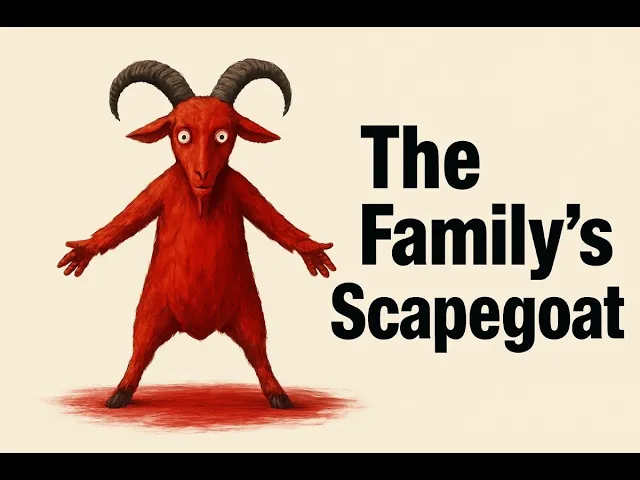
Being the scapegoat isn't just about blame. It's about being cast into a role you never asked for. [Music] The scapegoat role doesn't appear by accident.
It is a deeply psychological mechanism that families unconsciously create to maintain balance, to avoid collapse, to direct their hidden chaos somewhere safe. But the safe place becomes a person. [Music] Now, why does this happen?
Why do families which are supposed to be places of love and protection choose one of their own to carry the collective weight of their dysfunction? That's the question I want to explore with you today. And I promise by the end, you'll see this pattern in a way you can never unsee.
Because here's what I've learned. When you truly understand the psychology of the scapegoat, you begin to understand not just families, but human relationships at large. You begin to see how unspoken dynamics silently control our lives.
And if you've ever felt like the scapegoat yourself, you'll understand why it feels so painfully real, but also why it was never truly about you. Think about it like this. Every family carries tension.
Secrets, regrets, financial struggles, unhealed wounds, unspoken conflicts. These things don't just disappear. They need somewhere to go.
And so unconsciously, families create a system of roles. The golden child, the peacemaker, the invisible one, the hero, and then the scapegoat, the one who absorbs everything no one else wants to touch. Psychologists call this projective identification.
It's when one person becomes the container for the emotions others cannot face in themselves. If the parents feel shame, the scapegoat becomes the shameful one. If the family feels anger, the scapegoat becomes the angry one.
If the family feels inadequate, the scapegoat is painted as the failure. The role becomes a mirror reflecting not who the scapegoat truly is, but everything the family cannot accept about itself. But here's the cruel irony.
The scapegoat often ends up being the most sensitive, the most intuitive, the one who sees the family's truth most clearly. And that's precisely why they are chosen. Because their very presence threatens to expose what everyone else wants to deny.
So instead of listening to them, the family silences them. Instead of embracing them, the family exiles them. The truth teller becomes the problem.
Now imagine growing up under that weight. Every criticism hits you harder. Every glance feels like judgment.
Every success you achieve is either minimized or twisted into something else. Over time you start to internalize the role. You start to believe maybe I am the problem.
Maybe I am the one who ruins everything. And that belief doesn't stay in childhood. It follows you into adulthood shaping your friendships, your relationships, your career.
It whispers in your ear whenever you feel joy, telling you you don't deserve it. But let me open a loop here. Because what if I told you the scapegoat isn't just the most rejected one in the family?
What if I told you they are also paradoxically the most powerful? That buried inside this painful role is a hidden strength that no one else in the family possesses. Hold on to that thought.
We'll come back to it. For now, let's go deeper into the psychology. One of the most important concepts here is called family homeostasis.
Families like any system crave stability. Even if that stability is unhealthy, it feels safer than change. So when conflict rises, instead of facing the root cause, families often redistribute the tension onto one member.
The scapegoat becomes the pressure valve. They are blamed not because they are truly guilty, but because the family's fragile balance depends on it. It's like a play where every actor has a script, the golden child gets praise, the peacemaker smooths over fights, and the scapegoat gets blamed.
Everyone plays their part, so the story keeps running. But here's the tragedy. The scapegoat is not playing a role they chose.
It is a role imposed upon them. And once the narrative is written, it is painfully difficult to rewrite. If you've ever been scapegoed, you know the feeling of invisibility.
You can shout your truth, but nobody listens. You can explain your intentions, but nobody believes. You can try to be perfect, but perfection never protects you.
Because the role isn't about what you do, it's about what the family needs you to be. And yet, here's the part that's easy to miss. The scapegoat is often the healthiest member of the family system.
Why? Because they are the one refusing to participate in denial. They are the one carrying the shadow that others refuse to face.
They are the one exposing the wound even if unconsciously. And in that way, the scapegoat is both the victim and the healer. But let me ask you this.
If you've ever been scapegoed, have you noticed how it repeats itself? How you sometimes find yourself playing the same role in workplaces, friendships, even romantic relationships? That's not a coincidence.
The role gets internalized. your nervous system, your self-concept, your sense of worth, it all learns to expect blame, to anticipate rejection. And without realizing it, you might walk into new rooms already bracing for it.
But here's where it gets interesting. When researchers study family systems, they find that the scapegoat is often the one who eventually breaks the cycle. Why?
Because pain becomes fuel. The exile becomes the seeker. The rejected one becomes the truth teller.
And the very role that once crushed you becomes the reason you learn to heal. Now, I promised you earlier that there's a hidden power inside the scapegoat role. And here it is.
The scapegoat carries awareness. They see what others cannot. They feel what others deny.
And while that awareness makes them the target inside their family, it becomes their gift outside of it. They develop resilience, empathy, intuition. They become the ones who can walk into a room and feel the unspoken.
They become the ones who create art, who write stories, who lead with compassion, who see through illusions. Of course, this transformation doesn't happen automatically. It requires healing, reflection, often years of unlearning.
But the potential is there. And that's why if you've ever been the scapegoat, I want you to hear this. You are not broken.
You are not the problem. You are the mirror that was forced to carry everyone else's reflection. And now you get to decide whether to keep carrying it or to set it down.
But before we get to how the scapegoat can heal, there's another layer of this story we need to explore. Because not every family chooses a scapegoat in the same way. Sometimes the scapegoat is the oldest child.
Sometimes the youngest, sometimes the one who looks different, thinks different, or refuses to conform. Sometimes it shifts. Today it's one sibling, tomorrow it's another, but always the choice reveals something deeper about the family's hidden wounds.
And here's the new curiosity I want to leave you with as we close this first part. What if the scapegoat's role isn't random at all? What if the very child who becomes the scapegoat is chosen precisely because they carry the qualities the family cannot face?
What if being the scapegoat means you were never weak but always the strongest? What if the scapegoat isn't chosen randomly? What if the one who carries the family's blame is actually chosen because they reflect back something the family cannot handle?
Here's what I've come to believe. Families, just like individuals, have shadows, hidden aspects of themselves they don't want to see. And often the scapegoat is the one who embodies or reveals that shadow.
Maybe they're more sensitive and the family cannot tolerate vulnerability. Maybe they're more rebellious and the family cannot tolerate defiance. Maybe they're more honest and the family cannot tolerate truth.
In other words, the scapegoat becomes the screen onto which the family projects what they most fear about themselves. It's not weakness that makes someone the scapegoat. It's often strength.
Strength that threatens the family's illusion. And so unconsciously the family says, "We cannot carry this. You will carry it for us.
" and the child without choice becomes the carrier. But what does this do to the scapegoat psychology? To understand that, we need to look at something called internalized blame.
When you grow up being told that you're the problem, you don't just resist it, you absorb it. You start building an identity around rejection. Every criticism confirms what you already suspect.
Every misunderstanding reinforces the belief that maybe you're fundamentally wrong, fundamentally unworthy. Psychologists have found that children who grow up scapegoated often develop what's called a false self. This is a protective mask, polite, accommodating, sometimes even overachieving, that hides the pain inside.
The false self says, "If I can just perform well enough, maybe I'll finally be accepted. " But deep down, the real self is suffocating, waiting for permission to exist. And here's the heartbreaking part.
The scapegoat often spends years, sometimes decades, trying to earn the approval of the very people who placed them in the role. They try to fix themselves, prove themselves, redeem themselves. But the truth is, no amount of proving will ever rewrite the family script.
Because the role was never about truth. It was about survival. Now, let me open another curiosity loop here.
Because while this sounds bleak, there's a hidden doorway inside this pain. And once the scapegoat discovers it, everything begins to change. The very thing that once crushed them becomes the seed of their freedom.
Hold that thought. We'll come back to it. For now, let's look at another layer.
How the scapegoat role affects adulthood. Research shows that former scapegoats often struggle with boundaries. They may overexlain, overapologize, or stay in toxic relationships longer than they should simply because their nervous system expects rejection.
On the flip side, some become fiercely independent, determined never to need anyone again. Both are survival strategies shaped by early wounds. But here's where awareness comes in.
Once you realize that your patterns are not proof of your brokenness, but proof of your survival, you can begin to shift them. You can begin to see that what you thought was weakness was actually resilience. You can begin to reclaim the voice that was silenced.
And this is where the scapegoat's hidden power finally reveals itself. See, most members of the family system remain trapped in the cycle of denial. The golden child may continue performing for approval.
The peacemaker may continue smoothing over conflict, but the scapegoat, the one who was exiled, is often the first to seek healing. Why? Because pain forced them to.
Exile pushed them towards self-discovery. Rejection demanded they look inward for strength. And so, paradoxically, the scapegoat becomes the one most likely to break the cycle.
They become the cycle breaker, the one who says, "This ends with me. " They become the one who learns about psychology, therapy, boundaries, spirituality. They become the one who dares to face the family shadow head on and to refuse to pass it forward.
Think about that for a moment. The very person who was blamed for everything becomes the one who transforms everything. That is the hidden gift of the scapegoat.
And if you've ever been in that role, I want you to hear this clearly. The pain you endured does not define you, but the strength it gave you can. Now, let's circle back to the doorway I mentioned earlier.
The scapegoat's healing begins the moment they realize that the blame was never about them. It was projection. It was displacement.
It was the family's way of surviving. And once you see that, you can begin to step outside the role. You can begin to ask, who am I outside of this identity?
What do I love not because I'm trying to prove something, but because it's truly mine? What relationships feel safe not because I'm walking on eggshells, but because I'm free to be myself? That's the work.
That's the path. And it's not easy. It's often messy, filled with grief for the years you lost, anger for the injustice, confusion about who you really are.
But inside that mess is also a rebirth. Because to be the scapegoat is to be forced into exile. But exile is often where transformation happens.
Think of every myth, every story, every hero's journey. The one who is cast out is the one who eventually returns with wisdom. And maybe that's the deeper meaning of the scapegoat.
Not just to suffer, but to awaken. Not just to carry the family shadow, but to eventually transform it into light. But let me leave you with this final reflection.
If you've ever felt like the scapegoat, misunderstood, blamed, rejected, I want you to remember something. You are not defined by the story your family told about you. You are not the problem they projected onto you.
You are the one who saw what others could not bear to see. You are the one who felt what others could not bear to feel. And because of that, you carry within you a depth, a resilience, a clarity that no one can take away.
You may have been the scapegoat, but that role does not have to be your destiny. Your destiny can be to transform that pain into wisdom. To build relationships that are real, not performative.
To raise your voice where it was once silenced. To live not as the reflection of someone else's shadow, but as the embodiment of your own light. And maybe, just maybe, the greatest gift of the scapegoat is this.
You know in the deepest part of your being what it feels like to carry what is not yours. Which means you also know how liberating it feels to finally lay it down. So if this is you, if these words feel like they were written from inside your own chest, then let this be the moment where you begin to rewrite the script, where you stop trying to earn love that was never conditional in your worth, where you step out of the role that was handed to you and step into the life that was always waiting for you.
Because you are not the problem. You are the possibility. And the world doesn't need you to carry the blame anymore.
The world needs you to become who you were always meant to be.