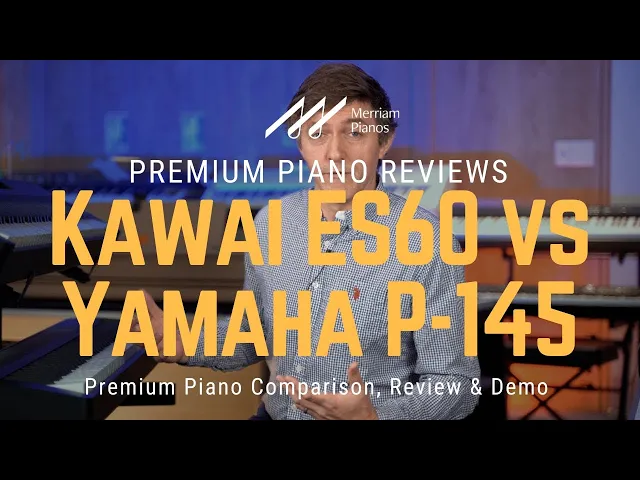
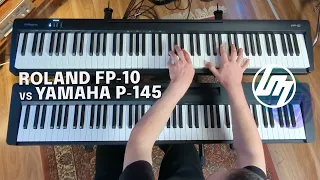
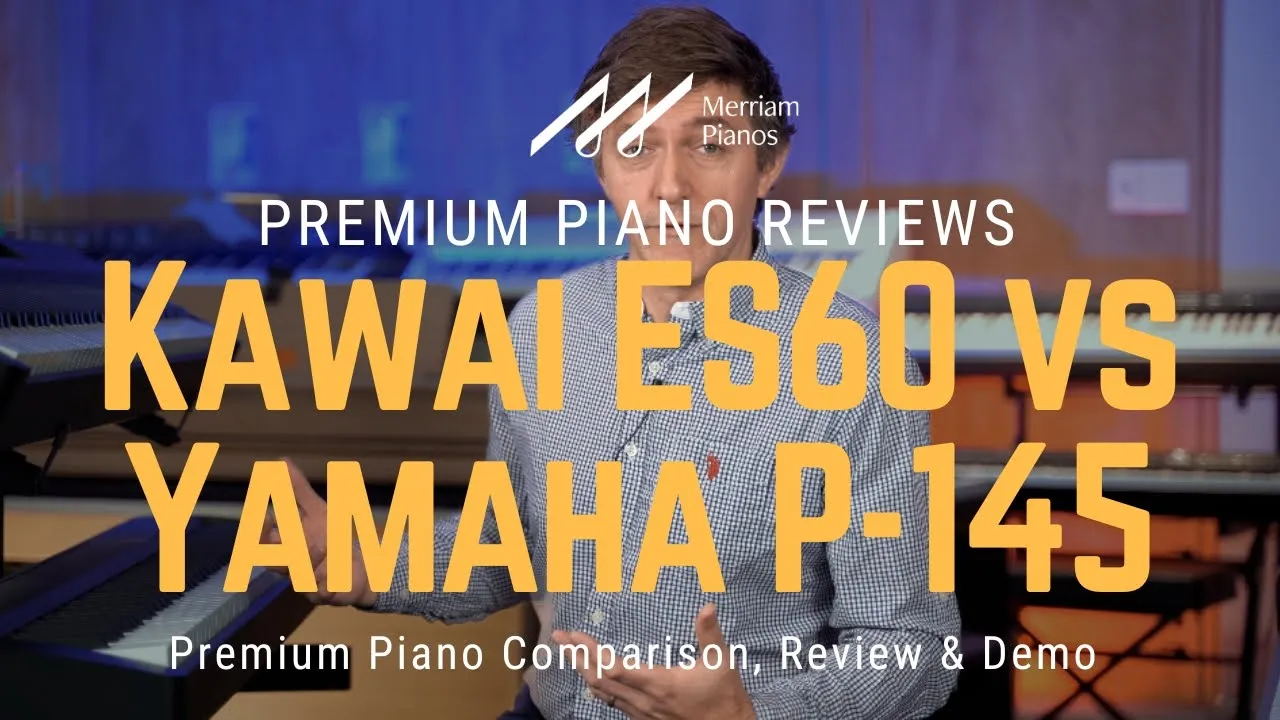
now the Yamaha p145 is the replacement to the p45 and between those two models Yamaha really has dominated the 500 US market in terms of weighted 880 instruments with Kawai they've never had a model that really competed with the 45 or the 145 until now the es60 is designed explicitly in fact to go after this market and come out with a product that isn't just a copycat of the 145 it actually changes the equation of what this price point should be delivering to the customer here's how specifically the p145 has a maximum poliany of 64
now for the price point that's pretty typical but down here with the es60 we're now up to a pony of 192 it's a big difference now if we're talking about speakers and amplifier the p145 is sporting a pair of 7 watt speakers again pretty typical if not maybe on the slightly more robust side for this price point move down to the es60 however and now we've got a pair of 10 watt speakers and it definitely fills a room in a very different way than any other option I've been able to play at this price point
and then third is undoubtedly the quality of the piano sample itself and if you think about really what kawhai has tried to build its digital piano reputation around over the last 10 years it's been action and the quality of the piano tone and so I'm not totally surprised that with the es60 particularly when you get get it in a side by side this sample just feels thicker it sounds thicker there's just more audio information in there there's less filtering going on and the dynamic range of the instrument reflects that as well now before we get
too much further I'm well aware that specs very rarely tell the whole story completely on their own you've got to listen to them and where possible you know touch and play them as well so what do we actually get when we play these two instruments side by side well let's have a listen [Music] there's just more information contained in the samp that the kaai is using and on top of that because of the added pany you also have a lot more resonance that's happening and capable through the harmonic Imaging engine so it's just producing and
sustaining more partials meaning more audio information more harmonics than the Yamaha can and that has nothing to do with whether you prefer a Yamaha tone or Kawai tone so this leads to an interesting observation which is that Kawai has equipped this piano with two in outputs on the back which is also pretty rare for this price point Roland doesn't do it nor does Yamaha and this makes me think that they actually see the es60 potentially being embraced by the semi-professional community because when you've got a piano tone that's that rich it's almost borderline able to
be used in some recordings and for sure it's good enough to be used in a professional performance setting and you've got the audio jacks now to support that now neither one of these instruments has any Wireless connectivity but in terms of the features that are on board we've got a fairly wide array of sounds available on the Kawai at 17 with the Yamaha that's limited to 10 they also both have all of the same basic functionalities such as transpose and onboard metronome now I've left one big subject out of the conversation so far and that
is action [Music] these two actions feel quite different the Yamaha is using their traditional GHC action now that has been improved over the years I was not a big fan of some of the earlier Renditions of the GHC which I've made mention of over the channel their newer versions of the GC I've personally been a lot more satisfied to play on whereas on the kawhai they've released a brand new Act with this model called the responsive Hammer light or rhl now both are fairly compact actions but there are definitely some differences so the first difference
is I'm not sure how kawhai has engineered this but the pressure difference in terms of how hard it is to press the key at the front versus the back of the key is a much smaller difference here than it is on the Yamaha and even though you never really play the key up here it is a good reference point to understand how big a gradient there is and pressing right there compared to right there the Quai is substantially lighter to press down at the back of the key that's an interesting piece of engineering cuz that's
been a common complaint of increasingly compacted graded Hammer actions over the last 5 years but the more meaningful difference here comes in actually how the action feels to play in normal settings and there's two big differences here one is that the Omaha goes with a slightly more sticky glossy action on their white keys so you're going to feel a lot more grippy on that key and depending on your playing style and what you're used to that could be a positive or A negative or a neutal down on the Kawai they have gone with a matte
finish on the white key which is actually pretty unusual for digital piano in this price range matte white keys are kind of an ongoing debate anyway even up into the acoustic piano realm you've got some pianos that just have a slightly more matted Finish versus others which are really highly glossy so kawhai has selected the mat now what does that mean it means that your finger is more easily able to Glide over the key it's not going to feel quite as stuck or sticky on a gloss key on the Kawaii it's a deeper key bed
than what you get on the Yamaha the Yamaha is quite a bit of a shallower key bed this is going to produce a couple of different effects one you are going to notice it playing but what that extra travel distance actually gives you is the ability to control a wider dynamic range with a greater level of accuracy no matter what angle you're looking at this from from a spec standpoint the Quai really has outmuscled the Yamaha in this Lane so we're going to do one last thing with these two instruments which is give you at
home a sense of the speaker performance we're going to record both of these instruments with exactly the same settings and exactly the same mic placement so you can hear as close as what I'm hearing in person and not just the line out so let's get started with that [Music] thank you so much everybody for checking out this comparison we've got links to both of these instruments depending on which one you want to go and investigate more we've also done individual reviews of both of these instruments as well on the channel so please check those out
consider subscribing my name is Du Harrison and we will see you soon [Music]