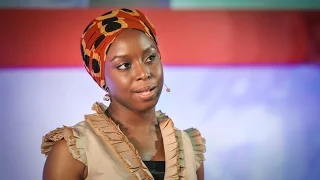
I'm a Storyteller and I would like to tell you a few personal stories about what I like to call the danger of the single story I grew up in a University campus in eastern Nigeria my mother says that I started reading at the age of two although I think four is probably close to the truth so I was an early reader and what I read were British and American children's books I was also an early writer and when I began to write it about the age of seven stories in pencil with crayon illustrations that my poor mother was obligated to read exactly the kinds of stories I was reading all my characters were white and blue-eyed they played in the snow they ate apples and they talked a lot about the weather how lovely it was that the sun had come out now this despite the fact that I lived in Nigeria had never been outside Nigeria we didn't have snow we ate mangoes and we never talked about the weather because there was no need to my characters also drank a lot of ginger beer because the characters and the British books I read drank ginger beer never mind that I had no idea what ginger beer was I would have a desperate desire to taste ginger beer but that is another story what this demonstrates I think is how impressionable and vulnerable we are in the face of a story particularly as children because all I had read were books in which characters were foreign I had become convinced that books by their very nature had to have foreigners in them and had to be about things with which I could not personally identify now things changed when I discovered African books there weren't many of them available and they weren't quite as easy to find as the foreign books but because of writers like shinuache Bay and kamaralay I went through a mental shift in my perception of literature I realized that people like me girls with skin the color of chocolate who's kinky hair could not form ponytails could also exist in literature I started to write about things I recognized now I loved those American and British books I read they stirred my imagination they opened up new walls for me but the unintended consequence was that I did not know that people like me could exist in literature so what the discovery of African writers did for me was this it saved me from having a single story of what books are I come from a conventional middle-class Nigerian family my father was a professor my mother was an administrator and so we had as was the norm live in domestic help who would often come from nearby rural villages so the year I turned eight we got a new house boy his name was fide the only thing my mother told us about him was that his family was very poor my mother sent yams and rice and old Clues to his family and when I didn't finish my dinner my mother would say finish your food don't you know people like fides family have nothing so I felt enormous pity for fida's family then one Saturday we went to his village to visit and his mother showed us a beautifully patterned basket made of dyed Raffia that his brother had made I was startled it had not occurred to me that anybody in his family could actually make something all I had heard about them was how poor they were so that it had become impossible for me to see them as anything else but poor their poverty was my single story of them years later I thought about this when I left Nigeria to go to university in the United States I was 19. my American roommate was shocked by me she asked where I had learned to speak English so well and was confused when I said that Nigeria happened to have English as its official language she asked if she could listen to what she called my tribal music and was consequently very disappointed when I produced my tape of Mariah Carey she assumed that I did not know how to use a stove what struck me was this she had felt sorry for me even before she saw me her default position toward me as an African was a kind of patronizing well-meaning pity my roommate had a single story of Africa a single story of catastrophe in this single story there was no possibility of Africans being similar to her in any way no possibility or feelings more complex than pity no possibility of a connection as human equals I must say that before I went to the U. S I didn't consciously identify as African but in the U.
S whenever Africa came out people turned to me never mind that I knew nothing about places like Namibia but I did come to embrace this new identity and in many ways I think of myself now as African although I still get quite irritable when Africa is referred to as a country the most recent example being my otherwise wonderful flight from Lagos two days ago in which there was an announcement on the Virgin Flight about their Charity Walk in India Africa and other countries so after I had spent some years in the U. S as an African I began to understand my roommate's response to me if I had not grown up in Nigeria and if all I knew about Africa were from popular images I too would think that Africa was a place of beautiful landscapes beautiful animals and incomprehensible people fighting senseless Wars dying of poverty and AIDS unable to speak for themselves and waiting to be saved by a kind white Foreigner I would see Africans in the same way that I as a child had seen fide's family this single story of Africa ultimately comes I think from Western literature now here's a quote from the writing of a London Merchant called John Locke who sailed to West Africa in 1561 and kept a fascinating account of his voyage after referring to the black Africans as beasts who have no houses he writes there are also people without heads having their mouths and eyes in their breasts now I've laughed every time I've read this and one must admire the imagination of John Locke but what is important about his writing is that it represents the beginning of a tradition of telling African stories in the west a tradition of sub-Saharan Africa as a place of negatives of difference of Darkness of people who in the words of the wonderful poet Richard Kipling a half devil half child and so I began to realize that my American roommate must have throughout her life seen and heard different versions of this single story as had a professor who once told me that my novel was not authentically African now I was quite willing to contend that there were a number of things wrong with the novel that it had failed in a number of places but I had not quite imagined that it had failed at achieving something called African authenticity in fact I did not know what African authenticity was the professor told me that my characters were too much like him an educated and middle class man my characters drove cars they were not starving therefore they were not authentically African but I must quickly add that I too am just as guilty and the question of the single story a few years ago I visited Mexico from the U. S the political climate in the U.