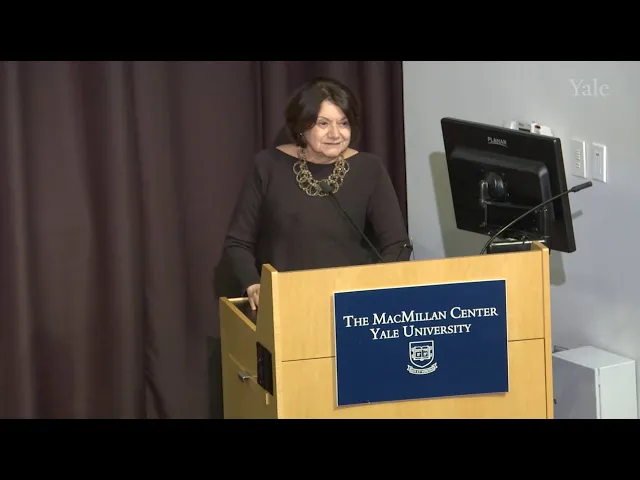
good afternoon to everybody thank you thank you for coming thank you for your interest and I have a privilege and honor to hosted a very distinguished diplomat with amazing diplomatic career rosemary D Carla dr. rosemary DeCarlo who is the other Secretary General of United Nations for political affairs and peacebuilding listen.you title of the of rosemary DeCarlo and peacebuilding so previously it was separated rosemary Dakar is American diplomat with a fantastic career working around the world in Moscow in Europe everywhere and we met first in 2007 I was appointed ambassador Ukraine to United Nations and Rosemarie
was in American mission to United Nations and she performed fantastically a duties there being the deputy ambassador to the United Nations in the rank of ambassador representing United States in the Security Council [Music] she was everywhere and still she's everywhere on the monthly basis or even more frequently she's appearing and in Security Council to brief on whatever convene is well on Syria Libya on Ukraine or whatever so we have a really important interesting guest today who is very open to to discuss any questions about the world of hers which are not clear they are not
well understood even in the expert community was going on and of course on division from the United Nations is very important but of course the well the openness is limited because Rosemary's injuries and that's why she is to balance she is representing the pas de bourree which depends on the on a membership but at any rate she promised to be as open as possible and we will start with a short presentation and then immediately question and answers and this time you'll be the first to ask her to give more space to you to ask and
then I will mediate mitigate with my questions which not very easy even for me well to formulate them in a way to have a good answer so thank you thank you Yuri I don't know if I can live up to that introduction very important imported moment of your of your biography Rosemarie had lectures at Yale for three years starting in 2015 and well in Jackson Institute and it was about the multilateral institutions in the 21st century it will be one of the questions about the multilateralism and the role of United Nations in the 21st century
thank you thank you it's a real pleasure to be back at Yale as ambassador Sergey has mentioned they did teach a course here and multilateral institutions is it not working and I was here soon after I had left the US State Department and I was drawing on my experience representing the United States in multilateral fora especially the United Nations today I'm official of the United Nations I have not one state that I work for but 193 States it's quite different I'm in a department that I had plays a very central role in UN efforts to
prevent deadly conflict and build sustainable peace we've got a global mandate we have political missions in Afghanistan Colombia Iraq Libya Haiti and Somalia we have envoys that are addressing the israeli-palestinian conflict Syria Yemen Lebanon and Myanmar we also have envoys practicing conflict prevention at a regional level in East West and Central Africa and Central Asia and we provide support to the UN secretary-general in his engagements across the world when he uses his good offices to mitigate conflicts and we're increasingly involved in work with countries where there is no formal or no formally manded peace process
or peace operation by either the UN Security Council or UN General Assembly so the question the title of this talk kind of raises the big questions it's the press of demands of my job a means that I don't often think of the bigger picture putting out daily fires so I'm particularly happy to have this opportunity to talk with you and share some of my thoughts with you today and hear your perspectives on multilateralism and the future of multilateralism I mean we're having this discussion today at a very difficult time far from having any new world
order or a preserved old order what we see is unease and uncertainty around the globe we have intensified competition among major powers a recession that we face threats that are more serious than we've seen in a generation we have persistent conflict accelerating climate change and new forms of warfare derived deriving from technological change and without international governance in our core work of conflict prevention and resolution we're seeing some negative trends there are three that stand out and they're sort of intertwined the first is that conflicts are increasingly intractable the average duration of civil wars has
risen over time and it's reflected in the increased average duration for our peace operations and emissions ii in abundance and fragmentation of non-state actors and armed groups think of syria conflicts today often feature complex and decentralized non-state armed groups with loose and fluid chains of command some adopt terrorism as a deliberate tactic some target the UN complicating our acceptance as an impartial actor by all sides and third increased regional and international involvement conflicts are increasingly affected by competition from power for power among regional and other actors as well as factors such as migration the priorities
of influential neighbors or international actors can directly impact on our ability to resolve conflicts together these factors contribute to a sense that we've lost traction on major conflicts also contribute to increase calls for isolationism in closed borders and feed skepticism about multilateral efforts yet as Secretary General Antonio Guterres has frequently observed this is a moment where there is arguably more need for multilateral cooperation and collective solutions to a range of problems that transcend borders and regions than at any other time in United the history of the United Nations how do you explain this and respond
to this central paradox my view is that the questioning of the relevance of multilateralism is rooted in divergence among states in their interpretation of the basic principles on which United Nations is based principles that have defined international cooperation for the past seven decades this underpins a tendency to circumvent rules and lead some states to seek to redefine their roles in a multilateral system when the UN was established 74 years ago its member states committed to the sovereign equality of all states to refraining from the use of force and to take in collective action regarding threats
to international peace and security these principles are outlined in the UN Charter to which all member states of the United Nations all 193 have pledged adherence they were developed by the victors of the Second World War still major powers that exist today but there are new powers now that we're not weren't part of the creation of these rules and even those who were interpret them differently let's take just one principle that's enshrined in the Charter in the Charter sovereignty to many countries sovereignty does not mean that a state has the absolute right to do as
it chooses it also means that a state has responsibilities not only to its own citizens but to other states and responsibilities not to pollute the environment to prevent terrorists from crossing borders to curb the flow of weapons to abide by international human rights in humanitarian law but to other states sovereignty is deemed absolute this is limited the UN's ability to prevent and resolve conflicts in many parts of the world including perhaps most obviously Syria meanwhile many people are losing faith in the process of globalization they feel left behind around the world we see the rising
appeal of nationalist and populist voices demonstrations are affecting countries from the Middle East to Latin America and the Caribbean and from Europe to Africa while every situation is unique one common thread connecting all demonstrations is a growing deficit of trust between people and political establishments this constitutes a rising threat to the social contract yet not all the news is bad indeed if we look back at the high-level week of the General Assembly this past September more world leaders than ever before descended on New York the climate crisis quite rightly toughed the bill in terms of
their attention and beyond States generated an extraordinary mobilization of act this many of them young demanding change at the climate action summit now as a collective body the UN General Assembly itself counters the idea that unilateralism could be the answer to the world's problems what we heard from a number of member states is that many of today's challenges cannot be addressed by one state or a few states alone for some issues the way forward lies in more not less International Cooperation to quote set the secretary-general however he said many times and I'll quote it is
not enough to proclaim the virtue of multilateralism we must prove its added value end quote and I would add and collective action must be for a defined purpose based on principles that are commonly agreed so what do we do what does multilateralism look like in practice well the short answer it's just one word partnerships there's not a juxtaposition between multilateralism versus regionalism for example multilateralism can mean a few states working together to solve common problems or an organization like the UN working with regional organizations or international financial institutions I just want to say that my
department has liaison offices with just about all the major regional organizations out there certainly the African Union European Union NATO the Shanghai Cooperation Organization ASEAN and a number of others but these partnerships have to go beyond States and regional organizations and beyond intergovernmental bodies to include civil society the private sector women's organizations in youth all of whom make an important contribution to global international cooperation now while we're still wrestling wrestling with existing threats and challenges to security and to name just a few migration terrorism proliferation of weapons of mass destruction arms transfers we still have
new challenges to address the impact of climate change on security and the benefits and risks of new technology I think that you would probably all agree that not one country can solve these challenges alone so I'm gonna end here I'm really keen to hear your views in particular on how you see cooperation that is needed to address today's security challenges and your role in helping to realize it thank you thank you did Thank You rosemary used to be concise and comprehensive at the same time so now this the space is open for questions and answers
should I start or you will please okay okay well we have traditional speakers from Germany thank you very much ambassador DiCarlo just to kick off the discussion can you give us an example from the last 12 months a positive example coming out of the Security Council that helped resolve a current conflict [Music] yes okay okay I think there are a number of positive examples that I can cite of course some are still a work in progress first of all I think the role that the UN has played alongside the African Union in Sudan for the
transition in Sudan is a very positive development it's work that was done very quietly but behind the scenes with the strong support of the UN Security Council we've seen a transition to what we hope will be a stable civilian government and a society that is trying to work through a number of reforms to not only improve the economic potential of Sudan but to deal with the the needs and the desires of the society so I think that's that's one that I would cite and again as I said it's a work in progress and it's going
to demand a lot more attention not only from the United Nations and the African Union but from many many member states to help a Sudan through this transition this one another one and this is a one that probably doesn't get a lot of attention and it would be lasted over twenty years I think it's 25 actually we managed to produce an agreement between Greece and the Former Yugoslav Republic of Macedonia on Macedonia's name it may sound as if this was not a conflict that that was an armed conflict but it certainly was a huge irritant
not only for North Macedonia and its movement forward but for the entire Balkan region so I really think that this shows that persistence actually can make a difference our envoy who handle these negotiations did it for the full 20-some odd years those are two examples I would give you I think that you know highlight the work that can be done quietly behind the scenes there are many examples obviously where peace has not been achieved I mentioned Syria [Music] [Music] [Music] [Music] [Music] [Music] [Music] so I think that we have to find ways to do these
new new challenges [Music] [Music] [Music] they are challenges that really could cause the stability in various countries [Music] thank you [Music] um my name is Ron Nabil I'm a former student of a masters that you have in your capacity have certainly worked with the Chinese the Russians to Europeans I was wondering in light of the great power competition that you had mentioned [Music] delegations from those countries ahead of their approach towards multilateralism in your opinion very from those of the American delegation to the UN it depends you know it depends obviously and what the issue
is there is a lot of professing practice achieve that kind of collective action that is needed I think you also will see that countries come at the issue of resolving conflicts or what is a conflict in very different perspectives and again Syria I think is a case in point where there were a number of countries that felt that the violations of human rights an international humanitarian law were unacceptable in other countries that felt that indeed a state has the right to deal as it sees fit with an insurgency a rebellion just prior to this position
ambassador Rose Marie de Carlos was the president of National Association for American foreign policy and what he noticed how many efforts she dedicated to find the dialogue to create a dialogue between three major powers in the Yellow Sea China South Korea given China's over go into that and Japan so and we had the panel the top political experts and Plymouth's there and that helped you well to earn a well-deserved authority at that time in the region and so you are using that now traveling there while trying to find and to create dialogue which is absolutely
important United Nations the dialogue is in process well right you're absolutely right United Nations is a process and it's I have to tell you it's very different being a diplomat for a national service from being an international civil servants when you are working for your national service you know what your policies are or you think you know what your policies are and you go for it right when you're working internationally you are trying to bring people together and that is the point your impartial and your trying to bring impartial obviously based on certain values and
principles that we all adhere to as international civil servants and that is the principles enshrined in the UN Charter but it is to bring people together and I have to say that my past experience both in the nonprofit world I think in and in teaching here and I'm listening to the various views of students as students I had every class I had was I think would say 50 percent us and then 50 percent from other parts of the world really has helped me in the work that I'm doing now it is not very easy obviously
to be sitting at a table with such divergent views sometimes but trying to get something something together that you can move forward with in order to let's say at least manage a situation if not one of the world leaders and his address to the General Assembly recently stated the future does not belong to globalists mm-hmm everybody knows what's about yes well no need to give a name or country and so on and we actually immediately appeared from from the membership there can be no return to pre globalized world so of course this is this is
the competition between the realities which really they're facing around the world but so this is about the what do you dimensionally you're in your statement how how fragile multilateralism is but how greatly supported moderators have as in community and of course the multilateral is will gain because a lot of the challenges the challenges which none of the even big country can't cope with below your questions thank you for thank you for being here um so the Syrian constitutional committee met for the first time I think a few days ago and I was wondering whether you
thought of that as a success of multilateralism and also just generally from your position at the UN how do you work through the challenge of having to include powers that say maybe bomb hospitals in multilateral efforts kind of brokered by the UN and how you work through that difficulty [Music] [Music] [Music] [Music] [Music] and as we have discussions going on on something that is broader and more major solve some very nitty-gritty problems that can improve the situation for everybody in Syria and for those that left Syria and hopefully in be an encouragement for them to
feel that they would be able to return and our view is the UN you know policy on refugees is clear and it's it's around the world and it's not does not just pertain to Syria but to everywhere else including yep off that the return of refugees has to be voluntary safe and dignified otherwise we are not in a position to encourage that I didn't answer the second part of your question how do you sit down at the table with people who bomb hospitals you have no other choice let's put it that way you have no
other choice but to sit with everybody who's involved in a particular conflict and try to move forward and try to reach some kind of agreement on some basic parameters and basic principles to help resolve a situation and move forward to perhaps a better future thank you professor de Carla I had a pleasure of being in a couple of years ago one of the one of the last classes you were teaching here thank you for being here I have a question speaking of cooperation and dialogue some of the most important dialogues and human rights obviously were
happening within the Human Rights Council from which the US would do as we know in 2018 and how does it I would like to know from your vantage point of how does it affect the dialogues in that area and whether you see some ways around it and what would be the next steps and whether there are some countries that are taking the leadership in this area thank you edible that the United States left the Human Rights Council I think that they were a major force for good on the council that said I do see the
United States still working to promote human rights elsewhere in the UN system and on specific country issues in particular that come before the Security Council I think that there is an absolute need to in in any conflict situation in particular but across the board that human rights has to be a factor and included very much in there some who are look more to the political aspect of any given situation some who look to the humanitarian but I think you have to conclude all three and we do see countries taking the lead when there are many
countries very common - to human rights that speak out and drive that and drive policies forward to ensure that human rights law is observed in international humanitarian law is observed new amendments to the Charter I hope that it will happen the the council will appear in the text of the United Nations Charter it is not their trusty Council which is eroded so is there but Human Rights Council is not there and it's reduce its legitimacy well so a lot of the reforms ahead are the questions raised thanks ambassadors for being here especially as a DeCarlo
there are numerous Security Council resolutions that are either not adhere to or that are violated intentionally that makes the credibility of the Security Council a bit shaky now granted that they these resolutions were able to diffuse major crises but I feel like these crises are now very percolating or simmering and so my question to you is what can be done to remedy this this conundrum is this major challenge [Music] yeah case in point where arms are flowing into both sides of both warring parties that clearly the resolution that was adopted several years ago is completely
ignored it's blatantly violated and we see pictures on TV and some of the countries supplying those arms will tell you that oh there's a need to observe the arms embargo so it's really it's quite it's quite amazing similarly Yemen again arms embargo that's being violated very clearly I think this is an issue that has been raised on a number of occasions both for countries that have been on the Security Council for other member states how do we make these resolutions binding really binding on member states and there's been no no way to do so but
we seized the Security Council rights the letter sometimes if there's a violation I'm thinking of the case of Lebanon where there again we have a situation where arms transfers are in violation of resolution 1701 and I think a you know goes to the credibility of the council and the credibility of the United Nations now obviously some would say those who are sort of deniers of international action and that the council overreached in adopting some of these resolutions and then others would say no we didn't overreach at all it's just that we have no mechanism really
to call the violators into question and that is I think a major part of the problem I don't think we ever will have that kind of mechanism adopted but I think that the credibility of a council is really what is let's say it going to be necessary in order to see greater observance of a number of resolutions where does that credibility come from I think it comes from council actions and acting early often they act late I'm not criticizing the UN Security Council I was on it and I just you know saw it from within
but sometimes it's it's hard to get the council to an agreement to move forward on a particular issue early enough I think it also comes from the fact that not only the council but the United Nations that until very recently was focused on putting out fires on resolving conflicts instead of preventing them I think that's a huge part of our problem and this is what really needs to be addressed the current Secretary General has made conflict prevention a priority it is throughout the UN that we're working on conflict prevention activities my department does a lot
of conflict prevention a lot of things you will never read in the news working with countries that are going through various crises hoping to defuse those crises before conflict violent conflict erupts certainly the work we're doing in the development area on sustainable development is all geared at also helping to ward off conflicts around the world I think the Security Council in doing more early-warning and perhaps working on issues that where we see we see a problem coming perhaps would then end up having at the greater credibility so when they do have to act they might
have more observance from mark grant and one of the meetings in the Security Council he made interesting statement that the Security Council called you to the Charter was designed to be a smoke detector and not just a fire extinguisher it is about the the crisis management so he said about that just it wasn't well to work on how to prevent conflicts how to detect them on the early stages and what should be should be done well not to to let the the companies to move to most of the serious Wars and whatever and my son
just mentioned that there is a number of responsibilities the ownership of the state ownership to create a sustainable environment human rights respect well so this is exactly what Security Council slowly but moving they had for the recent two-three years maybe for three years for sure what Security Council took it an agenda the human rights issues as the source of potential crisis even including the climate change is there no because it's existential for some of the countries like in the in the Pacific but it's not just about climate change it's about the people well great thank
you from a spectator perspective who follows news on the on the on the UN one good thing that the UN is a place where people talk a lot but they do little so how would you um reassure people that what the UN does is important for them and they should believe in multilateral institutions like the UN and then my second question is how can you talk less and do more so what's the reform that's needed to talk less and do more probably need to be able to explain I mean justified to taxpayers why we are
being paid I'm talking about the Secretariat now they're two different things there's a secretariat and the Member States and the various bodies at the member states are part of but let's just just talk about the part that I can have an impact on which is the the Secretariat I think we do need to do a better job we're very very quiet about the conflict prevention we areas we work in for a number of reasons one we do want countries to think they resolve the issue themselves we don't want to go in and take credit for
something even if we feel that had we not been engaged that perhaps conflict over a particular electoral result would have led to perhaps unrest in the country secondly as I said there's there is real concern about interference and domestic affairs of a country that is something that we see many member states concerned about whether it be the UN coming in or a particular state coming in to resolve a particular issue and I'm not talking about military intervention I'm talking about intervention of other kinds so we're quiet about that but we do need to do I
think a better job of explaining what it is we do I'll give you an example I mean my department has a standby team of mediators that we deploy it could be for a lot dealing with elections I have to say elections are always a flashpoint in a society that's not the major problem but that that's the spark that sets things off constitution drafting mediation from a number of issues we're working on right now mediation and mitigation efforts on you know dealing with climate change you know conflicts between farmers and herders and various aspects we don't
go around publicizing it very much countries often don't like the fact that it's you've used them to explain you know what it is you're doing on the other hand it is kind of important for people to know that the Secretariat is working and doing things and trying to resolve conflicts as far as the talk you know there's nothing wrong with talking I have to say that if if hammering it out in the General Assembly or some committee meeting means that it's by the end of the day you might have changed a few minds or it
helped defuse a situation there's really there's nothing wrong with that and it would be better obviously if some of the talk resolved you know resulted in finding a way to have adherence to certain Security Council resolutions etc but the fact that people are talking is it's a good thing thank you hear me wonderful thank you so much for coming ambassador in regards to fires the Amazon rainforest recently and their refusal of Brazil's presidents make significant changes to curb the fires even in face of international economic sanctions do you think there could be a multilateral effort
to curb deforestation that would not eventually disregards Brazil's sovereignty and in the face that the fires reach critical levels in the Amazon rainforest that would lead to eventual UN peacekeeper intervention [Music] problems different let's say new challenges and so it makes it all the harder now so again going back to the comment about how come the Security Council do better or what could it do or how could it make its resolutions more binding on member states when you have such divergent views in the international community it's very difficult somehow there needs to be a coming
together of what the basic principles that we are all willing to adhere to I wanted to ask do you think that the UN Security Council can maintain its long term legitimacy without including additional major or emerging powers as permanent members remember States to decide I think they look inclusivity is important there is no question about it I think that it's not just a question of adding new members I think that that you know obviously would would certainly make the resolutions that are adopted perhaps more relevant to certain regions but it's also a question of again
coming together on what it is the the international community adheres to what what are the parameters for their action and that is going to be the most critical thing I think in credibility going forward thank you so much for coming today so you guys have spoken a lot today about structural reform in the need for reform in the Security Council and I'm curious how feasible you see submitted reforms being especially given the veto powers of permanent members I guess then [Music] Russia we have to be five or six you were fighting for geographical technical presentation
is it caps there because [Music] [Music] [Music] [Music] we have just today we have two things first of all the United the membership they are involved in the construction of the unicorn either they are gathering here on T major centers or they are trying to define themselves as the center of the new war of the central D so we are in the dynamic speed and still the [Music] [Music] [Music] [Music] [Music] [Music] so this question is how to convince them and so there is wink and bringing new players so there is no answer oh all
the variations [Music] [Music] [Music] of course what's going on it's not you my question next question to be honest extra peers that city park multilateralism you should also pay attention to parable going processes like ad hoc alliances like midnight area networks we use them in the past the first world war he had the conditions of economies dissemination of the countries and we have today of course the performing immediately so the [Music] we ilysm a lot and what we really mean I think is collective action based on a set of principles that we all agree to
okay a rules-based order now the rules may be changing but you need agreement to change them and I think that's that's the key and sometimes if issues can be resolved within a country there's a conflict and the country manages to come together and that's great or it can be resolved with a few states working with a country or it can be resolved by a regional organization or group of regional countries working on an issue all of that is fantastic it doesn't have to be 193 countries professing on the issue or they come to the UN
so I think that that is all the better if it can be resolved at a lower level of smaller grouping we have a lot of initiatives and some of them are absolutely excellent I mean I think that the point you made about the former Yugoslavia at the contact group that I was a part of for a while that worked together and I think help to resolve a whole number of issues related to the breakup of Yugoslavia we see many groupings we've got you know friends of Sudan and working on helping Sudan through its transition we
we see various either regional organizations or countries coming together on Haiti on a whole range of issues and this this is good but I think there's also a question of you know it's not just working together it's question what are you working together for you know are your principles grounded you know are we really paying adherence to you know international conventions and basic human rights and civic and political rights and is that changing and I think that's something that we have to look at it's you know what is what are we putting these collective efforts
toward and obviously I'm not saying that things are sacrosanct and that you know new rules are adopted there are changes maybe to certain systems but that needs to be there needs to be a consensus or broad consensus let's put it that way to do that and I think that we we often say today copings going off in different directions and while it may be multilateral because there are a number of them perhaps what they're aiming toward isn't exactly what a lot of us so it means to cope with that we are to feel this normative
gap and in the six committee saw the debates are still going on in general assent in master de Caro mentioned the cybersecurity still we have the institutional gap still there is no instruments how to manage that including normative gap as well there is no D comprehensive convention how to how to deal with all that so still we have legitimacy gap with the one of the main institutions how to bring the perpetrators to justice I mean International Criminal Court so people are in and out in and out so it is a question of the jurisdiction of
the court but it is relatively new institution in some of the elements in even in its statute Ron steroid they appeared or recently today we mentioned some with some elements of that for example the crime of aggression it's a new element in that and so how how to judge how to judge whether it is aggression or any humanitarian intervention or it is something like around rights to protect well something a lot of work to be done by the experts in the international legal affairs from Yale University from anywhere to move ahead with all these gaps
in [Music] international legislation and so and of course compliance gap compliance gap is which exists everywhere because of the differences both culture ideological political and so on and how to reach them through the dialogue what is the biggest the best platform for that of course you ready - it's the only Universal institution of course the platform's the General Assembly what whatever in that is real is good but it's also good to work on the working level other questions please well ambassador the color is travelling a lot so I mostly schedule so recently you you were
in southern Caucasus while in Turkey before that throughout you know my career it has not been let's say easy when I join the State Department I joined in 1984 and until 1974 a female diplomat could not be married and remain in the Diplomatic Service okay so by the time I joined in 84 there were new there were a number of women coming and so there were a lot of there were not many women let's put it this way in up until 1974 in the US State Department more came in but they were at lower levels
so it took quite a while for the State Department to really you know get get on with the gender equality issue and I found myself throughout you know my career trying to ignore the fact of whether I was female or what I was but just tried to do my job and eventually I'm as I said we've got now in the State Department a large number of female ambassadors and so forth I never thought I would make it to ambassador when I started out my career because they just weren't any women at that level it's sort
of it just eventually it happens and women more and more women became ambassadors the job that I'm in now at the UN I'm the first woman in 74 years of the United Nations to hold this position and I didn't think that much of it I mean having already been an ambassador and I realized when I came into the position two things first of all there's a huge burden on my shoulders for all the women who were in the Secretariat who you know want to make their way up and I couldn't fail not that I wanted
to fail but I certainly could not fail secondly it was quite different and challenging at times because Secretary General Gutierrez has made a point of gender equality in all assignments not just senior assignments and he's done far better because senior assignments he can name and he's also been trying to help move women up the ladder in the Secretariat but there is still I think a sense of there's a way you act in a way you do things and what I found is that most women don't act and do things in the same way that a
man does in the same position so while my counterparts were fine because I had a number of female counterparts as well it's those that I was managing kind of saw this unusual American woman and in a position and and perhaps acting very differently from a male who had been in that position over the years so it was challenging but what I do find in I think that there is still enough credibility but the United Nations has so when I travel and I meet with some you know a number of mostly male leaders in countries then
I'm taken seriously I have a message I have a message that not only I'm carrying for the secretary-general who has tremendous credibility I'm also representing a number of states with certain positions and it's not as hard as you might think that said I'm always aware I mean every so often I'm aware that of the differences and the fact that being a female in a position that had always been had you know given to a man means that you've got to work kind of twice as hard and sometimes it gets a little tiring let's put it
that way well which is not easy I could imagine that today the Secretary General is criticizing through Maduro and to all she has a meeting with well so this is the blows you see I'm not raising any question about the about Ukraine I am doing this purposely because in 2014 and 15 Rosemarie presided sakura-con so many times on our issue and so real persistence how to mobilize the the United Nations community and including in the Security Council so where we are speaking body multilateralism Security Council is the multilateral deal to have the majority in the
area recall so it's it's a lot well and that's why I'm grateful I'm not raising this issue today because I know that there are plans to visit Ukraine and to well to look and to assess the processes there and then to bring to the secretary-general the thank you I said been a loss of interest in humanitarianism a loss of any real consensus on it because we see in Europe and certainly in the u.s. a sort of hostility to refugees hostility to the most depressed people and almost a sort of shutting light up in wanting I
get the impression sometimes people want these people to suffer maybe that's just in personal connection anyway is that the case has there been a loss of consensus on humanitarianism insists on humanitarianism as much as defining it in a different way in some cases I think that look there there are issues that one has to take a stand on okay and certainly supporting you know those who are vulnerable those who are in need those who are refugees migrants is really it's an issue that we have to stand by perhaps there you know there's a debate on
measures on degree of assistance etc but it's clear that we there there are some principles here that I think for the United Nations for those of us who work with me it's in the Secretariat we've got to be firm about and this is one of them I mean there are there are laws conventions governing for example refugees and these these they're in existence and they should be certainly respected the situation of migration you know there was an attempt at a broad-based pact on migration which a number of countries opted out of but we've got a
huge problem with migration and people are fleeing for very good reasons and there needs to be a way to address their concerns so I think that it is one of the areas I think that what we've seen in sort of this breakdown of a social contract among government and citizens in various parts of the world has contributed to this I think that you know the fact that people feel left behind and therefore are looking to be as Oh as open and welcoming as they have been to both refugees and migrants is is a serious concern
I know there was a question earlier but how do you deal with you know how do you sit down and deal with people who are bombing hospitals you know how do you deal with dictators well you've got to deal with them if you want to help you know and a crisis but then you also have to stand on principle on some issues and I give you one example I think that the UN has been very clear and the secretary-general has been very clear about his concerns about how there have been treated in Myanmar he was
very clear just this past weekend when he was in Bangkok at the ASEAN summit about the need from Myanmar to address the issue of the rahega to create the conditions inside the Myanmar yeah is that so that they can return and not just the physical conditions but the political conditions so there are you know I think we have to be those of us who feel strongly about these issues have to speak up about it I'll give you an example I was in a country recently that was having a big debate about violence against women some
of them thinking that this was first of all an internal matter they shouldn't sign on to various conventions bad it was cultural okay and publicly I said and I would say again that violence against women is not cultural it's criminal so there are some there are some things that again as I may be the diplomat that has to bridge all the gaps there are some principles I think that are you know enduring and undeniable young students are the greatest they are to have you led some some remarks to help them to better understand what's about
so graffitis and migrants all the refugees are migrants but not all the migrants are refugees in terms of international law refugees are more or less protected by the international conventions migrants they were not until 2015 when a journalist my adopted a resolution and then they launched the process and last year we had in Morocco we had an assignment where the Global Compact on migration was adopted and well to bring both categories to the more or less equal position the second important issue is a responsibility of the parties involved responsibilities of the countries of origin the
the global community should work with should work closer with the country of origin to help them well to to build this sustainable environment not to push people outside of the country so the first responsibility is there the responsibility of the countries of the transition they are to care about the the migrants refugees they are to define who is who and then to either to open doors move ahead your refugees like with the Syrian migrants running to Europe so the first countries of Andres they are to exactly define who is who is not easy it's costly
and so on and of course country of destination so if they are permitted legally to enter in so all the international rules should work perfectly to help them with the shelter with the education for their children medicine so so this is a complex of the issues and still we still we have some normative gaps there and of course we still have the compliance gaps of all three parties involved in that country of origin country of transition in country of destination all of them should work together so and this global compact of Morocco is about that
so but I am absolutely confident that still a lot of work to be done ahead thank you well first of all welcome back thank you for coming back so one of the places where multilateralism at the UN has been incredibly effective it's an anti money laundering combating the financing of terror just in March was it that 2462 was passed and it brought all the anti money laundering and combating the financing of terror regulations have been passed somewhat sporadically and sort of reinforced them and reiterated them and sort of celebrated and reinforced the role of financial
action task force but in the NPO and NGO community there was some concern because as these are the humanitarian organizations that go into conflict zones increasingly they're finding it more and more difficult to bank to get money and aid to people who need it most the UN in their language said that we must support humanitarian efforts they main they must not be disrupted and that's great language but if it's up to a bank to assess the value of a client that's a small Muslim bathe faith-based NPO and they decide well you're simply not worth the
risk and so we're going to unbanked or deserve a 60 to 70 percent of these small npos are do have this concern is language alone enough can more be done to protect humanitarian efforts being undertaken by NPS and NGOs in this area and I was wondering what are the debates behind the scene to do just that words words are not enough obviously there this this is under discussion there are you know various initiatives mechanisms that are being looked at to try to address this issue it's a complicated one it's a really complicated one because it
puts then perhaps the UN in a position you know verifying a particular NPO or NGO or not which is not a position we can we have the capacity to do but we couldn't agree I couldn't agree with you more I mean on the one hand we adopt something that is really helpful to a certain end but then it actually hurts on another aspect of the particular problem and without having thought through how we might address that but that is under discussion and it is it's a serious problem thank you for coming back to thank you
for sharing you should all the best success in favor of all of us and in a global community Thank You indeed thank you [Music]
![[Q&A] Kishore Mahbubani: Can Singapore Survive?](https://img.youtube.com/vi/IlwlkYYIcQI/maxresdefault.jpg)
![[Festival of Ideas 2019] Are the US and China Doomed to Enmity?](https://img.youtube.com/vi/rl0wf2WF3ec/maxresdefault.jpg)