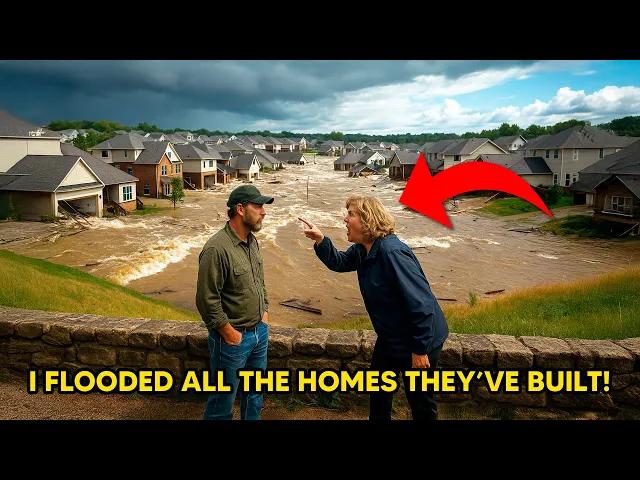
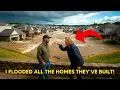
There I was, standing at the edge of what used to be a mountain dam, now just a roaring, unstoppable flood, tearing through the brand new homes the HOA had illegally built on my land. Freeze frame. Yep, that's me.
You're probably wondering how I ended up flooding an entire suburban development and why nobody could stop me. It all started when they thought they could steal what my grandfather left me. When my grandfather passed away, the last thing I ever expected was for his greatest gift to become a battlefield.
He left me his land, a sprawling piece of the old country. Wide open fields, dense woods thick enough to lose yourself in. And at the heart of it all, a mountain dam he had personally designed and built after surviving one of the worst floods this area had ever seen.
It wasn't just a dam. It was a wall of stone and stubbornness, an inheritance of wisdom and defiance handed down through bloodlines. The will was clear, signed and witnessed.
The land, the water rights, and everything that touched the soil belonged to me, free and clear. For a while, I lived in peace, working a job in town and spending weekends fixing fences, walking the dam's crest, and watching the seasons turn across the mountains. The first sign of trouble didn't come with a bang, but with a whisper, a letter in my mailbox, crisp white with a gold embossed logo I had never seen before.
Willow Ridge Homeowners Association, it said. I frowned. I wasn't part of any HOA.
My land sat outside town limits, protected by grandfather zoning battles decades earlier. At least it was supposed to be. The letter informed me so very politely that I was now subject to community review under new county maps approved during the last municipal session.
Curious turned to concerned when I attended the next town meeting and saw a slick smiling man with perfect hair presenting brightly colored maps showing the expansion of Willow Ridge community amenities. There in heavy blue ink was my land folded into their new development plan like it had never belonged to anyone else. I stood up furious demanding to know how this could happen.
That's when I met Karen Langford, HOA president, self-proclaimed community visionary and living embodiment of the word menace. She acted confused, tilting her head like a curious owl, and then assured me it was all perfectly legal. Survey mistakes, she said.
A simple clerical error corrected. I left that meeting with the first hint of real dread, gnawing at my gut. Over the next two weeks, surveyors trampled my fields without so much as a knock at my door.
Wooden stakes with neon flags popped up like invasive weeds across the property. each one a nail in the coffin of my inheritance. Then came the heavy machinery.
Bulldozers and excavators rolled in, carving roads through the pasture where my grandfather had taught me to ride a horse. Foundations were poured in fast, sloppy grids. Before I could even catch my breath, the HOA had green lit 58 homes, luxury craftsman style, the banners boasted, right on top of my land.
I tried everything. I hired a local lawyer, a good man, honest and sharp, but even he seemed nervous when he saw the names on the paperwork. County clerks were evasive.
Property officers lost my filed complaints. Karen smiled sweetly at me every time I protested. Her army of board members nodding behind her like well-trained dogs.
They made me look like the crazy one. The stubborn holdout clinging to dusty deeds and outdated maps. At the second town meeting, Karen actually suggested with a faux sympathetic voice that I accept one of their generous offers to buy me out before, as she put it.
Progress left me behind. I remember the way the room fell silent when I stood up and said loud enough for every last realtor and bureaucrat to hear that I would never sell what my family had built. Not for any price.
That was the moment it shifted from bureaucratic theft to open hostility. Violation notices began appearing on my old truck. Fines for imaginary code breaches stacked up like unpaid bills.
I woke up one morning to find a sign staked into my yard declaring the area an upcoming development zone. No trespassing. My own damn yard.
Even the sheriff's deputies when I called them just shrugged and said it was a civil matter. Every door I knocked on closed faster than the last. Karen wasn't just playing hard ball.
She was playing with loaded dice. I found out from a sympathetic clerk at the county recorder's office that Willow Ridge HOA had been donating heavily to certain council members campaigns, building inspection waiverss, zoning exception approvals. It was all being papered over with smiling pictures and handshake deals.
I was outgunned, outmaneuvered, and outvoted. For every legal protest I filed, I received a countersuit threat from the HOA's lawyers, claiming I was harassing them by disputing the new boundaries. I knew I couldn't beat them head on.
Not yet. So, I did what any patient man would do when the odds are stacked against him. I pretended to give up.
I stopped coming to town meetings. I let the flags stay in my fields. I nodded politely when Karen waved from her brand new white Range Rover, flashing her blindingly fake smile.
And while they celebrated, breaking ground and selling lots like Conquering Heroes, I documented every single move they made. I took pictures of every construction violation, every environmental impact ignored, every bulldozed tree and ripped up fence post. I recorded every conversation, saved every letter, and made copies of every shady reasonzoning approval I could dig up late at night from public archives.
I built my own quiet case, a fortress of proof stacked up in boxes in my grandfather's old workshop under the dam. I didn't make a sound. I didn't lift a finger to stop them.
I watched them pour hundreds of thousands of dollars into infrastructure they didn't understand. Lay water lines across unstable soil and build McMansions right over old flood basins without so much as a geological survey. They thought I was beaten.
They thought the land would bow to their blueprints. They didn't realize that some things, especially old country land and the bloodlines that guard it don't break just because you scribble over them with ink and concrete. They thought the land was theirs because they signed a piece of paper.
But paper means nothing when the rain starts to fall and the mountain starts to roar. They had stolen my fields, my woods, my damn. They had declared war without even understanding the battlefield.
And now, deep down, I knew a reckoning was coming. As inevitable as gravity and twice as unforgiving, I just had to wait for the first storm. The dam had always been the silent guardian of the valley, a thick slab of stone and packed earth built with nothing but stubborn hands, hard labor, and the grim memory of a disaster burned into the town's bones.
80 years ago, before the land was parcled and sold, before asphalt sliced the mountains into neat little grids, there had been a flood. A biblical kind of flood, the sort that didn't just wash away houses, but wiped entire families off the map. My grandfather was a young man back then, hauling sandbags alongside neighbors, trying in vain to hold back a wall of mud and water that didn't care about deeds, about fences, about dreams.
They failed. The valley drowned, and when the waters finally retreated, they left nothing but shattered homes, ruined fields, and headstones where there should have been living people. Grandfather swore it would never happen again.
He wasn't an engineer by training, but he had the stubbornness that sometimes counts for more. Over years, not months, not a summer project, but years, he and the other survivors built a dam into the mountainside, one stone at a time. It wasn't some high-tech concrete monstrosity.
It was oldworld engineering. A massive buttress of earth, rock, timber, and faith designed to hold back the mountains wrath. When the skies opened up, it worked, too.
For decades, while neighboring counties suffered landslides and seasonal floods, our valley stayed dry. Grandfather's Dam absorbed the mountains tantrums, catching rain runoff and channeling it down manageable slooes into the lowland creeks. Over time, the emergency it was built to prevent faded from memory.
People forgot why the old dam was there. They forgot what it protected. But the land didn't forget.
Water always remembers its path. When the HOA came in with their glittering plans and tidy blueprints, they didn't even pause to consider the dam. In their minds, it was just another ugly bump on the landscape, something to flatten for easier development.
They paved over drainage channels, rerouted creeks, and bulldozed entire swaths of the old flood plane to make room for culde-sacs and ornamental fountains. The crowning insult came the day I watched from a distance, hidden behind a line of old trees, as a backhoe operator, wearing a neon vest and zero awareness, gouged into the outer shoulder of the dam itself. not deeply, not enough to cause an immediate collapse, but enough to its stability.
Enough to tear open wounds that would fester with the first heavy rains. I wanted to scream. I wanted to charge down the hill and throw my body between them and the bones of my grandfather's work.
But I didn't. I clenched my fists so hard my nails bit into my palms. And I stayed hidden.
Because by then, I understood something important. They didn't just disrespect the land. They didn't even understand it.
In their minds, they had won. They had the legal papers, the smug signatures, the politicians in their pockets. To them, I was just a ghost of the old world, clinging to memories nobody cared about.
They had no idea they were building their glittering suburb on a ticking time bomb of their own making. They had no idea that every broken stone, every severed route, every blocked runoff channel was quietly, patiently counting down to the moment the mountains would take back what was owed. They thought they beat me.
They didn't realize they were living on borrowed time. And so I began preparing in the only way I could. I stopped visiting the dam openly.
I stopped patching up minor leaks after storms. I stopped clearing the intake channels that kept pressure from building up behind the damn wall. I let the debris gather, the silt accumulate.
The natural forces simmerred just beneath the surface. I became invisible to them, a forgotten relic wandering the woods while they held barbecues on half-cured concrete patios and installed solar lights along streets that wouldn't exist in 6 months. When the fall rains came early that year, I watched them from my porch, sipping coffee while puddles formed in the newly sawed lawns.
When winter melted into a soggy, chaotic spring, I took slow, quiet walks along the dam's edge, and noted how the cracks widened with every cold snap. How the ground sagged slightly where the back hoe had ripped into the outer shoulder. I didn't cause the dam to fail.
That would have been criminal. I simply stopped protecting it. I let nature take its course.
I let the laws of physics and hydrarology, laws older and far more ruthless than any HOA charter, do what they were always going to do once the arrogant little empire of Willow Ridge decided it knew better than the mountain. The irony, of course, was that all their careful, expensive construction work only accelerated the inevitable. Their storm drains choked with debris.
Their manicured lawns sloughed off top soil into clogged retention ponds. They rerouted the natural waterways without understanding that the mountain didn't care about property lines or homeowners associations. It cared only about gravity, about water pressure, about the simple truth that water will always find a way down.
The first few heavy storms were a warning shot, a test. Minor sink holes opened up in the unfinished sections of the development. The HOA blamed unseasonal rain patterns and ordered more fil dirt, more quick fixes.
They held meetings about environmental stabilization measures and charged new homeowners special assessments to cover the costs. All while ignoring the thick tension in the ground beneath their feet. I watched it all with a patient, almost reverent silence.
I kept to myself, tending the few scraps of land they hadn't bulldozed yet. I made polite conversation when I bumped into Karen at the gas station, listened to her smug little updates about how successful the Willow Ridge expansion had been. I smiled and nodded and said nothing at all about the growing fractures running through the bedrock below her feet.
It wasn't about revenge anymore. It was about balance. It was about honoring the land and my grandfather's work and the old truth that arrogance always gets paid back with interest.
They had tampered with a sleeping giant, and I didn't have to lift a finger to awaken it. All I had to do was step back, let the damn rest in its wounded, exhausted state, and wait. The rainy season was coming, and this year, it wasn't going to be kind.
The first storm rolled in like a slow drum beat, low and steady, pounding against the mountains until the rocks themselves seemed to hum with tension. I sat on the covered porch of my grandfather's old house, a battered thermos of coffee in my hands, and watched the gray wall of rain crawl across the valley like a living thing. The mountains vanished behind a curtain of mist, and somewhere far off, I heard the low, rattling groan of distant thunder.
In the subdivision below, the shiny, smug heart of Willow Ridge, porch lights flicked on automatically, little squares of yellow blinking against the gloom. I knew the land better than any of them. I knew how the clay would swell with rain.
How the shallow top soil they'd foolishly planted over would slough and crack when the water found its ancient channels again. And I knew deep in my bones that the damn wounded and neglected would not save them this time. As the rain poured down hour after hour, I slipped on my old work boots and wandered the perimeter of what had once been my fields.
Now a quilt of half-finished homes and newly paved streets. Even in the downpour, I could see it happening. Long, jagged fissures opening in the brand new sidewalks.
Fine spiderweb cracks forming along the foundations of houses that hadn't even been occupied yet. Water pulled where no drains had been installed, creating shallow lakes and culde-sacs and seeping slowly into the basement of the most expensive lots. I passed Karen's house, a monstrosity of white columns and faux brick, perched proudly at the top of the ridge, and saw her standing inside the massive picture window, phone clamped to her ear, gesturing wildly.
I could almost hear her voice through the glass, blaming the weather, blaming bad luck, blaming anyone but herself. Across the development, neon vested construction crews scrambled to set up sandbags and dig emergency trenches with back hoes that only made the flooding worse. They moved dirt here, shoved water there, trying to outmaneuver the rising tide with plastic barriers and desperate prayers.
It was almost beautiful in a terrible sort of way, like watching a sand castle crumble beneath an incoming tide. And this was only the first storm. The second came 3 days later, colder and meaner, roaring out of the mountains with a rage that felt almost personal.
I felt the pressure shift before I saw the clouds. A heaviness in the air that made my skin prickle. The dam, already cracked and weary, groaned under the added weight of a week's worth of rainwater.
Minor leaks along the shoulder widened into muddy scars. A small breach, no bigger than a man's fist, spat muddy water down the hillside. then another, then another.
I didn't need instruments or fancy monitors to know what was about to happen. I had my grandfather's instincts, and they were screaming. I stood on the highest ridge, the wind whipping rain into my face, and watched as the dam gave its last ragged sigh.
The earth trembled under my boots, a deep gut punch rumble, and then with a roar that shook the valley, the damn burst. Not all at once, not a cinematic explosion, but a slow, brutal collapse as tons of water, trapped and furious, tore through the brereech and poured down the mountainside. The force of it shredded trees like matchsticks.
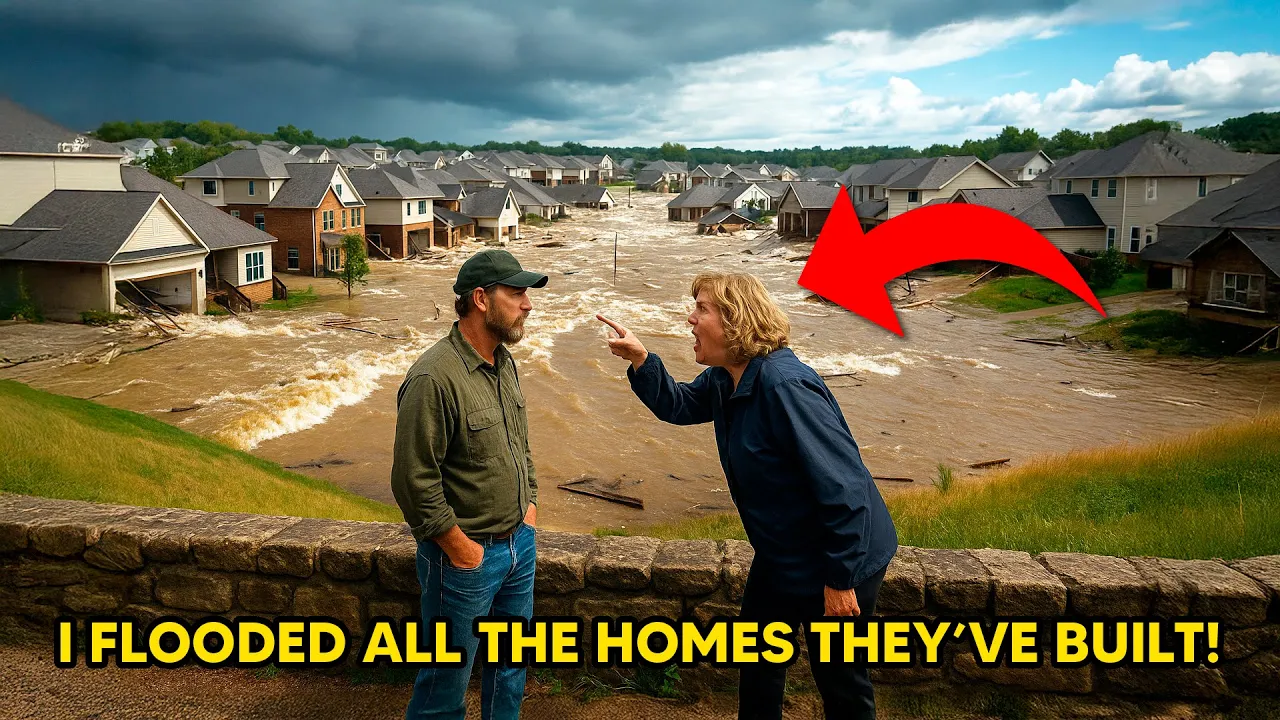
The water took the path of least resistance, the path it had always taken before man tried to tame it, and that path led straight to Willow Ridge. In seconds, the first row of homes, still draped with four sail banners and fluttering patriotic bunting, were swallowed by a boiling wall of brown water. I watched roofs lift like leaves, walls crumple like wet cardboard.
Streets buckled and split open, swallowing minivans and decorative mailboxes alike. Power lines snapped and danced wildly, hissing and sparking against the flood. Karen's house, that gleaming temple to hubris, stood firm for a moment longer than the others.
I could see her standing on the front porch, screaming into her phone, frozen in the headlights of disaster. The water reached her foundation, hesitated like a predator savoring the moment, then surged. The ground under her perfect lawn liquefied.
The house shuddered, leaned drunkenly to one side, and with an awful groan, cracked cleanly in half. One side slid down into the churning flood. The other collapsed backward in a slow, almost graceful bow.
The massive white columns snapping like toothpicks. It was over in minutes. The emergency crews came then, too late.
Always too late. Waiting through kneedeep water with their radios crackling and their faces blank with disbelief. They shouted orders, strung caution tape that sagged uselessly in the rain, and tried to triage the chaos.
But the mountain didn't care about their protocols. Water doesn't listen to sirens. I watched from a distance, dry and calm.
My heart thuting slow and steady. Part of me wanted to feel guilty. Another part, a much louder part, felt only grim satisfaction.
I had tried to warn them. Months ago, before the bulldozers came, before Karen's Range Rover tore up my grandfather's fields, I had filed official notices with the county warning about the dam's compromised condition and the risks of disturbing the land. I had letters, emails, certified receipts, all tucked safely away, timestamped and notorized.
I was legally shielded. I had tried. I had told them, and they, in their arrogance, had ignored every word.
Insurance adjusters descended like vultures once the skies cleared. They walked the muddy ruins with grim expressions, poking at collapsed driveways and half- buried foundation slabs with metal poles. "Claims were filed.
Claims were denied. " "Acts of God," the adjusters said, shrugging. "Nligence," the lawyers whispered.
Karen tried to sue the county, the developers, the construction companies, even me. Nothing stuck. Their own surveys, their own approvals, their own greed had done them in.
The HOA, once so smug and powerful, found itself drowning in lawsuits from furious homeowners, bankrupt contractors, and even state regulators investigating illegal land use practices. Karen's name became a punchline in town, a cautionary tale told over beers and backyard fences. Willow Ridge itself was condemned within 6 months.
A ghost town half buried in mud and silence. A soggy monument to arrogance and forgetting the simple truth. The land always wins.
And as for me, I stayed quiet. I stayed patient. I watched the weeds reclaim the broken streets.
Watched the birds return to the shattered rooftops. watched the creek beds carve new paths where once there had been sidewalks. Nature had done what I could not.
Justice had rolled down the mountain like a flood, and somehow, impossibly, my grandfather's land, scarred, but not defeated, had been given a second chance. The flood had barely finished carving its jagged path through the ruins of Willow Ridge. When the first news vans arrived, they descended like flies.
Satellite dishes blooming at top their vans. Microphones clutched in desperate hands. I watched from the rgeline as they slogged through the mud, snapping photos of half-drown furniture, shattered white picket fences and broken dreams tangled in debris.
Within hours, the headlines began to spread like wildfire. Tragedy in Willow Ridge. 58 luxury homes destroyed by negligence.
They screamed, plastered across every screen and printed in every paper. Reporters clutched their umbrellas against the drizzling rain, solemnly narrating the devastation to viewers across the state, while Karen, now stripped of her careful hair and makeup, her eyes wild and hollow, tried in vain to spin the narrative. "It was the weather," she insisted.
"It was an unforeseen act of nature. It was everybody's fault but her own. But the cameras didn't care about her excuses.
They loved a villain. And Karen, with her Range Rover stuck axle deep in a sinkhole and her million-doll house snapped in half like a rotted toothpick, was the perfect face for the fall. The story spread even faster once investigators started asking questions.
Real questions. It turned out that when you bulldoze a dam, build houses on unstable ground, and fasttrack zoning changes through backroom deals, you leave a paper trail even deeper than the flood waters. The county announced an independent inquiry less than a week after the flood.
By the end of the month, the state attorney general had launched a full investigation into Willow Ridg's development practices. Public records were subpoenaed. Financial ties between the HOA board and local officials were dragged, squirming into the light.
Every corner of Karen's carefully constructed empire crumbled. Kickbacks, bribery, illegal easement filings, fraudulent environmental impact reports. It all came spilling out in ugly, undeniable waves.
One revelation after another. Homeowners, many of whom had already been furious over their collapsed investments, joined class action lawsuits against Karen, the board, the developers, and even the banks that had financed the disaster. The names once whispered in fear at town meetings were now printed in bold black ink alongside words like embezzlement, malfeasants, and gross negligence.
I watched it all unfold with a quiet satisfaction, never once stepping into the spotlight. There was no need. I had laid the trap long before the first foundation was poured.
Karen and her cronies had simply marched themselves into it, blind and arrogant. The best part, their insurance claims were all denied. Every last one.
The adjusters, backed by ironclad evidence of ignored warnings and reckless construction, refused to pay a dime. Lawsuits drained what little wealth the board members had left. Karen's beloved Range Rover was repossessed first, then her jewelry, then her house, or at least what remained of it after the floodwaters and scavengers had taken their toll.
I heard she moved in with a cousin two counties over, scraping by on temp jobs and nursing a grudge so bitter it could curdle milk. The other board members scattered like rats, filing bankruptcy papers and ducking subpoenas. Their reputations burned beyond repair.
Meanwhile, I moved quietly, methodically, while the state wrangled over who to blame and how to divvy up the wreckage. I filed my own paperwork, a petition for adverse possession. Thanks to their abandonment, the laws were on my side.
The flooded lots, the crumbling streets, the swampy remains of Willow Ridge, they all reverted to me parcel by parcel, acre by acre. Nobody fought it. Nobody even showed up to contest it.
They were too broke, too ashamed, or too busy running from their own mistakes. Within a year, the land was mine again. Officially, legally, righteously, I set to work rebuilding what mattered.
First came the dam. I spent the better part of a summer hauling stones, reinforcing the breaches and pouring new concrete footings with the help of a few trusted old-timers who remembered what the land had been before ambition poisoned it. We worked without fanfare, without cameras, under the same stubborn sun that had baked my grandfather's neck decades earlier.
The new dam wasn't flashy, but it was strong. Strong enough to hold back a dozen floods. strong enough to remind anyone with eyes that some things are bigger than politics, bigger than greed, bigger than the schemes of small-minded people who think nature is something they can outsmart.
As the dam took shape, I turned my attention to the fields. Gone were the manicured sidewalks and faux street lamps. I let the wild grasses reclaimed the broken lots.
Let the creeks find their natural beds again. Let the deer and the foxes and the herands return to a land that was finally being treated with respect. The final touch came on a crisp autumn morning.
I hauled an old cedar post up the new gravel road leading from the county highway, sunk it deep into the earth, and mounted a heavy wooden sign handcarved by a local craftsman. It read simply, "Welcome to High Water Acres. We respect the land here.
" Below that, in smaller letters, was the motto I had come to live by. Built by nature, protected by memory. I stepped back, wiped the sweat from my brow, and smiled.
It wasn't just a sign. It was a declaration, a warning, a promise. No HOA would ever set foot here again.
No scheming developer would ever try to paper over the bones of the mountain for a quick buck. This land had been bought and paid for with sweat, sacrifice, and sorrow. It belonged to those who remembered, not those who forgot.
On the first sunrise after the sign was installed, I brewed a fresh pot of coffee, grabbed my old thermos, and hiked up to the dam. I sat on the rebuilt crest, the stone still damp with morning dew, and watched the valley unfold before me. The sun burned away the last wisps of mist, revealing fields brushed gold with autumn and creeks that sparkled like silver veins across the earth.
The scars of Willow Ridge were still there if you looked closely. A crooked line of half-sken fence posts, a warped manhole covered jutting from the grass, but in time even those would fade. Nature was patient.
It would reclaim everything in the end. I sipped my coffee and let the peace settle over me. I thought of my grandfather, of his battered hands shaping stone and earth with stubborn hope.
I thought of the flood that had taken so much from him and the flood that had in its own brutal way given everything back to me. And I thought of Karen, wherever she was now, clinging to bitterness like a drowning woman to driftwood. She had built her kingdom on stolen land and lies.
I had built mine on patience and truth. In the end, only one of us had something worth holding on to. The mountain rumbled quietly beneath me, not with anger, but with satisfaction.
It was a sound older than fences, older than lawsuits, older than greed, a sound that promised, in its own slow, deep way, that as long as someone listened, the land would endure.