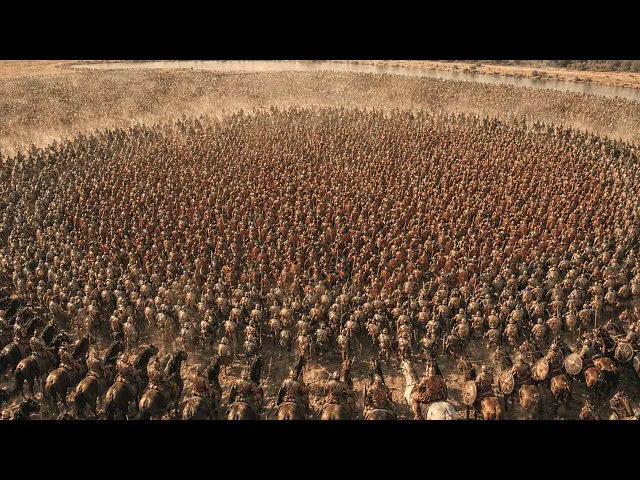
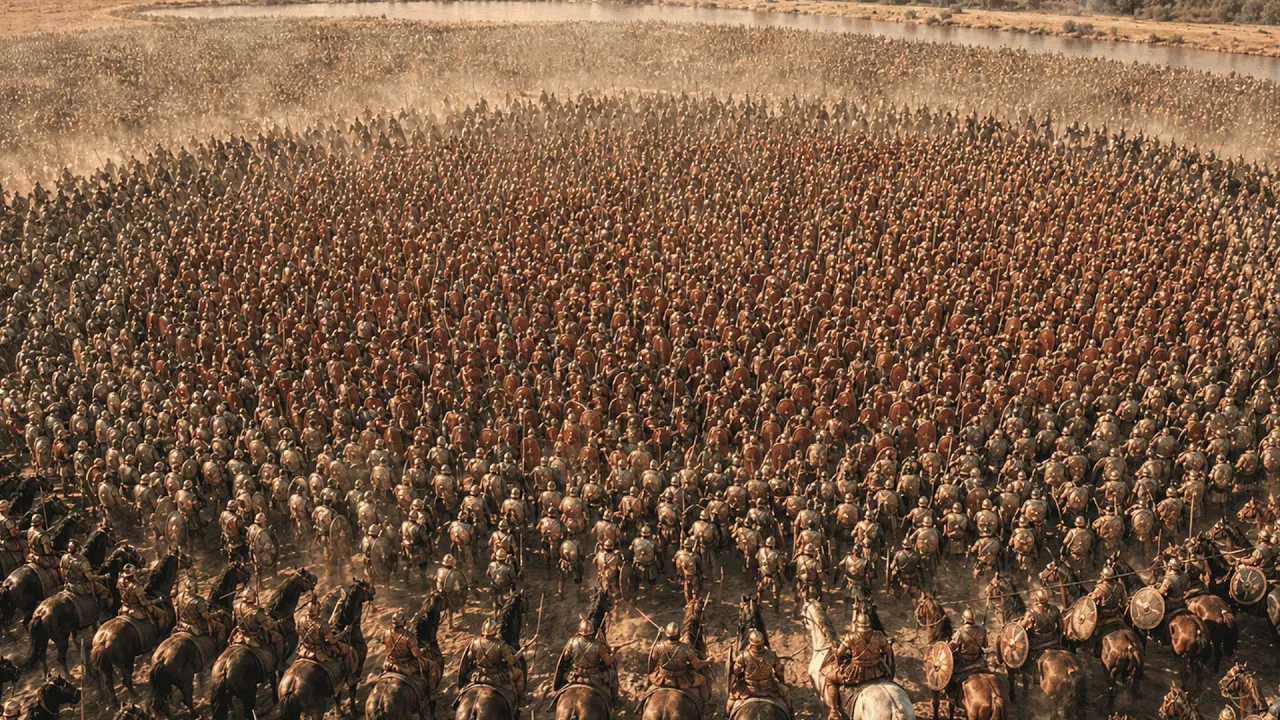
The 2nd of August 216 [music] BC, a flat, dry plane in southern Italy beside the river Aidus. On one side, the largest army Rome has ever put into the field. Around 86,000 men, eight legions doubled in strength, with both of Rome's consoles commanding at once.
On open ground in high summer, their infantry outnumbers Hannibal's 2 to1 with about 50,000 men, little more than half the Roman numbers. Everything a commander is taught to avoid is on that plane in front of Hannibal. A far larger enemy, flat, open ground, no high cover.
And he chose it anyway. He picked this ground himself and offered Rome the kind of open, decisive battle its generals had been refusing him. His own officers have gone quiet just looking [music] at the Roman numbers.
>> There are more of them than I have ever seen in one place. Yes, it's a strange thing to look at. There's a stranger thing you've missed, Gisco.
And all that great number over there, not one of them [music] is named Gisco. By the end of this one afternoon, around 70,000 of those Romans will be dead. Hannibal will have lost barely 6,000.
It is still studied 22 centuries later as the most perfect battle ever fought and the bloodiest single day in the history of Rome. [screaming] This is how he did it. >> Hold the line.
After the battles of Trebia and Lake Trazamine, Rome had tried something it hated. It stopped fighting Hannibal. The man behind that idea was a careful, stubborn commander named Quintis Fabius Maximus.
His plan was simple and unbearable. Never give Hannibal the open battle he wanted. Shadow him, starve his foragers, trade ground for time.
It worked and Rome despised [music] it. They nicknamed Fabius the delayer and they meant it as an [music] insult. Once Fabius nearly trapped him, boxed his army into a valley with the mountain passes blocked.
For one night, Hannibal [music] was caught. So Hannibal had his men tie bundles of brushwood to the horns of 2,000 oxmen, set them al light, and drive the herd up the dark hillsides toward the pass. The Romans guarding the pass ran toward the lights, certain it was Hannibal escaping over the mountain.
The pass emptied, and Hannibal marched his real army straight out through it in the dark. He had slipped a Roman trap with a herd of cattle. That was the last straw.
Rome was done being patient. In the elections for 216, the city threw out caution and voted for the opposite for men who promised to find Hannibal and finish him. And to do it, Rome built the largest army it had ever [music] sent anywhere.
Rome did not just replace its losses. It doubled down, literally. The Senate raised eight legions for one campaign, each enlarged beyond normal strength and matched them man for man with Italian allies.
Palibius, our closest source, puts the whole force at around 86,000 men. To grasp how strange that was, a normal Roman army was two legions. This was eight plus as many allies.
Again, Rome was betting that the answer to Hannibal was simply more. More men than any trick could swallow. Command went to the year's two consoles, and they could not have agreed less.
Lucius Amelius Pace, older, cautious, a man who had actually fought a war. And gas Torrentius [music] Varro, loud, popular with the crowd, elected on a promise to do the one thing Fabius wouldn't, end it. Varro was the people's choice, swept in on the promise that the running was over.
Where Fabius had dodged, Varro would fight. It was exactly what a furious, grieving city wanted to hear. And though no one in Rome saw it, it was the same instinct that had already gotten two consoles killed.
With two consoles of equal rank in one camp, command switched every day. One man in charge, then the other. Back and forth.
One day cautious, the [music] next day eager. The same army with two opposite brains. By now the two armies were camped within sight of each other.
And every day the same argument played out in the Roman command tent. >> He chose this country. Flat open ground.
That's not for us. That's for his horse. >> We don't fight him here.
We pull back and make him follow us to ground his cavalry can't use. >> His cavalry. Always his cavalry.
[music] We have 80,000 men. Paulless. >> No horse alive stops A WALL OF MEN THAT BIG.
>> That wall of men is exactly what he's counting on. He picked this ground hoping we'd be too many to say no. Tomorrow's my day.
We'll see. >> That was the real danger inside the biggest army Rome ever raised. Not the enemy, the calendar.
Sooner or later, an eager day would come, and Hannibal only needed one. [music] Beside a town called Cana sat a fortified supply depot, a granary the Romans used to feed the region. Hannibal took it.
In one move, he fed his hungry army and planted himself squarely between the Romans and their food. The huge Roman army could not just sit and watch him eat their granary while sitting on their supply line. It had to come to him.
And the ground he had chosen to wait on was the worst possible for Rome and the best possible for Hannibal. Flat, dry, and wide open. And the clock was running on Hannibal, too.
An army deep in enemy country lives off what it can seize. And even a captured granary doesn't last forever. He could not sit on this plane forever any more than Rome could ignore him on it.
He needed his battle soon, which is exactly why he kept goating the Romans to ward one. And on ground like this, Hannibal held one quiet advantage. Horsemen.
He had close to 10,000 of them. Rome had barely six. On broken or hilly country, that gap means little.
But here on flat, dry earth with room to run, it was the kind of advantage that doesn't stay quiet for long. It was one of the reasons he had chosen this plane. On Palace's days, nothing.
He would not be drawn onto the open plane. On Pharaoh's days, the army edged forward. The day before the battle, Hannibal drew up his whole army and offered it.
Paulus refused. So Hannibal turned the screw a different way. He sent his light cavalry down on the Roman water parties at the river, fouling their only water in the August heat.
It was a small deliberate humiliation. And it worked exactly the way he wanted. Thirsty, baited, sick of standing still, the half of the Roman camp that wanted to fight only got louder.
They send their own men down to the river for water with our riders on them the whole way. And still the cautious one won't bring his army out to fight. He has them on a leash.
The cautious one only commands half the time. We don't have to beat Paulace. We have to wait for the day he isn't in charge.
And when the other one takes the field, then we'll have our battle before noon. He was right. The next morning belonged to Vero, and Vero had not raised the largest army in Roman history to keep it standing still.
The Romans form up with the river on their right, cavalry on both wings and the infantry in the center, but not spread wide as usual. Vero packs them deep. A dense rectangle of men with one job smash straight through Hannibal's thinner line and split it in half by sheer weight.
Two details of the ground matter. The Romans leave around 10,000 men behind to guard the baggage. 10,000 who won't fight in the main battle.
And by Livy's account, Hannibal sets his line facing so the hot wind off the plane throws dust back into Roman eyes. Now his side in the center, his weakest [music] infantry, the Gauls and Spaniards. On the wings set a little back, his best troops, the African veterans in tight columns, many of them in armor stripped from Romans killed at earlier battles.
On the left by the river, his heavy cavalry under Hazdrabel. On the right, the fast Numidian lightor under Maharbal. On paper, it is a smaller army drawn up to be punched through the middle.
The Romans look across at [music] that thin center and see exactly what they came for. The horns sound. The lines step off across the open ground.
And what happens next? No Roman on that field sees coming. First come the light troops, slingers and javelin men swarming the space between the armies, loosing and darting back through the lines.
Then the heavy infantry slam together, and the noise becomes something you feel in your chest. And out on the wings, the cavalry goes in. Down by the river, Hannibal's heavy horse under Hazdribble smashes into the Roman cavalry headon and rides it down.
Pinned against the water. The Romans have nowhere to turn. On the far wing, his Numidians come swirling in among the Allied horse.
And as that fight erupts, a trap Hannibal set days before goes off. About 500 Numidians had ridden over to the Romans as deserters and been waved safely behind their lines. Now they pull the swords they had kept hidden, snatch up weapons from the ground, and begin cutting at the Romans from within.
By the river, it is already finished. The Roman cavalry there is broken and scattered, and the ground behind the entire army lies open and undefended. But almost no one inside that vast host knows it.
Every eye is forward on the center where the noise is. And the center begins to give. The Gauls and Spaniards fight and bleed and step back.
To the Romans, this is the moment it all pays off. [screaming] They are advancing. The enemy line is buckling.
The deep ranks behind shove the front ranks forward into the gap. And the cry goes down the line. >> Keep pushing.
They are breaking. >> This is the high point of the Roman day. Word runs back through the ranks that the line is broken.
That the impossible enemy is finally giving way. Men who marched out that morning expecting a hard fight are suddenly sure they'll go home heroes. It is the last good moment most of them will ever have.
What they cannot see is the man holding that retreat together. >> Hannibal did not watch from a hill. Palibius says he and his youngest brother, Mago, rode in the middle of that thin caving line among the Gauls and Spaniards, [music] taking the worst of it, steadying men who had every reason to run.
It is one thing to plan a retreat that loses on purpose. It is another to stand inside it with the best infantry in the world driving into your face and hold your men to giving ground one step at a time without that step becoming a route. And through all of it, Hannibal's [music] best troops had not moved at all.
The African veterans on the wings simply stood in silence and watched the Romans pour past them into the hollow, waiting for the single order that would turn the whole battle. At Cany, discipline was a weapon as sharp as any sword. >> Push.
PUSH INTO THE GAP. DRIVE THEM APART. >> HANNIBAL, the center's bending badly.
How far do we let it go? as far as it has to. >> Bend, don't break.
The Roman triumph in the center is not a triumph at all. Every step [music] forward packs them tighter and drives them deeper into a space that is [music] quietly closing around them. And on the wings, the African veterans, the men who have not yet thrown a single javelin, feel the Roman flanks slide past them on both sides.
And then the trap springs. All at once, the African veterans on both wings wheel inward and slam into the sides of the Roman column where it cannot defend itself. The bleeding center stops giving ground and holds.
And behind the whole Roman army, the cavalry comes back. That last piece is Hazdrabil's having shattered the Roman cavalry by the river. His horsemen don't chase the survivors off the field.
They wheel clear across the rear of the battle, scatter the cavalry on the far wing, too, and then charge straight into the back of the Roman infantry. Front, both flanks, rear. In the space of minutes, the largest army Rome ever assembled is surrounded on open ground by a smaller force.
The line that was supposed to break in the middle never broke. It bent all the way around them and closed. And all of it happened half blind.
That hot wind Hannibal had set his back to was driving dust straight into Roman faces. The men in the ring were choking and squinting, unable to see the next blow until it landed. Fighting an enemy they could barely make out through the grit.
And now the very size of the Roman army turns into the thing that kills it. Close to 70,000 men are jammed into a shrinking circle. The ones on the outside fight on four sides at once.
The tens of thousands trapped in the middle can't reach the edge, can't see, can't even raise a weapon. Picture what that means on the ground. A man in the middle of that crush cannot fight, cannot run, cannot see the sky for the dust.
He can only be carried shoulderto-shoulder deeper into it as the ring grinds smaller around him. Almost none of them got out. Of the tens of thousands inside that ring, only a few thousand [music] cut their way clear.
The rest were killed where they stood or taken when it was finally over. An army that had marched out at dawn, certain it would end the war, was by dark simply gone. >> They've stopped pushing.
They're just standing. There's nowhere for them to go. >> No, there isn't.
We tighten the ring on the riverside first. >> Tighten it everywhere slowly. Hold the shape until the end.
>> The killing was not quick. It went on through the afternoon and into the evening. And by the time the light failed, Rome's greatest army had, for every practical purpose, ceased to exist.
The numbers are still hard to take in. Palibius says about 70,000 Romans and allies died at Ka. Libby puts it nearer 50,000.
Ancient figures vary, but every account agrees this was the bloodiest single day Rome ever suffered and one of the deadliest days of battle in the entire ancient world. One of the consoles, Lucius Amelius Powas, the cautious one who had said this ground was made for Hannibal's horse, was killed on the field he had argued against. With him died as many as 80 men of senatorial rank and dozens of military tribunes.
In one afternoon, Rome lost more soldiers than in [music] any battle in its history, and much of its Senate and its officer class along with them. Among the dead were hundreds of Rome's equestrian class, each one wearing the gold ring that marked his rank. When the fighting stopped, Hannibal's men moved across the field and stripped those rings from the bodies by the sackful.
The other console, Varro, the eager one, survived, cutting clear with a few horsemen to gather the scraps of the army at the town of Kuzium, and the 10,000 Romans left guarding the camps were surrounded and taken prisoner. Hannibal ended the day holding the field. Thousands of captives and a victory almost without equal for the cost of perhaps 6,000 of his own.
most of [music] them the galls and Spaniards of that center. There is one more story from the morning after. Libby says Hannibal had the field searched for the body of Powace, the consul who had fought him hardest and gave him an honorable burial.
Whatever else he was, Hannibal kept a clear line between an enemy and a man. That evening, his cavalry commander came to him with one idea. The most famous argument of the whole war.
>> Give me the cavalry. I'll go tonight. In 5 [music] days, you'll dine in Rome.
5 days to reach it. And then what? Do we ride over the walls?
Let me think on it. Think on it. The gods don't give one man everything.
Hannibal, you know how to win a victory. You don't know how to use one. >> Vincere.
Hannibal. Victoria Utinescis, you know how to win. You do not know how [music] to use it.
Whether Maharbal ever truly said it or not, the line has followed Hannibal for 2,000 years because of the question underneath it. He had just fought the most perfect battle in history. He chose not to gamble at all on a night march at the walls of Rome.
His men were spent. He had no siege engines and the walls were strong. Historians still argue whether he was right.
Hannibal sent his youngest brother Mago home to Carthage to report the victory. And Mago did not just report it. He made them see it.
By one ancient count, it was more than a bushel of gold rings. It was the most powerful casualty report ever delivered. Not a number, but a pile you couldn't look away from.
And on the strength of it, Margo asked the Senate to send Hannibal everything he [music] needed to end the war. >> He didn't get it. >> Even now, voices in Carthage argued that a man who kept winning on his own hardly needed help.
And Hannibal would never be [music] sent the full weight of his own city. But the real weapon Hannibal reached for after Cany wasn't gold or even soldiers. After every victory, he did the same thing.
The Roman prisoners he kept, but the Italian allies, the Samites, the Campanians, men from the towns Rome had conquered, he freed without ransom and sent home with a message. I am not here to destroy Italy. I am here to free you from Rome.
The thing Rome had feared for 200 years began to happen. Its confederation cracked. Capua, the richest and most powerful city in Italy after Rome, went over to Hannibal.
Much of the south followed. Even the king of Macedon signed an alliance with him. By the autumn of 216, if you stood anywhere in the Mediterranean and looked at Rome, you would have called it finished.
Its army destroyed, its allies changing sides, [music] its enemy unbeaten and camped in its heartland. When the news reached Rome, the city nearly came apart. There was no army left between Hannibal and the gates, and everyone knew it.
Crowds filled the streets, begging for word of fathers, husbands, sons, most of whom were never coming home. And then the city did the one thing no one expected. It refused to break.
The magistrates took hold of the panic, posted guards, kept public mourning, shut down the rumors. Hannibal offered to sell back his thousands of prisoners. [music] Rome refused to pay because paying would admit it had been beaten.
It refused peace. It enrolled new legions and when it ran short of free men, it armed [music] slaves and sent them to fight. How frightened was Rome under all that defiance?
Frightened enough that the Senate opened the old sacred books and on their reading carried out a right it almost never performed and was ashamed of even then. Burying alive two Gauls and two Greeks in the cattle market. A sacrifice Libby himself [music] calls wholly unroman.
And yet in those same weeks when the surviving consul came home expecting to be torn apart for the disaster, crowds went out along the road to meet him and the Senate formally thanked him. Not for the defeat, for not despairing of the republic. Sit with that because it is the whole answer to Cany.
Rome thanked the man who lost for refusing to act like a man who had lost. Hannibal had fought the flawless battle, destroyed [music] the largest army Rome ever raised in a single afternoon. And it still wasn't enough because the enemy he was trying to break simply would not accept that it had lost.
And that young officer who cut his way off the field, >> they are wrong. At Kenucium, he stopped [music] a group of desparing nobles from abandoning Italy, holding them at swordpoint until they swore to stay and fight. He was about 19 years old.
His name was Publius Cornelius Scipio. Remember it. Rome would spend more [music] than a decade clawing its way back from this one afternoon.
It quietly picked up the very strategy it had thrown away. Fabius's strategy. and refused Hannibal another open battle for years.
He stayed in Italy, unbeaten in the field and unable to take the one city that mattered. Cany had given him everything except the thing he actually needed. An enemy [music] willing to admit it had lost.
Cany did not end the war. It spread it. Even after the slaughter, Rome refused to fall.
It raised fresh legions [music] out of whatever men it had left and kept fighting on every front at once. But its grip was slipping and the next city to break away would carry the war across the sea. In Sicily, the greatest Greek city in the world, Syracuse, master of the island that fed Rome and guarded the sea lanes between Italy and Africa, tore up its alliance and went over to Carthage.
3 years later, one of Rome's new armies came to take it back. Marcus [music] Claudius Marcellus arrived with a fleet and legions to storm Syracuse by land and sea. But the city was no easy prize.
Behind its walls stood a strong garrison and Carthaginian troops and one old man the Romans had never reckoned with. His name was Arimedes, a mathematician, not a soldier. and he had spent years turning Syracuse itself into a weapon.
Catapults that struck ships before they could close the range. Iron claws that reached out over the walls, caught [music] Roman vessels by the prow, lifted them clear of the water, and let them drop. The whole city had been engineered to kill anything that came too close.
And it stopped Rome dead at the walls. A rebuilt Roman army against a city that had turned its own genius into a weapon. The siege would grind on for almost 2 years.
>> Watch it now.