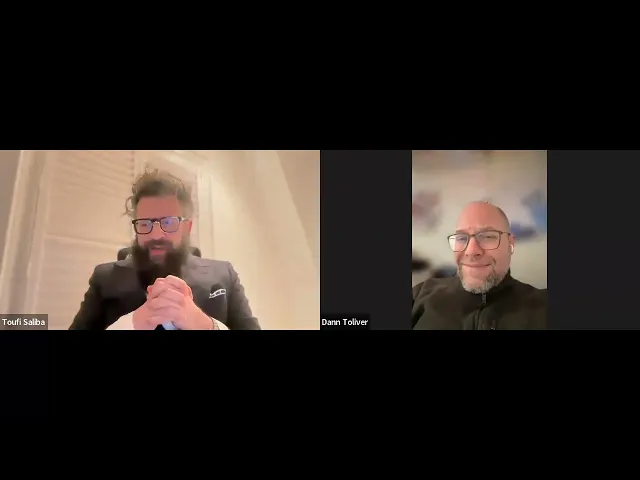
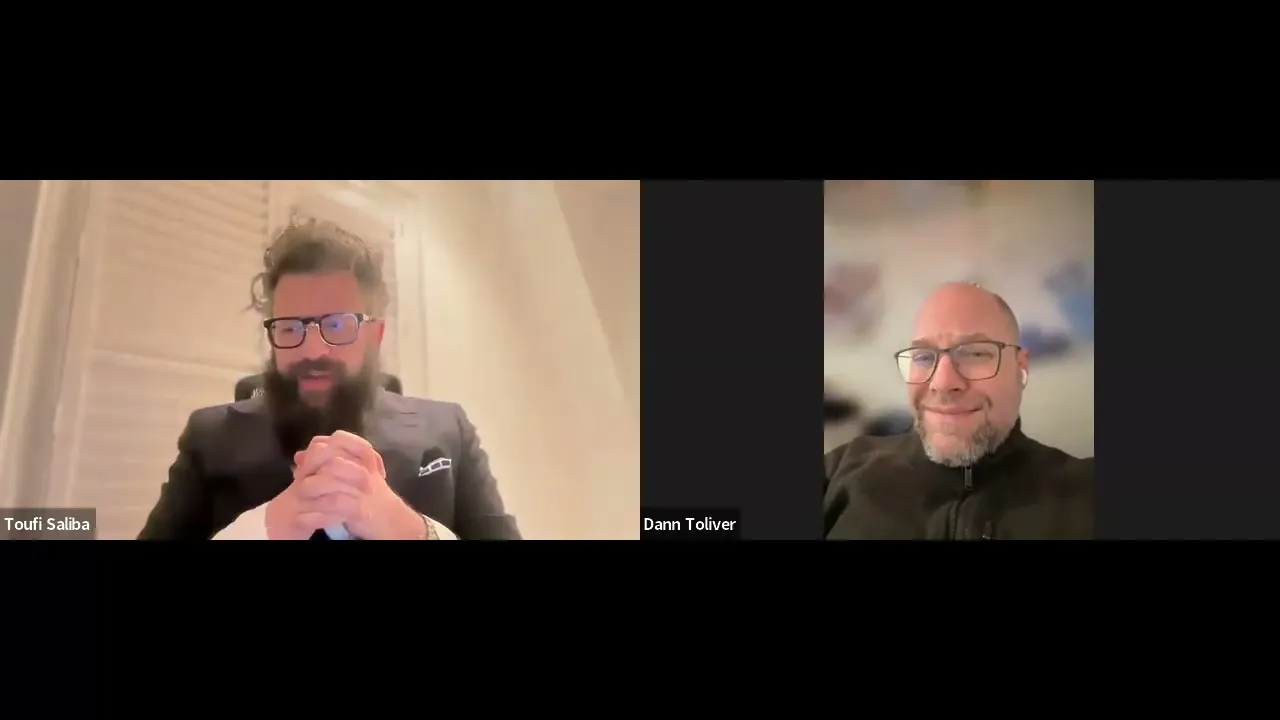
Dan, how's it going? It's good! Merry Christmas!
Merry Christmas to you too! So, uh, we did promise the community and a lot of people in our ecosystem that there would be some major announcements during Christmas, and I think here we are to deliver on some of those announcements. But at the same time, I think it's extremely important to let them know some of the details of those announcements and what they're actually about.
So, um, one of the groups that a lot of people have heard about—the 31 million users that are part of an organization that elected to build on Hypercycle—they are making the announcement on January 7th and not on Christmas Day. We have decided to not be the ones talking; let them do the talking. Let the world do the talking about what's being built on Hypercycle.
Now, um, we have other things as well that can go very well with this, because people are looking into, like, “Okay, this Hypercycle—is it really the infrastructure that can enable the internet of AI? ” We know it is; a lot of people in our community know it is, but the rest of the world doesn’t know that yet. The difference between what we know and what the rest of the world doesn’t know—while we're getting the rest of the world to know—is the actual opportunity that people get to work on.
Otherwise, if everyone in the world knew, then it wouldn’t be an opportunity. So, um, yeah, I feel like we're kind of living in a time where it doesn't matter what kind of AI scientist you talk to. I was talking to or looking at Eric Schmidt, the ex-CEO of Google, and he was saying there isn’t anyone who knows more than 1% of what's out there.
It’s just impossible! Which means that there’s a lot of unknown. But the unknown is whether they’re going in the right direction or not, and this is where people get to feel.
So the three things that I feel like we want to touch on: one is that when we say 31 million users, this is the low estimate. We know that this organization has over 60 million users, and the important thing here is why they elected to build on Hypercycle, in your opinion. So I’ll let you talk about this, and then I can add on a little bit to discuss number two and then number three.
Sure, yeah! I mean, I can talk about what I’m really excited about in terms of what this project is highlighting and the way that it's using Hypercycle and what that speaks to for the future. All of that is really about the interface on top of the multi-agent system under the hood, which is made possible because Hypercycle allows Hypercycle nodes acting as agents to transact with each other and interact with each other across the boundaries that would otherwise keep them apart.
If agents are inside of a single corporate data center, it's really easy for them to interact and transact with each other because they’re all playing on the same team. But once you have incentive gaps that need to be overcome, you need some kind of incentive mechanism; you need the ability for them to transact, to pay each other a little bit, for instance, in order to be able to convince each other to do useful work. That’s exactly what Hypercycle provides, and that's exactly what this particular project is really relying on under the hood, to have all of these different agents able to interact with each other.
Because of the nature of this particular project, it really highlights, and we'll be able to speak to this more directly once the details come out, this aspect of Hypercycle and requires it. We’re not going to mention the organization’s name because they want to be the ones announcing it—their entire leadership team. But we can talk about this because we promised our community to tell them what it is.
Okay, effectively what they've elected to build is a tool. They can talk to this tool—any one of the 60-plus million users—and that would be their companion. That would be the thing that they talk to that represents that organization.
We're talking about an organization with numbers of people larger than most countries. And I think what's really cool here is that they’re not talking to a single entity; they're not talking to a single corporate entity, but they’re also not talking to a single AI entity, if you will. What they're really talking to is they’re in a chat room where thousands of different agents are available, and any one of them can be pulled into this particular room to interact with them and help them get their jobs done and figure out what they’re doing.
Yeah, so the way to talk about a little bit of what we have witnessed so far and what the rest of the world would witness is that the actual interface that enables them to talk to this—whether they go through texting or talk to it via voice—let's say the actual open-source that is being. . .
Utilized, say it is a claw or the llama, and, um, what, uh, what's happening behind the scenes? Like, somebody's got a hypercycle node that's got subscription delic, which is ChatGPT, and then that subscription is enabling this other node to talk to it in fractions of a second and respond. Then, putting in the answer together, it's a composition of many different answers, and this is where the emergence comes in, and then the emergence of the emergence, which is super exciting.
And that's just if you were to say LLMs; but as we all know, AI agency has like 99 different, uh, you know, uh, shapes and forms. So, this is super exciting, and why we're excited about it, again, is because it proves that the factories that we are selling—remember, we're in the business of manufacturing factories—that our community, when they have a factory, what does the factory do? It manufactures nodes.
Those nodes enable people to plug them into any AI, so those AIs can talk to each other. That proves that those nodes actually work, you know? So, it's super, super exciting from that perspective.
People feel like, "Oh my God! I have this factory that is actually making nodes that work! " So, I think this is phenomenal from one perspective.
The other point that I think you wanted to talk about a little bit is some of the added tools for those factories and for those nodes. You have the—oh yeah, yeah—so, HTS is out, and the Node Explorer is ready to go, so that people can go in and use that to see their full history. I'm really excited about that coming out.
We've got a number of demos that are queued up and ready to go, so, you know, as soon as we hit the new year, there’s a bunch of stuff that's going to come out of the pipe, and a bunch of stuff that has come out actually over the last couple of months that came out earlier than Christmas—about a couple of weeks ago now, it did. Yeah, we pushed a pretty major revision to it yesterday, actually Christmas Eve, that fixed up a lot of the issues that people were having. Wow, okay, cool.
HTS, what does it stand for? That's the hyper PG Tiling System. But it is also—so, there are two things that I think are cool about HTS.
One is that it is using hypercycle nodes under the hood, so we’re eating our own dog food here. Part of the reason that it was a little bit tricky to get that out the door is because of our insistence on using hypercycle nodes under the hood and building it in a decentralized and distributed way from the ground up. So, there are actually multiple different hypercycle nodes that are active as servers; it’s a whole distributed system under the hood, and we sort of forced ourselves to do that in order to ensure that there is no dependency on hyper cycle hyper PG.
Those are all fully decentralized. For those that are not familiar with Tiling—although this announcement is more for our 3,800 owners of node factories and growing—they know what Tiling is, but for those that don’t know, Tiling is when your node is doing computation on an ongoing basis. It enables that node to actually manufacture other nodes, but that Tiling includes the ability for the node to tell the world about what it has and to know about the world of what the rest of the world has.
It starts by emitting a lot of cryptographic proof about its own computation, its own uptime, and later on about its own reputation. Those are extremely powerful elements, because many people would be like, "How would the node know that there is some computation somewhere that can help it? " It’s the actual process of Tiling that can enable it to learn about the rest of the network.
It's got a heartbeat and keeps doing that. So, that's the HTS. Another thing that you also released a bit earlier, which is the Explorer, enables people to subscribe to the Explorer.
Here’s the thing: in hypercycle, because it's fully decentralized, there's no dependency on a ledger, so it's not like somebody can build an Explorer and point to some ledger like, "Oh, okay, now I can see how many transactions, whatnot. " That would be a third party; that would be the weakness, and that would not be something that we would ever want to do. There are a lot of L1 blockchains or databases that can enable systems out there, whether it is like an oracle as a company or Microsoft or Google, or whether it is like Ethereum and others.
Those work very well for humans, but when it comes to those machines, they want to talk to each other. If they depend on that third party, it would not work, because the time it takes for a node to reach out to another node—if it’s going to depend on a third party, it would take a lot of time, and then it won't be able to receive the response that it needs in those fractions of a second. And it's also, from a scalability perspective, you all know if it depends on.
. . A third party and we talk about billions of nodes; eventually, they're not going to be capable of going to that third party, and it becomes a central point of, uh, or a single point of failure.
So, yeah, I think the, um, we had actually released the Explorer yet? Yeah, you just did! That was the release of the Explorer.
Yes, yes, this is. . .
so that Explorer, that effectively, it's a service that if you have a node and you subscribe to that Explorer, then the rest of the world can see you. But if you don't subscribe, the rest of the world does not see you, which is not necessarily something that you would want to do. But we've already noticed a lot of nodes; they already subscribe to that—they've been doing Tilling for about a year and three months now.
So, for those that don't know what HyperCycle does, the actual computation of HyperCycle started about a year and three months ago with a process called Tilling—precisely one year, two months, and twenty-five days ago. And that Tilling is the enablement of those nodes to manufacture, um, uh, end-of-those-node factories to manufacture a HyperCycle computation node or network node. Um, so the Explorer is that if you subscribe to it, then others can see that your node has been emitting those cryptographic proofs and heartbeat, and so forth.
But if you don't, it's okay. If you were to ever do any transaction or any, um, thing that you would need, you can keep this data to yourself, and whenever you show it to someone, this data has all the necessary proof that it actually did exist. So that's the second part.
All right, and then the third part is what most people, I think, care equally about. So, the first part we've talked about huge deployment that is being done on HyperCycle, and that uses all the agents in the world— all the AI agents—without having any borders or anything in the middle of it. It's all going peer-to-peer, which is phenomenal.
The second is some of the releases that came out earlier than Christmas, which include the Hyp Tilling service and the Explorer, and there's, I guess, a few more people they want to dig deep and find out. Now, the third one is Project C8. People that they've heard about Project C8 for the very first time publicly maybe about a month ago in, um, in, uh, Twitter space.
So, what Project C8 is going to be doing, it's a 200-day project that starts at some point in January, and what it does for every node factory, it starts adding more factories without people having to ever feel like they have to—oh, do I have to buy this additional factory? Do I have to go reach out? Nope.
This is one of those things that we feel like we always want to set expectations and exceed them. So, somebody owns a node factory. It’d be like, so my node factory— I buy it if at the very smallest level, let's say I buy it for $400, okay?
The one that has 1. 24. Now, of course, if people buy the master, you know, $250,000 or whatnot.
But when you buy that node factory for, uh, which includes both—what is a node factory? —is a node license in order to make it a factory you marry it to the HYP. Great!
You’ve got that node factory. The added elements—some people heard about like Amier, some people about the CTIP, and all of those cool stuff—they would be airdropped into the node. So, if you’ve been doing Tilling, if you’ve had the node already married before that period, then you don’t have to purchase those additional elements, whether they are a result of us buying companies, merging with other companies, or getting those companies that you’ve invested into to be part of HyperCycle.
It is something that somebody who owned a node factory was not expecting those things to be dropped in. So, what does that mean to somebody who's like, okay, well, I've got this factory for B for $400? If I want to add those elements into it, um, so let's say it starts, uh, January 31st, and on August 31st, after those 200 days, somebody wants to go and buy those additional elements and put them into this factory, it would be, so far based on what we have seen with all the elements, a minimum of $2,000 as opposed to $400.
So, um, so folks that they are outsiders, they don’t know anything about this entire ecosystem, they will see that the minimum is $2,000. And the reason why we are so confident of that is because the actual numbers when you add all of those coupons together is actually $9,800. So we're setting it up in a way that if people want to sell off, they'll be selling off at the $2,000.
So those are components that—uh, that's the market price of those components. Now, of course, somebody might say, but who's to say that this market price is going to be the same? It's not going to go up or whatnot.
It might, but we’ve calculated all the elements to see what the floor is, and that's the beauty of this. Because people that they are buying nodes, they're not just buying it because they want to, um, you know, be part of a club or whatnot; they're buying a business. And if you're buying a business, you want to grow this business.
For an outsider who has never heard of this, it is effectively, as of today, the combination of those elements that cost about $400, enabling somebody to have a node factory that can manufacture 1. 24 nodes. That means that in about 6 to 7 years, on average, if you're operating those nodes, you will have about 1.
24 nodes. Imagine each and every one of those nodes generating maybe $10 a month. So people feel like, at the low end of it, if they're looking after those nodes, they could have something valuable—uh, private equity folks, when they look at businesses that generate $10 per node—1.
24 nodes, that's about, you know, $10,000 a month, $122,000 a year. That business can be worth $1. 2 million.
Now, did I say that? Not just me; almost every private equity person, if you were to ask them how much revenue that business generates and how much it is worth, would say that because that's recurring revenue. Now, people might say, "But wait, does that mean that this is like the HPYC price, or is that like the CTIP, or is that like whatever?
" All of those, if you even put them to zero, the actual business itself—that's what those private equity people are telling you the business is generating. So it decouples the value that people are creating by operating those businesses from the elements that constitute that thing. It's kind of like you buy bare metal and plastic and all of the stuff, and you put them together to manufacture this machine, and then this machine starts manufacturing machines.
Suddenly, you have a business that is operating. So yes, Project C8 is effectively, by not just us, but by us and all of the community members, by almost all the companies that we've invested in, we're kind of putting them together, and we are growing from 3,800 to over—we're staying over 5,000, but likely we might go a lot higher than that. We want to grow a lot higher than that.
We want to have, at some point, millions of factory owners, but in those 200 days, I think it’s reasonable to say that we're going from 3,800 owners to about 5,000 plus. And August 31st will come, and when people look at it, it'll be like, "Holy, you're over 20,000! You said 5,000!
" Remember you said 5,000? So let’s keep setting the expectations to a certain level and exceed them. I think it’s quite exciting to see that because a lot of people that came into this did so for the long term, and they see that it's long-term value that really matters.
Because today, if you were to look at this company called HPYC, what are all the assets that it owns? They just look at the HPYC thing. But remember, Hyper Cycle owns all of those other things.
We’re bringing them together and giving them to owners—not telling them, "Hey, you have to buy those. " Amazing! If you were to look at all of the HPCs today, with a valuation of $418 million, the average is about a billion for the last 12 months.
Okay, so we're talking about a company that is known to the world to be a unicorn, but the reality on the ground is that they are a lot more valuable than this, and they're putting them all together so that the node owners can benefit from that. So remember, there is no airdrop for just somebody who owns a license or just some token, this and that. This is for the actual node factory owners who have been having that marriage.
And there are those additional bonuses that are coming down the road that Project C8 will actually enable them. One of them is the education credit. So what does that mean?
You own a node factory, but you’re like, "Man, this is way too complicated, over my head. " Remember, you could be owning a Starbucks, and all the details of operating Starbucks could be over your head. But somebody needs to learn that stuff.
In order to learn it, they need to spend time, effort, and often money. You know, you don't go to university for free and whatnot. So that education thing is estimated to cost between $3,000 and $99,000 because of Project 999.
We call it nine hours for almost anyone to learn just the essentials, nine days just for the developers to learn to do some sophisticated stuff with those nodes, and nine weeks, which can enable somebody with a little bit of tech knowledge to become just as good as those developers can become in nine days. If people want to opt into that program, they need to pay the educators. Remember, those educators are coming in from many different places.
So Project C8 can set it up in a way that it isn’t— we’re not a company that’s doing this to make profit from this. Not at all. The educators and all of that are the ones who will be making the money.
However, a node owner is going to get those credits. So, somebody who owns a node can take that credit and give it as a present to someone who becomes the operator. This is how you distinguish: the node owner doesn’t really need to learn all the details of how this factory functions, but an operator does need to learn.
To do that, and if the operator needs to know that, then they need to learn. If they need to learn and they're going to, um, pay money for that education, that’s if they’re extremely external. But if they know a node owner—every node owner they have, like that one, take it that they can give it to somebody—then they may want to give it to somebody who is really going to take it seriously.
Um, so yeah, so that’s—uh—super exciting. Um, and as more exciting stuff they, uh, unravel, we will share with the community. Stay tuned for an announcement somewhere on the web; somebody's going to be talking about it on January 7th.
If it happens before, we will let you know. Project C8 will launch at some point in January. I said January 31st; it’s looking like it might be a lot sooner as well, but at some point in January is when it launches.
You will have about 30 days where the very first 30 days of its launch will keep the actual note factory at whatever static price that it is, and then from there on start adding the elements, and that note factory will start to grow into a phenomenal factor. It has all the components that can actually, um, function at a lot faster, better speed. Like, for example, for those that don't know, MFire is the ability to, uh, reduce the development time when you want to add any AI into HyperCycle.
So, um, the metaphor that I've used is that, like, humans, they go on and get ISP (Internet Service Provider) in the '90s, and you get like this technician who comes in and spends all this time to kind of plug it into your home and all of the stuff. And then they have to install those components onto your, uh, computer, and it takes like, wow, all of these, uh, hours. Imagine there’s a tool that you can click on and it does it in like, you know, 10 minutes.
So that’s precisely what MFire does, right? So, um, and all the other, uh, amazing tools like CTIP and others that get to be added, a lot of value being added, uh, you know, and we know what the floor value is going to be of those elements, and we know how beneficial that would be for, uh, node owners. We’re here to make sure that our clients are successful.
So, if you are a node owner, if you’re a node factory owner, you are our clients, so we want to make sure that you’re successful. So, continuing that journey, is there anything—any closing remarks you’d like to say? Then that was great!
Yeah, yeah, looking forward to this coming year; it’s going to be great! Fabulous! Well, thanks!
Then I’ll, uh, send this recording to folks, and hopefully, they will push it to the community. We’re always looking to, uh, grow together. And remember, if you’re part of this community, you’re partaking in building this.
That’s why we did it with full conscience that this project, C8, you are not going to buy for those additional elements. Even if we have invested in all of these companies or bought those companies and brought them together, um, you’re just going to get them airdropped. Now, of course, if somebody’s going to come in after August, they’re going to have to pay for it, and through that period, it will be like stages of that.
And then, um, beyond January 7th, you’ll be able to walk around town and tell them, “Yeah, I’m part of this project that’s enabling over 60 million people. ” Um, so, on that note, this, uh, entity—they have over 10,000 offices in the world, and they’re going to have a lot of, uh, HyperCycle nodes in those offices. So, for anyone who has a lot of, uh, nodes and they would want to, um, enable this, uh, entity or partner with them or sponsor or whatnot, um, let us know when the time comes because they’re really taking it seriously.
They’re starting with looking over those 60 million people, and they want to have a rack for each and every one of those offices. That way, the data remains in each and every country; they are conforming to all of the regulations in all of these countries. Furthermore, um, the user is another level of that multivectorization; they keep the data into their own device.
So imagine it learns about you, but it’s yours that’s learning about you. There’s nothing going to the world; it’s yours. And then in that center, it’s got some confidential data; it stays in that center, doesn’t go to the world, and so on and so forth, which is super awesome.
Of course, because it has a multi-agent system, that means it’s capable of reaching out to all of the newest and latest AIs that are out there. All right, um, then thanks! And Merry Christmas to everyone!
Hopefully, people can treat this as a nice present from this group that’s been working, uh, you know, nonstop to get us here. Yeah, Merry Christmas, everyone!