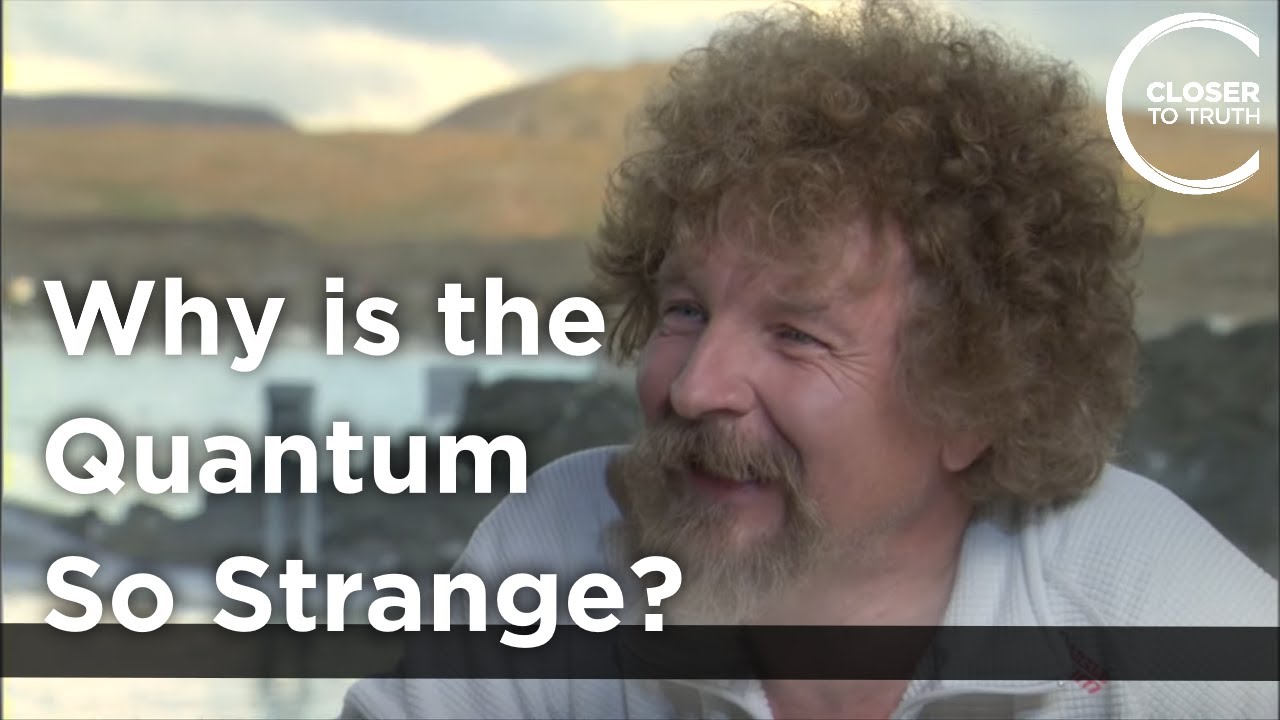
Wojtek I want to understand reality I'm told that the understand reality I have to understand quantum theory and to understand quantum theory I'm gonna come to you I'm honored so the reason we need to understand quantum theory before we understand reality is that quantum theory is the only theory which is encompassing everything it has no limits non limit that we know of at least so quantum theory was discovered by looking at things which are very small electrons atoms photons but as time progressed we started testing it in systems which are bigger and bigger and in
some sense the tests were done in the hope that it will break down and it will break down their way which which will affirm our classical prejudices and quantum theory is weird it is weird because it's so a gallate area in quantum theory any superposition of states is a legal state now I know when that idiot tell me what that means this means that if this glass can be here and it can be there yes it can be also in here and there at the same time we don't see things which are here and there
we see things which are real which are which are localized which are indefinite places and something else ought to come in if quantum theory is the only theory and we say that no matter how small we look at things and microscopes we never see things in two places well in microscope you have evidence of things being in two places right so in some sense for example electron microscopy works because things are in many places at the same time and then get recombined okay so microscopy electron microscopy is is there because quantum mechanics is there in
fact you know if you look at applications of which are which are having a big market share to use you know a measure which we cannot understand a lot of that weight cause of quantum mechanics transistors computers run because of quantum mechanics transistors run video discs video discs lasers if you look at chemistry it is there because of quantum mechanics so quantum mechanics is the theory which underlies all of our normal everyday applications we've grown accustomed to okay let's understand the weirdness the weirdness is this superposition the weirdness part of the weirdness the place where
the weirdness start okay is a superposition it gets weirder it gets weird rounding the wielder part has to do is a fact that in classical physics if you have a well-defined state of an object which consists of several pieces this means that you have a well-defined state of each of the pieces and quantum mechanics is not the case in quantum mechanics you can know everything that is to be known about a collection of objects and yet to be you can be left in a situation where you nothing about any of the parts so these are
the entangled States in some sense they are consequence of superposition but they are strange enough and characteristic and have consequent of superposition to take and give another name okay and what else is there I've heard that that if you can have particles separated by very large distances and if you know something about one suddenly you know something about the other absolutely almost instantaneously and the information can't trend doesn't go between the two it's impossible so this is a consequence of entanglement so entanglement is an intimate knowledge of two particles about each other and that knowledge
is so intimate that it precludes any communication with anything else so these two particles know about each other so well that indeed if you ask a question of one of them and it gives you the answer the other one will give you a correlated answer no matter how far away no matter how far away so the interaction doesn't matter the state is a shared property I mean and that's and the particles can be so far apart that even light would not have a chance to communicate and this has been expert this has been confirmed experimentally
so people have done very clever and and increasingly convincing and increasingly sophisticated experiments where they separate these particles by distances which are further and further apart clearly the communication as limited by the speed of light cannot transfer information from one particle to the other and yet they are perfectly correlated so what we're saying is that the the theory that underlines all reality that describes the microworld in its entirety has these elements in it which seem so totally inconsistent with everything we know about the way the world is absolutely you are you I'm more mystified now
yeah how do we make progress in understanding this is it possible it is possible and I think one of the links we were missing until recently and had to do with our prejudices of how we understood classical theories in classical physics we always thought that a system by itself is something to be understood really in separation from the rest of the universe and there are many examples of why it's a good strategy and so on and so forth and people have gotten used to the fact that you read to understand the system before you understand
its interactions with it with the rest of the universe now in quantum mechanics it turns out that because of entanglement the nature of these interactions the consequences those interactions are so subtle that the fact that even very weak interactions exist can change the behavior of the system in a very dramatic ways so in fact the most quantum aspect of quantum mechanics which is entanglement can help one understand how quantum mechanics ends up explaining what we see classical so help me understand how superposition how entanglement can help us understand how the microworld explains the macro world
so superposition is a problem right superposition is a fact that this glass according to quantum mechanics can exist here and there at the same time entanglement is for one step up above superposition it's a combination of locations of several different objects the interesting thing is that entanglement even though it's in many ways the weirdest consequence of quantum mechanics maybe the way to understand classical physics or how classical physics emerges from quantum mechanics well that's the key question how classical physics the physics of the world that we see in our ordinary lives in the universe we
look out see a planet star how one 'm comes from the other absolutely so the key point in decoherence which is what I want to tell you about is that quantum systems are not isolated they interact with their environments when they interact with their environments they leave records they leave memory in their environments so there's a transfer of information so I'm calling decoherence this I am calling because it's ok the quantum is this wave this probability of where it where things are right and and when that D coheres then that's the the the interaction with
the environment that's right so the interaction with the environment allows the environment to know where an object of interest is or that it was a just a probability of it's worse than that before that it was a superposition okay after the interaction happens it becomes a probability okay so after that so before the interaction with the environment happened you had doodles of possibilities essentially all of them incompatible with what we see in the real world after that interaction happens you end up being offered a menu but the menu has only uh net positions which are
classical hold important okay so decoherence because it involves entanglement in the system and the environment ends up fixing the set of possible things which can happen it doesn't he'll tell you which one of them happens but it tells you the set of possibilities and the set in models that we can calculate is classical and that's the probability and then you can say I assign probability to this set of possibilities all right okay so how then can we go back and say well what what is really happening in quantum theory is is this just a mathematical
formulation that is a that it's a kind of a way to understand some some reality or is this really what's happening is that a fair question I think it's probably a fair question let me try to answer and then you'll then you'll judge all right so so so my take on it is people are doing exceedingly more sophisticated experiments on verifying quantum mechanics and they get better and better limits on the fact that quantum mechanics is obeyed and larger and larger scales now we know that component which make objects which we deal with are definitely
fundable so the questions that can arise is does anything strange happen when these objects can be bigger and bigger right nothing seems to everything seems to be still quantum so if in a controlled situation when the system is isolated it behaves as if quantum laws were sacrosanct so I think the isolated me requirement is the key it's not just the size the size can get bigger and I could have this quantum weirdness is maintained so you put your finger on the key thing if the system gets bigger it's harder to isolate from the alarm so
if something is as small as an atom or an electron it sees well you can make it separate and and and keep it carefully away from everything else but if something is as big as as a glass or as you or me that's impossible let's drink to quantum mechanics let's drink to quantum a kinder stand it a little bit better but let me make one more point one more put before we drink before we drink okay okay so there is a very good evidence that you are I leave a very definite imprint in the environment
and that evidence comes simply from the fact that I can get all the information that I get about you looking at you and you can get all the information looking about about me from the photon environment so the photons reflect from us and the tiny fraction of the photon environment that we intercept with our eyes allows us to extract a lot of information about each other so that means that really is this environment which has a memory of what has happened now let's drink let's drink to it