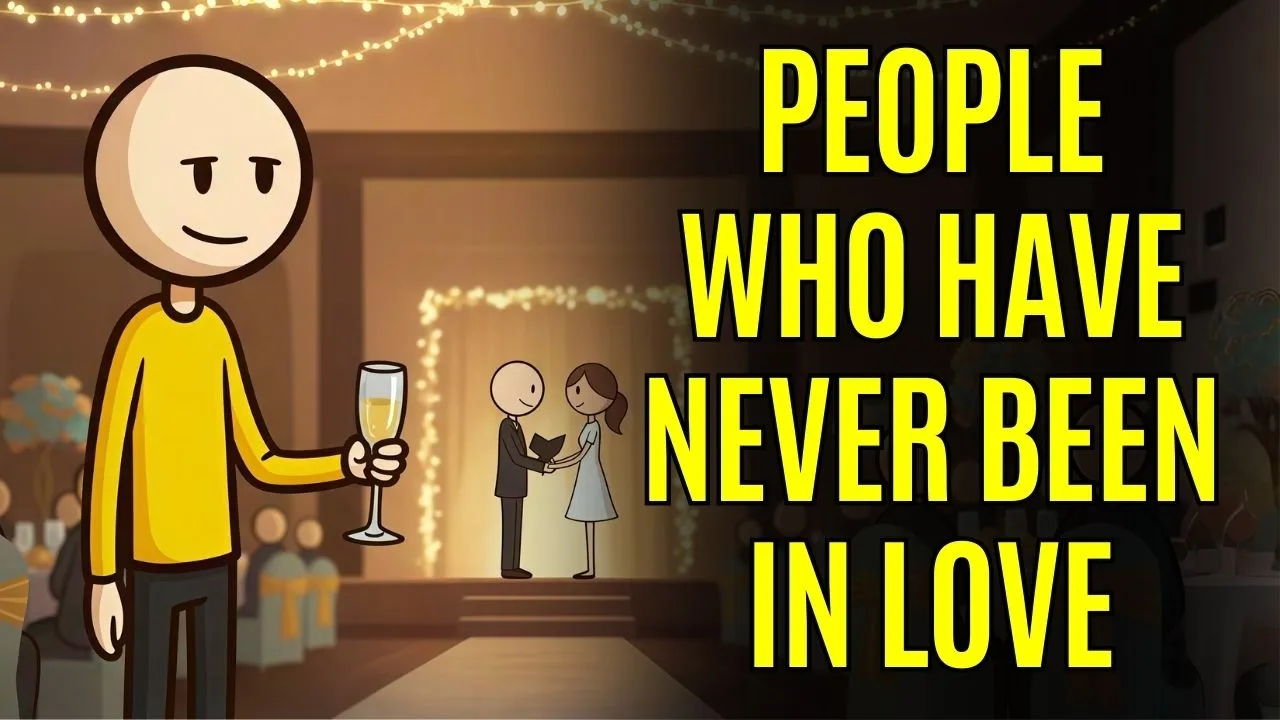
What if you're in your 20s, 30s, or even older, and you've never been in love? Not once. No butterflies, no late night obsession, no devastating heartbreak, not even that one person who completely rearranged your emotional world.
And no one really talks about that. You sit at weddings and watch two people promise forever. You scroll past engagement photos and anniversary captions that say, "I can't imagine my life without you.
" Your friends analyze their relationships over coffee. The chemistry, the red flags, the almosts. You nod.
You smile. You say the right things. But quietly, in the back of your mind, there's a question that feels almost shameful to admit.
Why hasn't this ever happened to me? We live in a culture that treats romantic love like a universal right of passage. Movies build entire plots around it.
Pop songs orbit around it. Social media amplifies it. The message is subtle but relentless.
Falling in love is not just normal. It's expected. So if you haven't, it can start to feel like you missed something fundamental.
Like everyone else received an emotional blueprint you somehow [music] never downloaded. But here's the truth. Not being in love does not automatically mean you're broken.
It means there is a deeper story behind your experience. One shaped by psychology, biology, environment, and timing. And today we're going to uncover it.
To understand why you may have never fallen in love, we have to start with how your brain learned to connect in the first place. In the 1950s, psychologist John Bolby introduced attachment theory, later expanded by Mary Ainsworth. Their research revealed something profound.
The way your caregivers responded to you in early childhood quietly shaped your emotional blueprint for adult relationships. If your needs were met consistently, comforted when you cried, reassured when you were afraid, you likely developed a secure attachment. Love feels safe.
Intimacy feels natural. But if your early environment was emotionally unpredictable, dismissive, or critical, your nervous system had to adapt. For many people who have never been in love, that adaptation looks like dismissive avoidant attachment.
On the surface, it doesn't look dramatic. You might pride yourself on independence. You don't need anyone.
Your self-sufficient, capable, composed, but underneath that strength, your subconscious may carry a quiet belief. Depending on others leads to disappointment. So, when someone [music] gets close, when there's potential for romance, your brain doesn't flood with warmth.
Instead, your [music] threat detection system activates. The amydala scans for danger. Cortisol rises.
Vulnerability feels unsafe. You might suddenly notice small flaws. The way they text, the way they laugh.
Something feels off. You interpret it as [music] lack of chemistry. But sometimes it isn't chemistry that's missing.
It's safety. There's another pattern, too. Anxious attachment.
In this [music] case, love feels overwhelming before it even begins. You overanalyze every interaction. You fear rejection so intensely that you never initiate.
The relationship dies before it has a chance to breathe. In both cases, you didn't fail at love. Your nervous system protected you from what it once learned was dangerous.
The tragedy and the paradox is that the very shield designed to keep you safe may also be the barrier that keeps love out. But what if the issue isn't fear of intimacy? What if it's something quieter, something harder to see?
There's a concept in psychology called childhood emotional neglect. It doesn't mean you were abused. It doesn't mean your parents were cruel.
In fact, many people who experienced it will say, "My childhood was fine. " And that's exactly why it's so invisible. Emotional neglect happens when a child's physical needs are met.
Food, shelter, education. But their emotional world is never truly mirrored back to them. No one helps them name what they're feeling.
No one says, "I see that you're hurt. " No one teaches them how to sit safely inside their own emotions. Over time, the child adapts by disconnecting from those feelings.
As adults, this can show up as something called alexathyia, difficulty identifying or describing emotions. You might feel neutral most of the time, calm, even stable. But when people describe falling in love as overwhelming, intoxicating, all consuming, you feel nothing close to that.
It's not that your heart is empty. It's that your emotional vocabulary was never fully developed. You can't [music] fall deeply into an emotional experience if you've learned to live slightly detached from your own inner world.
For some people, the question isn't, "Why haven't I fallen in love? " It's, "Was I ever taught how to feel safely enough to recognize it? " And that realization isn't a condemnation.
It's an invitation [music] to reconnect with parts of yourself that were never given space to grow. Now, we need to consider another possibility, one that has nothing to do with trauma, fear, or emotional blocks. What if you've never been in love simply because romantic attraction [music] isn't part of your natural wiring?
Modern psychology increasingly recognizes something called the split attraction model. It suggests that romantic attraction and sexual attraction are not the same system. They operate independently.
You can desire physical intimacy without craving candle lit dinners, emotional merging or lifelong partnership. You can also long for deep companionship [music] without experiencing sexual attraction. If you fall somewhere on the aromantic spectrum, your brain may not generate the same neurochemical cascade, dopamine, oxytocin, norepinephrine in response to romantic cues that other romantic people experience.
It's not repression. It's not immaturity. It's not fear.
It's orientation. Our romanticism exists on a spectrum. Some people never experience romantic attraction at all.
Others identify as gray romantic. They feel it rarely under very specific circumstances. Demi-romantic individuals may only develop romantic feelings after a deep emotional bond has been established over time.
In a culture that assumes romance is universal, what some researchers call compulsory romance, realizing you don't experience it the same way can feel isolating. You might question yourself. Wonder if you're delayed, broken, missing something essential.
But consider this. If someone is colorblind, we don't accuse them of failing to see red. We recognize their perception is simply different.
Romance may not be your primary language of connection. That doesn't make you less capable of intimacy, loyalty, or depth. It just means your emotional landscape follows a different map.
And there is nothing defective about that. There's another layer that rarely gets discussed in conversations about love, neurodeivergence. If you have ADHD, are on the autism spectrum or process social information differently, romantic connection can feel less like magic and more like a complex code everyone else somehow learned to read.
Flirting, for example, is often indirect. It relies on subtle cues, prolonged eye contact, [music] tone shifts, playful teasing, ambiguous text messages. For some neurode divergent individuals, these signals aren't intuitive.
They can feel confusing, inconsistent, even stressful. You might replay conversations in your head for hours, wondering, were they interested or just being [music] polite. Or you might miss signals entirely, only realizing months later that someone had feelings for you.
Dating environments can also be overwhelming. Loud restaurants, [music] rapidfire small talk, the pressure to perform socially, sensory overload, and social fatigue can shut down your ability to feel present, let alone romantically open. This doesn't mean you're incapable of love.
It may mean you require clarity over ambiguity, direct communication over guessing games, emotional safety over performance. In a culture that romanticizes spontaneity and unspoken chemistry, your nervous system might simply be wired for a different rhythm. And that difference deserves understanding, not self-criticism.
But what if you do want love? What if you don't feel avoidant? You're not aromantic.
You don't struggle socially. And yet, it still never happens. Welcome to the modern dating landscape.
In 2004, psychologist Barry Schwarz introduced the concept of the paradox of choice. His argument was simple but unsettling. While some choice increases freedom, too much choice increases anxiety, paralysis, and dissatisfaction.
Now apply that to dating apps. For the first time in human history, you carry access to thousands of potential partners in your pocket. Swipe, match, scroll, repeat.
On the surface, this should make love easier. But neurologically, it does the opposite. Each swipe activates a small dopamine reward loop.
Anticipation, possibility, novelty. Your brain begins to crave the potential of someone better, funniest, smartest, most attractive, most aligned. So when you go on a date and it's good, not electric, not cinematic, just human, your mind whispers, "What if there's someone 10% more compatible?
" This is where perfectionism quietly enters the room. If you're high achieving in other areas of your life, you may unconsciously treat relationships the same way. You optimize, you compare, you measure, you hesitate.
But love doesn't reveal itself in bullet points. The illusion of the perfect partner keeps you scanning instead of investing, evaluating instead of experiencing. You're not failing at love.
You may be trapped in an environment that trains you to see people as options, not as evolving human beings. [music] And in that environment, commitment can start to feel like a risk instead of a choice. Long before dating apps, many of us were conditioned [music] to expect love to feel cinematic.
We grew up on Disney endings, romantic [music] comedies, pop songs that describe love as overwhelming, undeniable, destined. Two people lock eyes across a room and suddenly the world rearranges itself. That narrative runs deep.
It quietly teaches us that real love should feel like fireworks. [music] Instant chemistry, effortless certainty, a soulmate who fits so perfectly that doubt never enters the picture. So when real life presents something slower, quieter, more ambiguous, it can feel disappointing, no dramatic soundtrack, no lightning bolt moment, just two imperfect [music] people trying to understand each other.
For some, perfectionism amplifies this conditioning. If you hold yourself to impossibly high standards, you may do the same with a partner. You create a mental checklist, shared values, matching ambition, emotional intelligence, physical attraction, timing, stability, and the moment someone falls short on item 14, you withdraw.
But here's the uncomfortable truth. Fantasy love is frictionless because it isn't real. Real love unfolds gradually.
It includes awkwardness, missteps, growth. If you've been waiting for something epic enough to justify surrender, you may have overlooked connections that were simply human. And human doesn't sparkle.
It deepens. There's another reason you may have never fallen in love, and it has nothing to do with fear, standards, or wiring. It might be survival.
Psychologist Abraham Maslo proposed that human needs are hierarchical. At the base are survival needs, food, safety, stability. Only after those are secure do we naturally prioritize love and belonging.
If your teens and 20ies were spent trying to stabilize your life financially, emotionally, mentally, your brain may not have had the capacity for romance. Maybe you were navigating family chaos. Maybe you were dealing with anxiety or depression.
Maybe you were focused on education, career, or simply staying afloat in an economy that felt unforgiving. When your nervous system lives in fight orflight mode, it prioritizes control and predictability. Romantic love, by contrast, is uncertain, vulnerable, disruptive.
Biologically, love is not a survival requirement. Safety is. So while others were experimenting with relationships, you may have been building foundations, paying off debt, healing trauma, learning independence, becoming stable.
From the outside, it can look like you're behind. But development is not a race. For many late bloomers, love doesn't appear until life feels steady enough to risk it, until the nervous system finally exhales.
You weren't failing at love. You were protecting your future. And sometimes love arrives not when you're young, but when you're finally safe enough to receive it.
Even if you've made peace with your story, there may still be emotions you don't talk about. Envy, for example, not the bitter kind, but the quiet ache when a close friend gets [music] engaged. When your sibling builds a life with someone.
When you're the only one without a plus one at the holiday table. You can be genuinely happy for them and still feel the sting. Loneliness can show up in subtle ways, too.
Not dramatic isolation, just the [music] absence of having one person who chooses you first. The absence of being someone's emotional home. And then there's shame.
The shame of family members asking, "So, are you seeing anyone? " The shame of feeling developmentally out of sync. the shame of wondering if there's something you're not understanding about being human.
These emotions are heavy because they're rarely acknowledged. Society assumes that if you're single and haven't been in love, you must either be carefree or flawed. But the truth is more complex.
You can be strong and still feel left behind, self-aware, and still feel unwanted, independent, and still crave closeness. Naming these emotions doesn't make you weak. [music] It makes you honest.
If you've never been in love, here is what I want you to remember. Romantic love is not the only evidence that your heart works. In ancient Greek philosophy, there wasn't just one word for love.
There was os, passionate romantic desire. But there was also fyia, deep friendship. [music] Stoga, familial devotion.
And Felutia, self-love, the quiet ability [music] to feel at home within yourself. Our culture elevates OS as the ultimate achievement. But a life can be rich with connection [music] without following that single script.
You may not have experienced romantic infatuation. But have you cared deeply for a friend? [music] Felt protective over a sibling?
Sat beside someone in their grief? Learned to forgive yourself? That is love.
Wholeness is not granted by another person. It is not unlocked by a relationship status. You are not half of anything waiting to be completed.
Maybe love will arrive later. Maybe it will look different than the movies. Maybe your capacity for connection expresses itself [music] in ways the world doesn't always celebrate, but you are not behind and you're not broken.
If this video made you feel seen, let me know in the comments. Share your experience that this is a space for honest conversations. And if you want more psychology- based reflections on the quiet parts of being human, consider subscribing.
You're not alone here. Thank you for watching.