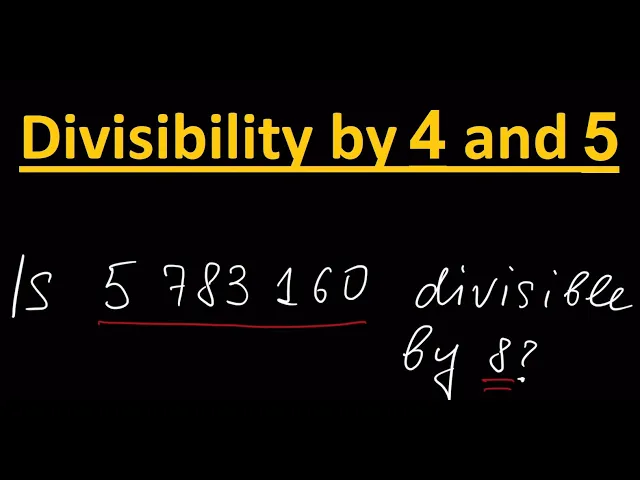
um let's continue the visibility criteria for number four and this quad criteria is last two digits digits are zeros or form a number a number divisible by four so we look for example we have a number we have to look just at the last two digits last two digits of our number and if this last two digits are zeros or the last two digits for example two and nine uh form a a number 29 for example if this number is 4 and 8 it forms a number 48 and if this formed number is divisible by 4 our initial number will be divisible by 4. let's begin with examples and then we will prove the result examples first example is 8264. um is this number divisible by 4 the answer is yes because 64 is divisible is divisible by 4 and that's why let me write just yes so our big number 8264 is divisible by 4 because 64 is divisible by 4.
another example is number 1352 is divisible by 4 yes because number 52 is divisible by 4. and if we divide 52 by 4 it will be 13 that's why the answer is also yes example um because look at result we have last two digits are zeros or form a number divisible by four let's assume an example where the last two digits are zeros so 27 000 on 272 000 800 is divisible by 4 because sorry is divisible by 4 because it has two zeros as last digits that's why an answer is yes and the last example fourth example is number big number two seven two eight one four two 200 72 814 is not divisible by 4 because 14 is not divisible by 4. so an answer is no next let's prove this result begin our empty triangle i assume we have a number a b c d a b c d of course it can be a bigger number it can be a b c d e f g and so on but assume for simplicity we have four digits number and let's write um powers of 10 for easily writing decimal representation for this number 0 1 2 3.
if you don't know decimal representation look at our previous tutorial i'm trying to give information in such way that everything which is used now is explained before i'm trying to do it let's see how it will be so let's write decimal representation it will be eight times 1000 plus b times 100 plus c times 10 plus d times one and we have a divisibility by four of course this element of our sum is divisible by four so we put yes this v means yes this also divisible by 4 let's just put v is also divisible by 4 and look at this c times 10 plus d times 1. obviously this is the definition of the number cd where c and d are digits and it has decimal representation of c times 10 plus d times one let's rewrite it for better explanation c d is equal to c times 10 to the power 1 plus d to the power 0 or c times 10 plus d times 1 and we have here here this number so if the number formed by last two digits is divisible by four or in other words if this number is divisible by four our pre initial number is divisible by four and it is the proof of our result so we just take last two digits and look at number um which is um generated which is formed by these two digits and if this number is divisible by 4 or c and d are equal to zeros of course they this part will disappear and our number will be divisible by four because uh this is divisible by four and is also divisible by four so it's obvious let's go further um divisibility criteria for number five and it's if last digit is 5 or zero it's actually quite obvious but anyway um we will try to prove our result to be rigorous examples examples 6820 is divisible by five because last digit is zero it must be zero or five um seven thousand one hundred fifteen is divisible by zero is divisible by five sorry we cannot divide by zero never do it last digit is five that's why this number is divisible by 5. third example 8146 is not divisible by five because last digit is six and six is not equal to five and zero and that's why our number is not divisible by 5.
let's prove this result let's prove this result and assume we have a number a b c d let's write its powers of 10 for better writing our decimal representation it's a times 1000 plus b times 100 plus c times 10 plus d times one and any what this um element of our sum is divisible by 5 because 1000 is divisible by 5. 100 is divisible by 5. that's why this element b times 100 is also divisible by 5.
c times 10 is also divisible by 5 and everything depends on this d is d equal to 5 or d equal to 0 if d is equal to 5 then every element of our sum is divisible by 5 and our resulting number initial number is divisible by 5.