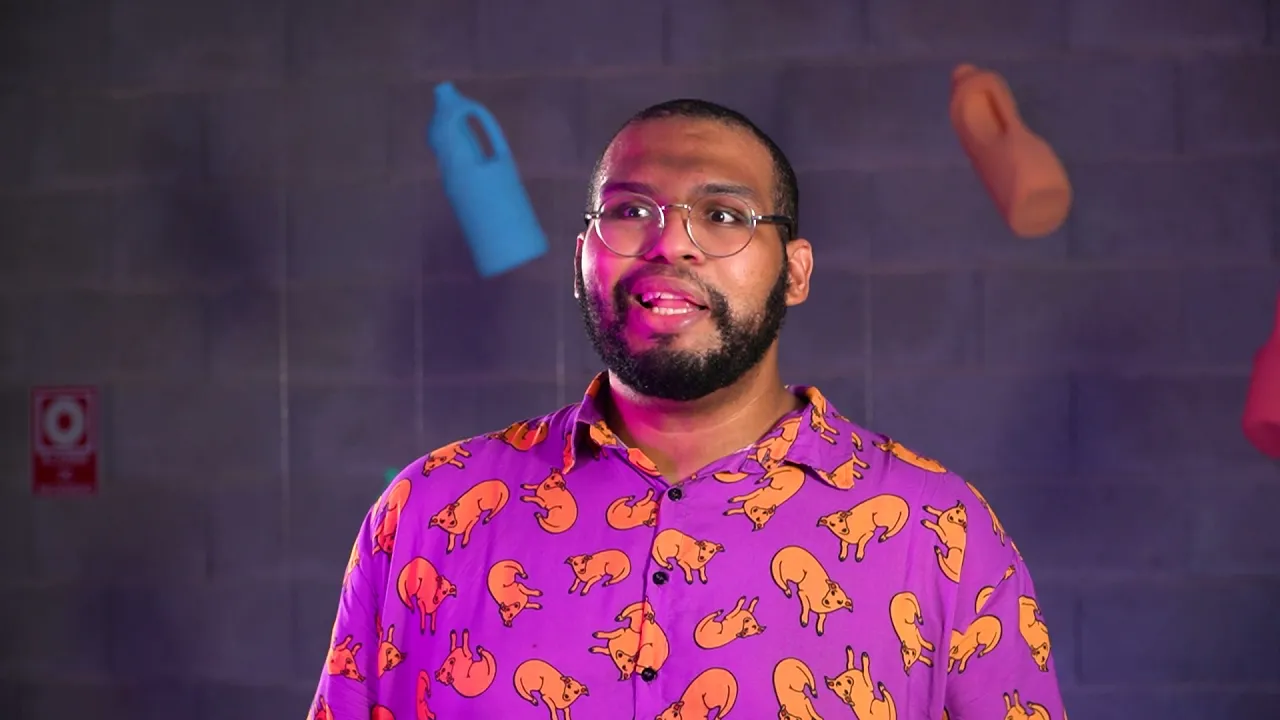
Translator: David DeRuwe First of all, good morning, good afternoon, and good night. Independent of when you’re listening to this conversation, I invite you to get to know a little about my work and my world. But first, I want to invite you to think about a hypothetical world - a world where everyone has access to information, where 59% of young people living in the favelas aren’t unable to access a computer or the internet, where everyone has access to the technologies of today’s world, and opportunities aren’t different for those who live in the favela than for those who live where the roads are paved.
Today, we say that knowledge is in the palm of our hands - in our smartphones, tablets, and computers - and the only ones who don’t learn are the ones who don’t want to. But is this reality? Should we take this literally?
With examples taken from my professional and personal life, I can prove to you that it’s not really like that. I’m one of millions of young Brazilians who have had their lives impacted directly by the transformative power of education. Education made it possible for me to accomplish things and go places I never imagined could be possible, but, during my personal and professional journey, education had a partner accompanying it, side by side, and that was technology.
Technology wasn’t presented to me in my school’s last-generation laboratory or with a supercomputer in my home. In addition, I was poor and there was no money for this in my childhood. Technology was presented to me by my father when he gave me my first video game and said: “Son, from here, it’s up to you.
” When the video game control broke, I had two options: I could try to find money to buy a new one, or I could learn to fix it. I chose the second option because I didn’t have money, and that’s how I learned electronics - from curiosity. This turned into an addiction because I didn’t stop with the video game control.
When I looked on the street, I saw appliances and electronic devices in my neighbor’s trash, on the streets of Complexo do Alemão and Morro do Adeus, so I picked them up, took them home, took them apart and tried to fix them. Because technology gives us this high - it turns us into curious beings and opens up a whole new world where we constantly want to know the how, the why, and the reason for things. And that’s how I learned electronics at such a young age - through curiosity.
In 2018, I founded a maker lab at my university without having the least idea what maker culture was all about. Today, I can tell you what maker culture is: Maker culture is nothing more than the culture of making things using basic concepts of carpentry, electronics, robotics, and the arts. It was in this laboratory that I first encountered the technology tool that today is what motivates me in everything I do: I was introduced to a 3D printer.
The university’s 3D printer was an American brand called MakerBot. It was love at first sight for me, and I said, “I’m going to buy you. ” I went to the website, and it cost R$ 15,000 to R$ 18,000 on the Maker Bot site - this in 2018, so I said, “No, I’m not going to buy you.
” That printer would have cost as much as a new Fiat Uno car. But still I thought, “If a gringo can get that, I can too. ” At that time of my life I was thinking about that phrase: “Knowledge is there for us all; it’s in the palm of our hands,” because really it was.
Through YouTube videos, international forums, and websites, I managed to store up all the knowledge about the production of these machines, and after six months, I’d already absorbed all the theory. Beautiful, let’s make it! But I didn’t have the tools to put my knowledge to use.
So I decided to use what I had access to: electronic scrap materials. I got these scrap materials from a collectors’ co-op called Coopama, where I learned about recycling and the circular economy. In this co-op, I managed to find the needed supplies, and after spending R$ 680.
10, I made my first 3D printer . . .
using scrap materials. Right then, I was facing a reality that other young people in the same social conditions I was in face today: they must confront 10 times more obstacles and difficulties to reach the goal they desire so much. It was then that I faced my first social and technological abyss, where I saw that I wanted to have access, and I would have a hard time getting it.
In 2019, I gave my first lecture, and I went to a public high school called Padre Manuel da Nóbrega. In this school I gave a 20-minute talk with 100 students in the room, and then I stayed two hours responding to the students’ questions. Most of these questions went like this: “Cool, man.
Can I do this? ” “Do I have the capability to do what you did? ” “Do I have the capability to learn?
” “Hey, could I one day put a business like this inside my house? ” It was then I realized my life wasn’t about making cheap printers; it was about the sharing of knowledge. It was from this pain that I founded my startup, Infill.
Infill was started with one specific goal: the democratization of technologies in the favelas. The main objective is to transform the favelas into true Wakandas where we can see poor Black youth improving the local reality of their communities, as well as discovering themselves and creating new businesses. And too, because young people always wanted to learn from my example, I developed a booklet that, in a simplified way, they could use to learn to build their own 3D printer.
I gave this to every young person who wanted to learn. In this way, I was democratizing the access to technology. Today, three Rio de Janeiro NGOs have my printers, and they are used as tools for social change in robotics and technology classes for young people and children.
But man, if the maker culture is really so incredible, why not take it into the favela? Since I was thinking about this, I decided to do a field survey, and I randomly interviewed 30 young people from Complexo do Alemão. I asked them: “My young friend, do you know what maker culture is?
” The thirty responded: “No. ” I know most of you attending this talk must be asking yourself: “Really, all the answers were negative? ” But it’s likely because you’ve experienced American cultural influences in your children’s school or in your work.
But these young people are part of the same social system as I was inside the favela. Maker culture wasn’t a part of their daily life. This was a response I already knew would be negative.
Why? I was a teacher at an upper-class school in the South Zone of Rio de Janeiro. In this school, my students, from when they were six years old, all had access to a notebook, internet throughout the school, a robotics lab, an IT lab, a maker lab, and programming classes.
From six years of age! Compare that to young people from my community who barely had access to functioning school computers or broadband internet or a computer in their houses. This may be a reality that seems hard to hear, but for Rio de Janeiro residents, like me, we’ve come to deal with life on both sides of this inequality divide.
These are shocks of reality in Rio de Janeiro, frightening social shocks as we’ve moved into the 21st century. Two great thinkers have helped me to think: “How can we get technology to this young person? ” One of them was my grandfather, Israel.
My grandfather only studied until the third grade, and he came from the countryside in Minas Gerais to work in Rio. My grandfather always taught me that through education I would get to where I wanted, and I would accomplish what I wanted. The other great thinker was Paulo Freire, who taught me that teaching is understanding a reality and then transforming it.
So, I had wanted to put totally elitist and “gourmetized” technological learning down the throats of young people, and in the wrong way. I had to learn to read the reality that I was experiencing. I rephrased the question for these young people: “So, man, do you know what a “gambiarra” is?
The answer was positive. Everyone was saying: “For sure, my dad’s a beast. ” “My dad’s a master.
” “My house is made with gambiarra. ” It was then that I understood the transformative power of “gambiarra” for me and for the favela’s other young people, because for them “gambiarra” is a tool of technological innovation and a low-cost way of resolving problems. In a Portuguese language dictionary, “gambiarra” is an illegal source of light, a poorly-made electrical connection, or a piece of wire with a socket and a light bulb socket.
“Gambiarra” is “an improvised or jury-rigged solution,” but for people like me, it’s a technological tool used to make a social transformation. After that, I started to take the word “gambiarra” further, and to teach the young people of my technology community through this more informal and favela-based vocabulary. They started to understand technology with another vision, with other eyes.
And these young people started to get interested in technology. So, I didn’t have to bring the world into the favela; I had to show them that the favela is the world. If you give the tools to these young people to develop, from inside this place will come the next scientist or the next astronaut, because the favela is a highly-inventive place.
And gambiarra provides that. What do I want to say with all this? That yes we can transform education in Brazil through a clearer vision of teaching methods.
Instead of teaching in an the elite way used in upper-class schools, totally presented with terms in English, why not adapt a favela culture to teach technology? So, I make an invitation to you who are business and corporation owners to participate in this change. Give a chance for favela young people to show what the favela can do.
Because the favela will surprise you. Gambiarra today, for me, was what made me what I am as an engineer, an entrepreneur, and as a teacher. And it can help other young people follow the same path I went down or follow the paths that they desire, through this thing called opportunity.
I thank you so much for the opportunity to be talking with you. And I’ll end my talk with: Viva an inclusive education for all! Viva technology for all!
Viva Paulo Freire! And viva gambiarra! Until we meet again.