if you come up with a million-dollar idea you might assume it to be yours forever to cash in as you see fit unfortunately that's not quite how it works as many have found throughout history successfully crafting an idea is only a fraction of the battle the following inventors were pioneers for their time developing inventions that are still in use today luck however wasn't on their side either through their own unawareness and inaction or the ill will of outside parties these unlucky inventors missed out on cashing in big-time number 10 chené chené chené chené story is
one of immorality and as he describes it a broken patent system the Beijing native developed a two-wheeled self-balancing scooter known as the hoverboard for which his patent was approved in 2014 originally the thousand-dollar selling price was a deterrent for general consumers but Chen wasn't willing to use cheaper materials at the risk of making the hoverboard unsafe that however didn't stop others from taking the steps Chen avoided the original inventor of the hoverboard may have only produced several thousand but there's now a market of more than a million thanks to over 11,000 independent factories in China
despite patents filed by Chen Chinese companies started churning out cheap knockoffs just as Chen suspected the cheaper models which can retail as low as a hundred to a hundred and fifty dollars were a hazard weaker batteries and improper connections caused fires and early models resulting in well this according to Chen it's impossible to sell a safe hoverboard for less than $300 unfortunately this matters about as much as Chen's patent does to Chinese manufacturers who continue to produce the cheap knockoffs regardless the industry is estimated to reach 1.8 billion by 2021 and yet the unfortunate inventor
has been excluded from pocketing most of the fruits of his labor number 9 John Walker chances are your household has at least a few of them floating about but do you know the history of the friction match let's take a trip back to 1826 to the English of stockton-on-tees where we'll find pharmacist and inventor John Walker while experimenting with a flammable mixture a match doused in the concoction sparked against Walker's hearth and caught fire immediately Walker started producing friction lights or sticks coated with sulphur and top with sulfide of antimony gum and chloride of potash
clearly he was on to something as British scientist Michael Faraday known for his work on electromagnetism and electrochemistry advised Walker to patent the design Walker however refused under the belief that it should be free for anyone to produce that didn't stop Samuel Jones the inventor of a copycat match known as Lucifer's and Charles Sariah and venture of the phosphorus based match from profiting from Walker's concept Walker may have initially sold around 250 friction matches out of his pharmacy but once reproductions hit the market he saw no further profits assuming on average each person on the
planet gets through a $1 Matchbox of 42 matches annually that would mean that over 300 billion matches are used each year the industry Walker and his descendants missed out on by these figures would rake in more than 7 billion a year number 8 alexey pajitnov alexey pajitnov is known for being the mind behind the phenomenally popular video game Tetris but recognition doesn't change the fact that he missed out on a huge sum of money at the peak of Tetris mania it all started in 1984 as part of patch announced research into artificial intelligence at the
Soviet Academy of Sciences at the computer center in Moscow Soviet Russia Pajitnov came up with an entertaining way to test new hardware capabilities using an adapted version of the math game pentominoes which involves fitting together shapes constructed of five squares reducing the number of squares in each shape from five to four to prevent too much complication and hence changing the shapes from pentominoes to tetriminos pagin i've created a simple yet addictive game Padgett knob displayed his new game to colleagues and found it to be a surprising hit with the help of vladimir pachinko he created
a finished product combine the words tetromino and tennis to form Tetris and released it into the world unfortunately seeing as Tetris came about on state-owned equipment the Soviet regime kept him from patenting and mass publishing the game under his own name for ten years Padgett naav watched as his creation crossed the Atlantic and became a hit in the United States when Nintendo purchased licensing rights for around 40 million pagin off didn't see one penny it wasn't until 1996 after the fall of the Soviet Union that rights reverted to patch a knob but he would never
collect the profits made during those peak years number 7 they sook in a way in 1979 they sook in a way and the six member band he played drums for started attracting attention with simple music that was easy to sing along with eventually in a wave was requested to play drums for the president of a small steel company during a business trip though the young drummer couldn't attend he gave the businessmen the tape of accompaniment music for him and his colleagues to enjoy singing a lot too from there in a way saw the potential for
a machine that could play instrumental versions of popular songs for people of all abilities to sing along to in 1971 he and several friends connected 8-track tape players to amplifiers at least several of the machines to bars it was from these machines that the basic idea of karaoke meaning empty Orchestra emerged it was a popular idea that anyway failed to patent allowing Filipino Robert del Rosario to sneak in with his own pattern in 1975 for the singalong system in a way made no profits off his original idea but in 2004 was awarded the IgG Nobel
Peace Prize a parody of the Nobel Prize awarded for unusual achievements in science for being the pioneer that brought the karaoke machine to life whenever you find yourself butchering greased lightning on karaoke night be sure to dedicate it did they sue kin away without him the 435 million dollar karaoke bar industry simply wouldn't exist number 6 Walter hunt sometimes having a conscience can cost you millions just ask Walter hunt the original inventor of the sewing machine in 1833 huh designed the first sewing machine that didn't mimic a hand stitch and provided a more durable and
faster method of sewing fearing that it would put seamstresses out of work hunt didn't patent his idea that changed when Elias Howe jr. submitted his own patent for improvements made on Hunt's machine the 1846 patent came under question when attorneys dug up evidence of Hunt's earlier model in 1853 the original inventor submitted an application to patent the 1833 design though the Patent Office recognized Hunt's design as the original house patent remained in effect for being filed first while hunting how we're dealing with their machines and patents Isaac married singer snuck in with a machine that
incorporated elements from both designs despite a patent infringement suit filed and won by Howe against singer in 1854 singer became and remains a dominant name in the industry the sewing machine industry recently passed five billion in value neither Walter hunt nor the seamstresses he was concerned about ever got to experience any of that crazy well number five Elisha gray Alexander Graham Bell is commonly attributed as the inventor of the telephone but what about Ohio inventor Elisha gray a terrible stroke of luck is the reason that gray isn't the household name that Graham Bell turned out
to be gray a co-founder of Western Electric Company had been secretly working on an invention that could transmit voices through a liquid medium On February 11th 1876 he requested his patent lawyer William Baldwin to file a provisional patent application or caveat three days later Baldwin submitted the caveat to the US Patent Office unfortunately another patent application for this same concept was filed mere hours before Gray's caveat the owner of that caveat you guessed it Alexander Graham Bell great claimed that his lawyers reached the office before bells but Bell ultimately retained the patent omits Bell and
gray squabble there was also a lesser known third party in the background Antonio Santi Giuseppe Meucci an Italian inventor was said to have wanted to file a caveat for a talking Telegraph in 1871 but was unable to afford it poor guy at least he didn't live long enough to see that the phone industry is predicted to be worth three hundred and fifty five billion by 2020 number four Douglas Engelbart engineered Douglas Engelbart is far from unlucky when it comes to his many successes he's one of the pioneers of the hyperlink and developed the early stages
of graphical user interfaces but there's one invention that he was never able to cash in on in 1963 while at a conference for computer graphics in Reno Nevada Engelbert conceptualized a device that moved along XY coordinates on a computer the first ever computer mouse the original design used two wheels that moved at right angles to control the movement of an on-screen cursor joined by Bill English at the augmentation Research Center of Stanford Research Institute Engelbert developed the first Mouse prototype out of wood a circuit board and metal wheels Engelbart filed for a patent on the
design in 1967 which came through three years later unfortunately the patent technically belonged to the Institute so he never saw any money from the device even after Stanford Research Institute licensed it to Apple computers for approximately $40,000 today the value of the computer mouse industry is on its way to exceeding 1 billion dollars number three Heinrich Gopal Thomas Edison receives plenty of criticism for stealing other inventors ideas in many cases like that of the light bulb that criticism is well-founded Edison may have profited off the lightbulb but the development of the modern bulb can be
traced back to Heinrich Doble in 1854 using a carbonized bamboo filament in a vacuum bottle Goble was able to patent his product and approach Thomas Edison in 1882 hoping to sell the patent and design for several thousand dollars but Edison declined claiming he saw no merit in the invention however after Goble passed away in 1893 Edison quickly purchased the patent from Goebbels Widow for a lower price than Goble had asked for it would the patent secured Edison sparked an industry that now brings in more than 1 billion dollars a year Edison's sleight tactics helped secure
his place is one of the most famous inventors of all time number two Charles Francis Jenkins Thomas Edison would likely want you to believe the concept of the projector was his idea but I'd like the lightbulb that simply isn't the case the history of the movie projector can be traced back to Charles Francis Jenkins who would the financial backing of Thomas Arman developed the Fanta scope in the 1890s while Thomas Edison's Kinetoscope in development around the same time produce blurry moving images inside a container Jenkins's early model film projector was the first of its kind
to allow smooth clear projection of moving images following the construction of a prototype of the Fanta scope Jenkins and Arman became locked in a lengthy feud over the patent for which Jenkins claimed he was the sole inventor the patent was eventually filed with arm it's name included in Jenkins was awarded a cash settlement of $2,500 for the rights to the Fanta scope arm and in turn sold the rights to none other than Thomas Edison who would rebrand the invention as the vitae scope Jenkins eventually received the Elliott Cresson gold medal for scientific achievement from the
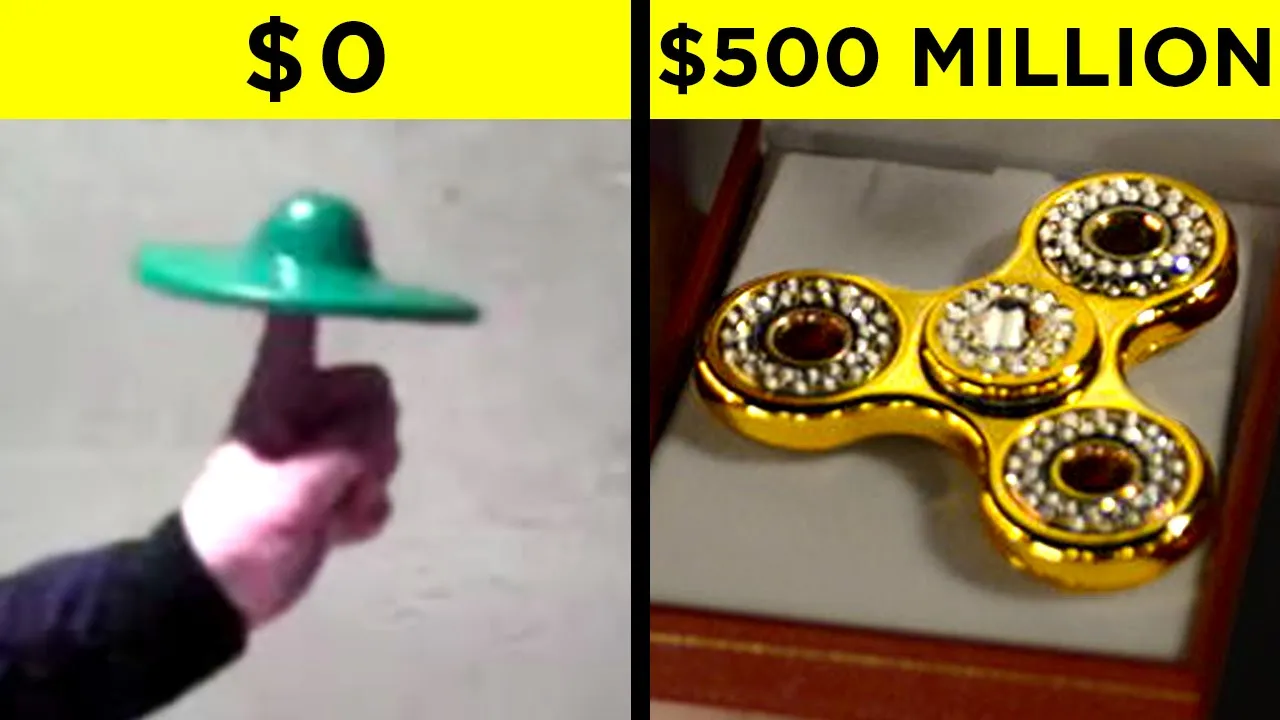
Franklin Institute and Science Museum a decent consolation prize but it doesn't match the profits from what would become one of the most lucrative industries in the world even in 1920 the cinema industry was already turning over five hundred million a year that's five and a half billion today adjusted for inflation needless to say Thomas Edison became a very wealthy man number one Kathryn heading her Kathryn Hettinger an American engineer responsible for creating what is perceived to be the predecessor of the fidgets spinner narrowly missed out on one of the most insanely popular trends in toy
history the original design which heading her developed in 1990 was a simple disc that spends on one finger heading her originally designed it for her daughters but saw the potential with locals at arts and crafts fairs ate it up she was awarded her patent in 1997 but had a hard time selling the idea Hasbro even turned her down not yet seeing the potential for 18 years heading her spinner remained on the sidelines when her patent expired in 2005 she was unable to pay the $400 renewal fee fast-forward to 2017 and fidget spinners were dubbed a
national phenomenon by USA Today the new wave of fidget spinners are a little more complex than heading his original design but the concept of a rotating hand toy is remarkably similar although she would never see any profits many outlets label Hettinger as the creator of the fad though heading her states that she isn't bothered it's difficult to overlook the fact that she narrowly missed out on a 500 million dollar industry have you had your ideas stolen and turned into a colossal cash cow or are you sitting on an idea right now waiting to share it
with the world let me know in the comment section down below and as always thanks for watching [Music]









![You Had ONE Job! [Part 5]](https://img.youtube.com/vi/wC0lasZdNfk/maxresdefault.jpg)