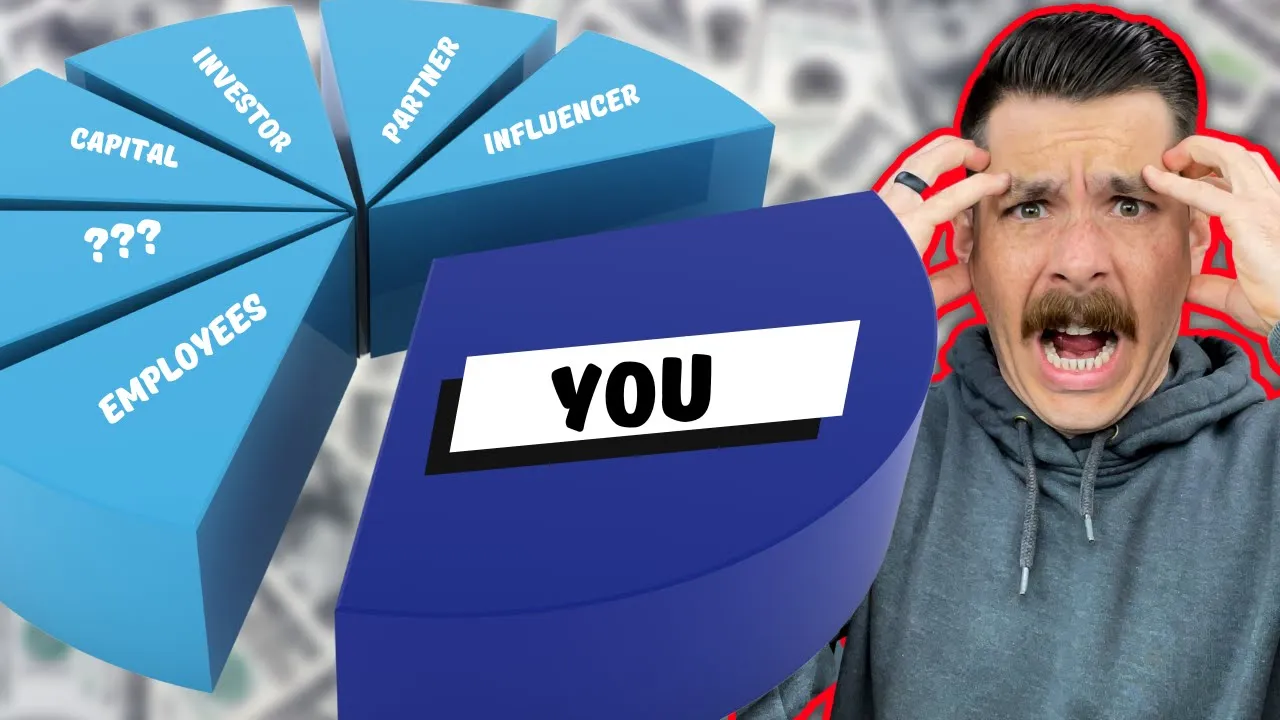
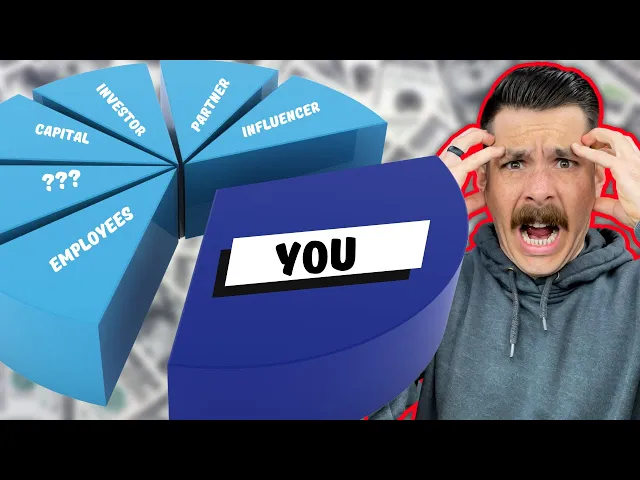
would you rather have a whole grape or a slice of a juicy watermelon see I used to think that giving up equity in your business was a terrible idea why would you give up a part of something that you worked so hard to build why would you sell an organ or cut off an arm if you didn't have to if you had the cash flow coming in why not just use the cash flow to grow your business why bring in outside investors why save some equity for your employees why save equity for strategic partners for that matter first we're going to talk about the breakdown of my company and how we are changing it from a grape to a watermelon then we're going to talk about the types of people you should be looking to partner with when you do give up equity and lastly we're going to talk about how to actually legally give that Equity to other players first thing I need you to understand this is a capitalization table it's also known as a cap table or an equity breakdown each person or each member of the business is given a percentage but you can't go above 100 obviously now for sake of discussion the found founder is going to retain 50 so they can retain control of the company now it's not always the case there are ways to have less than fifty percent of the company and retain all of your control but we're not going to talk about that yet first let's talk about why I decided to start giving up equity in the first place and it's very simple results through others I don't know what I don't know and I can't do it alone and that really sank in over this last year when I started to have conversations with people who knew a lot more than me this is no longer a game of you doing the work this is a game of getting results through other people casting the vision hiring the right people to execute that vision and then supplying it with money how do you get a bunch of money to fund growth how do you get a bunch of money to hire operations managers and logistical supervisors and brand managers and people to handle your head of marketing where's all that money going to come from because it's not gradually going to come from cash flow it can but you might not be able to take it advantage of all the growth you could have so if that's the case and we need to get people in to execute our vision how do we get the money for that one of the ways that we can do it is by doing a capital raise and that's right here where this first 30 comes into play Capital partners are people that you give equity in your business to for a sum of money and they hold on to that equity and they get paid back when the business changes hands or when it gets sold it's really that simple and it can be more complicated if you want it to be but in its Essence that's the simplest form of it and we're not going to get into all the nuances of like convertible notes and things like that in this video but what we are going to touch on is that I gave up 30 of my business for 1. 2 million dollars well how did I get to that figure like how did the math work out how did you convince people to give you 1. 2 million dollars for 30 of your business and that's a great question so we first have to look at the valuation of our business the valuation is the total amount that you believe your company to be worth a lot of people will value their businesses differently based on a couple different factors but if you just want to play it safe just take the profits of the business or the net income and multiply it by multiply it by five whether you have recurring Revenue whether you're manufacturer because we're just using a general rule of thumb here if we're valuing our company at four million dollars we should see eight hundred thousand dollars a year in ebitda or net profits that's the first step to determine how much your company is worth that's the number we started with our valuation I know that I want to retain at least half of the business overall I also know that I want to give up 10 of the business to employees employee stock options employee bonuses employee Equity shares employee incentive plans or just giving everyone a bonus when we sell a company any of those things are great options but there's ten percent of the company that I'm not touching because I'm saving it for my employees then we have another 10 percent and that is for strategic Partners strategic Partners can be people who have a lot of knowledge and want to come in and help you strategic Partners can be influencers they can have large audiences they can be Consultants they can be a CEO or a CEO that you need to bring in to help you strategic Partners can be anyone who Give You Sweat Equity in exchange for actual Equity I have a strategic partner he brings a super dialed in analytical skill set to the table a skill set that complements my skill set so I brought him as a strategic partner to do the things that I either don't want to do or I am incapable of doing you can do the same thing with influencers you can do the same thing with YouTubers you can do the same thing with other business owners the choice is up to you but nonetheless we set aside 10 for strategic partners for that reason because they can be quite powerful that's how Tim Ferriss became an angel investor he became a strategic investor for one to five percent of a bunch of different companies and then just give a ton of value helped him out with his audience with his skill sets with his network with his connections and became one of the most successful Angel Investors of all time all right so if we know that I want to retain 50 ownership and that we're going to do 10 for employees and 10 for strategic partners that leaves us with 30 left over and that's the amount of money that's going to be left over for Capital Partners Capital partners are different from strategic Partners Capital Partners bring money to the table they bring in capital they are literally buying a piece of your company now at a discount hoping that it will go up in value over time it's exactly the same as a stock market except we're doing it in a private sense this time they have to work with me they have to believe in me in my process in my team and my business in order to get a return on their money in reality it's quite risky and you'll see a lot of these investors or Capital Partners or Angel Investors investing in the founders not so much in the business model because they know that it's the founder that will take you to the end goal we're going there whether you join us or not I just want to know if you want to come along for the ride you can buy in here at this four million dollar valuation but when we're at 75 5 million your investment is going to be worth a whole lot more and that's what investors really want to see and that's what it comes down to for Capital Partners now I was willing to give up up to 30 of the business for Capital Partners why so much why not 10 and that's a really good question the reason is is because if someone is investing money into a business they don't want to invest a hundred thousand dollars just for ten percent they don't want to invest 25 grand for two and a half percent there's just not enough upside they're not going to get paid back on their money for a long time and it's going to be difficult for them to make the big needle moving Investments that are really going to affect their portfolio they want a chance to have real skin in the game skin in the game to me is 20 30 40 50 of your company that's what's really going to get investors excited about it now to the regular person it might seem like a lot of money it really might but let me put things in perspective for you let's say I kept 100 of my business and we ended up selling it to the investor who wanted to buy at the beginning of this year for 1.
2 million dollars power could have made 1. 2 million I could have had all 100 I sold a business I made 1.
![9 Secret Profit Maximisation Strategies to Scale Up Your Business [With Examples]](https://img.youtube.com/vi/F9qAVSzyVEs/maxresdefault.jpg)