you're watching the physics classrooms video tutorial series on kinematics with me mr. age today's topic is distance versus displacement and what we wish to do today is answer four basic questions what is distance what is displacement how are these two quantities different than one another and finally how do you determine the distance in the displacement for any given motion we're going to begin by talking about distance distance is the amount of ground covered by an object it's a scalar quantity and when calling something a scalar quantity in physics what we mean is a quantity that
is ignorant of direction it's fully described by magnitude alone magnitude or numerical value no distance is a scalar and because it's a scalar it's going to ignore any sort of direction change so here's an example where we have to use this concept of distance in order to solve a problem it's about reverse reverse walk six meters east and then four meters west and we want to know what's the distance so when trying to find the distance we just need to know how much ground did reverse walk over r-e walk six meters and four meters and
that sums up to a total distance walk of 10 meters so Ria's walked a distance of 10 meters that's the depth mod of ground that's covered by Rhee now when solving this question what we noticed we ignored that direction change that occurred after the first six meters segment of motion that's because distance is a scalar it's ignorant of the direction and then man or whether ReWalk six meters east and then four meters east or six meters east and four meters west distance is ignorant of direction so it does not affect the outcome of what the
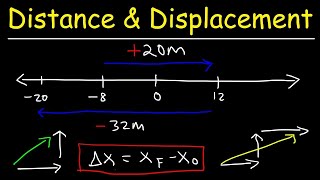
answer is if there's a direction change now we're going to begin our discussion of the topic of displacement displacements define it as the overall change in position of an object you find out what its initial position is if I doubt what its final position and you determine the overall change displacement is a vector quantity and when calling something of vector planning in physics we mean is a quantity that's fully described by two things magnitude and direction so when calling something a vector we're saying that it's a direction aware quantity let's look at that same motion
that we had looked at before when we spoke of reverse who walks six meters east and 4 meters west and now let's ask the question what's the displacement so we need to find the displacement or the overall change in position we need to find how far is the finished position from the starting position and if we take these two numbers 6 meters to the right and 4 meters to the left or east and west what we begin to notice is that that finished position is 2 meters to the east of the starting position so we
have determined how far out of place Rhea is when she finishes compared to when she starts the overall change in position here is 2 meters to the east that's the displacement now in this example we're calling 2 meters that magnitude of the displacement and we're calling East the direction so you see as we express the answer we have to include those two components of displacement magnitude and Direction like any quantity that's a vector now in this example one thing that occurs is there's a direction change taking place and displacements a vector and it keeps track
of direction its direction of where and the fact that this means that we need to consider the 6 meters to the right or 6 meters east to be like a positive 6 in the 4 meters to the left or less to be like a negative 4 so in effect this problem becomes a subtraction problem it becomes a 6 minus a 4 or a positive 6 plus a minus four and then gives us a negative two and or a positive two rather than that positive indicates a displacement to the east displacement is a factor and as
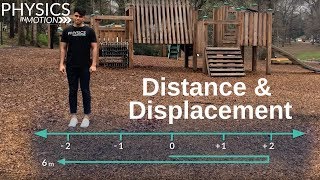
such it's aware of these direction change and that's the one part of the definition that makes displacement quite different than distance we're going to look a little more at this idea of direction change here we see a person walking to the right every step to the right takes them a meter further rightward well notice the distance and displacement are listed there in this this example the person's distance and displacement always have the same numerical value when we're done 11 meters the distance walked is 11 meters and the displacement is 11 meters rightward distance and displacement
will have the same numerical value as long as there's no direction change now we're going to look at the same in of a similar animation but we're going to notice this person this time changes direction and if there is a direction change what we're gonna notice it's gonna happen right now is we're gonna notice that the displacement in the distance have different numerical value here as the person walks backwards he's sort of undoes this forward displacement so maybe walk 7 meters to the right but then after those 7 meters by walking backwards four more meters
to the left that makes the displacement go down so now it's causing the overall change in position to be less than if he just walked in one direction so in this situation what we notice is that displacement and distance have different numerical value because displacement pays attention to that direction change now we're gonna watch a person walk 2 meters away from where he started as we watch this person walk one thing we noticed is he doesn't do a direct path from start to finish does a roundabout path and when doing this roundabout path what we
notice is that the distance and the displacement have different values the distance in this case may be something like 15 meters walks a total distance or covers a total amount of ground of 15 meters but the overall displacement is 2 meters to the right so this illustrates the idea of path dependency distance is a path dependent quantity depends on how you get from start to finish but displacement only depends upon the starting position and the final position and not up on the path it's not a path dependent quantity now let's look at a round-trip motion
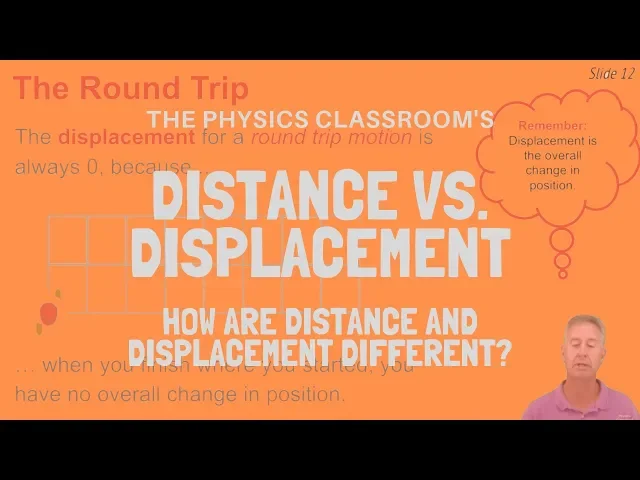
like the one you're watching in on the screen this person is walking 8 meters to the right or to the east and 2 meters north 8 meters back West and then 2 meters down south and finishes where they started this is what we mean by a round-trip motion when you finish exactly in the same position that you started from we might say that in such a situation you have not had any overall change in position you've not been displaced from the original position and as such there's no displacement we can say that the displacement for
any round-trips any round-trip motion is always zero now it's your turn to practice here's an example problem can't decide walks 2 meters east 8 meters west and 4 meters east and you have to determine what is the distance in what is the displacement so let me give you some time maybe you can pause the video and take some time to try to solve this question and when you're ready why don't you come back and check and play the video and see how you did one recommendation why don't you start with a diagram so here's my
diagram for this problem they have a starting point and then I'm I'm drawing out that the the various lakes of this multi leg truck two meters to the east I'm going to draw that to the right just like on a map and then eight meters to the last I'm going to draw that to the left just like on a map and then four meters back to the east and I want to know what's the distance and what's the displacement so when you do a distance calculation for a multi-link trip you simply add up all the
distances of the legs of the truck so I'm going to take the two the eight in the four and I'm going to add them up and I end up with 14 meters as the distance travel I do not need to indicate a direction because distance is a scalar in doesn't regard direction now when it comes to this place but I do have to consider the directions I have to consider this two to the right or to the east is a positive to the 8th is a negative 8 and the 4 as a positive 4 and
I have to end up the these little distance values but I have to put a plus and minus in there because displacement is a vector and that plus minus represents east or west so I'm going to do positive 2 plus negative 8 plus positive 4 and what I've done I get negative 2 meaning the displacement is 2 meters in the negative direction or off to the west so when we're done here these are the answers we get 14 meters is the distance and 2 meters west is the displacement so we set out in this video
to try and understand what is the distance and what is displacement and learning that distance is the amount of ground covered and displacement is the overall change in position of an object they're quite different based upon their definition and based upon the fact that distance becomes the quebec quantity that is a scalar in unaware direction and displacement is the quantity that is very very Direction aware at all times and direction changes have great huge effects of on displacement and then finally we've learned how to calculate distance and displacement for a very simple and more complicated
multi lake motions well thanks for hanging in till the very end of this video I like to give you it this time in action plan but before I do give some ideas to how you can help yourself out we'd like you to maybe help us out a few things you can do to help us out if you like the video you hate to just press the like button and give us a like or if you think you'd like to watch more videos like this one you could subscribe to our channel we'll be producing videos quite
regularly throughout the school year and finally there's a comment section down below if you have a question or a comment go ahead and leave that question or comment now here's what we can do to kind of help you out an action plan something that you can do next to put all this into practice and the first idea is that you could go off to our physics interactive section on our website you'll see the link in that in the description section of this video and then tap on the kinematics part of physics Interactive's and then go
to distance and displacement it's a great little simulation with some interactive practice for you that's a great first step another great first step is you could go to our website and go to the concept builder section it's the third choice on the page and when you go to that third choice pick kinematics and then pick distance versus displacement concept builder students love concept builders and it's a great way to get some practice and some follow up to this little video on distance and displacement or if your minds on physics unit users you could get our
app is number one there are three modules on that app the first module is called kinematic concepts and on the kinematic concepts module mission K c2 is a great one to do for understanding distance and displacement finally if you just need a reference we have a tutorial on our website that mirrors some of these video tutorials that we're doing and you could always use that as a reference thanks for watching enjoy your day