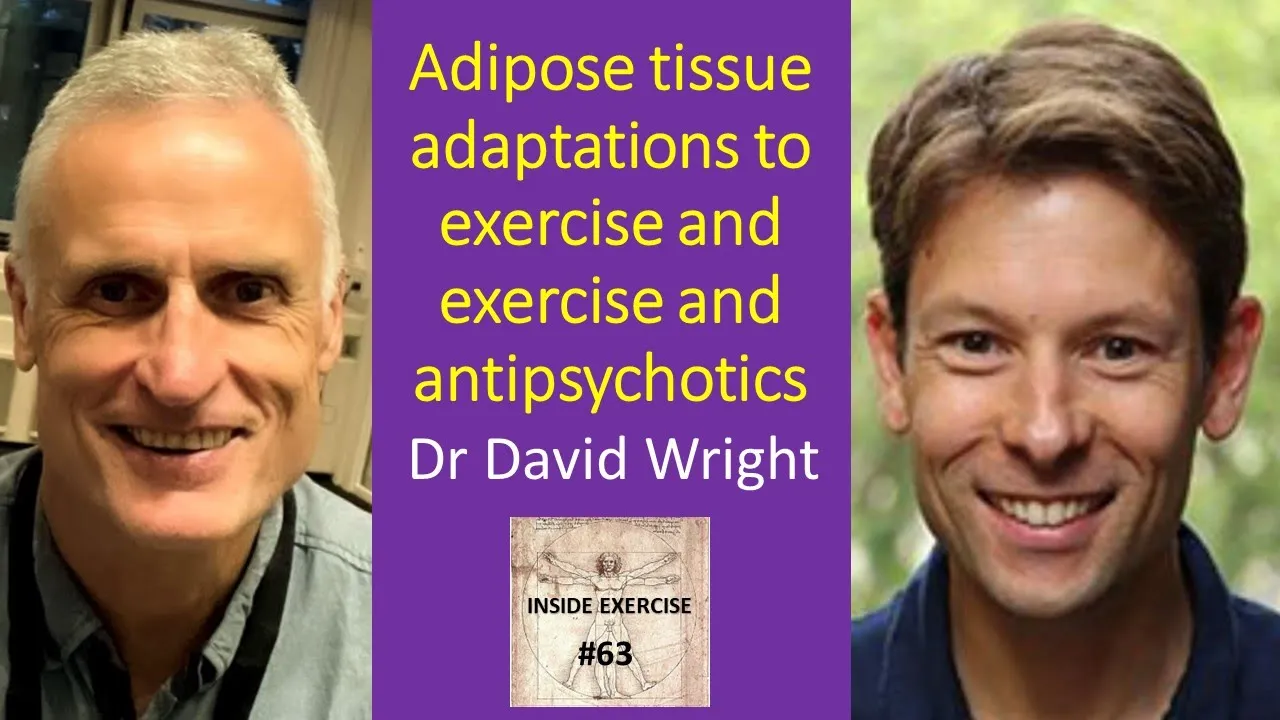
Hello and welcome to inside exercise I'm Emeritus Professor Glenn McConnell from Victoria University in Australia and I'm also currently a Danish diabetes and endocrine Academy visiting professor at the University of Copenhagen the idea behind inside exercise is to bring to you the absolute who's who of exercise research so exercise physiology exercise metabolism and exercise and health and what I really want is for you To get your exercise information from the research experts rather than from influences and indeed today I bring to you Professor David Wright from the University of British Columbia in Canada he's an
expert on exercise metabolism for many years he was looking at exercise metabolism and muscle and then he started looking more and more at the effects of exercise on adipose tissue so on fat So for example not only does exercise increase mitochondrial content in muscle it also increases in fat so he's been looking at how that's regulated Etc and then the past few years he's also shifted to looking more and more at the effect of antipsychotics although antipsychotics are obviously critically important for people having psychotic episodes they have been shown to cause weight gain but interestingly
Professor Wright Has been shown that even acutely so with each time you take an antipsychotic it can increase your glucose levels and he's been showing that exercise can prevent that so very important work I found the discussion very interesting I think you will too so stick around hi David how you doing thanks for coming on inside exercise yeah no my pleasure glad to be here and and be able to chat with you a little bit today yeah we're just talking before uh on air That I'm a visiting Professor here in Copenhagen University Copenhagen and you
also are but you've had because of covert you've had a bit of a hiccup yeah yeah so I think like you uh got a visiting professorship through the DDA uh and myself my entire family were set to come over uh losing track of time here with cobit like 2019 2020 and then you know the world stopped so instead of doing one big six-month chunk for my sabbatical Week you know I ended up taking two or three weeks here and there um so I'll be back over there uh actually in a few weeks oh great well
maybe I'll see you then because I actually managed to to just to get good with the timing so six months in 2019 then covered and then six months and they even let me extend because I covered so now five and a half months all right so um we're going to chat About fat uh metabolism and fat adaptations to exercise yeah but why don't you give us a bit of a background you look like a bit of a lean machine now I'm assuming you started off as a as an athlete or something and then got interested
in exercise is that how it worked out and then well I mean thanks I mean I I don't know if I consider myself an athlete I like to run I like to ride my bike so I I've always had an interest in in physical activity But I never really did anything at a super competitive high level probably like the majority of folks you've you've had on this pod um in my PhD in the human performance Lab at Ball State so I know that you've had a bunch of x-ball Staters on this on the spot so
that's great to see um and I worked with a guy called Bruce Craig and we did some skeletal muscle glucose uptake type stuff um and then Bruce had actually done a a Postdoc with John Halsey so I was finishing up with Bruce I was looking for a postdoc position John had a position open went down and and interviewed with with the crew down there and was lucky enough to to secure a postdoc position and so when I was in John's lab my first couple years we were looking at the Royal of calcium and ampk signaling
in terms of mediating contraction stimulated glucose transport so this would kind of be an early to mid 2000s and so that was a fairly Hot Topic uh back in that time anyway so Eric Richter who obviously you know really well uh and Lauren and Laurie Goodyear we're looking at the same questions and then I kind of Switched or transitioned from the glucose transport story my first couple of years and probably my last two years of my post-doc we were looking at you know mechanisms involved in exercise induced mitochondrial biogenesis in skeletal Muscle which was really
interesting and I think around that time I was starting to look for for faculty positions and you know I think I realized pretty quickly into my postdoc that I don't want to be looking at the same questions that John is looking at because I was never going to be able to compete academically and intellectually with with with that machine right so um I had a couple job interviews lined up I wanted to get a little bit of Preliminary data of my own and I kind of had this idea of you know could we look at
the or ask the same questions that we're studying in scalable muscle but can we look at it in adipose tissue what kind of really got me thinking about adipose this would kind of be mid 2000s was the effects of of any diabetic insulin sensitizing drugs like Rosy glittism so these These are D compounds had a pretty pronounced insulin sensitizing effect and that seemed to be Associated with increases in adipose tissue mitochondrial content or mitochondria biogenesis within white adipose tissue so we asked you know kind of very basic simple question does exercise turn on mitochondria by
Genesis and does it induce pgc1 Alpha in white adipose tissue so it kind of brought this idea to John and he kind of rolled his eyes and said yeah I mean you can take adipose tissue from from some of these rats that we're draining I don't I Don't think you'll see I'm going to stop you sorry you keep back from your table oh sorry yeah and it goes through the whole yeah sorry yeah so so this idea of of you know looking at mitochondria biogenesis and adipose tissue so I I talked to John about it
said you know we're doing these training studies can I take some adipose tissue from these rats because we were literally just just throwing the stuff out he rolled his eyes so he thought it Wasn't it wasn't yeah he's like you know he's very muscle centered right yeah exactly fine which is great um and there's probably a little bit of a blessing and disguise that he didn't have any interest in that um so we're we're able to get a little bit of preliminary data and and that kind of set the stage for my transition into an
in you know an independent investigator position um when I first moved back to Canada Um and so we started to look at you know really kind of low-hanging fruit I think in terms of all right does exercise induce mitochondria biogenesis and adipose tissue yes or no and could pgc1 Alpha be involved in this process um so if you go back and you you look at the literature um there would be one prior paper it was about 1990 1991. been to stalnik from Copenhagen was the lead author of that That paper and that came out of
Henrik gobble's lab and they showed a pretty nice induction of mitochondrial biogenesis with with exercise training in in rats now I say exercise training it was swim training right in Rat so maybe take that with uh with a grain of salt um but they didn't look at any kind of the molecular signaling Pathways that could be involved actually can we just say the grain of salt so I'm assuming It's saying that to to exercise rats is swimming it's like so often it's five hours or they put like a weight on the Tails there's a lot
of stress and I know we'll probably mention it later you've got some stuff about adrenaline maybe affecting fat so you're saying it we don't know if it's the training or it's the stress is that what you're thinking of yes yeah yeah it's a fairly extreme model of exercise for sure and I think probably the the translational relevance Of it to humans is slim or none um but it's a model right so um I guess any model that we use uh has its has its limitations right so um but we're going to say I want to
say something earlier I just I just wanted to sort of it may be a teaching up for people or something hey how you went from from you're looking at mitochondrial biogenesis and muscle and then you went To looking in fat and you'll get APK in Kelsey and then say oh maybe that's regulating in fat as well because I was actually a similar time I was looking at regulation of glucose uptake ampk but seeing if it was going through nitric oxide then calcium because nitric oxide nitric oxide synthesis a calcium dependent enzyme say oh maybe it's
going that way to glucose uptake but then probably about the same time I thought oh wonder if it's affecting Mitochondrial biogenesis but not in fat but in muscle and I literally had a Grant application I crossed out glucose uptake and mitochondrial biogenesis and it got funded because they're both were saying it could be calcium it could be APK it could be nitric oxide and and then you've actually gone now and now it sort of makes sense because we know how integrative the body is that like if something's Happening in muscle it's not that surprising it
could be talking but at that time people weren't thinking that integratively right that to jump from like muscle to fat in it right yeah yeah and and I don't know if I was thinking more integratively or not I mean really you could probably make an argument that it was you know just lack of creativity looking at the same question in adipose issue as I said Again awesome then again because I know talking about ampk again was it rudiment and Saha I think Saha was the first author they showed that exercising rats you've got activation of
ABK and muscle but also in fat and liver was that around the same time or was that yeah it was and it might be getting the dates wrong there's work from ruderman's Lab kind of came out early to mid 2000s um and Laura Goodyear's lab as well Um and so Lori's done some really really obviously some really really um work in the field of exercise physiology and biochemistry but they showed that exercise induced increases In apk and adipose tissue was dependent upon catecholamine signaling oh great okay well this is really interesting maybe for you and
me but we're probably a little bit ahead of some people so can we start off just thinking about during exercise you know what's happening to uh Adipose tissue you know different intensities different durations and things that so what we people tend to think about just generally with you know release about it yeah yeah so so I think once we start exercising one of the initial signals or triggers that goes off it's an increase in circulating catecholamine levels and so talking epinephrine or norepinephrine adrenaline or noradrenaline depending upon where You live right and that is going
to be a really potent stimulator of adipose tissue lipolysis so lead to the liberation of of fatty acid from adipose tissue so it'll get kicked out into the circulation and then it can get taken up by skeletal muscle and used as a as a substrate to fuel that we're talking about subcutaneous so the fat that people think of just your love handles and whatever just the normal stored fat Under the Skin yeah Under the Skin and Then also visceral adipose tissue as well so yeah that will also be uh liberated during exercise that's interesting so
so does uh oh okay so do we actually know I'm cutting off there but but is is most of the fat during exercise coming from subcutaneous and some from visceral or doing is it 50 50 or uh so this was around the organs people right not so sure yeah yeah that's a great question Glenn and I I'm trying to I'm trying to think of any Data that would kind of show relative percentages of of fat that's mobilized during exercise if it's you know primarily subcutaneous versus versus visceral or not Jeff Horowitz might have something on
that yeah I can't recall a thought in my head but I think it's probably safe to assume that both kind of broad Depots are contributing as we exercise and I think that you know the greater the exercise intensity and and the the longer the Duration of exercise um you'll see a greater contribution right and so if you're exercising for multiple hours there will be a significant contribution of adipose tissue derived fatty acids as substrate to be oxidized by by scale of muscle and I think especially as as glycogen levels in muscle ion and liver starts
to deplete yes so with prolonged exercise but with the intensities Um you know there's obviously the the study showing like maybe 65 video to Max might be 50 50 fat and carbohydrate then above that it's going to be more carbohydrate but I guess then you start talking about well as an absolute versus relative but but essentially lower intensely prolonged you'll burn more fat you're even even though you're burning less calories per minute yeah okay yeah yeah exactly and the adrenaline Is is part of what's stimulating that it is so the increase in Adrenaline and noradrenaline
and then the reduction in insulin right that occurs during exercise as well so insulin has an anti-lipulative effect so kind of the ratio between those two thank you cool all right so you're getting the adipose tissue um uh well it's lipolysis yes so breaking down the stored triglycerides the fatty acids into the blood and then The muscle can take it up um and I guess we should we should mention um because I know students don't always remember the intramuscular triglycerides so is it worth just mentioning that this the intramuscular triggers right as well sure and
and you know that's that's an area that we don't study that much really at all um but intramuscular triglyceride is also a a contributor to the provision of A fatty acid to contract the skeletal muscle during exercise and some of the same Pathways that you see in adipose tissue are also activated in scalable muscle right so so if we look at the activation of some of these lipolytic enzymes hormone sensitive lipase a tgl those are both activated in skeletal muscle and in white adipose tissue during exercise and probably contribute to exercise induced lipolysis in both
tissue bags that we're talking about Right right so that's a cute exercise but I guess you're you're thinking more about adaptations to training is that right in terms of effects on fat so so what are you looking at and what are you finding there right so so kind of our earlier work in the area show that if you exercise trainer rodent and we've done this with so with swim training that was our initial work right Um also with uh Force treadmill exercise which is a little bit better than than swim training so you can control
the duration and intensity still stressful uh to the animal um and then voluntary wheel running so so just giving other rats or nice access to voluntary uh running wheel in their cage and just just letting letting go at it and so you know depending on the strain of animals that you're looking at uh animals can run you know somewhere in The neighborhood of five to ten k a night so a high volume of exercise for sure and and in all three models we see increases in the amount or the note mitochondria in white adipose tissue
so kind of mirroring exactly what we see in skeletal muscle we see the same thing uh in white adipose tissue and some of the same kind of molecular signaling mechanisms involved so pgc1 Alpha is is induced in muscle uh with exercise we See the same thing in in white adipose tissue as well the PTC one alpha is that there's a sort of Master regulator of mitochondrial biogenesis yeah so yeah so increasing your mitochondria volume is what you want or content and but also the function I guess also the function also the function yep so I
mean we I'm trying to think we've never actually measured mitochondrial respiration in adipose tissue from trained animals Um so we we've looked at markers so citrate synthase activity uh Cox activity um you know looked at kind of uh markers or readouts of mitochondrial content so you know oxfaz protein content mitochondrial DNA protein content uh and and they all they all track in adipose tissue similar to what we see yeah you know so so it's the content that goes up monochondrial content but you don't really look at the function and people Haven't really looked at mitochondrial
function you know like yeah not to the same extent as they have for sure so that's very interesting to think about isn't it because it's naturally a very different kettle of fish so in the muscle you're actually wanting to increase your aerobic capacity so you can exercise better oh and there's also other so I've had Russ HEPA on and you know he's made it very clear that obviously there's a lot more to the Mitochondria than just producing energy for exercise but but why is it actually increase is it is it more to do if the
insulin sensitivity of the fat or is it is it to do with the oxygen consumption of the fat you know I mean I mean we we think we haven't really empirically tested this as of yet but with each vote of exercise there is an energetic demand that's placed on adipose tissue and so if we go back to this discussion of lipolysis right so we Think of uh lipolysis you think of a triglyceride molecule adrenaline goes up binds to its receptor turns on some signaling Pathways and you have to release a fatty acid out of circulation
and that's really kind of an oversimplified view biochemically of what's going on in adipose tissue and you stimulate adrenergically right and so if we were to quantify the amount of that liberated fatty acid in adipose tissue that actually gets Kicked out into the circulation and ends up in the muscle about 50 of that liberated fatty acid from that triglyceride droplet is kicked out into the circulation a small amount is oxidized like less than one half of one percent so negligible amount and then the remainder is actually reisterified back to triglycerides so there's feudal cycling that
goes on and that fuel cycling is probably the Largest single drain on high energy phosphates in a fat cell and so if you think of exercise or exercise training right with each butt of exercise yes you're seeing increases in uh lipolysis and fatty acid being kicked out into circulation but you're also seeing you know fatty acid recycling back to triglyceride and that's an energetic stress and so like just like in muscle right The induction of mitochondrial biogenesis and muscle with exercise is probably responding to some degree of energetic stress with contractile activity I think analogous
to that in adipose tissue we're seeing the same thing and so instead of that energetic stress being due to the muscle Contracting it's due to fatty acid reisterification being increased okay so just to make sure people are clear on some of those terms Yeah so so triglyceride as it sounds like Tri means three um fatty acids bound to a glycerol which is the glyceride bit and when you're breaking down the fat with lipolysis you you're breaking off the fatty acids and then you're saying you're reisterifying so you're putting the fatty acids back on the glycerol
so you know you go from a um monoglyceride to a diglyceride to a triglyceride again and that takes energy Now it seems like and you you call that you know futile cycling because it is future so why does anyone have any idea why the fatty acid why the fat does that because it seems like a particularly inefficient way of going about doing things exactly and that's a really really good question that you bring up and and it's something that we've spent a lot of time thinking about again we don't really have any empirical evidence To
to generate a solid hypothesis but maybe it's maybe it's you know if we look at exercise right we see huge increases in circulating catecholomy levels so adrenaline or adrenaline and maybe that's actually an overshoot and so by having this relatively High degree of fatty acid reisterification maybe what that's doing it it's protecting against lipotoxicity following exercise cessation So if you weren't able to restrain a certain amount of what of of fatty acid release from adipose tissue you stop exercising maybe you'd have a condition of lipotoxicity so that would be another kind of uh degree of
of control and if you look at that levels during exercise they in the circulation they wouldn't appear to be limiting right I mean they increase limited yeah it it it's very curious why that happens though no massive laser Because I mean I can't remember I think it's 0.5 millimole or something and then it sort of goes up to one you know during sort of normal exercise like an hour or two it's not massive increases but you've got these massive turnover in the in the muscle in the in the adipose tissue yeah yeah um and the
other thing it just reminded me when you said about the so when you stop you might you know you don't want to get this lipo toxicity where you're Just pumping on all those lipids and it gets taken up by who knows the coronary heart arteries or something it reminds me when you do high intensity exercise there's a reduction in blood flow in the adipose tissue right and then when you stop it does flush out fatty acids yeah is that right yeah that's and so I mean that that that does happen for sure I think though
with high intensity interval training there is such an increased metabolic Demand in the muscle that there's probably a a little bit of matching between the two right and so during that post-exercise period it's actually pretty interesting because someone just just the other day I was talking to someone about because you tend to think during high intensity exercise obviously you using a lot more carbohydrate than fat but I think it was Larry Sprite classic stuff you know in Canada when you do repeated Sprints like the Mali kibalo sort of 30 second Sprints four minutes recovery by
the third or fourth one you're actually using quite a lot of fat that would probably make sense yeah I'd have to go back and take a look at that data for sure okay all right sorry about that okay so I'm just thinking a question there that we could um tease out there's a question on Twitter from someone called Marco just Saying are there differences in acute effective exercise on adipose tissue in lean versus obese subjects so I'm not sure if you've thought about that so is there a difference because he's saying you know literature suggests
that exercise induced adipose tissue apollosis is impaired and obese slash insulin resistant subject so what we've been talking about is obviously you know what happens in your healthy non-obese person Um is there a difference do you know with that um yes so so we we've done some studies and again this isn't a rodent model but if you have a lean animal and an animal that you've provided uh you know a high-fat diet to for several months and then you challenge that animal either with exercise or with an adrenergic stimulus of some kind so injecting with
epinephrine or or norepinephrine the Degree of adipose tissue lipolysis in the induction of some kind of early response genes in adipose tissue is muted or reduced obese condition versus the lean condition and so I think this idea of kind of beta adrenergic resistance has been fairly well established in the literature for sure okay so that means during exercise they'd be having less of the adrenaline effect to like break capital pollicis and reisterify it there'll be just sort Of less of everything going on is that the idea [Music] um yeah that's a good question um I
don't know off the top of my head whether or not that is the case I mean there is a degree of at allergic resistance but adipose tissue does still respond to exercise in uv's condition versus the lean condition just not to the same Extent all right no I wonder if that could be the part of the reason why they tend to burn more carbohydrate during exercise perhaps it could be I mean you know in the obese situation right you you have metabolic inflexibility so that would fit with what you're suggesting right for sure yeah yeah
all right so so um we started off talking about the uh what you've looked at with exercise training increasing the The mitochondrial um content and uh biogenesis Etc so have you looked further at what's regulating that [Music] um you know what's yeah and and so I mean we think that I should back up and say that there's been a lot of labs kind of looking at this idea um and you know it's being put forward that's uh muscle derived factor of some Kind maybe so muscle contracts during exercise kicks out a signaling factor of some
kind which signals to adipose tissue and then is driving these adaptations that we've talked about um I have a tendency to think maybe a little more simpler um I think it's probably adrenergically driven and so we've we've got some work this was kind of late 2000 so about 2009 2010 um and if you treat an animal with a Beta blocker like uh Propranolol so this will gum up the beta adrenergic receptors um the acute facts of exercise anyways are blunted or attenuated so if we look at the induction of pgc1 alpha for example in an
animal that's been treated with this beta blocker they is probably reduced by about 50 to 50 to 60 so we think that's probably an initial signal that that's mediating some of these adaptive changes not to Say that muscle factors might not be playing a role but but we don't we don't seem to think that that's really a a primary driver and I wonder if it changes or something with training because I know with training you tend to get because it's less of a challenge to your homeostasis at the same workload you get less increases in
Adrenaline and noradrenaline during exercise yeah you do for sure but adipose tissue becomes More sensitive to it I think I can yeah because you because you burn more fat when you're trained yeah so you don't think it's um these might so you know there's always talk about my kind so il-6 and all sorts of things being released for muscle to Fat you think I know you've had papers I think you've talking about maybe my kinds interacting with the brain and things like that but You think in terms of fat it's probably not it's not necessarily
important yeah I mean we think it might play a modulatory role um and so we I mean we've done stuff with interleukin-6 so if you inject an animal with a pharmacological dose of interleukin sex so so we're talking about a dose that would lead to circulating concentrations many fold higher than you'd ever see during Exercise you can see subtle changes in the induction of some of these early response genes but the physiological relevance of that I you know I I'm not sold on it and I think you know a lot of times it's kind of
offman's Razor right that that normally the you know everything else being equal the the simplest explanation is is normally the correct one and I would have a tendency to live in that Direction versus you know some of these more kind of elaborate signaling Pathways that have been hypothesized now I know a lot of people probably disagree with me but okay I know you had um papers with uh you know with your background and ampk and and I mentioned earlier that the Saha and rudiment and maybe Laurie Goodyear had also shown activation of ABK in fat
do you think that's playing a role or do you think maybe that's Actually what's uh increasing the PG's one alpha yeah no no absolutely we had a paper uh 2014-15 around there that we did in collaboration with Greg Steinberg's group with McMaster and so we took adipose tissue from their Ambi K beta1 knockout animals and we did some tissue culture approaches and so if you take uh White adipose tissue from a wild type animal and you dump epinephrine on it or Really any beta adrenergic stimuli you see a nice big induction of pgc1 Alpha and
you see the activation of amdk so we looked at the phosphorylation of ampk and then some of the stem stream substrates you do that same experiment but this time you culture adipose tissue from an APK baby to a knockout animal APK is inactivated nearly to the same extent and you see a pretty marked blunting of the effects of some of these Adrenergic stimuli as well so to answer your question yes we think ampk is is probably a planner in this we're not looking at those questions anymore um I think to really answer the question in
Vivo with exercise you'd want to use an inducible ampk knockout of some kind ideally adipose tissue specific as well okay yeah yeah so I guess just just to to explain to people why you do that like often people knock out genes and mice but but it's it's their whole life Yeah so you get all these compensations and things so more recently people have you know developed techniques where you can do this inducible so you can bring it on uh when it suits you and it's there should be less adaptations and things and then if you
can make it specific because you know early on it was like you just knock it out it'll be tissue in the whole body and then you're going to get all sorts of effects but if you had an inducible One that you could just bring on when they're an adult for example in the fat only yeah that would be the best way to look at it uh yeah exactly yeah exactly hey you know I saw you had a review with Jonathan Littlewoods first back in 2011 and Jonathan Little's been on which is great yeah talking about
ketones and things I know you've done some research with with Ketone uh studies uh I I did something occurred to me so it was You're talking about how exercise increases mitochondrial biogenesis not just in muscle but in fat as you've talked about but also liver brain kidney um something occurred to me that that the point there is that the the muscular exercise is increasing Pages went out for in mitochondrial biogenesis and things in the muscle that's Contracting and then all these other tissues but then I thought hang on a minute you may not have thought
of this before it's Only just myself why isn't it increasing it in the non-active muscles then you know so if it's if it's releasing these my icons or extra kinds or something they're going everywhere why not the inactive muscle exactly exactly to the point I was trying to make earlier right that if there is some type of unifying work factor or exercise Factor right Then you would expect to see an effect in the non-exercising muscle as well you said it earlier well you know kind of I'm dancing around dancing around right yes all right cool
you know it's a muscle signaling Factor but you know it's a really really good point and if you look at kind of classical work out of Scandinavia right like one-legged kicking exercise you see adaptations in the leg that's kicking exactly Lateral control right it's not to say that you know maybe a muscle derived stickling Factor isn't important so so there's some type of synergistic effect right that's exactly what we're doing here we can check one we exercise one leg and do insulin sensitizing in both legs and mechanism that's uh very interesting and what it might
be is is you don't actually want your inactive muscle to have increases In mitochondrial biogenesis and things do you because you know like it's it doesn't sort of make sense but it makes sense obviously in these other tissues or it wouldn't be happening I guess exactly it's philosophical but yeah yeah and and so I think you know any tissue that is going to undergo a degree of energetic stress during exercise I would predict that tissue would then respond by increasing the amount of mitochondria right exactly Right so whether that opposed to Heart liver there you
go and the inactive muscle isn't having an energetic stress Perfect all right so we just sorted that one out um now what I've thought about a lot is is the fact that you've done a lot of studies and it's very interesting on this concept of Beijing so and and turning you know white tissue more Brown so do you want to just explain first of all what that is because people may not Even realize there's different types of adipose tissue and whether exercise does actually cause uh changes yeah and so we kind of think of adipose
tissue perhaps naively along a Continuum so on on one end of the Continuum you have white adipose to shoot so this tissue Depot that's engineered to store access calories as fat and then on the other end of the spectrum we have brown adipose tissue which at least in a rodent is a thermogenic organ When Brown adipose tissue is activated uh it turns on heat producing uh processes right and then in the middle um we have a type of adipose tissue called brown or or I should say a beige or right adipose tissue so this is
a white adipose tissue that has pockets of uh Brown adipocytes within it so this would be characterized by the presence of uncoupling protein one and um Multi-locular fat cells so one fat cell with with multiple lipid droplets within it and really that that's all right do you want to just tell us what you know why is brown adipose tissue important you said thermogenic maybe just explain what that means and you know what right so so it turns on um uh heat heat producing processes to maintain um the core temp of the animal so if you
Take an animal and you put it from you know room temperature or thermal neutrality which is a little bit warmer into the cold Brown adipose tissue will be activated probably through some of the same mechanisms that we've been talking about before so adrenaline and noradrenaline and this is going to lead to the generation of heat and that would be futile cycling as well I guess yeah yeah exactly yeah and so this is thought to be have been you know A potential anti-obesity chart here right so if we can turn on Brown adipose tissue maybe this
could either prevent the development of obesity or be used as a treatment uh modality for it okay so because you'd be churning through energy exactly yeah yeah yeah exactly um and so what's what's interesting with exercise is at least if you perform that exercise At room temperature so animals are housed a little bit below Thermon neutrality in thermal neutrality is the temperature range where the animal doesn't have to engage any additional heat producing um processes and an animal a mouse anyways the Thermon neutrality their Thermon neutral zone is around 28 to 30 degrees Celsius depending
upon who you read and so if you house animals at room temperature Which is comfortable for us and The Graduate students and postdocs doing the work there's a little bit of thermal neutral stress or or thermal stress in the animal right and if you exercise the animal under those conditions you see a Beijing of white adipose tissue and so okay by using uh you know be the presence of these multilucular fat cells um it'd be the presence of uncoupling protein one um and it would be the presence of of uh You know some of these
genes and proteins involves in fat oxidation and this has been a really consistent finding in the animal literature anyways um so if you do Force treadmill running if you do voluntary wool running if you do swimming at least at room temperature all leads to the Beijing of white adipose tissue and it's been there and the point the point was I guess at one stage people were saying that humans Don't really have much brown or even I think beige adipose tissue that was the thinking and the animals do and then if you exercise train them Etc
you get more of it but your urine some others came along and said well hang on a minute maybe that's because they're at room temperature right and that's not normal for them so then you kind of question that right yeah and you bring up a really good point so the human literature didn't Line up with the animal literature at all and so there's probably been I'm spitballing here at like 10 to 12 papers probably um in in humans so various modalities of exercise training you know both genders uh different durations of exercise and there hasn't
been a consistent increase in other adipose tissue mitochondria biogenesis or indices of Browning and so to your point that that kind of God is thinking a little bit right so what could explain these discrepancies between the human literature and the rodent literature um and so we we did a really kind of simple comparison um and just looked at the effects of exercise that we housed animals at room temperature and gave them access to running Wheels versus thermal neutrality so about 30 degrees Celsius with access to running wheels and the effects of Exercise in terms of
the Browning of white adipose tissue uh was completely gone and so we published that in 2019 the same time a group from Copenhagen published the same thing and then uh who's the third maybe six months later Peter all this showed the same thing and so if you house animals at Thermon neutrality the Browning uh effective exercises is the center sleepy completely wiped out okay So so basically animals I guess it depends on the animal tend to have more Brown fat than than humans but what they've got tends to not be affected by training yeah is
that is that what you're saying essentially you know if you do it at the thermal neutral condition so I'm assuming they're adapted to right so so we were specifically looking at White adipose tissue and so this Beijing effect Was was gone in white when we housed animals to determine neutrality we looked at Brown adipose tissue um there's an effective housing to temperature for sure so uh things like uh unacoupling protein one uh gene expression and protein content were reduced in brown adipose tissue if we just did the temperature comparison there wasn't much of an effect
uh of exercise per se um work from Orlando serious Lab at York Has actually shown a reciprocal regulation of those two fat Depots with exercise which we think is pretty interesting so again at room temperature the exercise trains rats he sees the Beijing of white adipose tissue while at the same time markers of thermogenesis are reduced in brown adipose tissue but at least we don't see much of an effective exercise on on bat okay so what about humans so so it was thought we didn't really have much uh Brown I don't know about beige but
is it is it thought now that there is so that they've got more sensitive uh ways of measuring it that there is maybe some subscapular or something there there is um and this like we we don't delve into this methodology that they're using to actually measure it but depending upon the subject or patient population you can detect it I think perhaps one of the caveats or those measures Is is that when they do those do the measurements um is combined with a cool challenge and so those participants are you know they're sitting in a room
at you know 12 to 15 degrees C so they're actually activated those tissue right so so they can see it so they can see it yeah exactly okay so I guess what's the takeaway here um so what's the you know because I Guess we're not overly interested in the in the rodents and how much Brown fat they have and things I guess the idea was you were saying people were thinking that if we could increase our Brown fat turnover Etc we could burn more energy but is that is that looking I know you haven't really
looked at that but is that looking like it's not really a thing at the moment yeah I mean I think the majority of Dina would Probably suggest that that's not the case um it's not to say that Brian adipose tissue couldn't be doing something else right maybe it's kicking out about a kind of some kind that that could be influencing systemic metabolism and could have beneficial effects on insulin sensitivity fat metabolism Etc but from an energy expenditure standpoint if We're just looking at energy balance as our endpoint you know especially with exercise I I don't
think it's doing much okay so what about the the white outer burst tissue then during exercise we talked about it in a lipolysis etc going on but what about the adipocine so things that are released from White adipose tissue they are increased during exercise so leptin adiponectins is that right yeah acutely We don't see changes with exercise training you well for sure um okay so if you compared a an obese animal that was sedentary versus an obese animal with the exercise train um due to a reduction in fat Mass to expect to see reductions in
circulating leptin levels and probably increases in an actin I did some work with a colleague at Guelph David dick years ago and we exercised trained uh adapinect to knock Out animals and the effect of of exercise and any number of kind of you know systemic or muscle specific markers of endurance exercise training were completely intact in The adiponectin Knockout um okay so probably at best a modulatory role we think at least at least at the end points uh that we've looked at Lori Goodyear's lab has published some stuff looking at various significance so TGF beta
2 Was identified and she's in her group showed some some pretty impressive effects um we did a study 2017-2018 just you know trying to get to this idea of is there something that's being secreted from adipose tissue with exercise training that could be mediating The Beneficial effects of exercise and what we did is we used a model of Lipectomy so this was in collaboration with Michelle Foster's group at Colorado State and so will peppler who is a PhD student in my lab at the time he went in uh learned how to do the lipectomy surgeries
and removed inguinal white adipose tissue from these animals let the animals recover for about a month month in a bit and then gave them access to voluntary running Wheels and whether or not the animal had Um you know intact normal amounts of wine and white adipose tissue or no I'm going to White adipose tissue the exercise effect was completely maintained right and so exercise very well could be causing white adipose tissue to be kicking out something but it doesn't seem to be required for the beneficial effects of exercise at least in a rodent model that
we were dealing with yeah just making sure people Um I think I call it inguinal but you call it something else do you want to just say what that where that fat is and and is that a substantial amount of fat is it that's that's in that bed so that when you're aware of that that's uh yeah so it would be uh it'd be less than a gram in um so it's kind of found in the inside crease of the thigh and it it was this Inguinal uh subcutaneous adipose to Shoe Depot is probably the
most responsive to exercise so it responds really robustly to either treadmill running voluntary wheel running or swimming okay um so it's kind of the depot of choice among folks in the field okay and then when you when they removed that it didn't have any real effects yes We're totally normal so glucose tolerance insulin tolerance energy expenditure mitochondria biogenesis in any number of different tissues circulating factors it was a little bit disappointing I mean it was just normal it was just an exercise effect across the board okay just looking at these Twitter questions uh I think
we've probably covered this does exercise favorably favorably impact brown and white tissue In the same way well I guess we talked uh that it's not really doing a whole bunch in Brown by the looks of it if you do it in mice anyway it it's thermonuteral conditions which is the most relevant is that fair to say yeah yeah discussion all right uh now we've got another one uh the subcutaneous neck topic fats mobilize randomly during August I'm sure it's not randomly but during a steady state exercise or is there a way to bias the energy
Mobilization from each type I guess we kind of talked about that earlier didn't we we did uh because you're saying how why don't we just say what ectopic fat is just because that's come up um yeah yeah so it's topic fat would would be limit that is stored in non-atibles tissue Depots um so muscle liver heart pancreas kidney um and kind of the thought being that this ectopic fat lipid deposition could Be a contributing factor to the development of insulin resistance yes and it can be on the coronary arteries as well yeah yeah for sure
um yeah yeah yeah all right so we I mentioned the brain we've talked a little bit about the brain before and naturally people were very interested in whether you know exercise could improve your cognitive function and maybe reduce Alzheimer's disease and things like that now I know you've had an interest in in The brain and exercise and specifically with antipsychotic medication do you want to tell us a little bit about that because I know you've been pumping out a lot of papers recently on that yeah so so probably take a step back and talk a
little bit about anti-psychotics and and what they do and who they're prescribed for and so these are drugs that were uh originally designed and given to individuals with schizophrenia and probably at least in Canada and North America over the last decade they've been using used increasingly more kind of off-label so given to folks with a variety of different conditions uh anxiety depression and bipolar uh in elderly individuals used as a sleep aid so so these drugs work centrally and they antagonize dopamine serotonin muscarinic histamine receptors amongst others okay and so these drugs are really effective
at reducing psychosis but they have some fairly pronounced Metabolic side effects and and probably you know one of the most well-described uh is weight gain uh obesity uh increased risk for developing type 2 diabetes and priority vascular disease so this would be with chronic use and so there's I mean there's there's been a a wealth of of uh papers in that area but I think probably an underappreciated metabolic side effect of these drugs is that with each dose of drug it causes acute increases in blood glucose so These spikes in blood glucose and this is
being with each dose of drug right and so if you look at it from the standpoint of you know the development of cardiovascular disease uh endothelial stress things like that obviously not a good thing um and those acute metabolic side effects have been shown both in pre-clinical models and in a clinical patient population as Well so it's a pretty consistent finding and so probably five six years ago we we became interested uh in this question and so kind of what we did first was we kind of wanted to to figure out what could potentially be
driving these these these spikes in blood glucose that we see with each dose of drug using a rodent model and so if you take an animal inject with an antipsychotic and one of the antipsychotics that we use is a drug called olanzapine Um we see increases in blood glucose you know causes a spike up to maybe 12 to 15 millimolar uh blood glucose within yeah within an hour so keeping in mind um well in humans uh glucose is usually about five but in rodents okay six something so it's like a dog you know depending upon
whether it's better fast we do all of our experiments in in event States so it's about a doubling blood glucose and we think that this is probably Mediated by increases in liver glucose production secondary increases in glutathione so in that same experiment if you look at serum glucagon levels so glucagon is a neuroendocrine regulator of uh hepatic glucose output uh serum glucon levels are increased probably I don't know threefold so it's a fairly robust increase that we see and then that same experiment in a glucagon receptor knock on animal the Animal is completely protected against
the lenses excursions glucose so we think that's probably one of the mechanisms that that's mediating these effects and so we wanted to see all right you know we know that exercise has all these potent insulin tensifying effects so you know uh work from your your colleague Eric Rich Richter right back in the early 80s with Neil ritterman single shot at exercise uh sensitizes the muscle of insulin Uh you know work from John Halsey and others showing that muscle contractions stimulate uh glucose uptake independent of insulin we did a very very simple kind of study design
took animals exercised them on a treadmill took them off the treadmill or took sedentary animals and then immediately treated with olanzapine which is our kind of antipsychotic of choice the sedentary animals blood glucose levels go up and the Animals had previously exercised Blood glucose levels were completely flatlined wow so exercise has a protective effect which is great um we've done similar experiments using voluntary wheel running which is a little bit trickier to do because you can't control how much an animal wants to run or not and you know if you give an animal access to
a voluntary uh running wheel overnight and then take the animal out and hit with the drug again Pretty much Flatline yeah so we know that exercise has a really kind of marketing robust protective effect against SGA induced hyperglycemia the bad news uh is that individuals that are prescribed or prescribe these drugs so individuals with schizophrenia uh exercise adherence in this particular patient population is not great right um and so we kind of took a step back at the time and said all right we know that exercise is beneficial unfortunately Individuals that would be prescribed these
drugs gonna adhere to exercise so can we use exercise maybe as a model to try to understand signaling Pathways that we could pharmacologically Target that might quote unquote mimic some of the beneficial effects of exercise right and so I'm I'm not a believer in this whole idea of an exercise pill right but you know can we use exercise as a model to identify Pathways that could then be Pharmacologically targeted and and so ampk agonists do a very nice job um glp-1 receptor agonists do a very nice job as well um and so both both you
know drugs that can Target either either of those Pathways have pretty nice protective effects for sure okay so I just clarify just one thing I can't help thinking is so you say you give the antipsychotic lazapine and you get a big increase in glucagon so glucagon as you said is a Hormone that stimulates the liberative release glucose uh and you get like a four-fold increase so you get a like a doubling of glucose yeah and then but if you exercise you prevent that but are you preventing the glucagon effect or is it more because the
exercise stimulates more insulin sensitivity in the muscle yeah great question and it depends upon the model of exercise that you're using and so with forced treadmill running which Is much more intense most likely than the voluntary will run we think it's probably a muscle insulin sensitivity story so you just have a bigger sink right to put that glucose into following drug treatment whereas with voluntary wheel running we do see a suppression uh of the glucagon response to the lands being challenged and so they're they're two completely different models yeah to get sort of the same
end result that's Interesting yeah and do we know well it's probably getting a bit nitty-gritty I was just wondering if we do we know what causes the glucagon release and do we know how exercise stops the glue on release but it's probably a bit do right so we think that the glucagon release is probably centrally mediated so increased sympathetic outflow we've done a little bit of of collaborative work with with Jacob Knudson uh in Copenhagen if you squint at the data maybe there's a little bit of a direct effect of a lens being in terms
of of causing glucone secretion um in islets um we think it is probably driven driven centrally so that's something we could probably tease out I think and when you I'm sure when people are taking Elizabethan or another antipsychotic it's having its effects in The brain but you're injecting the latter pain peripherally or are you injecting it into like The ventricle in the brain uh peripherally yep so depending upon the drug we're using either like an IP or Sub-Q injection um we also do long-term feeding studies and I mean as you probably know it's really stressful
to the animal if you're doing repeated daily interactions of anything um so in those experiments what we do is We we compound it mix it into a high fat diet and then they just eat it yeah okay so there is there is a little bit of clinical relevance to it great all right so you've sewn exercise uh can prevent this this negative effect of raising glucose but as you say a lot of people are schizophrenia don't exercise so you're trying to instead Target Pathways that are activated by exercise such as amb kinase uh what was
the other one you said so Yeah what's the drp1 story so a lot of people why don't you just tell people what glp-1 is and and it's kind of all their age nowadays yeah yeah so yeah great question so glp-1 is uh inquiry in hormone so it's secreted by by the gut following the you know the the consumption of of carbohydrate and it you know it helps suppress glucagon secretion and at the same time stimulates insulin secretion um and so we've used drugs that have Targeted the glp-1 receptor so things like glutide and lyric lutide
has a uh fantastic protective effect for sure and these gop1 drugs or gop1 receptor Agonist drugs have been in the news quite a bit recently so things like ozampic um so gop1 receptors is expressed in a lot of tissues uh it's expressed in the brain and this drug called ozempic causes fairly marked weight loss through inducing Society so Folks with obesity are treated with those ampic kind of off-label right and um it causes uh you know a suppression of appetite and and weight loss it will be one stuff is fairly relevant to what's going on
today and you think the effect you're getting with the elizopane is because it's preventing glucagon release is that right so it's boiling the increase in glucose right and so we we've done these Experiments where we've co-treated so any psychotic plus the glp-1 receptor Agonist completely blunts the rise in blood glucose and it blunts thrives in serum glucagon as well and so it lines up It lines up pretty nicely so pretty much any intervention that we've done whether it be voluntary exercise a drug like uh glp-1 receptor agonists we've done some nutritional approaches as well we
see really nice kind of Mirrored relationship between if there's a blunting in blood glucose there's a blunt in in the Horizon serum glucagon as well which I think lines up with our data in the glucagon receptor to knock out animals being protected against because you know how you're saying you were trying to prevent the increases in glucagon that you get or or the increasing glucose that you get with with antipsychotics in humans but you're Saying they don't exercise enough so maybe you'll get it in a roundabout way if they happen to be um if they
put on enough weight they'd be given they might be given a glp-1 Agonist right and then they'll get it they'll get it that way which is a very roundabout way there's been a study done using Lear glutide in individuals with schizophrenia and they weren't looking at The acute effects of the antipsychotic blood glucose but they're looking at the prevention of weight gain weight and the prevention of weight gain within antipsychotic was pretty much wiped out uh in individuals that were prescribed the gop-1 receptor Agonist so it's I I think it's it's a good Target to
go after for sure I wonder if they looked at there to be interested yeah go that'd be interesting to see it look at The acute glucose effect as well to the to the medication yeah yeah I think the problem being that that there's just not enough of the drugs out there right there's shortages so that's a challenge for sure that's the thing it's interesting because it's been around for years but it's only really be coming to the mainstream sort of thinking because I think as you said it's kind of off-label that they're prescribing it now
not just People with type 2 diabetes but to right overweight obese people as well and then you can get to the point where there's not enough medication for the people with type 2 diabetes okay that's interesting yeah yeah yeah so again with people with schizophrenia mainly but as you said uh some other mental illnesses are also taking these antipsychotics um you're saying you it's hard to get people to exercise enough but um you Also have a paper with with fasting and uh consumption of High Ketone diets yeah and that that could be protective do you
want to just tell us about that as well yeah yeah we think so um and so you know as you just mentioned right that that individuals with kids for any exercise adherence is going to be poor and so we were wondering if maybe we could take some nutritional approaches to uh you know potentially Alleviate any psychotic and do cyproglycemia and there had been an earlier paper and they had they had looked at the acute effects of antipsychotics and blood glucose in the FED state in the fast food State and then the FED State they saw
the expected increases in blood glucose and in that same paper in a different panel they showed it under fasting conditions and under fasting conditions it was markedly reduced but They they never did a direct comparison between the two okay which is just like I have no idea why they didn't so we went ahead and repeated that and did a direct comparison between the two and if you fast an animal overnight so we're looking at about a 16 hour fast the fasted animals completely protected against the lands being induced hyperglycemia again that lines up pretty nicely
with uh suppression of glucagon secretion oh that's good you thought all Right what is it about fasting that could be mediating this protective effect and you know what one of the uh kind of Hallmark characteristic changes of fasting is increases in fatty acid oxidation right and so a marker of that leaves systemically would be beta hydroxybutyrate and old work like kind of uh late 70s early 80s um you know using a a perfused rat pancreas I think he perfused that Pancreas with Ketone bodies and glucagon uh secretion is suppressed so we thought you know maybe
this could be a potential mechanism so we we did a follow-up to that fasting study and just went ahead and took mice and injected them with you know beta hydroxybutyrate at various concentrations with a ketone body yeah which is yeah sorry which is a ketone body um and then treated with the Antipsychotic wasn't much of a protective effect at all so then we thought all right maybe we need to jack up uh Ketone bodies even higher so we talked to John little and he sent us some uh oral Ketone Esters which we ended up divashing
the animal with and that causes screamingly High beta hydroxybutyrate levels so Ketone bodies were around six to eight millimolar so like well outside anything really physiologically Relevant and again so uh gavage for the Ketone Ester that wasn't protective against the effects the antipsychotic so kind of took a step back and said all right we have this fasting effect we don't we can't really mimic that at least acutely with other beta hydroxybutyrate which is a ketone body or these oral Ketone Esters so maybe we need to have these you know an increase in Ketone bodies on
board for a longer period of time so how could we do that So uh ketogenic diet right which is kind of all their age I don't know if you've had anyone on the Pod outside of John that's talked about Ketone bodies at all but so far only John but yeah I've got a couple of others yeah so so we we fed animals uh uh a ketogenic diet for a couple days the reason that we did a relatively short-term feeding was we wanted to minimize differences in body weights Between the two groups at least in the
mouse that if you feed them a ketogenic diet they lose weight really really rapidly so we kind of match them as best we could for for body weight so two day ketogenic diet treated with the antipsychotic and the animals were were protected so the animals that had been eating the ketogenic diet were protected and again that seemed to line up pretty nicely with the suppression of of glucagon Secretion as well and so we think you know maybe fasting maybe ketogenic diet could be beneficial I think we still kind of run into the same problem though
Glenn of of adherence issues in these individuals right so there's so much going on at the social withdrawal a motivation that really getting him to follow um a fairly strict dietary regime could be just as difficult uh as getting them to perform exercise you know prior to Taking or antipsychotics so I think if you were to try to pull off this type of study to try to get kind of proof of principle clinically that would be protective you'd almost have to do it I think you would have to do it in an inpatient setting of
some kind I don't think you could do it uh otherwise I think adherence is an interesting yeah if they if you could get them to do it it would be interesting because because you're getting both Preventing the overweight that they tend to have as well yeah right and the glucose spikes so um but I wonder what effect it has on their mental Health you know I guess we don't know from Mouse studies but you know even if you because I guess that's the thing as well now even if you've prevented the increase in weight and
you're prevented the glucose spikes that would be good for their diabetes and things risk of diabetes but wonder if it has any do you Know has anyone looked at and this is getting way off has anyone looked at the effective ketogenic diets on Mental Health people cognitive function I don't know yeah yeah so there's I have a new postdoc and all that that just started and so he's done some behavioral work uh in in pre-clinical Mouse models before so cognition and and and that type of stuff open fuel tests and and so we're going to
try to answer some of these questions Right in a long-term model of of a lens being treatment to your point right I think it's really really important consideration that it's great if you're improving metabolic health but not at the consequence of reduced drug efficacy in terms of you know mitigating psychosis right that's I guess that's the end point isn't it if they're getting less and so that's what we that's what we Really really need to uh tease out and I think what we also need to do is to repeat some of these studies in a
rodent model a pre-clinical model of of kind of a psychiatric illness there's not a lot of really good ones out there there's a few that that we've talked about doing but I think that will be an important consideration as well moving forward and there's I guess no one's thinking is anyone thinking about these in human trials Um and if we've thought about it yeah you thought about it so I'm uh my lab is actually at BC Children's Hospital Research Institute um and so I've talked to clinician colleagues of mine here and we would like to
at least attempt something at some point uh really really tricky patient population to deal with though that's for sure and I guess I'm I'm guessing but I hope I'm wrong Is it fair to say that the average psychiatrist probably wouldn't know about these acute effects of antipsychotics on glucose levels for example um I think they'd probably be aware but I and I I could be speaking at a turn but I think that their primary concern is the mental health mental Wellness of their patients right of course and so let's let's have the highest suicide Rates
yeah exactly so if someone's suicidal you're not that worried about their um metabolic Health in 20 years time or something right right I guess we've got to keep the eye on the prize here yeah right exactly yeah exactly yeah and and it's and these drugs are it's scary right because you're seeing younger and younger individuals being prescribed these drugs so kids like 10 11 12 years of age being to you know prescribe these drugs and metabolically terrific but to your point right like what's what's the important uh aspect of the disease that needs to be
treated well it's a mental health aspect it's not uh the metabolic Health at least so I was surprised when you said because I always thought antipsychotics were Schizophrenia and and bipolar if they're having you know manic episodes and things but you're saying it's becoming let's finish up on something different is there only six so going back to to either the fat oxidation during exercise the effects of exercise on fat or the the um psychotics do you know is there any sex differences or any sort of age if people looked at effects of age or sex
on on any of these things maybe I don't Know maybe yeah so so if we look at our antipsychotic stuff I mean not age per se but but we've done a comparison between lean animals and uh animals that we put on a high fat diet for a couple months we thought that was an important uh consideration because individuals that are prescribed antipsychotics often present with obesity and metabolic dysfunction even before they're given the drug and so if you look at the animals with Diet-induced obesity it's a potentiated effect of the antipsychotic right yeah it's not
age per se but my guess is if you aged animals out which are expensive studies to do you probably see exactly the same thing so yeah the older the animal the worse that the metabolic outcome and in terms of it's true biological sex we do see some really pronounced uh effects both acutely and Chronically which which make kind of modeling that the pre-clinical data is difficult um so we've we've published this data um female mice are protected against the acute metabolic side effects at least if we're looking at changes in blood glucose levels compared to
males um lipid metabolism is also perturbed uh with acute antipsychotic treatment and that's there's no sexually dimorphic effect Um in mice in in terms of that endpoint and with chronic treatment females are more susceptible uh to weight gain dyslipidemia fatty liver disease uh and males so it's so it's difficult to it's it's difficult to really accurately model what we're seeing clinically in a pre-clinical model so we end up doing everything in both sects is pretty much okay and I guess I didn't think about acute and chronic because um I guess Ideally you'd have people taking
the antipsychotics just when they're acutely at risk um you know for weight gain and glucose changes and things but um that's rather than sort of ongoing yeah yeah yeah and those are probably studies that that need to get done at some point so do we see this actually dimorphic response acutely in uh in human participants and that hasn't been looked at well I think there's lots to be looked At huh if we um yeah so what I like to do is um sum up at the end so some takeaway sort of messages I know we've
covered a lot of ground here maybe if you've got some takeaway message messages for both the effects of exercise on on adipose tissue and maybe the anti-psychotic side of things sure yeah so I think in terms of in terms of the adipose tissue story you know it's I think there's a couple of really two two big questions that that still need to be addressed so one why don't we see these metabolic adaptations in humans when we see it in rodents right and that could be due to the housing temperature it could also be due to
the fact that in humans when you do these exercise training studies and you do an adipose tissue biopsy you're taking it from a subcutaneous Depot you're not taking You're not taking it from an intra-abdominal or visceral Depot and maybe cutaneous adipose tissue in a human isn't the same as subcutaneous adipose tissue in the rodent and so if there could be any way that you could do pre-post adipose tissue biopsies any human but from an from a abdominal adipose tissue Depot then that might be able to answer that that question pretty nicely I guess I guess
people do take Subcutaneous from the abdomen but you're talking about the actual organ like the deeper yeah exactly yeah I don't know if you ethically can pull those studies off in Copenhagen and they've said no um so if not in Copenhagen where I guess exactly yeah um and then I guess the other big question is is you know what is the function of an increase in Mitochondria in adipose tissue with exercise right and so we've talked about this idea of you know maybe it being somehow linked to fatty acid refsterification that hasn't really been uh
empirically tested as of yet so I think that's another big question that needs to be addressed um you know from the antipsychotic story we've done a lot of work pre-clinically what I think needs to be done is that pre-clinical work serving as the basis First tonight's translational studies down the road again super challenging to do given the patient population but I think if you really want to impact that the mental and metabolic health of individuals given these drugs those are studies that definitely need to be done okay and when uh when you do get over
here is it the work that you're looking at so you mentioned Jonas I've just forgotten his name I was talking to him yesterday Um with the antipsychotic stuff oh uh Jacob uh Jacob Knutson sorry Jacob yeah yeah um yeah so so what is is that the work you're you're doing with that's Copenhagen yeah yeah so that's the work that we're going to be doing I say we it's probably going to be the postdocs in his lab that are going to be doing the experiments but we want to do some follow-up and actually see if these
antipsychotics have a direct effect on Causing glucagon secretion from isolated islets um and then try to follow that up with some work in in Viva work in in my lab back here in in Vancouver okay so for isolated island so people people would have heard of artists probably with beta cells with insulin seclusion but you have the alpha cells in the eyelets that release glucagon and that's sort of not thought of as often well I guess they're getting thought of more and more Recently yeah yeah and Jacob Jacob's done some fantastic work in the field
so we figured he'd be a good guy to collaborate with in the studies for sure right all right well thanks for your time great to chat and now I might see you in a few weeks or yeah absolutely okay thanks mate all right bye you too bye-bye I hope you enjoyed this podcast and please like subscribe pass it on to your friends and colleagues check out the other podcasts thanks again