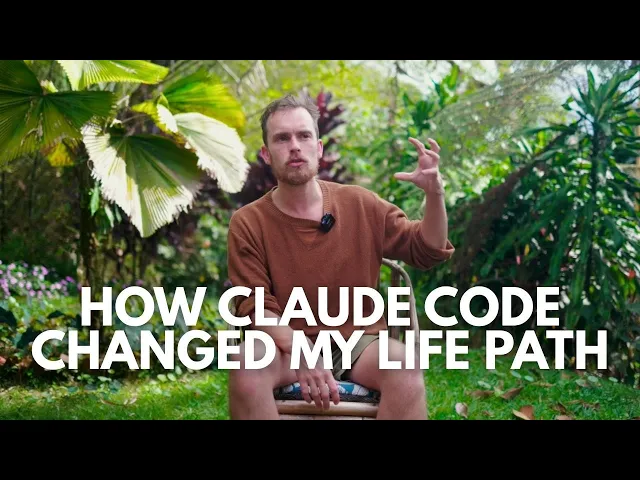
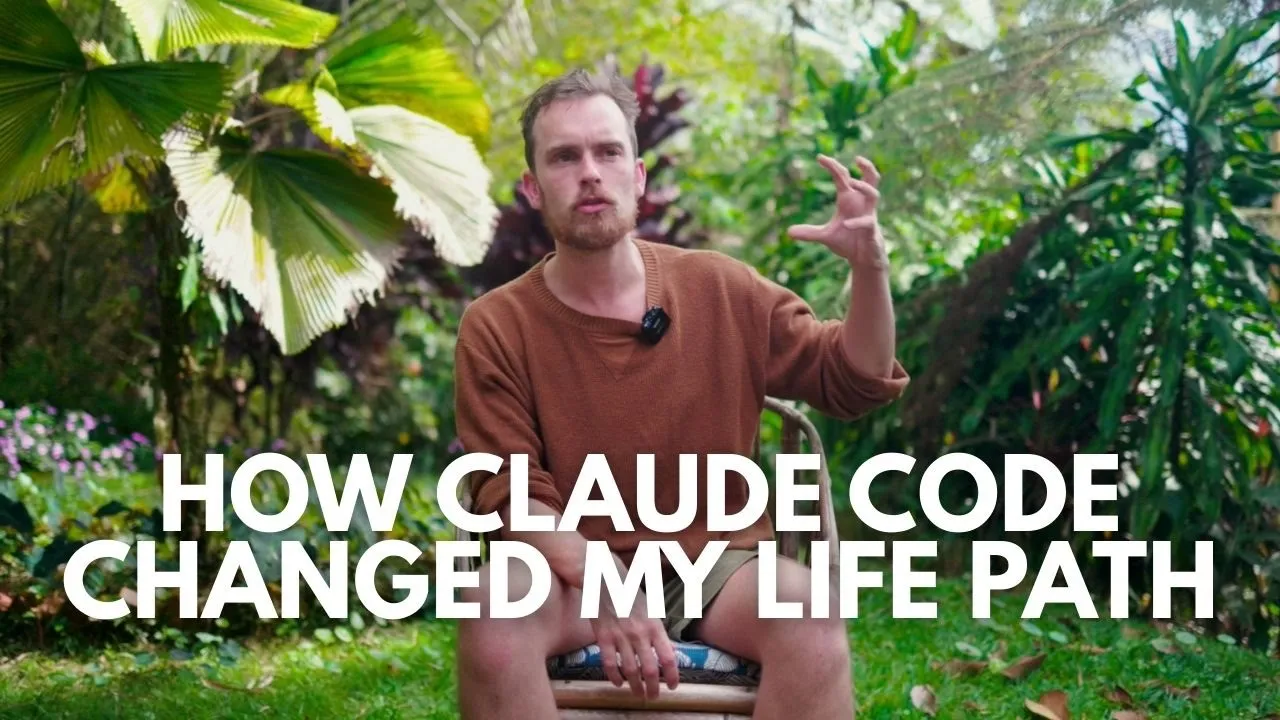
I recently made a video entitled something like "I am fed up of TASH" or "I hate TASH" and the core premise of that video was that after 14 years of being TASH, the music producer, toured the world, put out 130 something releases and also being TASH teachers, this sort of guru-centric twat on YouTube who talks about the delicious nature of generative music and bitwig etc. and I'd been doing courses and coaching and all of that, I just got to this point where I was fed up of this identity that I had seemingly co-opted myself into playing for my life. And in that video, I effectively just said that I had suffered this identity death.
I could no longer relate to being a music producer slash teacher. And that my focus had been steadily moving, if not quite incrementally and exponentially moving into code and development, particularly using services like Claude Code. Now, I just want to add a little caveat in here.
I don't really have any interest in learning to write code. I'm not thrilled at the prospect of having to sit down and spend years and years and years learning to write types and all of this and blah blah blah. What I am interested in though is using code to solve my problems.
And maybe not even just if you could class them as a problem but using code to make my life better, more exciting, more creative, more abundant. And since I made that video I've had some pretty fucking crazy breakthroughs. So I launched my first software company.
without having written a single line of code some 40 days ago. I called it sequins and the whole point of it was creating unusual eccentric music technology tools. I've since shipped two plugins, Anima and Angels, and a Mac app, Words, that lets you transform text into MIDI.
And in those just under 40 days, I've had over $32,000 in revenue and I've had over 500 customers. And I think the wild thing here is that I built this entire ecosystem, just the next. js e-commerce site with all sorts of features that I'm going to dive into in a second.
But I did all of this without writing a single line of code. And I did all of it with just the $200 a month max plan on Claude Code. So some of you always say like, oh, well, the max plan is too expensive, $200 a month.
And sure, I get that. Like if you're on a small budget, that's a lot of money to spend. However, if you can afford that, and even if it's a little bit of a stretch, you can use that $200 a month to literally just like 10, 100x your money if you have the right ideas and you implement them properly.
Anyways, back to the idea of this I implemented everything from scratch. I am not a coder, developer, you know. I mean I am a developer because I'm developing things and I'm shipping them which is actually more than a lot of developers do.
But at the same time I'm not a coder guy. I've never worked for a company. I've always worked for myself.
I've always been either a solo music producer or I've been a coach and a I've never worked for anybody else. That was a decision I made when I was quite young. I refuse to work for anybody else.
I do not want to work in some office. So all this to say I don't really know how business works. I don't know how companies work and I definitely don't know how tech companies work.
That being said I am a very curious person and I am very tenacious when it comes to if I'm interested in something learning as much as there is to learn about it so that I can absorb all of that information and ideally do cool shit with it. That being said, when I started creating these plugins, the first thing that I shipped with Sequins was called Words. It was that Mac app that a bunch of you guys have bought and I've been iterating on that ever since with a lot of your great feedback.
But I built this thing and all of a sudden I was like, well, I can't just make something that I'm going to sell that people could just share with each other. That kind of defeats the object of selling it in the first place. So I was like, well, how do plugin companies, how do these music tech companies deal with licensing?
I know I've bought plugins before that I'm going to get this code and I'm going to have it in my email I'm going to type it in it's going to say congratulations it's now licensed I know these terms I know this from experience but I didn't know how to do it so obviously once I'd completed my my words I said to Claude I posed the question how do we create a licensing system and it told me a bunch of things that we could do we could do this with gumroad blah blah blah blah blah but my approach with Claude Code and particularly just AI in general is if I can do it myself or should I say I would like to own the entirety of the pipeline. I'd like to roll as much from hand as possible, like create it from scratch, do everything from scratch. I don't want to use any paid services.
I don't want to be bound in by any other library or company that is charging me per monthly, when most of the time I don't love a product 100%. Instead, I would like to create solutions to these problems and to create actual services that can replicate what these companies often charge $20, $30, $50, $200 a month to do. And to do it exactly like I want it.
The UI, the UX, the features, the apps on limits. Get rid of all of it. Scale the whole thing.
Keep the entire data pipeline all to myself. So this started with licensing. How do we create licensing?
Claude suggests blah, blah, blah. RSA key pairs. Interesting.
What is that? I ask Claude. Claude tells me.
We go on this wonderful hand-in-hand ramble through the meadows. of learning about licensing and I commit to a licensing pattern. I also commit to ethically what I think is right.
I don't want an always online licensing system. I don't like those kind of things where you have to be on the internet in order to use a service. So I put in, I bake in all of my opinions, not just of how I think should be, but things that I know should be based off of my own personal use as a consumer of services, of plugins, of software.
Anyways, this then leads on to creating the website. And one thing I I hate as well is I want people to get a refund if they don't want if they don't like my thing I want them to get a refund I also don't want to have to reply to emails saying yes you can have a refund so one of the most important things was like I want to create an automated refund system no other companies do that that I can find so we had to plan it out how is this going to work what kind of security measures can we make what security measures do we need to take so I built from scratch with Claude Code an automated refund pipeline if you don't like the product you have 30 days to put in your license key and email bash automatic stripe refund sent to you all automated with an email of the receipt tremendous stuff now at this point i also wanted to have an email system you know and in the past when i've come up with ideas for businesses i've gone and bought a domain name i've bought whatever my latest idea is dot com and all of that and then i've gone to the google and created a google workspace account at which point i've had my arm twisted behind my back to have some sort of massive I can't even tell you how much I hate the G-space bullshit, but just to have a Gmail account. I just assumed that was the way that you did it.
So I then looked into how can I have my own email system and I found Resend. Resend is absolutely amazing. It allows you to, with API first and programmatically, run your emails.
So I said to Claude, how do I integrate into my sequence. music business a system where I don't have to pay somebody like Google? And so we created inboxes, catch-all inboxes, specific and this allows me to have a pretty best-in-class, I would say, email system that I've iterated on since as well.
Truly amazing stuff. Then I was like, I like Superhuman, but Superhuman costs $40 a month to have this sort of AI triaging, keyboard-focused, super-fast system. So I looked into it.
How do we implement these features? I now have a fully Superhuman-style email system built into Sequins. Other things as well.
I wanted to have a system where people could submit feedback to me from inside the plugin. If they click anima, the little nameplate, there's a button to submit feedback. They type their thing in, it sends me their feedback as well as the email address attached to it, as well as the actual hardware that they're on.
So some features or bug requests might be very easy to diagnose because I can see that somebody is on the wrong operating system or stuff like that. This was amazing. This is great.
It allows me to triage feature requests, bug requests. But that then continued on. I sat down with Claude one day and I was like, well, how can we make this even better?
How do we make it so that this is an automated process? Because what I would do is I would go into Claude and I would say, oh, check the feedback and it would query my Superbase dashboard or I would copy and paste the feedback in. And instead I've set it up.
So now whenever a bug is detected in a feedback, so it could be a feature request, but if it's a bug or if somebody emails me with something that is a bug, AI classifies that, Claude classifies it. And then using all of the information based off of the hardware print of what's that person's machine was, the things that they said. It then takes all that information and then with a GitHub action, first creates an issue for me in the Git repo, but then it creates a GitHub action that goes and explores that issue and then proposes a fix to me.
The next time I sit down, I can just pull up the issues. Boom, there are the issues and I can just get to work on fixing them. Another thing is building plugins, like actually building them so that they become things that you can install.
I can't build Windows. I use plugins or Linux plugins on my Mac easily. So I have a GitHub Actions setup.
So whenever I have an automated pipeline process, so when I'm done with a plugin, I can literally just do slash command release plugin. And what it does is it builds it on my Mac, it staples it, notarizes it, does all of the necessary stuff, it builds it in Windows on the GitHub Actions, builds it for Linux, and then it automatically downloads them, creates an XE installer for Windows, it creates a tar file for Linux, and then it's can even just if I want then publish it straight to my website automating every single part of the process. Now the reason why I'm saying this is that I am not bound by what I know to be possible.
I feel like a lot of people who have come to being an experienced developer who in many ways have had to put up with what is possible what they know to be true things that the internet have documented are the limits of what is capable or possible. A lot of people get It's stuck in these very narrow-minded views. And so the underlying theme that I think has just led to such success for me using Claude Code and being able to build a successful business is that I dream big.
My responsibility as a Claude Code user is to dream bigger than is commonly known to be possible. And the way that I approach any new feature, any new idea, any optimization or automation is to assume it's possible. I assume everything is possible.
And Claude Code can help me figure it out. It's not as simple as just saying, "Yo, Claude, do this thing. " A lot of the time we need to actually iterate back and forth.
We need to research. We need to reason. We need to consider the trade-offs and we need to take these ideas.
I think another key feature here, beyond just being somebody who is a big dreamer, a person who assumes that what they want is possible, which I think is actually a very helpful approach to take in life. If not that you demand it be possible, that you at least assume it is. of knowledge.
So we've got two kinds of knowledge, I would say here. There's declarative knowledge and procedural knowledge. Procedural is probably what's more important if you're going to go and learn to write code, which is that procedural is how to do the thing.
It's the step-by-step approach on having a problem and how you solve that problem. Now, procedural knowledge deficit is one of the biggest reasons why your grandmother isn't coding her own plugins. And maybe your grandma's a bad example, but just like, you know, the average person has many problems that they would like to manifest and bring into the world and potentially sell and ideally make life for everyone on earth a little bit better but it is that deficit that valley that lack of procedural knowledge on how to do things and the very scary incline between here and being able to actually build something of consequence required to all of the information that you need to learn to do that just stops people from doing it so so many great ideas are just thrown away because people can't reasonably assume that they could ever develop enough in their busy lives procedural knowledge to be able to do a thing.
Declarative knowledge, however, is a different thing. This isn't knowing how to do something. It's knowing that something exists at all.
And I think this is one of the key things that AI has really revolutionized for people like myself, which is that I don't need to know how to do a thing. I just need to know that it exists so that I can ask AI how to do the thing. And the key thing here, I think is the real exciting fusion of this point and my previous point about being a big dreamer and assuming things are possible is that AI doesn't sit down and just decide to start fusing disparate concepts.
As a music producer throughout my entire life, as a creator of all sorts, I've always found that my best ideas come from when I take random things, seemingly unconnected, disconnected things, and say, well, what if? What if we merged them? And so the power of using something like Claude Code is I can have the declarative knowledge that something exists or that there is a way to do something or there is a way that people do do things or that there is a result that you could have.
And they're going to have a completely different thing, a completely different integration or feature or just idea. It doesn't really matter what they are. And me, being a human being with a creative synthesizing brain, can ask the question to AI, what would it be like if we fused these things?
How could we fuse these things? What is possible by taking these fundamentally different approaches or concepts? concepts and fusing them together.
And this is where I've been able to do things that I've had people, senior engineers at Google, Apple, Shopify, Webflow, I've had people reach out to me to just say that the things that I am doing, it's insane. It's insane to see a developer who does not write code doing the things that I'm doing. And it's an interesting point here as well, is that a lot of the people who have shit to say seem to just be these kind of gatekeepy developers that seem to have this idea that if you didn't write every single line of code yourself, if you didn't go through the decade of of learning about all of these different functions and stuff, then what it is that you're doing is of no consequence.
I find that the people who are probably the best and most qualified to judge the output of creative content with code, I think are people who have demonstrated extreme technical prowess. And this is just the reason why I'm even saying this is I think this is just such an inspiring moment in human history where somebody like myself, somebody who has done all sorts of creative things, but I've made music, I've cooked, I've even had a little deodorant line for a while. I'm able to go and create things that I dreamed of.
You know, that's another thing, is that these products that I'm coming up with, these solutions, these automations, these are all things that truly I just dreamt them up. Some of the things genuinely, like the Anima plugin was a dream that I had. I wanted a plugin that did X, Y, and Z, and I woke up and I was like, if only.
I even get feature ideas. I wake up in the morning after having I've dreamt something up overnight and I just sit down and get to work. Anyways, I'm noticing that I'm actually running out of space on my card, so I should probably wrap this video up.
I'm definitely going to talk some more about this because I really want to dive into the GSD or the Get Shit Done system. That is really the underpinning, the powerhouse machine that's allowed me to do these things is a system that I built, a framework for Claude Code called Get Shit Done, the GSD system. And I think it would be really helpful to actually break down the philosophy and the thinking that went into building that.
But anyways, I just wanted to make this little video just to throw this out there. Again, I'm going to have to wrap this up. Unfortunately, I'd like to keep talking, but we're going to have to see each other next time.
Wishing you all the best. Happy coding always. And yeah, buy my fucking plugins.
You're going to love them. Or also try the GSD workflow. It's killer.
If you're using Claude Code, highly recommend you use it. It's going to change your life. Loving you loads and I'll talk to you soon.