>> I'm here to introduce Amy Jo Kim. For most of you, she does not need an introduction because you--if you’ve paid attention to Gamification and engaging players, you have probably run acro--across Chris Lysy on Slideshare describing virtual goods and how to put the fun in functional and how to create reward systems for users. You may have read her book on Community Building on the Web or heard about her work in Digital Chocolate or working with Electronic Arts and some of the biggest companies out there on engaging their users and making applications on the web feel like they're game.
I got to know Amy Jo Kim through Irene Au who introduced me to her. And I got a chance to attend her full-day workshop on Gamification at the Gamification Conference this--this January. It was absolutely amazing.
It was some of the best, most structured thinking on user engagement that I have ever encountered, and I really, really enjoyed it and very highly recommend it. We'll try to bring her to Google because I think it would be very relevant work and it would be really fun to attend. So, without much further ado, I give you Amy Jo Kim to be here to present and then she will take your questions.
>> KIM: Hi. It's really great to be here. I would love to, after this, learn more about what you guys are working on.
And I'm here today to share a pretty short talk about what I now think of as going beyond gamification. So I've been both a game designer and a web designer for many years sitting at that intersection. And this is really what I've come to learn from working with lots and really, really smart people and great teams, about merging game thinking into everyday life.
So, gamification is a silly word and--but it's become a touchdown for people that are really interested in taking games beyond gaming. So what does it actually mean? It means different things to different people, right?
To some people, it's a loyalty program on steroids; maybe not so much to you, but at the recent Gamification Summit, maybe half the audience was coming out of traditional loyalty programs which are very game-like. They have points. They have levels.
But are they games? Now, can we make them games? That's the question there.
To some people, it's using game techniques, particularly specific mechanics; to turbo-charge products and services. You can also use the visuals of games, you know, the animation and fun of games, but a lot of people are particularly interested in game mechanics. I'm here to tell you that that's a great place to start, but that's not going to get you where you need to go in terms of engagement.
And in 20 minutes, you'll see exactly why. Some people really look at the levels and rewards and unlocks and say, "I can manipulate behavior with that. Look, games do it, I can do it.
" There's a lot of ways to do that. You can do it in karate, which I think of as a very positive kind of gaming, and there's even a movement now. I heard about this from one of my young game designer friends called the Positive Gaming Movement where people--especially young idealistic people--want to create good in the world.
And I know we do here, obviously. We want to do it. So there's ways to use game mechanics to support a cause, but you can also use them to manipulate people and, you know, just watch all the people in Vegas lined up in front of the slot machines and look at the looks on their faces, that's another game mechanic.
So just like any tool, it can be--it's powerful and it can be used for different purposes. But levels, rewards, and unlocks are part of gaming but they're really not the thing that makes games really truly work and be compelling. Another idea for gamification is the idea of turning any real-world activity into a game.
Nikeplus is a great example. FitBit is starting to get there. Jane McGonigal is doing a lot of work there for certain kinds of causes.
And that's another great thing to do, and it's very tempting now to look at mobile devices and look at all the affordances and say, "All the world is a game," you know. Why not? Why not make it a game?
Well, I believe personally there's real good reasons why every moment of your life doesn't want to be a game. But there is the desire particularly of people to—I’ll hold off a moment, it looks like a large group of noisy people is going by. Maybe that won't stop.
Okay. We plunge ahead. We don't let us deter us.
Okay. Is gamification also experiencing a hype cycle? Raise your hand if you think it is.
I think it is. How many of you have ever heard of the Gartner Hype Cycle? So, if you've been around a while like I have, you'll see that--a couple of years ago, everybody needed a social graph.
You know, Time Warner needed a social graph. And now gamification is this thing, it's this hype thing and it's going to get too much hype and then people will get disillusioned. "You mean it's not the solution to everything?
You mean that's not like the golden ring on the merry-go-round? " And then, my prediction of what I think most of these things do, it'll just become part of our toolkit. It'll just be one as user experience designers, because we all are; we're creating experiences people have.
This will be part of our toolkit, and it's part of my toolkit and I'm trying to share that in--as tools for you to think about in using your own work. So I think of it, I think of gamification as just using game design, along with other great forms of design, to create really compelling products. So let's cut through the hype.
Here is a working definition I find useful, "Using game techniques, not mechanics, but techniques to make activities more engaging and fun. " That's not the same thing as a core experience. All the game techniques in the world won't prop up in any long term sense a crappy experience.
It doesn't provide value. So step one is some core experience that is fun or rewarding or provides value. And the game builds around that.
One--how many of you have read Daniel Pink's book, "Drve? " Okay, a smattering of you. I have.
So, he lays out something that game designers know and have worked with a lot, but he lays out in the business context which is that intrinsic motivation trumps extrinsic. Extrinsic motivation is all the game mechanics that now platform vendors are selling like points, rewards, levels, add it, and your product will be successful. And, no, actually, it turns out you can get short term lift from that, but that's--game mechanics are like the ingredients in a meal.
And the whole experience of the meal; the recipe, the chef, the way it's served, the way you experience the atmosphere; that's what a game is. So, game mechanics are a small part of it. They're--especially the extrinsic ones.
Intrinsic value is also part of game design, but you don't think of game mechanics is providing that. What's providing that is being part of something bigger than yourself, having some autonomy, gaining power, which is a byproduct of the game mechanics. Feeling like you belong, learning something, having fun; those are intrinsic motivations.
And the core of doing good gamification, smart gamification is to really identify the core intrinsic motivations of the heart of your product and then build around it to support that with your game mechanics and aesthetics. So, what extrinsic motivators are particularly good at--and Daniel Pink plays this out in a beautiful way--if you go look at my slides on SlideShare, I assign some of his talks as homework. Just like--it's great--if you haven't seen it, he's got a 15-minute TED talk, gives you the main ideas.
So, extrinsic motivators like money and bonuses ina work environment and, like--progress bars, a great example of that--are very good for task completion. If you have a series of tasks, it's clear what to do, you want to complete them something like a progress bar or game mechanics can actually work very well. But if what you're trying to do is longer term engagement, if you want people to love their jobs and stay because they love their jobs, if you want people to exceed their own performance in a work environment, if you want people to love your product and Tweet about it not because you scam them into it with your mechanics, but because they really are excited about it--what it provides--that's where the intrinsic motivation comes in.
How many of you have ever heard of or seen or used ModCloth? Okay. Good.
A few. So ModCloth is an interesting example. It's not a game company.
It's--I think of it as Cosmo Girl for 2011. It's like a branded channel for clothing and accessories and a whole lifestyle around young, hip, yet retro, urban 20-somethings; is their core market. And they've got this system inside of their product called "Be the Buyer" where they take the, "Gee, I liked it, but not enough to order a big order of it" from the buyer, from ModCloth, put all those samples in front of the community and crowd source, custom manufacturer of the community's favorite clothing.
And that's inside of ModCloth. That's a game mechanic. That's a system that actually provides core value that's fun to play that changes your life in some way.
You get clothing that if you weren't playing the system, you wouldn't get. That's intrinsic motivation. People feel like, "Hey, we have real power here," and, in fact, they do.
So a player is the person who's playing your game. So, one thing for you to get from this talk, just for fun, in your next conversation where you're talking about, you know, your users, talk about them as players and see if that changes how you think. Just--it's a fun exercise.
The thing about good games that's missing from a lot of the throw a few badges at it, they balance skill and challenge to keep players engaged. I mean, it's a core of a good game. It has to change over time as the player's skill gets better.
That's what makes people engaged on a fundamental level. This is from a book called "Flow," and that's a great resource as well. And that channel in the middle is the flow channel.
It's where you're not bored and you're not anxious because the challenge is too high. You've got this good balance. The thing about games is in order to deliver that, you have to first teach someone the ropes and then deliver more and more interesting challenges as they get better.
So that's really much of the core of what makes a game interesting, not throwing a few points at something. So the journey is the player's progression over time. Sometimes this is called the lifecycle.
I've done a lot of user experience work and UX design and player lifecycles are their experience over time. First, there's onboarding then there is, you know, you're just regular and then there is the enthusiast or the elder game, we call it in gaming. And I used the wordplay "Journey" because if you add progression and learning and mastery to a lifecycle, you essentially get a game.
You get a journey. You're taking your player on a journey. Imagine you're looking at Gmail and thinking, "Okay, what journey are we taking the players on?
" Maybe you would show them less things upfront and unfold functionality over time as unlocks or something like that; something simple like that; a journey where you deliver to people special powers or privileges when they're ready for it, when they've earned it. So this is a simplified chart, just to think about the key stages. And, again, good games give people something to master, whether it's WOW or whether it's Bejeweled, or whether it's City Ville, there's some core underlying system you can master.
You know, core, you can look at core like that. There's a system to be mastered. How to ask and answer good questions to get voted up and get popular That's a system.
So, in this lifecycle, novice, expert, and master are just stages. They're not the whole thing. You don't move chunk, chunk, chunk from one to the other.
It's a continuum that those are key design points to think about if you're designing something that's game-like. So novices basically need good onboarding. And it could be a tutorial, it could be a series of quests.
It could be a little game-like experience to rate stuff like Netflix and GetGlue has which, by the way, they're doing because they want to get custom data about you and then feed that back. That's why they're doing that game, but they're also teaching in the system. Whatever your system is, good onboarding just makes it--things--everything go better.
And the key about that is you need to introduce the core features and systems during the onboarding. Teach them how to use it. Give them a sense of making progress in some sense; progress towards something and then you've got a compelling onboarding experience.
The expert who's beyond the onboarding, they know the ropes, they learn the ropes, they know how the systems work. Usually need either, if you've got a content-based environment, fresh content or fresh activities, fresh people. You know, when you log into Facebook, there's fresh content, boom, right there all the time.
But some systems aren't so much about content and they are usually--these people are wanting customization, power tools, status, access to things they couldn't access to before. And then masters are further along that. That's the 2% to 5% of people that are going to go nuts for your product.
They're going to be emailing with wish--what they wish you would ask. I mean, what they wish you would add, that are answering other people's questions on forums, that use it all the time. Those are the masters and they are a great resource.
If you can figure out a way to harness their energy and feed it back into the community, that's the golden ring on that one. But even if you can't, you can give masters exclusivity in some form. It can be access, activities, unlocks, maybe a special behind-the-scenes forum where they can chat with the devs, whatever.
But that's what those people need both to stay interested, if you've got a situation where they could jump to a competitor, but also to get value from them. So, the overview of this is rather than thinking about game mechanics, think like a game designer. Think about "Which journey am I going to--what's the journey, the backbone of my product?
" And there's three different things I want you to think about; dynamics, mechanics, and aesthetics. This is from one way of looking a games. There's a lot of lenses to look a games through; they’re sophisticated, complicated things, some of them.
But a nice way to chunk it and understand what mechanics is dynamics are time-based patterns and systems. In some ways, they're actually much more important than mechanics because they are what happens over time. So if you have progressive goals or quests that get metered out if someone gets better, that's a time-based system.
Pacing, reward schedules; those are all time-based systems. Reward schedules are something that a lot of people have gotten excited about particularly from the loyalty and marketing side. And basically, there's a bunch of research from psychology--how many of you have ever seen that chart before on the left; Psych 101 or Behavioral Psych 101?
The punch line--this is the kind of thing in the workshop I go into in much more detail--but the punch line of that--of that chart is that surprise and a certain amount of randomness mixed in with expectations gives you by far the most compelling and addictive reward schedule, which is a pattern over time. So you don't--if you have all surprise, you know, pure surprise and randomness; that's actually not very interesting. But it's a mix of having something very expected with something that feels surprising or serendipitous, that is the most rewarding and addicting.
And almost every product can add some of that in. By the way, the one-armed bandit that we all know and love or we know and hate is programmed with that red schedule which is called the variable reinforcement schedule where both the pacing in between the rewards and the size of the rewards are varied. And that's why all those people are sitting in Vegas with the frowns on their face pumping quarters in, you know?
So, mechanics are the system's--a good way to think about game mechanics, not every single one but most of them, think about them as the systems and features that make your progress visible. So points, levels, leaderboards, badges, missions, virtual goods, in a sense, what they do is make your progress visible and meaningful to you. Foursquare actually does, with very simple mechanics, a good job for what it's trying to do of making your progress meaningful for you.
I'll talk about that a little bit more. But essentially, the mechanics are lighting your way. It's like, what does progress mean?
What does it mean to play this thing well? The mechanics should answer those questions. Aesthetics are the overall experience that yields emotional engagement.
Things like the page loading fast and responsiveness in the interface and really good feedback and, you know, the email from Amazon telling you your package is on your way. All of that is part of the overall aesthetic experience. So when people say, "Okay.
I'll make this like a game. I'll put some points and badges on it," that's a little piece of it. The--all these other things work together to make a compelling experience.
Aesthetics essentially are what yield emotions. And different products are going after different emotions. Sometimes what you want is trust and security.
Sometimes what you want is surprise and polite. Sometimes what you want is satisfaction. But it's very useful to ask yourself when you're developing a product, "What emotions do I want this person to have along the way?
Are there moments of delight I could deliver? And would that be," you know, "What would that mean? " Moments of connection, moments of any of those emotion.
Emotion is fundamentally what drives action and engagement. This is why people click on these stupid little updates if they're--they have a seed of strong emotion. And social actions are how players engage with each other in your game.
So, I'm talking about social actions because I'm a multiplayer game designer. I've never designed a single player game in my life. I've worked on Ultima Online, on Rock Band, on Sims.
Actually on the Sims website which was a multiplayer game, and many websites like family. com. I worked on eBay with their game systems.
But a lot of how I think about gaming is social. And I think that more and more, that's how people are going to experience digital products, is socially because that's our landscape. So when you're looking at that, again, there's many lenses to look at.
Social--you guys probably know Jerry Engstrom; he's got a notion of social objects and a lot of analysis. That's awesome. I totally absorb that.
Social actions are how players engage with each other in your game. They are these moments where there's an action that causes them to engage. They're the building blocks of social engagement, whether you're engaging with updates in a social network sense or in a multiplayer sense inside of a product.
And I'll talk a little bit more about that in a moment. So, what you want to ask yourself is whatever your product is, who are my players engaging with? Who is it?
Is it friends? Is it family? Is it people I know?
Is it people I don't know? And what's their preferred social style? So there's three social styles that have emerged out of Facebook gaming that are very broadly applicable.
One is competition. It's one--again, it's not the only. And a lot of gamers, especially guys who are used to like certain kind of game go, "Oh, game means competition, leaderboards," right?
Well, some games, but not all games, in fact, not the most popular game as it turns out. So if you start seeing verbs like brag, taunt, challenge, you're in a competitive game. A great example of that is Brain Buddies on Facebook, one of my favorite games, and it just uses its leaderboards and game mechanics beautifully to create a very competitive environment where you're like, "I am not going to let my," you know, "High school roommate or college roommate be smarter than me on this test.
No, I'm going to go. I'm going to beat them. I'll play this thing until I beat them.
" You know, that's the--that's really what it's going for. And you really can see that in the language. Cooperation is on the rise because the nature of who's gaming and the social style of who's gaming is changing.
Cooperation is--has verbs like share, help, gift, greet, visit. If you look at CityVille, Zynga's newest game, you see that if you go to the leaderboard, which is a lot more like a friend list than a leaderboard, the things you can do are visit and gift. You don't taunt and challenge.
You know, you're--you're helping them. "I'll help you. You help me.
" And the only reason Zynga is doing this is because it works, you know? It's--they are very metrics and success-driven. This kind of game is working.
It's got the most players of any game ever, as far as I can tell; they may be lightweight players. But we're seeing a lot more of this and that's a happy thing if you're interested in positive gaming because you can do a lot through cooperation, whether it's one-on-one or crowd sourced. And then the third style is self-expression.
Sometimes people don't think of this as part of a social style, but it's huge. I mean, we first saw it in MySpace with all the blinging out of pages and there's a tremendous amount of self-expression going on in Facebook games. This is from Farmville.
So it turns out instead of just building a farm, you could take all the pieces and make video game--old school video game characters. There's Link. There's Mario and Luigi.
So that was cool because that enabled self-expression in a way that maybe the developers didn't even intend. But you see verbs like customize, select, design, create, that's part, along with cooperation, that mechanic is very much part of all the hit Sim-like Facebook games and things like Stardoll, which is huge on the Web where it's just this paper dress up or girls go--girls being 14 to 30-plus and dress up. It's aspirational with fashion.
So--and, you know, simple things like really having something interesting to customize in your profile can be a bit part of self-expression, but self-expression has many forms. For some people, that's a primary reason why they game. That's the punch line.
So, competition, cooperation, self-expression, there can be a mix. Ask yourself of your--of any project you're working on, think about who's using it. Do any--do any of these describe what their preferred social style is?
And if I don't know, how can I get that answer? How many of you have ever heard of Bartles Player Types? Okay.
Well, I'll give you a really quick overview. Can I [INDISTINCT] to this in a lot of detail. In--this is a cool story.
In 1996, John Bartle, who's one of the co-inventors of MUDs, which are the text pre-cursors to WOW and other MMOs, noticed that in the first three months he built--and they were all different; he's one of the very first people--the same styles of play kept coming up. MUDs are multiplayer by definition. They let you do a lot of things; you can kill, you can build, you can create, you can share.
He saw this forced player types keep coming up; achievers, explorers, socializers and killers. Achievers are the people that are competitive and that like things like leaderboards. They want to know who they're better than.
They want to know what--they come into an environment, they say, "What can be achieved? How can I gain status? How can I, like, show how great I am?
" And we all people like that at work and in games. Explorers are the people that want to know every nook and cranny. They are the people that are going to, like, pull down every menu and check out every little--every little feature.
And in MUDs, they check out every little room and then they're proud of knowing that. That's their--that's what they're after. They want the fullness of--they want knowledge, comprehension and exploration.
That's what these people are driven by. Socializers are the people that would stand in the lobbies of the MUDs and greet people and, like, share gossip. And they wanted--that web of social interaction was what socialzers were driven by.
That was more important to them. They didn't care about a leaderboard. They didn't care about how many kills they have.
But they did care about knowing a lot of people and they cared about being acknowledged for. These are the kind of people that make awesome guild leaders in some of the MMOs because they really care about organizing people and being at the center of that. Killers are hackers, harassers, the people that just want to mess with either software or people.
They get off on messing with software or people. And, again, we all know people like that. And sometimes, they're very nice in real life and then online, [MAKES NOISE], you know?
Yes, I sense a laugh of recognition. But anyway, the point is these are four-player types. And if you have a rich multi--I guarantee you WoW sees these four-player types.
And what's useful for us is to understand where our players fall within these player types and then we can use social actions to design around that specifically. So, here's--here's some social actions for achievers: win, challenge, create, show off. Compare is a little bit mellower, but those are all achiever-types of actions, things that you could do in an environment.
For a socializer, helping, commenting, giving, liking, expressing, sharing. That merges over into explorer a bit. Some of these are, you know, more mixes of the two.
Greeting is very much a socializer kind of thing. For explorers, often they're very involved with content. So, voting and curating, rating, reviewing, and just exploring an environment.
Even viewing pages is partly something that an explorer would do. If you see somebody who just views, like, every page on your site, you know you've got an explorer on your hands. Killers, you know, teasing is the medium version of that; taunting, heckling, hacking, cheating.
Sometimes, you can turn hackers into either policemen or members of your dev team. We used to do that on MMOs, is reach out to the hackers who are messing with the beta product and say, "Wow. Cool.
Want to come work for us? " So, you may have had some experience with that at Google in dealing with hackers and getting them to help you fill the holes in your product. But, anyway, you know, they may or may not come.
There's various techniques to deal with them. But these are--these are some of the social actions, so you can see how that maps. And you can make your own chart.
Actually, that's one of the exercises in the workshop is you make your own chart with this, using this framework for your product; how it is today and how you want it to be. So let's take a look at Foursquare, the whipping boy of game mechanics, because every marketer in New York pulls out their phone and says, "I want badges," at least the ones I've met. So, however, I want to get Foursquare some props.
I actually think there's a lot they did right and there's a lot to learn from them. So why does it work? Why--are you--now, it doesn't work for everybody, but for a percentage of the population, Foursquare really works.
Are any of you avid Foursquare users? Okay. So, just briefly for you, why does it work for you?
Oh, wait. Let's do this so everybody can hear you. >> Okay.
I like [INDISTINCT]. >> KIM: You need to turn it on. >> I like the badges, especially when I didn't know what the badges are.
I kept wanting to get more and then compete with my boyfriend to see who was getting more badges. And see what my friends are at, so. >> KIM: Can you pass that back to--she--I think she--you're an avid Foursquare user?
>> I just like the history of all the places I visit and then be able to look back at it mostly. >> KIM: So it's like a notepad of where you've been? Anybody else?
Anybody remote have a Foursquare, why you like it? Yes? No?
Okay. So let's go through what Foursquare is. The core activity is to check in.
We all know that now, but Foursquare really popularized it. You can check in the venues and you earn points and stats, which I believe they're backing off from the leaderboard, but it basically lets you know its reinforcement loop that says, "Checking in is the core game. " This is how you know.
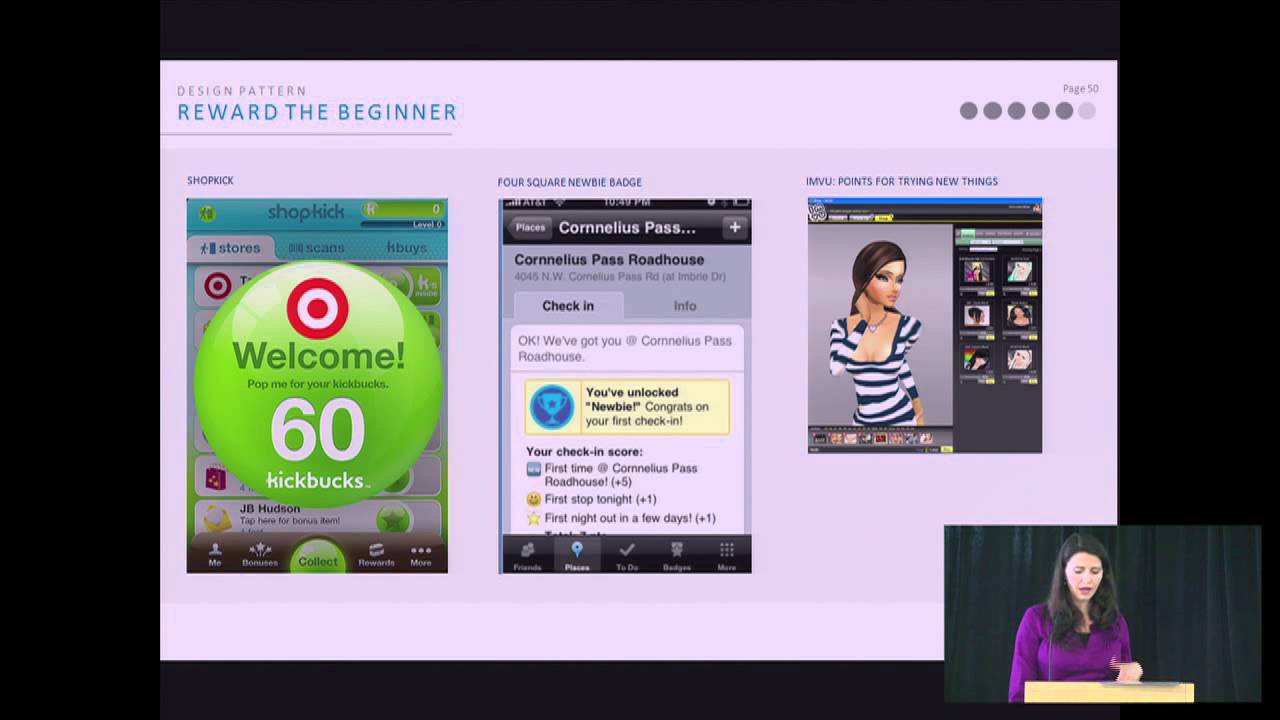
Look, you have point and stats. Badges are essentially what Foursquare does for onboarding. They mark your progress and they suggest goals just by the nature of being there and by the presentation of them as a collection, which is that, "Look, there’s 16, you got this many, collect them all.
" That's a very powerful mechanic. Not always appropriate, but very powerful when it is. The other thing about Foursquare's badges is that they have a lot of branding.
They have a lot of personality and attitude and humor. It's not just a generic badge. And it's consistent.
So, you start to get a feeling that there is a brand identity that you're dealing with which, again, seems obvious but is very, very powerful. Mayorship is the other core mechanic and that's a little bit more of an elder game, although by elder you mean been playing it for two weeks. And mayorships reward both loyalty and recency, which is just what you want them to do and they drive competition.
I've heard a lot of stories about people getting really pissed off that they were ousted of their mayorship of their own company or something that they felt was, you know, prideful by somebody else and then, boom, Foursquare wins. The two people start fighting it out. So the way--the simple act of sharing the check-ins and the badges promote social engagement, depending on how they're used.
Not everyone, but people use Foursquare a lot to promote themselves or promote what they're doing. And I see a lot of activity around that. So why does it work?
Well, remember we talked about intrinsic motivation at the beginning? The core activity--it's always good to know what your core action loop is. Core activity has an intrinsic motivation.
People, at least the people that play Foursquare, like to check-in, they like to have that history, as you say. It gives them something back. They like to earn the mayorship.
And not everybody wants to be a mayor. Some people just like checking in. And there's an intrinsic fun in doing that, particularly when other people can see it.
It isn't just about, "Oh, come by. I'm at this bar," it's also about, "Oh, it's a bleary morning. I'm at LAX.
I had this experience and, oh, 14 other people are there. That's kind of cool. I feel less alone.
" Were you going to make a comment? Okay. Progress--the progress mechanics light the way.
You go through the simple onboarding of badges and then you can keep going with badges, but it really uses that. And then once you're beyond that, there's something else; there's mayorships. And once you'd be on mayorships you can see, "Oh, if I've got three mayorships, I earn a special badge.
" So there's a sense of this is what it means to make progress. And the social actions enabled inside of Foursquare are aligned with the social needs of the populace. And then sense--in some sense, that's a self-fulfilling prophecy because there's a competition.
So, people that like competing with their husbands on things, for instance, like Nadia, will be engaged by that. I personally stopped using Foursquare because I don't want people to know where I am. I'm having a lot of NDA meetings.
I'm like, "Okay, this isn't working for me. " But, I mean, that's me. I'm not the core target audience.
And if I was mayor of anywhere, it would be like my son's karate studio and there's no cred in that, so. It didn't work for me, but what's cool is it does work for some people and it works really--and it's aligned with their need for bragging and competition and sharing. Was that a question back there?
Oh, sorry. I keep seeing motions. Okay.
So here's some things to ask yourself, this is like a shorthand, and I'm going to use Quora as an example for some of these just to bring it down to earth and make it real. So, don't start by saying, "What game mechanic should we use? " Start by saying, "What's our vision for this product?
What is the--what's the key benefit that we're building everything around? Is there a game people are already playing? Even if it's sort of a not a real game, but just--is there some system people are optimizing?
And most importantly, where's the fun? Where can we put the fun or where is the fun already that we can support? " So Quora, again, not perfect but I think a really interesting system and an interesting example, is pretty clear about what it is, which is it's this set of questions.
It's not like we're doing a platform for blah, blah, blah. It's content. We want this content to be really good and I think the systems are designed to make that happen.
That's the core game is, "Where do I go if I want good content? " Now, when you hear that, it may not be true as people are asking about Quora. But right now, especially for me when I want certain kind of really good content, that's where I go.
It totally worked. Second thing, playstyle. Who's playing?
Who are they playing with? What kind of playstyle? Are they competitive?
Are they cooperative? Are they into self expression? What do they--what's going to motivate them?
So how do these players want to engage? The way that one--I think Quora has a lot of different play. I think they've got different verticals and different playstyles going on.
But I know that for me, personally--and I see this a lot in the answers--when I've got some--some knowledge that I've worked hard to acquire, whether it's domain knowledge like I'm sharing with you now or, you know, I just got back from my first cruise I took. I did all this research. It's like I kind of want to share it.
You know, I--I did all these research. I took really good notes, but now what? And so here's a guy who did that from New York.
I have to go to New York in April and, boom, I go to Quora and here's a guy saying, "Well, I just went with my kids and I'm taking my kids. I went with my kids and I did all this research and I want to share it. Here we go.
" And here's his answer. And so, the urge to share information where you feel knowledgeable about and--and to have a place to share what you've worked hard for, that's an intrinsic motivation and that's certainly one way that players want to engage. And that's a very positive loop way.
Here's another one, mastery. So, what can be mastered in your system? Is there something that can be mastered?
What's the core activity? What's the progression built around that? What is it that people are going to be optimizing?
Those are the questions that lead you to mastery. What does it mean to play well? So, in Quora, what it means to play well is to ask and answer good questions as far as I can tell.
So what I noticed is the first time I asked a question, I had to go through this whole jump through hoops and be taught there's an onboarding for asking questions. Now, that when I ask questions, I can ask them and then I can edit them and then it tells me, "Oh, yeah, other people can edit them too if they want to make it better. " "Oh, really?
Other people can edit my question and make it better? " Well, that might not work some of the time, but I bet--like, if somebody could do that and actually make it better, yay, because there'll be better answers and--you know? So there starts to be this little bit of collaboration sneaking in there.
So, what can people learn and master, they can learn and mastery how to ask, "How do I write an answer that gets voted up? " That's something for me to learn and master. Progress.
So, how do we like the way to mastery? Ask that of every one of your projects you're working on. You know, how--what are the signs that someone's playing well and, in fact, making progress?
So another way to say it is what are the key metrics for progress? How are they represented? So I think Quora could do a much better job of this, in particular because here you go.
Here's--you know, you go to your page and, "Look, I got some up votes" and "Look, I got some follows. " And, like, that's a bunch of metrics. So this is like a best practice.
Put your numbers in to context. Numbers without contexts are much less powerful than numbers with context. And here's--I think Quora will probably do something really interesting here, but I'm using it as an example because it's scattered, it's spread out, and it's not that clear to me if I'm making progress.
And it could probably be clearer. Engagement. So I haven't gone--I have a whole section on engagement I didn't have time to go into to day, but I'll just touch on it.
So, engagement is really--games are very good at engagement. But they're not the only--the only thing that's good at engagement. But there's all these techniques that I've been talking about, and I think the core one is designing over time.
Designing and experience that unfolds and changes over time, that gets more interesting and in fact, more challenging, the more you do it. So within that framework, what can you do to reengage people throughout their lifecycle? The other core insight is a newbie and a master are going to be engaged by really different things.
It's the same thing as they're going to engage someone as they use your product more and more if your product is interesting. So, here's a chart just to help you remember that. So, imagine--ask yourself, "Okay, what's the engagement loop?
What's the reengagement loop? What's the email or the notification or whatever? How is someone going to come back to my product?
Is it driven by damage? Is it driven by something with this? What does that loop look like?
Is it social? " Same thing, once somebody's been playing for two months, they know the ropes, it's just this tool they use, now what does it--the core thing that's going to engage them? And what can I build around that?
Same thing, your avid users--that 2% of crazy people that just can't believe this product didn't exist before--what about them? What's going to engage them? What's going to be the thing that pulls them back?
And if you think about that, that can help you create a really strong backbone for a game that may or may not have points or badges, but you'll know why you're putting them in there. So, there you go. If you want more like this, I Tweet a lot of links and I let people know about what's happening via Twitter.
And you can also feel free to send me an email at the best email service, gmail. com. So, I'd love to take any questions anyone has.
The gentleman in the back, wait a moment, sir. >> Hello. My question is regarding--it's related to Quora.
I work in kind of customer service and support. I'm just wondering if you've seen any really successful uses of gaming techniques to drive kind of support and service. >> KIM: To drive?
>> Kind of support and service. You know, kind of a lesser glamorous part of the industry. >> KIM: I have--I haven't worked on them, but the place I saw was at the Gamification Summit.
There were a bunch of people that were talking about experiments that were going on with that. What I know is it's a hot area that's low-hanging fruit. The things I heard about were pretty simplistic like, "Oh, let's give them points for answering, you know, calls.
" And the more interesting discussion was around how you motivate and empower customer service people, you know, to--to do a great job not just, like, complete lots and lots of calls. But I know that there's a lot of development happening in that area. Anybody else?
Anybody on the remote side have questions? Looks like none. Okay, great.
Well, thanks for coming. I hope it was useful to you.