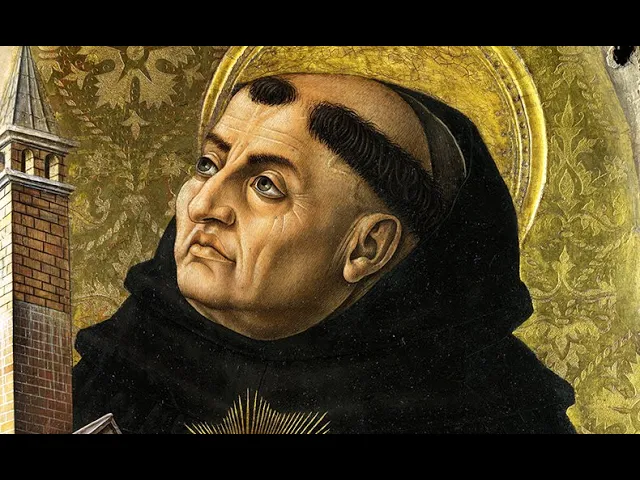
all right so now with a little bit of change of scenery we have the voitiwa article for the week or the chapter I should say on the metaphysical and phenomenal phenomenological basis of the mole Norm and here he's going to compare the ethical systems and I think more from meta ethics perspective or at least the foundations of Ethics between Aquinas and Shaler all right so uh this is a good review at the start of um St Thomas I think this is something that of course we are uh probably all familiar with but I like the
way that uh I like the way that voiti was summarizes this and I think it's important to start here so I'm looking at page 74 uh middle of the page um most important among these genetically platonic views was the concept of participation with it Thomas like Augustine was able to grasp the relation of created Goods to God as the Supreme good because the good is really identical with being this relation goes hand in hand with the relation that occurs between contingent beings which Exist by participation essay per partitionum or participation and necessary being which is
subsistent existence essay subsistence the Australian concept of the good which place the primary emphasis on teleology underwent a reconstruction in Thomas's view which gave priority to the aspect of existence such that Thomas's concept of the good may be properly called or may properly be called existential okay so this is a good summary of a central point in Thomas and and again I think this is a bit of review I don't think that this is anything new but um but it's worth starting with I think to get the pieces together uh in anticipation for how we
contrast his view with Shaler and what jp2 will think is the resolution between the two how can we bring these two very different Traditions together uh on 76 I wanted to look at this quote from De veritate I think this is from De veritate 21 6. so uh this is toward the top in the Latin um Unum quad cue bonum in Quantum as perfect Hobbit modems specimen ordinen specium Quantum at ipsum razionem uh modem Quantum marseudonym perfect TV so just to translate this uh the thus every good being perfective in accordance with both its specific
character and its Act of being has measure species and Order species in its specific character measure in its Act of being and order in its status as perfective so let's see how uh voitio explains that in his own words too from this we can see that the good is identical with the whole being with its Essence and its existence the basis of a being's real perfection in the mode proper to it should be sought in the order of existence whereas the good becomes an object of knowledge only from the point of view of essence only
Essence is conceptualized order however is based on the real Perfection itself for a good in the existential order displays tendency toward other beings either as ends for it or vice versa so again this is still I would say review or should be review for us thinking along the foundations optimistic ethics in harmony with domestic metaphysics but it's important to be reminded of this thinking ahead again to uh how we look at this in comparison with Shaler that isn't a metaphysician like this and takes a step back from that um ontological perspective that we have with
Thomas but I think really the key Point here to keep in mind looking ahead again is this necessary connection between the ontology of the good itself and the good as the object of the will and how these two things are necessarily related all right so let's look then at 77 so the next page this is uh toward the bottom half of the page in Saint Thomas's thoughts Aristotelian teleology is essentially combined with platonic augustinian participation at the basis of this Union stands the idea of exemplarism which has its ground in Divine reason God is the
Supreme Transcendent measure of all beings through the unconditional Perfection of God's Own being through the unconditional fullness of existence that God is this entails the resemblance of All Creatures to God in being and this resemblance has its degrees both the resemblance and its degrees are cognitively encompassed in the Divine mind as their Exemplar the Creator season itself the Supreme model of created beings and knows these beings in their exemplification that is insofar as they exemplify its essence which is what the Creator knows in the primary sense herein lies the very heart of the normative order
purposiveness does alone does not entail it he's talking about teleology here even the resemblance of creatures to the Creator in being does not determine it for this resemblance says nothing about the normativeness of the world of goods as a whole only exemplareness speaks of such normativeness for the Exemplar is the Transcendent measure for what is modeled after it consequently every being has its own imminent and Transcendent measure so that I think will be the key for voitiwa just thinking about the uh well God is the Exemplar cause and the top Exemplar and participation in God
who is the highest good um that's what will allow him to answer I think shaler's view of the moral Norm who's I think will respond to Kant really Kant is going to be the object of shayler's critique uh just to finish up here at the bottom of 77. the imminent measure results from the internal relations that Prevail in a given being such as for example the relation between its form and matter the Transcendent measure results from the being's exemplification of the Supreme Perfection of divine being and this exemplification can occur to a greater or lesser
degree so really what we're doing here and again this is review but this is the metaphysical basis for establishing the proper hierarchy of goods leading up to God and this sense of participation that Aquinas is borrowing from Plato and Augustine to explain the moral Norm based on that metaphysical hierarchy so it's how all of these things are essentially coming together all right now let's look at Shaler then so bottom of 79 so this is uh in contrast with jailer so I mentioned this because of Shaler who will be discussed later and who holds the the
hierarchization of values and an indirectly of goods is a function of pure feeling a function of a unique kind of reflex of the emotional sphere within us or in US whereas rational reasons for the Practical hierarchization of values even if such reasons could be given do not play any role okay so that's going to be your big contrast with Shaler that this hierarchy is something that is felt for him so it's relying on um I a feeling let's say an intuition really an emotion um let's say for him it's all pathos to get to this
hierarchy of value whereas for Thomas the basis will be in the Exemplar cause of God and thinking along these kind of um platonic slash augustinian lines of the one and uh participation in God who is the let's say Plato's archetectonic form in reality uh which is the good right I mean that's that's the archetectonic form for Plato and that's not really going to change for us I mean we fill that out understanding that we don't have separated forms but we do have in a sense God as a separated form of the good and of all
these Perfections contained in it as the one so um there is a way I think through Augustine and rethinking it in these ways to essentially baptize neoplatonic thought in certain degrees on this point so God is the form of goodness itself God is goodness itself and this is indeed the archetectonic form so to speak but um but of course it's God God is what we're talking about here ultimately so for Aquinas this is going to be based on reason there's a rational ordering to the hierarchy of goods and values whereas for Shaler it's it's uh
pathos it's something that simply felt now that doesn't mean I think and this is where I where voitiwa will try to maybe rescue Shaler is that um this doesn't have to be necessarily uh contrary to realism but uh but that's something that we'll have to think about right is it are we able to reconcile this from the same point of realism all right so uh moving on from there where just to finish up the review of Aquinas here's the last passage that I have um marked out for this so on page 80. the good is
the object of the will whereas the cognitive apprehension of the good its objectification is according to Saint Thomas an object of reason both of these faculties work closely together with one another octum altarios operator the will Wills so that reason may know reason in turn knows that the will wills and what the will Wills a result of this cooperation of reason and the will is that the good and the true somehow mutually include one another when reason sees that the will Wills are good and still more when reason sees that something is good then the
good becomes an object of reason and AO ipso a particular truth truth in turn is the good of reason and so truth is also an end of the will which so to speak urges reason on to truth the truth of the good may have a speculative meaning reason apprehends the good in a speculative way when it defines the good and thereby reveals its essence this is a purely theoretical knowledge of the good in addition however reason knows the good in a practical way when the good is an object of action bonum or junability very which
I'm going to translate um a little Loosely for you but basically uh you can read this as the good is ordered to the task let's say the task at hand according to the understanding of Truth um so in other words if you're thinking about a human action whatever you are willing okay this uh well okay just to back up the good going back to the fundamental definition that we get with Aristotle that's not going to change with Thomas is that at which all things Aim so we know that the good is the proper object of
the will and we also know therefore that everything that we will is willed under the aspect of the good now that though is it's co-extensive with truth such that um being truth and goodness are all one and God essentially but in terms of the relationship between the will and reason uh likewise we're going to at least naturally try or or the the way that the will works will try to have this concordance between them such that whatever we will necessarily follows from our understanding of Truth uh with respect to the good right so the the
understanding of the good for us is governed by our understanding of of truth that's the the last part the subracione very so uh under the the governance of this understanding of truth that um takes priority so uh what we at least perceive to be the truth with respect to the good so that's going to determine the uh task at hand whenever we will anything