so before the break we we have uh discussed realism as a school of thought which explains compliance and we ended that part with the utilitarian rationalism the approach that has been put forward by Louie henin which explains why even under realist assumption States would normally comply just to illustrate this further uh the United States which we mentioned before uh sometimes is on the receiving end namely it has to comply but sometimes it is the party that is actually pressurizing other states to comply so for instance the US foreign assistance Act of 1961 as was amended
subsequently in the 1970s does create linkage between eligibility to receive US foreign assistance and compliance with basic human rights Norms so states that fail to observe human rights Norms would not be generally eligible to receive uh US foreign assistance unless the president decides that there are overwhelming considerations that would justify this so this is a good illustration of the henan view that there would be a price to be paid if States violate human rights and therefore States would have a strong incentive if they wish to obtain US foreign assistance not to violate human rights or
not not to be caught violating uh human rights the second approach and I will now now go a bit quicker the second approach which um explains International compliance is an approach which has been developed in Yale Law School in the 1960s uh by a number of writers including Michael rizman uh this is sometimes referred to as the New Haven school because this is where Yale University is situated and this school is called policy oriented Juris prudence and policy oriented jurisprudence basically said something like this in the end the law is not just um texts it's
not just norms and it's not only institutions this is really uh a a process of decision making so uh authoritative decision making so you you have officers that could be the president it could be the chief of staff of the military it could be the judge it could be the legal advisor all of these uh indiv uals who have uh legal Authority are making decisions about whether or not to apply this or that version of international law so this is these and their decisions and this is where uh policy oriented Juris Prudence is different from
legal realism it is based on a cost benefit analysis like legal realism so these officers are thinking about what would happen to them what would happen to their institution if they follow this or that interpretation of the law but they are also uh implementing values so they are also they have an ideology they have a world view they have a system of morality and that could actually lead them to adopt a position which will be Pro application of the law so if the if the decision makers are uh consider that part of their responsibility is
to comply with the law this would be a strong reason why they would uh uh adopt decisions authoritative decisions that would be compatible with international law a third Theory which I would want to present briefly is the liberal is the liberal Theory the liberal Theory generally draws a connection which we will also see in other units of this of this course between the regime inside the state and the propensity of that regime to comply with international law so the liberal Theory would say that uh states that adhere to the rule of law internally and that
there are liberal states in the sense that they believe in the restricted powers of government and the fact that governments have to comply with the law for these kinds of states it would be more natural to also comply with International Norms which speaks often similar language has similar processes of reasoning and invokes similar values now a modern uh articulation of liberal Theory which is closely uh related to international law and modern international law is the notion of legitimacy that has been developed by Thomas Frank and Thomas Frank would argue that when a decision maker within
a state or or a collective decision-making body within a state uh identifies as certain International Norm as legitimate in the sense that it was created through a proper process by an authorized body through uh through uh a decision making procedure that is acceptable that is fair that is effective that is transparent Etc then that decision has a compliance pool it will actually be very hard for the decision making to reject such a procedurally uh legitimate decision and the same would also go for uh decisions which are substantively legitimate because they they do uh correspond with
values that are uh important for the state or for the decision maker so it's really legitimacy it's not interest but it's legitimacy that is often driving decision-making processes especially inside liberal states and Frank does argue that there are some uh variables that would affect the compliance pool and the legitimacy weight of a specific International rule so for instance uh determinacy the more specific the rule is the clearer is the rule the harder it is for the decision maker to deviate from that rule uh if the rule has been adopted through what is called symbolic validation
for instance it was ratified by a treaty which the state had signed and it's not just customary international law which is abstract but there was actually a a a a ceremony uh a signaling of consent it would be again hard for harder for the state to go against the word that it is explicitly given to the extent that the norm is coherent with other Norms again it would be harder for the court to reject that Norm because then it has to reject a whole bunch of norms and finally the more this Norm actually is consistent
with upper or lower values of the legal system it does not conflict with other uh with other uh with more important ideas in the system then again it will attract more and more compliance the fourth and final Theory which I want to present uh belongs to a school uh of thought which is called the constructivist school this is what international relations experts refer to it and it basically what the school proposes is the decisions to comply with the with the law are decisions that are heavily affected by interaction between different actors so the idea is
that the law and decision making uh regarding the law is really an iterative process it goes back and forth between different decision makers the decision makers convince persuade one another the decision ision makers extract pressures on one another and the decision makers also generate some social pressures on other decision makers to adhere to their own position so it has been commented by experts such as Scholars such as Ryan Goodman and Derek Jinx both American Scholars that one could actually speak about not only about coercion and Po and persuasion as uh as mechanisms that create uh
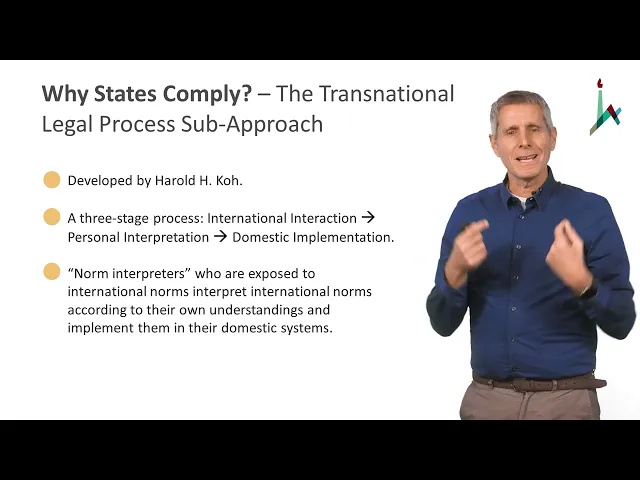
societal inter interactions that create compliance but also what they call a culturation so often States follow other states which are likeminded which have the same uh which belong to the same group of states which have the same culture the same tradition or they are used simply used to to follow them so in the same way that people in a crowd actually look at one another as to how to behave and adjust their behave accordingly this is what also happens uh with States uh another um sub genre within the this constru constructivist approach is the transnational
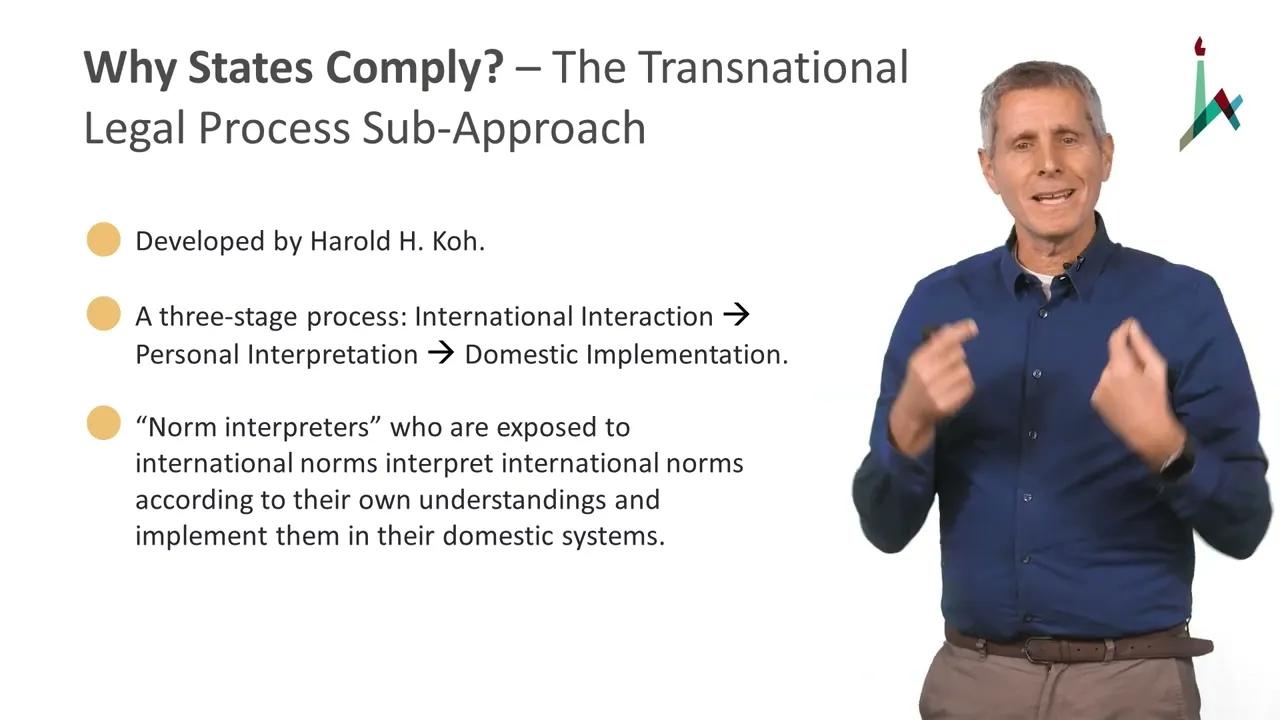
legal process approach which has been advocated by heral Co a former dean of Y law school and also a for former legal adviser for the US state department who has talked really about the the role of Norm entrepreneurs which would be individuals who have been exposed to International Norms uh then they uh interpret these International Norms uh according to their own uh understandings of these norms and then they Implement these International Norms in their own domestic system so there is a process by which a norm originates outside a legal system in an international fora is
then internalized by a norm entrepreneur an agent could be the president it could be the foreign minister it could be the legal advisor it could be the professor who goes to the conference and hears uh comments about a certain position then um the the the interaction helps the the the agent the normal Tre preneur to understand the norm to understand its importance to interpret it and then implement it so for instance all those States who are participating in debates about climate change part of their uh part of the process which facilitates the um policy changes
that are related to climate change is that during these uh International conferences conferences of the parties the delegates are exposed to a lot of scientific information about uh the dangers of climate change and about the the the way in which the treaties that regulate climate change have to be reinterpreted in order to address that Rising Challenge and then they come back home and engage with other actors with government Ministries with domestic judges with domestic Regulators with the general public explaining why we need to reinterpret our existing obligations and why we need to pass new legislation
in order to adjust more closely to the emerging International standard so these are the sort of transnational legal processes that are taking place and finally an Marie Slaughter another American Professor formerly uh in Princeton um in Princeton University has and also um a senior officer official in the in the state department under the Obama Administration uh took the view that a lot of what's happening in this uh in this field is not only happening uh between states or inside States on this level but also that there are these networks of officials uh from uh inside
the states that communicate with one another and they create their own epistemic community that advocates for the implementation of international Norms so judges go and meet in conferences other judges and in a way they develop a thinking about international law which is different from the thinking which has emerged in their own state of nationality and they rely also on one another in their judgments in order to Advocate a certain approach to international law and the same would goes for Parliament for government Ministries uh for uh for uh diplomats Prof professors Etc so these networks of
uh internal organs within the states are really one of the important drivers of implementation of international law so these are the four principal approaches to uh explaining compliance it is realism it is policy oriented Juris Prudence it is the liberal school it is the constructivist school but despite these four schools violations continue to occur and we have seen in recent decades some very high-profile violations the invasion of Iraq in 2003 the invasion of Ukraine in 2022 and before that in 2014 the Israeli settlements in the West Bank are largely viewed by the International Community in
in breach of the Geneva conventions the United Kingdom refused to comply with the advisory opinion of the international court of justice which proclaimed the law on the chagos archip plos uh China refused to comply with zunos uh so so that means that either that the theories do not work or that uh these would be all exceptional cases which cannot be which expose the limits of the theories or maybe they simply represent conditions under which those theories would predict non-compliance to conclude it is possible to say that uh under certain conditions what the four theories predict
under certain conditions compliance is going to be more likely and vice versa under certain conditions it is going to be less likely so for instance one thing that we need to uh consider when we are trying to predict whether States would comply with an international obligation is the interrelation between the rule and essential National interest to the extent that the rule does not conflict with essential National interest as the state understands it uh the likelihood of compliance is higher and and vice versa the other the other question has to do with real sanction I mean
one of the reason why icj advisory opinions are not often complied with is that these decisions are not binding to begin with I mean they proclaimed the law but they themselves the advisory opinion and like judgments are not binding and certainly there is no sanction which pertains to the violation of these advisory opinion this is also true when a judgment is issue issued against a permanent member of the security Council there is no real sanction hence uh there is no likelihood of compliance this is not the case when we are dealing for instance with WTO
decisions where you do have sanctions because a state can be authorized to punish a trading partner that violates the law it is also not the case often in ICC cases international criminal law cases where you do have actually some enforcement power behind uh behind uh a decision to issue an indictment against a suspected war criminal another consideration which would help predict instances of compliance or non compliance are perceptions of legitimacy so Israel is often very um skeptical of complying with United Nations Council recommendations one because they're not binding but twice because it views that body
as a highly politicized body which does not adhere to uh to Fair process in in its work uh they Israel did uh however fully comply with a decision of an award an arbitration award in the taba case between Israel and and Egypt concerning a land strip in in the south of Israel because the process there was completely legitimate uh International organizations also play an important part in embedding International rules and in providing a venue in which International rules can be discussed and implemented and part of the success uh relative success of certain CL certain environmental
uh Norms has been the fact that these environmental Norms have been embedded in organizations that Contin continually monitor compliance with these Norms but also continually provide information to States both about the Norms the need for the norms and also about ways to better implement M them so the relationship between rules and organizations is also very important and finally uh one has to perhaps distinguish between rules involving high politics uh where one is dealing with this with a scene an international scene of action that is almost inherently unstable uh and there you do have you see
more violations surrounding Civil Wars and the ways in which states are um are are uh intervening or supplying the parties in that regard then one one is dealing with areas of the law such as trade uh investment economic relations uh and other uh areas where stability is is very important and where states have to consider when they're uh adhering or violating a norm what would be the implications of their action on the overall system so when States value stability and when the system promotes stability the likelihood of a violation is considerably reduced I thank you
for your attention and look forward to meet you again in next units