Active readers are involved in what they are reading. They think and ask questions as they read, looking for the author’s main points and the support for those points. After—or as—they read, they take notes and use an effective study method to help them master those notes.
Active readers are the opposite of passive readers (such as the light-haired girl pictured in this Peanuts cartoon), whose minds do not really pay attention to what they read. In this final lesson, you’ll learn how to deepen your active reading by including writing and study. Here in a nutshell is what you should do to read actively: Ask yourself, “What is the point?
” and “What is the support for the point? ” Pay close attention to titles and other headings, and also mark off definitions, examples, and enumerations. An active reader, besides asking the two basic questions, “What is the author’s point, and how does he support his point?
”, writes out the answers to those questions. The very act of writing helps an active reader study and master and remember the material. These are the basics of a study system that really works: Read the material, looking for the main points and supports.
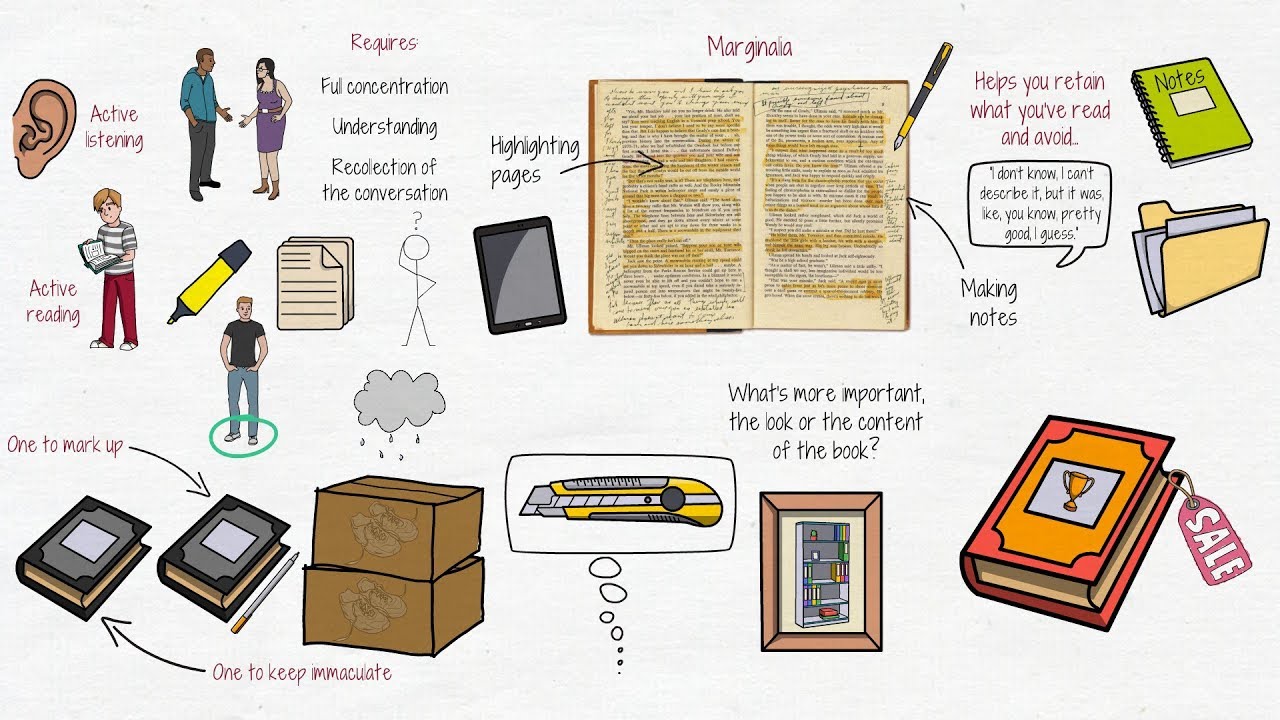
Very often the clues to important ideas will be titles, enumerations, definitions, and examples. Note that it helps to have your pen in hand so you can mark off material as you read. Take written notes on the main points and supports.
As you read, look for (and mark off) important ideas, and then take notes on those ideas. The very act of note taking—of writing ideas out on paper—will help you study and master those ideas. What many students do not realize is that taking notes on a subject can help in thinking about and understanding the subject.
Writing is thinking. Now let’s look at a more detailed study system. There are a variety of very similar “textbook study systems.
” One of these systems is called PRWR. This system directs you to study what you read by taking four steps. The first step is to preview the chapter to get a general overview before you start reading.
Note the title, which is probably a summary of what the whole chapter is about, and quickly read the first and last paragraphs of the chapter, which may introduce or summarize main ideas in the chapter. Step two is to read and underline or otherwise mark what seem to be the important ideas in the chapter. In particular, look for and underline definitions, and mark examples of those definitions.
Also look for enumerations— major lists of items, which may already be numbered 1, 2, 3, and so on, or which you can number yourself. The third step is to write (or type into your computer) study notes on the chapter. Actual writing and note taking is a key to successful learning.
In the very act of deciding what is important enough to write down and then writing it down, you begin to learn and master the material. Step four is to recite your study notes until you can say them to yourself without looking at them. It helps to put key words in the margin of your notes.
Key words can give you a way to test yourself. Look at just the key word and recite the information related to it. Once you can do that, go on to the next key word.
After you have mastered a new key word, go back and retest yourself on all of the previous key words. It is impossible to be passive in your study if you continue this strategy of repeated self-testing. To summarize, in this lesson you learned what it takes to be an active reader as opposed to a passive reader: Active readers think and ask questions as they read.
Active readers ask, “What is the point? ” and “What is the support for the point? ” Active readers also pay close attention to titles and other headings, as well as definitions, examples, and enumerations.
Active readers often have a pen in hand as they read so they can mark off what seem to be the important ideas. Active readers often use a reading study system. In a nutshell, they preview a selection first; then they read and mark off what seem to be the important ideas; next, they take written notes on that material; and finally, they recite their notes until they can remember them.