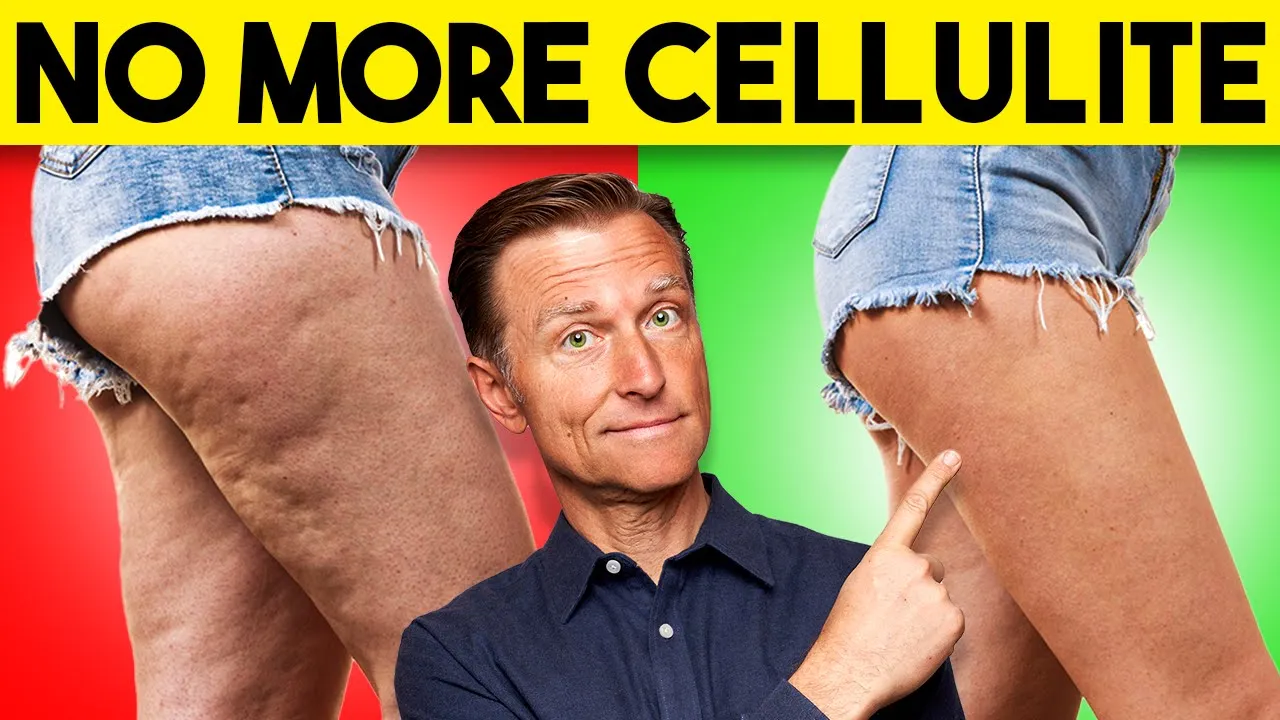
What would be the absolute number one best thing to get rid of your cellulite on your thighs and your buttocks? That's what we're going to talk about today. And it just so happens to be a very specific type of exercise.
What's really unique about cellulite is it only really occurs 4 in above your knee, in your thighs, and your buttocks. It cellulite does not occur in your stomach, arms, or breast tissue. What's even more interesting is really understanding what cellulite really is.
If you were to kind of go into the tissue and look underneath the skin, you have this layer of muscle. Then you have a fat layer. Then you have a sheet of connective tissue that's called fascia.
What cellulite is is a disruption of this connective tissue fashcia. And then the fat kind of comes up and then it becomes very very unorganized. But the big question is why?
What happened to that layer of connective tissue that's supposed to be there? Many people for many years had a confusion that cellulite was just a fat problem when it's really not. There's actually an enzyme that dissolves collagen and there's too much of it.
The primary trigger of that is going through your menstrual cycle. Because when you think about it, when you go through a menstrual cycle, you have to have this enzyme be released to create shedding of part of your uterus every single month. And so to create that shedding, you have this enzyme release that comes up, gets rid of the collagen, and then you grow back another layer.
That's all interesting, but now what do we do about it? Do we just start eating more collagen to get that connective tissue layer back? No, that's not going to remove the cellulite.
In fact, what you want to do is you want to put back that connective tissue layer to keep everything nice and tight and toned. But if you just focus on losing weight without building the collagen, you're still going to have the cellulite. And if you start eating more collagen, it'll provide more collagen material to build that connective tissue layer, but that won't be enough to correct it.
Another question is how can we inhibit that enzyme that's dissolving that layer of connective tissue? You can get something called green coffee bean oil and a lot of times it'll come with retinol which is vitamin A and sometimes some collagen and that cream will help you a little bit in inhibiting that enzyme that's breaking down that layer. And sometimes they'll put green tea extract in there as well.
The big question is out of all the things that you can do, what is the most potent way to stimulate the formation and growth of that connective tissue? It's highly responsive to mechanical stress. If you mechanically stress your skin, your muscle, your ligament, in your legs, and your buttocks, you will create a massive stimulation of new collagen.
You don't want to just jump into this overnight. You want to gradually ease into it because what I'm going to show with you is pretty intense, but it's very effective. Let me first give you some exercises that you would do to work up to what I'm going to tell you.
We're trying to stimulate some new layers of connective tissue around your muscles and your fat to give some more shape and tone to your legs and buttocks. So, there's two simple exercises that I'm going to recommend to start with. And this would be a combination of slow squats, like four seconds going down and then two seconds going up.
And just do like three sets of 10 reps. Do that every day. And the other exercise I would alternate with would be step down lunges.
You can do one leg at a time and then you alternate. But this will really target the buttocks, the thigh. And you can simply start off with three sets of 10 reps of each of those exercises going back.
And I would just do these twice a week. Of course, if you do them once and you're really really sore, you might have to wait, you know, three or four or five days to sometimes up to a week before you heal. I don't want you to do these on top of soreness.
We want to let the recovery occur because we're building collagen and you might not have anything left. And in that case, you're going to do this very gradual and work into it over a period of weeks or even months. There's a lot of other things you can do depending on your fitness.
You can do plyometrics where you're jumping on a box. You can jump rope which stimulates the cells that make collagen. But there's one exercise that's the ultimate of all these exercises.
This goes right to the core of your cells. Not to mention, it's probably one of the most powerful things to burn the superficial fat. It's called subcutaneous just underneath the skin.
What is this exercise? You find a hill that's not too even and you would start walking up the hill for a while and then you're going to eventually sprint up the hill. What that's going to do, it's going to create an explosion in your stimulation for connective tissue because we're doing super high intense.
We're pushing and we're pulling our body up and not even on an even surface. It's not just a linear thing. You're kind of going side to side and so your body has to do all this extra stabilization to be able to prevent you from falling over.
You're trying to find areas to step off and push yourself up. This exercise will like create a serious burn on your thighs and your buttocks and you'll only be able to go like 10 seconds at the very most. Why?
Because you're flat out doing a highintensity type workout. So, you run up as far as you can until your legs don't move anymore and then you stop and you rest. And of course, yes, your lungs are going to be burning, but you might want to rest for 3, four, 5 minutes, okay, before you do the next 10 seconds.
And you just do that three times. and you come down the hill, which adds a whole other dynamics of stability, stimulating the opposite muscles, which is also extremely helpful. In reality, what's wild about this is you're really only working out for 30 seconds, maybe once or twice a week.
For most people, they could really only go 10 seconds at a time because they're going uphill, but for some people, they might be able to go 15 to 20 seconds, but that's pretty much going to be the limit. You want to go in your pace and maybe not do the high intensity right off the bat because it's a little dangerous. You might fall.
So, you have to be careful. But I'm just telling you the best exercise to do. Not that you can even do it because you might have really weak knees or you might have to really work up to this.
But if you could do it, you would stimulate the most intensity of all these exercises because remember, it's the mechanical stress that's the most potent stimulator of the regrowth of this collagen. You got to really think of this as a long-term uh exercise program because you want to do this slowly and then give your body a chance to regrow these connective tissue. It could take 6 months to a year or more.
But out of all the exercises, this one is the best for cellulite in your buttocks and your thigh muscle. Just so you know, I'm already doing this exercise on a regular basis. I'm not doing it for cellulite, but I'm doing it for overall fitness level.
Thanks for watching.











![My Best Tips of All Time: Dr. Berg [Upgraded Advice]](https://img.youtube.com/vi/CvBR-GoBvzk/maxresdefault.jpg)