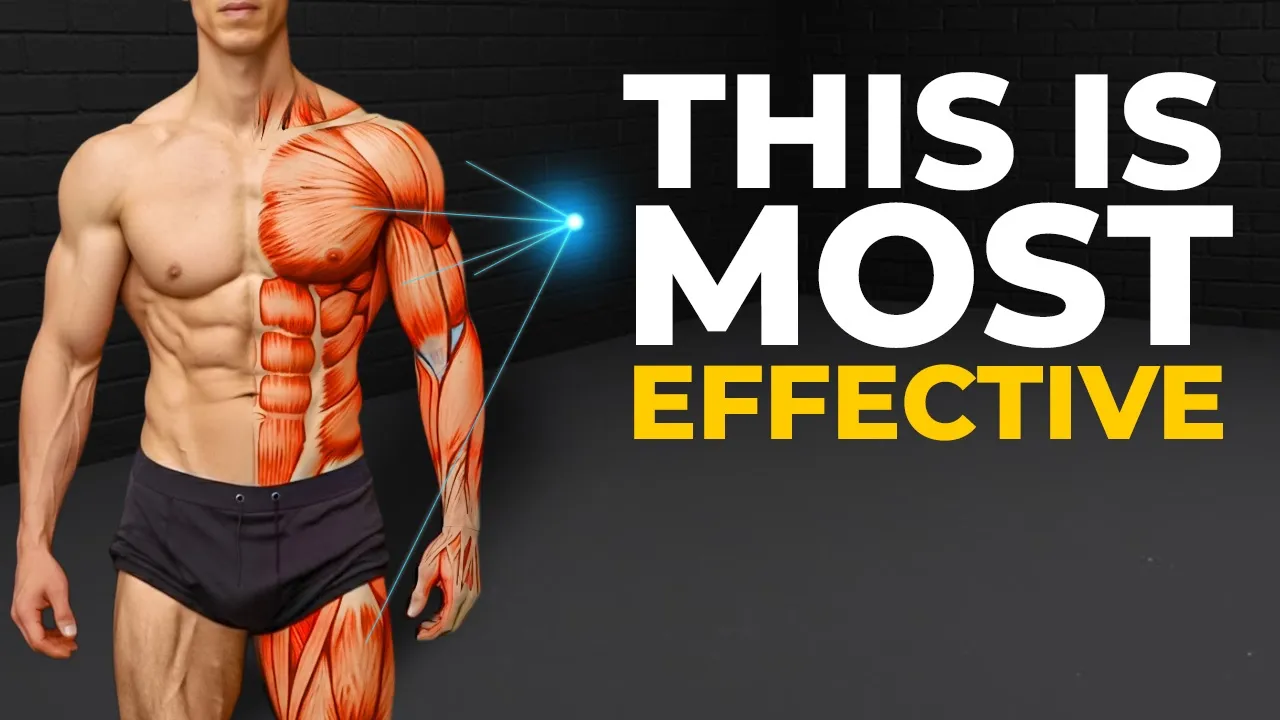
If you're looking for a full body workout that doesn't take a full day to do it, well, you've come to the right video because I'm going to give you not just one, but two full body workouts that you could put together over the course of an entire 30-day period that's going to be the most effective full body workout you've ever done for a variety of reasons. First of all, it's going to be based around something I call effective reps, which is very different than what you might be doing right now. For instance, if you were to do a regular set to your 12 rep max, the first few repetitions here are really not any challenge at all.
And you're familiar with how that feels. It's just really no effort. Just trying to get you to the point where the repetitions start to become more difficult.
Indicated here by the yellowish reddish all the way to the end, your red rep, your last final rep to failure. If you were to rest two to three minutes like you typically would and come back to do that set again, it's going to look pretty much like that same first set with that same level of fatigue building up with a lot of those repetitions wasted in the beginning of the set. But when we do effective reps, something is different.
We take that same 12 rep max, we perform that first set, it looks exactly like that last example that we looked at. However, with a shortened rest period of 15 to 30 seconds that acts almost like a rest pause, something drastically different happens. Right away from that very first repetition that you do after that brief rest, you're already into those grinders again.
You're into those high intensity repetitions. You're able to get the most effective growth producing reps out of those sets without having to waste some of that volume here that essentially becomes junk volume building up to the reps that count. So, what do we do?
We build the whole entire workout around that principle. This is workout A. Again, there's two workouts here.
You do A on Monday, B on Wednesday, A on Friday. Come back around. B A B.
In the second week, you just flip it around. You keep going in that order. Workout A starts with the incline dumbbell bench press.
And you can see here it says it starts with an ignition set. The point of the ignition set is simply to put you into that state of failure. is to basically do that first set so that when we start all we're counting are those effective reps because this workout isn't done for a specific amount of sets.
It's done for a specific amount of effective reps. What that means is it might be different for every single person who does it. With the incline dumbbell bench press, you perform that first set, you rest that brief period, you come back in.
Now you start to perform the reps that count towards 20. You might find that in that very first set because of that abbreviated rest, you're certainly not getting 12 again. You might get six or seven.
You rest your 10 to 15 seconds again. You go to the next set, you might get four. You'll grind out until you reach your 20 effective reps.
However many sets that takes you in rest pause fashion is how many sets you're going to do. Again, that could be different. You get your 20 effective reps and you move on to the next exercise.
This is the underhand barbell row. Now, the reason why we're using the underhand variation, very much the same reason why we chose the incline dumbbell press versus a flat press, is because in these total body workouts, you want to try to get as many muscle groups contributing to the lift as possible. We are the underhand barbell row will get your biceps more involved than they would be in a traditional overhand row without sacrificing the effect that we're trying to get on your lats, your midback, your upper back, even your low back here stabilizing against the row.
Every exercise can be separated by a threeminut rest. We don't need to rest very long or exceedingly long between these because we're going to vary the focus. We went from a push to a pull.
Now back to a pull, but a vertical pull. Working more of the shoulders. This is the dumbbell high pull.
The dumbbell high pull allows for delts to be hit because you're getting that abduction of the elbows away from your body as you would in a side lateral raise. But because the elbows are bent and you're pulling more upright rather than straight out to the sides, you're also going to get your traps, your upper back muscles. Again, multiple muscle groups contributing, making this a much more effective and certainly efficient way to train your total body.
20 effective reps there. Again, when you do the high pull, remember the elbows stay down, the hands go high. This is not an upright row.
That is literally the direct opposite. And it's a shoulder killer. As far as I'm concerned, the elbows in that position would be high and the wrists would stay low.
You go the opposite here. Wrists are above the elbows. Pull up.
Let the delts do a lot of the pulling and let the traps contribute here. This is not where we're trying to isolate muscles. The fourth exercise up here in workout A is the PJR pullover.
It's a variation of a pullover. You're going to use your lats to assist your triceps or vice versa. Depends on how you're looking at this.
You're basically setting up in a pullover, but you're letting your elbows bend at the bottom of the repetition. You initiate the return using the triceps by extending your elbows to get some momentum going on that dumbbell, but then you pull with your elbows to finish off the exercise again to shift the focus to the lats once those triceps have fully extended the elbow. And again, because we get that good deep stretch on the lats and again the arms up overhead, you get a really good deep stretch on the long head of the triceps.
This combination is one of the most effective ways I know to build up both those triceps and lats in the same exercise. Again, becoming much more efficient and smart in terms of the exercises that we're picking here for an effective full body workout. Now, we go to the legs.
We have the goblet squat. Now, we have a couple options here for you. Number one, for the goblet squat, if you're going to do that, you're going to have to increase the number of effective reps that you do.
It's not going to be 20 anymore because we have to lighten up that weight a little bit or at least realize that we're not going to be able to really adequately load up a 12 rep max on a goblet squat without maybe the limiting factor becoming either our ability to stay upright or our thoracic extension in our back. Something's going to drive that weight down. So, if we can go a little bit lighter on the weight and accept the fact that we're going to do that, we use a 20 rep max.
So, whatever you could do a goblet squat for 20 reps for, that's the weight that you would use. But because we do that first set to failure and then we get into those effective rep sets, we're going to raise the number of the effective reps now up to 40. You have an option, if you so choose, to do a leg extension here.
Now, you guys know how I feel about the leg extension. I'm not a big giant fan of it, especially if anybody has any ongoing knee issues or tendinitis, patellar tendonitis. However, if you have healthy knees, if the exercise doesn't bother you, it's sort of tailor made for effective rep training.
You do your 20 effective reps here, cuz once again, you're going to lower that first set down to that 12 rep max load, perform the ignition set, and then chip away at your 20 effective reps. It's brutal. Whichever way you go here, I prefer, as always, when you can get on your feet, become more athletic, train in a closed chain environment, use the goblet squat.
However, if you want to try this because you're looking for straight hypertrophy, that would be a good option there, too. And then, of course, we wrap up with the posterior chain. My exercise of choice here is going to be the barbell RDL.
And the thing I like about the RDL is it's essentially teaching the hinge, right? You're letting the bar stay in contact with your thighs as it simply rides the elevator up and down. And the only thing that's really moving here is your glutes back and forth.
Think of it as a movement that goes like this rather than one that goes like this. Even though the bar is going up and down, your movement is thinking hinging the hips backwards, driving the hips forward, hinging the hips backwards, driving them forward. You do your 20 effective reps.
And at that point, you're probably only about 45 minutes into this workout and you've completed your entire full body workout. Not many full body workouts can say that. You're either doing a lot more exercises, a lot more volume, a lot of wasted repetitions.
Here, you're hitting all the muscles that you need to in a much more effective way. That is workout A. We still have workout B.
And we didn't just choose exercises once again that are able to hit multiple muscle groups at once, making them very efficient, smart choices, but we're also trying to complement and fill in the gaps of whatever we didn't do in workout A. So when we put them together over the course of the week, the two week cycle or the entire month, we know that we're not missing anything important. It starts off with the weighted dip or just regular body weightight dips depending upon your strength.
If you're able to do a 12 rep set to failure with weight, then that's what you should use. You should choose the weighted dip. If you don't, you can't do that, you need body weight only, well then you just do a regular dip.
The target is still the same. The idea here with the dip is to make sure that you set up properly. Drve those shoulders down to protect your shoulders themselves when they get into that lower position.
Make sure you're keeping your chest out in front. And then when you get to the bottom there, take on that good stretch. Make sure you're feeling good and safe before you drive up and out of there.
This is not a momentum based exercise. 20 effective reps in rest pause fashion. You move on to the next.
Obviously, that exercise is hitting shoulders, triceps, chest, right? All three of them. in a very effective way.
The one- arm high cable row. This is one of my favorite ways to train the back. And what it does is it gives me the option of pulling and involving the biceps a little bit more as I sort of supenate on the grip and pull.
I can also get the rear delt in a very effective way. I've talked about before the number one driver of rear delt growth is extension of the elbow back behind the body. We're getting really good focused extension one arm at a time.
And because we're getting one arm at a time here, we can really really drive that good lat stretch at the top of the rep. And again, pull down really good tight contractions. Finish all the 20 effective reps on one side.
Then you switch over to the other side and you work on that side. The third exercise up here is the lateral raise. So even though we got some abduction because of the high pull, we can get a little bit more focused shoulder abduction, which is going to help to build that middle delt most effectively.
But with the cable lateral raise, because I'm getting pulled across my body, I'm actually getting a good assisted stretch of the middle delt and of the rear delt. We're going to be able to drive a little bit better growth here than maybe a regular dumbbell lateral raise because at the bottom there, you're not getting any of that. The fourth exercise, a barbell curl, I talk about all the time, even though we're indirectly involving the biceps in the underhand barbell row from workout A, we still need to target arms directly.
we still need to go at them directly, especially the biceps. If you want to build the biggest biceps that you can, and most people do, even when we're training total body, you're going to want to work that in somehow directly. There's nothing better than a classic barbell curl.
And it allows you to do the exercise really, really safely, especially as you approach fatigue. Training close to failure with a barbell and a curl can easily allow you to put the barbell back down on the ground. 20 effective reps here.
Rest pause style again after that initial ignition set. The dumbbell reverse lunge. One of my favorite lower body exercises.
And anybody that has any knee discomfort is going to find that this exercise feels amazing. Again, don't discredit leg training altogether because it hurts to squat or because it hurts to do leg press or it hurts to do leg extensions. You're always going to have an option.
I believe if you choose the right ones, this one is going to fit 90% of people that already have knee pain and still allow them to do it. The last exercise here is one that maybe not everybody has access to when it comes to the where you're training, but if you have a gym that you're training in, then look for the seated hamstring curl machine rather than the prone lying down hamstring curl. I have a lot of issues with the lying down hamstring curl in terms of it contributing to low back issues because of the driving of the knees as you're trying to pull the weight up into that bench.
It's just not the best option. Whereas, I don't have those issues with the seated hamstring curl variation. Here, what you do is lock yourself in, get that pad down nice and tight, drive your heels down, try to get to at least 90° if you can on that bend even a little bit further.
Even a little bit of a slight hold at the bottom there is going to intensify every single repetition that you do, making it more effective. Again, the idea here is can we not just choose the right exercises that hit all these areas, but can we do them in a complimentary way across the two workouts so when you want to go and try this guys, you feel it, you can come back here and say, "Yes, it it was incredibly effective. " And because we're using the effective reps, we're not wasting a whole hell of a lot of time.
We can get a lot of work done with a limited selection of exercises in a reasonable amount of time. Guys, I want you to try this out. Tell me how it works for you.
If you haven't done so already, guys, we have full programs. Total Beast is a complete total body workout. It uses different techniques here.
If you're looking for supplements, guys, to help you to recover from your workouts. We have them all high quality NSF certified for sport over at athletics. com.
If you haven't done so, guys, make sure you click subscribe, turn on notifications, and make sure you let me know how you like this workout. All right, guys. Good luck.
See you.