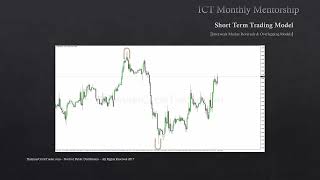
okay folks welcome back this is second fourth teachings and a final delivery month of our mentorship this teaching is ICT intermediate term top-down analysis weekly to daily foreign okay again like on the previous monthly to weekly presentation what I'm doing is I'm giving you my personal approach this is how I do it and again this is a model but this is how I go through the process of taking the information I've gleaned from the monthly chart and transposing it to the weekly now weekly information I give you here will be transposed to the Daily now
most of this is going to be basically Verbatim what we saw on the monthly chart which is the reason why I tell you we went through 11 and a half months of content that seems like an uh an amazing Olympic feat to do but you have all this information but you haven't had any idea what to do with it specifically in an order and I told you from the beginning once you get to this month you'll see just how easy it is to use the information and it doesn't take a lot of time um what
element of time that is required is you getting used to doing it so that way you understand what you're looking for and it makes your analysis quicker now doesn't mean shortcuts are the way to profit so doesn't mean you half rear end approaches if you will like my grandfather used to tell me don't don't half-ass anything uh if you do a half-ass attempt at your analysis well don't be surprised if you get lackluster results but once you understand what it is specifically you're doing and how you're breaking the market down it does not take long
folks it does not take long I'm actually going to spend more time talking and describing what it is that you have to do than if you just did it so the focus on this presentation much like on the monthly to weekly is we're going to determine the impact of the weekly perspective on any asset or Market we're going to identify the directional bias for the higher time frame weekly chart we're going to classify the PD arrays accurately to assist in key levels and we're going to complete an Institutional analysis on a weekly basis okay folks
the first thing I start with when I'm doing a new week is I start with relative strength now the reason why I start with relative strength is I may not have a clear picture from the monthly and to avoid any needless frustration if the monthly charts don't really speak well to me then I'll just go through the process of doing a relative strength analysis uh on the assets and the specific currencies or stocks or Futures markets that I'm looking to trade after I do my relative strength analysis I go into the commitment of Traders and
what I'll do is I'll go through all the currencies and commodities and I'll look for Extremes in the readings of the commercials and I'll give you the specifics when we get through the breakdown on what is I'm looking for but uh it goes from relative strength analysis and then once I have what I believe is um the you know leaders or my watch list if you will from my relative strength analysis of hopefully the trades that I find on the monthly chart like we did with the Australian dollar in the previous teaching with the monthly
to weekly hopefully that Australian dollar makes the cut for the relative strength analysis and we'll take a look at that as our continuing example but then we go into commitment Traders and I like to look for what the commercials are doing I'm going to get a read on what those heart those Hedges are doing because they're well informed and they usually make the tops and bottoms in the marketplace so if we can get their readings in the extreme basis then we can try to trade in the Middle where the majority of the move is made
after that I do a Market sentiment analysis and I go through a couple different things that arrive at Market sentiment and I'll share that with you in this teaching as well once I arrive at a market sentiment opinion then I start breaking the market down in a technical fashion like we did with the monthly so there's a couple things missing here that we saw in the monthly that is not in the weekly portion we had three different things that started off the monthly and we have three different things before the weekly here so I won't
get down to a weekly chart we're starting to look at more of opinions of others versus just technicals and we weigh them against the technical strength and weakness by way of the relative strength analysis once we arrive at our watch list and we determine which markets are fueled by commercial hedging and then we also blend in Market sentiment ideas with everyone else in the retail world is thinking uh because ideally you want to be diametrically opposed to that in an alignment with what the smart money is doing so Market profile is the next thing I
can look at and I start breaking down what the weekly looks like in terms of Market profiling is it in consolidation is it in a trending environment those types of things and just like we did with the monthly the same thing applies here on the weekly okay after I do Market profiling I look at inter-market analysis on a weekly basis so I start comparing what the weekly charts look like in other correlated markets and I compare likes and price action with positive and negatively uh correlated assets and markets with the market I'm looking to trade
so it's an example I could be looking at you know um a dollar versus uh you know the kiwi on a weekly basis and seeing if there's uh you know intermarket analysis supporting an idea I may have for the dollar or for the kiwi after that I start looking at Market structure and at this point I want to start blending and incorporating institutional order flow now institutional order flow I want to be looking for down close candle supporting price and up close candles being broken and up moves or bullish Market structure and I'm going to
see up close candles resisting price and down close candles breaking as Market structure is indicating lower prices so everything we mentioned in previous about the monthly applies but now we're going to start looking heavily for institutional sponsorship in by studying the order flow the next is I break down the PD array Matrix on a weekly and I'll do the same thing I saw on the monthly charts on the weekly as well so everything that I would break down in terms of the range that's defined by now the weekly chart so any PD array that didn't
exist in the monthly may now materialize in the weekly chart because you're going to get much more definition because you're going into a lower time frame thank you and after that by having the weekly PD array Matrix defined both premium and discount arrays then I can start working towards calibrating my key price levels for support and resistance or buy and sell areas and then as a result I come to a weekly bias and it's defined in such a way where now I can take that information and transpose that to the daily chart foreign detail what
I begin with when I start my intermediate term analysis I start with relative strength so if the monthly analysis is not as helpful as I hope and or it's not clear to me you know I begin my weekly analysis with relative strength analysis across all asset classes that means for Commodities currencies and stocks I determine what markets lead in strength by failing to make lower lows and lead in weakness by failing to make higher highs I look for stocks in the top 30 industry groups for strong stocks ranked by Investors Business Daily or IBD and
I'm going to actually do a separate individual teaching as a topical study so that way you'll see how I go through and sort with ibds resources you can see me do it and you can do the same thing when you look for stocks as well I look for logs and commodities that lead their respective Futures group with higher lows relative to the others in other words in the greens I'm going to find a market that doesn't make a lower low when all the grains should be bullish in dollars a week and I look for Longs
and currencies that fail to make lower lows relative to the other currencies when the dollar Index is weak I look for leadership and laggards so I want to know what the uh the strongest is and the weakest when I'm doing my relative strength analysis Concepts next thing I go into commitment of Traders and I want to know what the commercial hedgers are doing because the commercials they hedge in such a large degree of buying and selling they themselves end up creating the highs and the lows or tops in the bottoms in the marketplace now if
you know what they're most likely doing in terms of a high or low then you know you got a long period of meat in the middle type move or a range expansion that's directionally biased so by having this expectation about what the commercials have already done in the marketplace they're going to be diametrically opposed to what the large funds are doing and since we really want to be using the commercials to give us the the high in the low end of the range based on their extremes we trade with the direction of the large funds
in between the Middle because you'll see they're dimensionally opposed so at the highs and the low for the tops and the bottoms the commercials are always right in between those two price points the large funds are accurate they're right that's why large funds continuously make a lot of money but at the extremes they always get their ass handed to them so we want to know when the hedgers are calling for a potential high or a potential low and we work within the middle I look for the commercials to be at a 12 month or six
month extreme in net Holdings I also like to sort markets that are at two year and four-year extremes not using my proprietary cot hedging program concept I look for signs that commercials are buying or selling a market now you're going to go back and look at those teachings it relates to that I'm not going to teach it again here but I like to look for when the commercials are buying when it doesn't appear it's obvious like when we look at the zero line on the net Trader position chart that everyone looks at if it's above
the zero line they think they're buying well they are but they could also be selling inside that that range also but you have to look at the 12-month extreme high and low rating and dividing that in half you can actually get a better read on what their hedging program is and also like to sort Commodities that have an extremely large net holding compared to the Futures groups they're part of for instance if I look at the grains again if there's a huge astronomical uh amount of net long positions in the soybean Market versus then that
of all the other grain markets generally that's going to be an indicative of them seeing a big move as well foreign Market sentiment reading I use headlines from financial publications like Investors Business Daily Barrens Wall Street Journal Bloomberg and I like to fade the big story now the news isn't always going to be marked to market the very day it comes out sometimes it can but generally when I like I like to see story lines start building in a consensus or sentiment idea about you know Doom and Gloom or everything's great you know this is
the best bull market ever seen and it's on fire or there's I like to use headlines or stories to have real big descriptive adjectives you know something that gets things emotionally charged okay the more emotionally charged or descriptive they are and the more that they occur generally that builds in a sentiment idea and I hunt forums uh you know for retail thinking and to further build my sentiment opinion so I go to all the well-known uh forums online and if I want to do like a trade in the cable I'll go and look at what
all the retail minded uh individuals are going to do there it's uncanny uncanny when the technicals are in line like I teach it and then the sentiment idea they're saying the 100 opposite of what we expect to see in price it's unbelievable how it's like diametrically opposed and as a technical Market sentiment reading I use a Williams percent R indicator and yes I said the word indicator I use a percent r on a weekly chart in periods of 20 14 period and 10. now they're not all three applied okay there's the three settings that I
like to use and what I'll do is I look for which one is the most accurately um depicting or overlaps with the previous important highs and lows that's done in the past nothing's going to be perfect okay but I like to have a technical sentiment indicator in concert with what I'm seeing in the forums for retail thinking and what I'm seeing in the story lines in the newspapers or the Articles or whatever I see on CNBC so when all three of these things come together that builds my sentiment all right and what profile is the
market in much like we did with the monthly chart on This breeze right through it because it's very it's basically the verbatim is the market under uh consolidation if it's yes then expands they're likely to show evidence prior to a breakout we can start seeing things that lead well to a directional bias that will move outside that consolidation because we want to know what the next move is going to be and if it's not in consolidation the trend might be reaching an extreme and if it is it may be a retracement not only a reversal
but I always like to see retracement first as my first choice and is the market understudy um trending and if it is trending you I'm always going to be citing or looking for continuation trades to avoid the top and pick top and bottom picking and if it's not trending I look for signs to support a directional breakout while it's in consolidation I use intermarket analysis to do that and it's the market under a retracement and these are this is the third question I ask myself and if it's under retracement then I look for signs for
continuation of the Trade Post retracement and think about what I showed you in the monthly teaching as the monthly chart was retracing for the Australian dollar it retraced down into a bowl of shoulder block on a monthly basis and that would be an ideal scenario for us that goes long but if it's not retracing then I have to determine if it's consolidation or trending and I use the above ideas to get more information and that's what I do for Market profiling on the weekly chart just like I did on the monthly and everything that we
saw on the monthly for intermarket analysis it's done here as well and if I have a bullish Market structure uh determined in my Market of interest you know if I look for inter-market analysis to support the idea of positively correlated markets and opposed to it in negatively correlated markets example bullet a bullish pound I'd like to see a weak U.S dollar technically and if it's a bearish market structure determined in my market of Interest I look for intermarket analysis support the idea and positively correlated markets and opposed to it in negatively correlated markets example B
bearish US dollar and strong euro dollar technically and after that I go into Market structure and again I want to start incorporating institutional order flow here looking for premium arrays braking in bullish markets and discount array supporting price and reverses when it's bearish I want to see premium arrays resisting price and discount rates breaking down and not providing any kind of support that goes in concert with normal Market structure as outlined here so I'm going to be defining the current market structure on a weekly basis current market structure I Look to I classify every high
and low relative to smt ideas you know comparing it to a dollar or correlated payer smt in other words Euro to cable or euro to dollar so you have USDX smt and correlated pair smt on a weekly I start using it there and like on the monthly I compare the relationship with the highs to recent highs to determine if the long intermediate or short term high is in control of price presently and like on the monthly I compare the relationship to the lows to recent lows to determine if a low is a long-term animated term
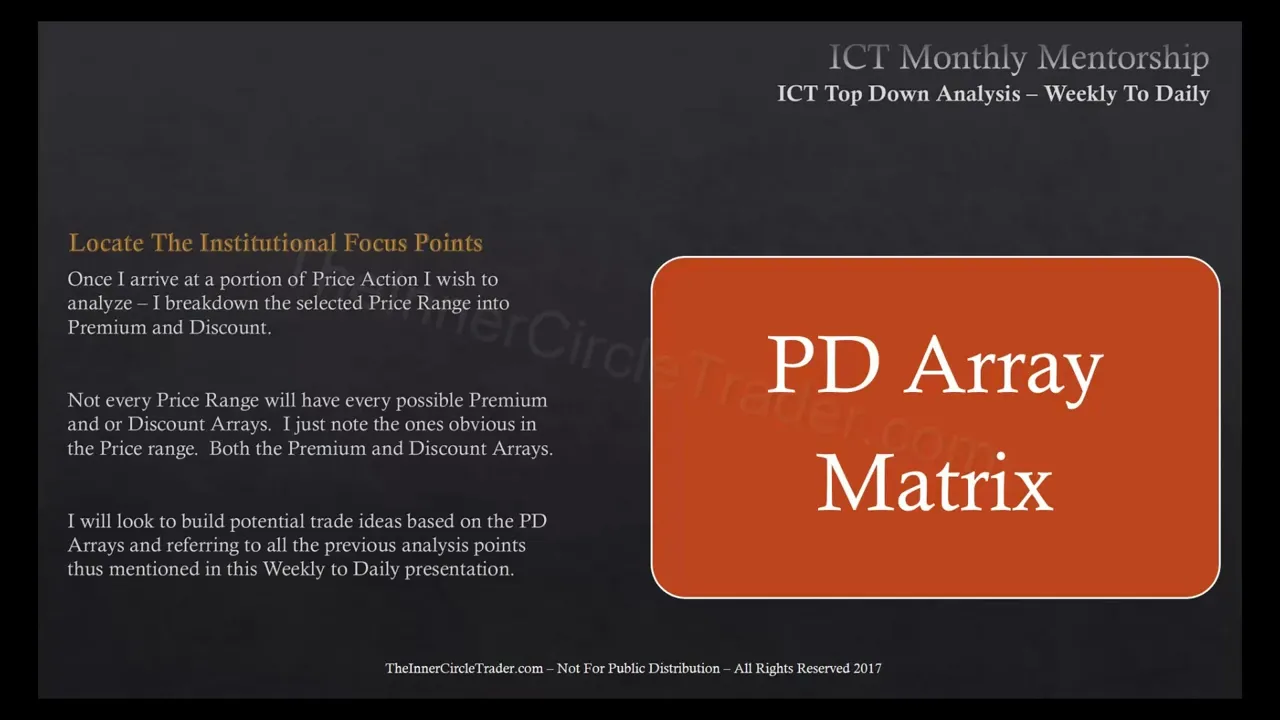
or short-term low and if it's in control price presently trade selected in the direction of the current market structure and monthly directional bias are going to be favored in my analysis and then obviously like we did on the monthly I'm going to be locating institutional Focus points once I arrive at a portion of price action I wish to analyze I break down the selected price range into premium and discount uh not every price range will have every possible premium and or discount array I'm going to just note the ones that are obvious in the weekly
range and both premium and discount rates are going to be identified and I I'll look for to build potential trade ideas based on PD arrays and referring to all previous analysis points thus mentioned in this weekly to daily presentation I'm going to be noting the key price levels relative to the premium and discount arrays on the weekly and once determine the portions of the market structure I want to use for my trade ideas like on the monthly I round each PD array to the nearest 10 level or five level and premium arrays above the market
price are calibrated and rounded down to the nearest adjusted number and discount arrays below the market price are calibrated and rounded up to the nearest adjusted number either five or ten level and we end with a weekly bias so after I refer to relative strength for liters and laggards I go into commitment Traders I look for the buying and selling based on their standard zero line are they above or below the zero line and then I break it down into my hedging program concept where we can look at the last 12 months and look at
the highest high and lowest low of just their net Holdings and disregard the zero line that everybody else uses for net Trader physician graphs and then split that in half and above it would be buying and belowing will be selling ad again I've done a teaching about that and you guys can refer back to that as well if you have any more questions about after we get through this month's content obviously we have plenty of time to go over that they don't determine the market sentiment based on those three principal approaches and then I confirm
my analysis with Market correlation so either USDX smt or correlated pair smt and or like for instance like dollar to Commodities you know dollar going down Commodities going higher those types of things I'm looking for that to occur on the weekly chart and I select a portion of Market structure to frame a trade within and then I defined a PD arrays to arrive at key levels within that range on the weekly chart and by that time I will have arrived in a directional based analysis and a weekly time frame that gets transposed over to the
Daily so what we're going to do now is we're going to return back to our Aussie dollar example and break that down all the things we've done here we're going to apply it to that Weekly to daily principle okay we're back on our Aussie dollars as a monthly and all I did was change some colors to keep it in better Clarity we have a rejection block over here and our old height knitted here as premium arrays this is our range defined by our low and our high and this is the discounted rate it was the
nearest below price action as we started uh June or shoulder block that mean threshold would be in here as well but I'm just going to try to keep it clean and then we have the rejection block lowest close and then we have the low itself that would be identified and then liquidity pool below it so on the upside we had one two premium array and then we had another that we'll add here which is the old high here and then there will be another one should this one break the next PD array I want to
print premium basis would be up here the last up close candle which will be a bullish order block from a monthly standpoint and again we're getting a little rich with the objectives in terms of Premium now but I just want to show you how you would just keep walking out with this and then we have somewhat of a fair value Gap in here as well so we could identify that so we have that to this High here so there's all of our premium arrays on the Australian monthly okay so now once we have all this
now once this range has been broken to from this low to this high so now this range is no longer valid okay so now we had price trained outside for external liquidity external range liquidity and now the next Range High would be up here so if this high was to be broken then we would start looking for fair value Gap to define the range and then the bullish order block and you just keep expanding that up okay and should this bullshorebot give way we would be looking for this all this downside delivery on price to
be rebalanced but that's so far away and not Germany into the discussion at the moment but that's how we would do it so now we're going to drop down into and again this line here just delineates the uh the beginning of May and uh on the monthly chart so now we have to adjust it to June because we're going to drop down to a weekly and we want to see all the relative price action so now we have everything that was on the monthly transposed to the weekly chart so now we have all of our
premium arrays discount eraser identified here and again our initial range was defined by this high this low once this high was formed here this range is no longer valid but we do refer back to it as a discount array because it's below price so we would come back down to this potency as a support level but we would look to justify why price may still reach up into the 83s okay on or 82 90s from a monthly premium array basis but I want you to take a look at how the price levels from the monthly
are going to be used in the weekly once we go through relative strength we're looking at the lows in here relative to the Australian dollar and we're going to take a look at the dollar Index at the same time and we can see there was really no disparity amongst the two markets Aussie was calling for higher whereas the dollar was looking weak as well so you would see lower prices so from a relative strength standpoint no disparity in here so everything's confirming it so we have weakness in the dollar as expected and strength in Aussie
okay so we didn't see any cracking correlation there so everything looks healthy for this move to transpire with the seasonal tendency for June to be higher we get the higher move off of the bullish order block okay from a monthly standpoint which is what this level is here this is the monthly bullish order block but notice also that price inside this range prior to move out right here this low to high let's look at this whole entire range a little bit more detail we have this candle here where once it took off above this short
term high on this candle so above 9 7 357 only buy side delivery is offered until it came back down and rebalanced the high on this candle comes in at 73.57 the low on this candle comes in at 73.29 so it more than comes down and rebalances that so we have a rebalance point we can take this order block now and refine it down to this level here get a little bit more detail in terms of where the low may form in this retracement that we saw on the monthly so we have a more refined
PD array for a discount at this level here and if we look at these two candles here which makes a weekly bullish order block all these things help us align ourselves with a much more refined and calibrated level we have equilibrium in here so price we don't want to see it go down to that level or through it I mean I shouldn't say shouldn't it can go down to it but we just don't want to see it violated and that's that level there and we'll get rid of this now so now we have a little
bit more detail in terms of our discount arrays price trades down find some support at the bowl shoulder block and fair value gap on weekly and price now trades through this up close candle I'm sorry this down close candle is violated with his up close candle so this becomes a bullish order block so we can anticipate price returning back to this so we're incorporating institutional order flow and here beautiful delivery of price there with this low body this candle's opening and runs away and reaches for the buy side liquidity resting above the equal highs and
above the range which is what these levels are here for the monthly and also we're starting to see support come in with the down closed candles in here okay the bodies the open on this candle is 7557 draw that out in time to close is 75.71 the open on this candle is 75.68 this down closed candle becomes a bullish order block when this candle trades through it we find we traded back down into it here price then runs away creates the run or for a little resistance liquidity run resting above these equal highs okay so
we can see the element of institutional order flow seen in the weekly chart now supporting price moving higher okay we're looking at the commitment shares report and this is the Australian dollar and I've already done the hedging program concept that's unique to me you can see the actual real institutional buying and selling when you do this and what I did was I highlighted the beginning of June you would have done this okay and it's hard to see with this but it's the red line okay here's a red line all up here and it stair steps
down goes to here it goes back up goes down goes back up damn stays down here and goes back up for a period of time then it drops down again okay what I did was at June I went back 12 months to the previous year's June which is this line right here okay and that was the highest reading since that time to June of 2017 and I look for the lowest low okay and I just used this reading down here went back to some may just to make sure I got a good range to work
within and I split that range in half to high and the low and this is the Midway point so it becomes basically this zero line that's normally on a net trading position chart I uh use the 12 inch range in 12 month range if you split it in half the highest and the lowest and divide it in half you get this ebb and flow type thing okay and when I started doing this for Commodities and looking at Futures contracts and such especially with currencies it became like a huge light bulb you can't they can't hide
from you anymore see I think they started messing with the data to screw up the uh the presentation of the cot net position charts and by having that like this it it gives us a actually I think I just took away some of the green didn't I don't think I did anyway this should go a little bit higher than that this should all be green in here and I'll show you what I how I did it in a second but the main point is in June right here you can see that they were above the
modified ICT hedging program concept where you can see whether they're hedging and buying and selling so just a real quick look you can see during the buy time here they bought the low here and during this red time here they sold down went long in here we had that rally up and we had this selling here where they sold into the rally then they bought it back in here at this low they sold it again and here which is that Decline and they bought it up again here which is this buy right here in June
and there's a runoff so we had in our weekly to daily uh procedure we'd look for see uh the the seasonal influence for bullishness in June to come into Australian dollar we did a relative strength studies we did see a smt Divergence on Aussie two dollar Aussie was failing to make a lower load when um dollar Index made a higher high and that was in place that was working so the commitment of Traders report and graph as we'll show the Australia's original one in contrast to what you're seeing here but cot data and the ICT
hedging program again you can't find this anywhere else folks you learned it here so looking at this information it gives us when the commercial is really buying when they're really selling okay and it's not always indicative of what you would normally see in a standard cot graph so we can see the real institutional hedging right in here what they're buying right at the low okay notice also it happens right when they close in the Gap so the only device I deliver here to this candle's High right down to it right there boom hits it okay
and it rallies away all overlapping with them being knit long notice that they aren't really that long until they get above zero if you look at the way everyone else looks at the modestly bullish there doesn't have to be viewed like that we can see this is actually a big massive increase of buying whereas so you can see when they come down and close that Gap they were much longer using my way of using cot data than that of the standard cot graph which we'll look at in a moment now so let's close this uh
here and you see what it looks like in paint and all I did was did a right click on bar chart uh chart once I applied a weekly contract and put the cot data on a large presentation okay and I'll show you what that looks like when we go over to barchart.com and what we do is I'm going to take all this off and you can see without it all in here it's not as apparent without the information it just looks like a bunch of squiggly lines okay and yeah you can see they just modestly
went above the zero line right here but many times you're going to find that using my way of interpreting cot data they'll be below the zero line but it still gives you a huge massive influx of buying okay and let's go over to barchart.com uh actual chart without the line and about me giving you the 12 month perspective okay and you can see very modest little buy Above the zero line but when you look at it in contrast to how I showed it it's a much more massive buying they did there and look at the
reaction in price that's Inner Circle Trader stuff right there okay that's worth the price of the mission alone so you can see how they remained below the zero line down here okay for the most part but every time it rallied okay you know why did they buy up here when they're still below zero line that was one of the things that plagued me as a Trader like cot data stuff didn't work I was doing it wrong because I was doing exactly what the book said so I changed it and threw out what Larry Williams said
about just look for this and look for that no I looked at if they're hedging they should be doing things from a seasonal standpoint and I found it in the grain market and by doing it like that seeing it cyclically happening I was like well let me try to apply it to the currencies well currencies are cyclical just like anything else because it's because of monetary policy because of global Commerce all those types of things I mean think about it you know there's holidays around the world that happen every single calendar year at single every
single calendar uh date that they're supposed to happen on you know everybody has some kind of a new year type celebration you don't think it's people spending money of course they are so if we look at these cyclical things then why wouldn't there be cyclical things in the technicals with the commercials so I think that's what's happened they've skewed this data to kind of screw it up and because it's law cftc requires them to report this information which I'm so thankful for um it gives us a greater insight about what's going on and yes you
can see a net long position that's really really wimpy right above here but if you look at the readings of the low end this is towards the high end of the range so this is a massive buy and that's why you get that big explosive price move right there very very indicative of smart money accumulation so then we have ideas about going through headlines and using major Publications and such and here's Bloomberg and this was on May 15 2017. the Australian dollars Outlook darkens okay does that sound like it's uh bullish or bearish well obviously
it's indicating that they think it's going down hard now In fairness this is about midpoint of May but this is when I want to start seeing I want to see these story lines start building these ideas about how oh it's Doom and Gloom or it's peaches and cream it's wonderful ticker tape parade you know exasperation uh you know everything's great or everything's terrible you know when the storylines start getting so heavily slanted on one side or the other good or bad it begins it begins to build in sentiment ideas okay and sentiment is a really
strong element to technicals when you work with them uh in a diametrically opposed condition in other words if Market sentiment like this is bearish in other words we would interpret this as bear so retail Traders see this like I don't want to buy Australian dollar I'm scared because they said it's going to go bad it's going to go lower you know Bloomberg you know think about Bloomberg they should know what they're talking about right okay well let's take another look at another person here here's daily FX okay and I'm gonna have to block out this
uh this guy's face and name because I don't wanna you know be in trouble valuing that stuff but uh here's daily FX and Australian dollar may find itself ex over extended okay so in other words uh the fundamental Australian dollar forecast is bearish and eventually um Australian dollar goes another several hundred Pips higher as a result of all this wonderful insight and here's another one Aussie dollar is directionless May 30th 2017 it's directionless folks okay it's the you know the end of May and our seasonals are calling for it to Rally and that's the end
of May right here and then we get this so what we're doing is we're putting an arm wrestling match against the banks and the knee athletic Traders or those you know the stupid people the dumb money okay uh the Working Class Hero you know Traders guys the guys that don't really know much the baby Pips if you will okay and if you have uh uh smart money against an entity like that obviously you know who's going to win at the end okay you don't want to be in the uninformed crowd and they are uninformed because
they follow all of the crumbs that's being laid in front of them like good slaves okay like good sheep they're going to eat what's placed in front of them all these news events they're there to build in sentiment all these media companies okay I wouldn't be surprised if they're not in cahoots to make this whole thing unfold just like that okay it's it's conditional programming so over a period of time they start building these ideas eventually you keep telling somebody it's bad it's bad it's bad they're going to think it's bad too okay and then
they're going to tell everybody they know about the whole thing so the sentiment like an opinion gets shared with everyone and the more it spreads it's like a virus it permeates everything and since we're on a social media and uh technology uh error it's so easy to share an opinion so once an opinion is developed and it's shared widespread it builds in a huge diametrically opposed condition which is Market sentiment so by itself if I see these types of things these ads and articles and then I see it in a sentiment play like here we
have Australian dollar and we're going to now apply a sentiment reading with oscillator Williams percent R and we'll start with the 20 okay and here we are um ideal long entry I have it set at 80 and ideal short entry or sell basically if you're long is 20. so this is 20 and I'm going to go back it gave a good reading for this by here uh didn't give me a good buy there did give me a good buy there okay so 20s it's iffy so now we're going to change the indicator to 14. and
this does look like form fitting I I know but you'll see what I'm doing here in a second okay so now we have a nice reading here we have a nice reading here we have a nice reading here so when price came down again and here this should be a good buy and it was so this is uh calibrated the 14 period for sentiment and we've done that by justifying the old lows back here see how fast it took it and I'll give you three to choose from 2014 and 10. now if I go to
uh 10 period it'll probably still do very well um but you really want to have a little bit more time you don't want to always use a small smallest one because the smallest one will always generally give you a good reading regardless and that sometimes is a little too sugar coated in my opinion but you can see it does it here here here here here here and here as well but 14 periods in my opinion would have been optimal because it gives you a little bit more time filter okay it Smooths it out a little
bit more versus these Jagged uh up and down readings you can get with a 10 period on a weekly uh candle so we have sentiment we'll put that back on 14. so that way it stays with us our presentation so we have our macro sentiment in terms of technicals down here saying we're you know this is everybody thinks it's bearish okay it's bearish bearish bearish okay short cover and ideal long okay towards the 80 reading and also at the same time when all the headlines were saying it's the end of the world for Australian dollar
it's going to go down or its directionless nobody was saying it's going to go up so sentiment was what bearish technically it's bullish because it's an extreme reading down here and we built all the ideas with the premium uh and discount arrays where we were in a discount array full of shorter block fair value got closed and seasonal tendency boom explosion Okay so we had we covered the uh relative strength aspect we looked at the CRT used both the natural use of cot graph zero line above as bullish below is bearish and then I used
my ICT hedging program concept where you use the 12-month range go back 12 months find the highest and the lowest reading on the commercials holding only okay just the commercials you're getting that reading let's put that line in half do it on paint and then you can get a real closer depiction of what they're buying and selling is and we figured out by sentiment looking at the headlines that the Australian dollar they were saying it was directionless or bearish nothing was long so Market sentiment was bearish and diametrically opposed to commercials which were buying and
we have seasonal influence expecting June lows to occur and a rally in June and we have it technically also with the Williams percent arm okay so we can see a visual depiction of sentiment being bullish because it's extreme oversold this means this is what the public thinks it's going down this thing's the uh they think the public is extremely bullish here public is bearish public is bullish public is bearish public is bullish public is bearish and if we diametrically oppose ourselves to that view when all of our smart money Concepts that I've been teaching you
when news overlap and then you have seasonal too ugh it's just like taking candy from a baby it's so easy now we go into Market profiling as well so we had Market come off this low rally away then retrace so we're in a consolidation but we now at this point we know the consolidation is giving us Clues it's going to break out to the upside if that's true then we should be looking for the profiling of a retracement even though we're in a long-term consolidation on the monthly on the weekly it changes to now we're
in a retracement and it's expecting a expansion swing so this is an Impulse swing retracement expansion swing okay expansion swing tends to go a little bit more than the impulse swing does that's why we have our fibonaccis usually um overlapped with this to get our extensions for targets so from profiling standpoint we see a retracement to expansion and intermarket Analysis we already saw that the dollar Index was supporting this up move by weakness in the part of the dollar and from a PDA PD array Matrix standpoint we have all of our discount arrays the bullish
Order Box okay supporting price you see buying coming in here and up close candles are breaking here okay and price has gone through and taken out the monthly rejection block and the old High that's what these levels are okay and that's an example of taking all the information from a monthly chart transposing it to a weekly and now weekly down into a daily so we take all this information okay all this information will be transposed and placed onto a daily chart for our short-term analysis top-down approach in our third teaching next week so hopefully you
found this insightful again we'll build on these Concepts and give you much more detail but for now this is all that it takes all the information you've learned that's all we do we take what you've been shown here from a process from beginning to end and you do things modularly you don't try to apply everything you don't try to push all the concepts into one time frame and try to make it all speak to you because you'll never get any you'll be confused none of this should be confusing to you it's really simple it's streamlined
there's not a whole lot of everything applied each specific time frame has its respective characteristics and you have to apply certain tools to those time frames notice we didn't do a whole lot of uh you know detail with analysis with time of day type things it's not required on these time frames monthly and weekly now when we go into daily our next teachings next week you'll get much more refined information about time of day and a lot more indicators and tools and that's probably what you're waiting for but you don't need that stuff this stuff
here what I've already shown you here so far this is what everybody else lacks so if they don't have this in a trading and it'll do well is it probably something that they should start doing sure but they're not in this group so that they're going to be without this information if you use it and you try not to and increase with taking other disciplines and applying to it keep it just as I've been showing you here the previous lesson in this one all we're doing is taking the information and building and fleshing out what
the institution should do notice what we did we applied seasonal influences that the technicals should support because of the technicals in our repeating seasonal tendencies or seeing higher prices and lower prices Aussie dollar we looked for seasonal low in June It came it came by way of institutional sponsorship institutional order flow the command the commercials weren't that long based on both camps whether it uses my concept of the hedging program or using the standard cot graph and sentiment was bearish to directionless the words were directionless or going the Hell in the handbasket that's basically what
it was nobody was saying in the reports to buy Aussie dollar nobody was saying that they were saying it's going to go down and it didn't go down it rammed right on up into a level we anticipated we talked about this in fact I was looking for it in March I was wrong we had a little bit of retracement back here but it came down to a buying opportunity and look at the nice explosive price move there we didn't miss it here it was all we were all over it but the long and short of
it is these are the components we use from monthly to weekly and now weekly to daily and until next time I wish you good luck and