hi everyone this is Dr Kingston and in this video I'll be talking about the soft palette I'll be combining learning objectives four and five for this video so we'll be looking at not only the makeup and the supply of the soft palette but we'll also take a look at the characteristics of the five muscles that move it around the soft palette is typically described as a muscular mucosal fold now what this means in plain English is that it is a structure that has a bulky core of striated muscle fibers and an outer layer of mucus
membrane there are actually five muscles that are going to contribute to that core and we're going to be talking about them in more detail as we move through the material here the function of the soft palette is to separate and close off the naso ferins from the Oro fairings the hard palette can't do that number one because it is separating the nasal cavity and the oral cavity uh but it also can't act is a valve because it's hard so having this soft movable structure allows the ferin to have a valve to control flow of both
air and other particles between its parts the muscles that make up the soft pallet attached to that hard pallet but they also have an additional supporting attachment structure called the Palatine aerosis now remember that an aerosis is a muscle tendon that is Broad and flat the Palatine aerosis is the tendon of the muscle tensor valy palatini now we can see tensor Valley palatini on the right here and we can see already that it is getting this nice shiny aponeurotic look to it so it's starting to look more like a tendon than a muscle belly and
that is going to travel inferiorly into the soft pallette and turn medially to form sort of a sling the other pallet muscles can attach to all right so I find that this is easier to understand if I pull up a diagram so let's do that here all right here we see the tensor valy palatini indicated by the green line it is going to originate superiorly from the sphenoid bone and from the fingo tanic tube and it's going to travel inferiorly and medially in the midline here the right side is going to meet up with the
left side and that's what forms this nice sling that the other muscles here are able to attach to all right so let's look at those other muscles on the superior aspect of the soft pette we have levator velli palatini sitting just posterior to tensor VY palatini um that is going to originate from the temporal and sphenoid bones and also from that fingo tanic tube so we have two muscles here that originate from the fingo tanic tube this is then going to travel inferiorly where it's going to insert on that Palatine aerosis when it fires then
it is going to pull that eposis upward it's going to elevate the pallet and close off the passageway between the naso fairings and the Oro fairings inferiorly then we find our two Fingal Arch muscles originating from the Palatine aerosis so we have pal glossus and Pingus when these are covered up with muc kosa they create those um hopefully by now very familiar arches uh that Mark the beginning of the oral cavity um and surround the tonsil fossa so we have the P glossal Arch and the pingal arch underneath that though they're made up of stried
muscle that are going to elevate the tongue so that's palad glossus and Elevate the ferx which is what palus is going to do the musculous uvula is kind of funny little muscle so its only bony attachment is a tiny little slip onto the Palatine bone but otherwise it runs entirely between the palatin aerosis and the soft tissues of the uvula now the uula remember in common Parlin is often referred to is that hangy ball thingy in the back of your throat when this muscle fires it's going to take the tissue at the end of the
uila and crunch it up toward the rest of the soft pet so if you'd like a little demonstration of this you can look in the mirror and say ah and you can usually see it take uh make a little dimple as it pulls the tissue here making up the uula up toward the soft palette as the whole thing lifts now one thing that I want to point out here is that all of these muscles are innervated by the Vegas nerve except for tensor belly palatini now Vegas innervation is what you'd expect for these muscles they're
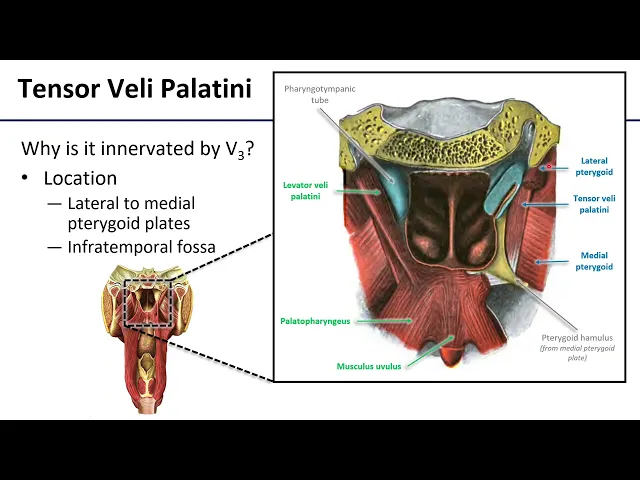
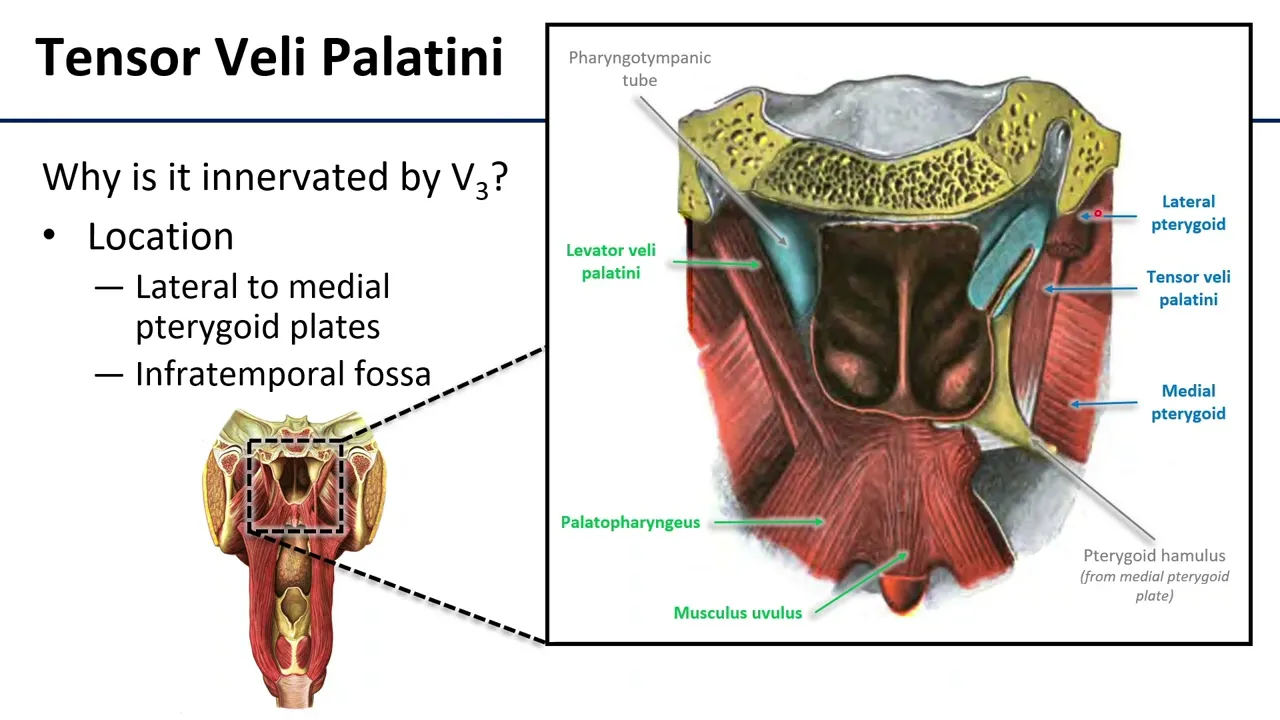
sitting in the fings and we learned way back in the beginning of the course that Vegas provides sematic motor for all of the fairings so what is going on here with tensor Valley palatini why is it the only one that's innervated by the mandibular nerve well the short answer here is that it's not really a Fingal muscle it's an infratemporal muscle that sneaks into the ferin and infratemporal muscles are innervated by the mandibular nerve the slightly longer answer has to do with where tensor palatini originates so we can see it in the diagram here and
it is sitting lateral to this bony structure here this is the medial teroid plate ending in the teroid hamulus or the hook of the teroid which is what tensor Valley palatini is going to bend its way underneath here okay so this medial teroid plate represents a sort of border between the ferx and the infratemporal FASA now because tensor Val palatini and especially the uh muscular part of that where its muscle belly sits is located mostly out here in the infratemporal fausa it is inovated by the same nerve as these other infratemporal fossa muscles so we
have medial teroid lateral teroid which remember are inovated by branches of the mandibular nerve okay and this remains true even though this aerosis bends underneath the teroid hamulus to enter into the ferx the rest of the soft pallet muscles so here's levator palatini Pingus pet glossus would be up here more and musculus uvulus are going to be originating medial to this medial teroid plate meaning they are entirely within the fairings therefore they are going to follow the Fingal pattern for inovation which is Vegas all right so let's take a look at these muscles in a
donor to better understand how they're related to one another so up here on the left we have our two Superior pallet muscles anteriorly we have tensor belly palatini which we can see already picking up that very uh tendonous Apon orotic look even as we see it up here in the naso fairings posterior we have the levator velli palatini muscle and levator palatini has a very close relationship with the fingo tanic tube so we can see the opening to that right here um now both of these muscles have some attachment to the fingo temp Panic tube
but levator V palatini looks like it's kind of spilling right out of it it's not they're just kind of close by but it definitely has that appearance now moving over to the right we can see our palog glossus and Pingus muscles on either side of the Palatine tonsil right here in the middle so here we're able to see um this relationship between the pallet and the tongue and the fairx much more easily so you can get a better understanding of how pal glossus will move the tongue up will elevate it and how palet fingas will
Elevate the fairings here the musculus uvila is really difficult to see um even in this image here so you're going to want to Envision some muscle fibers just traveling from Superior to inferior through the body of the uula and that is a soft pet so here is a practice question for you correct answer here is going to be D the Vegas nerve so the Vegas nerve is going to Supply sematic motor inovation to all of the muscles of the soft palet except for tensor VY palatini because apart from tensor Valley palatini these are all going
to be originating in the fairings and that brings us to the end thank you for watching