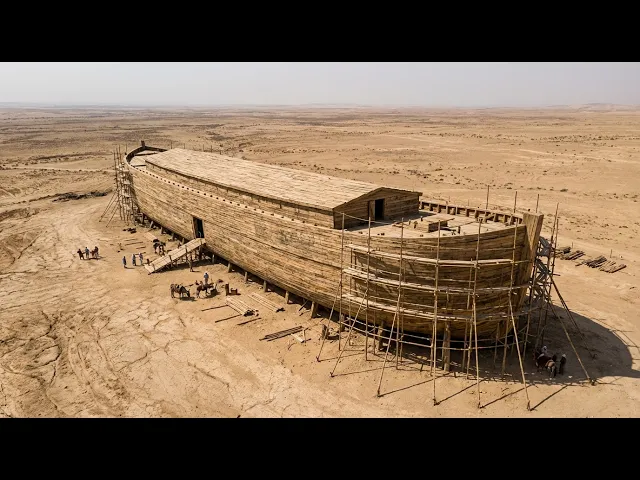
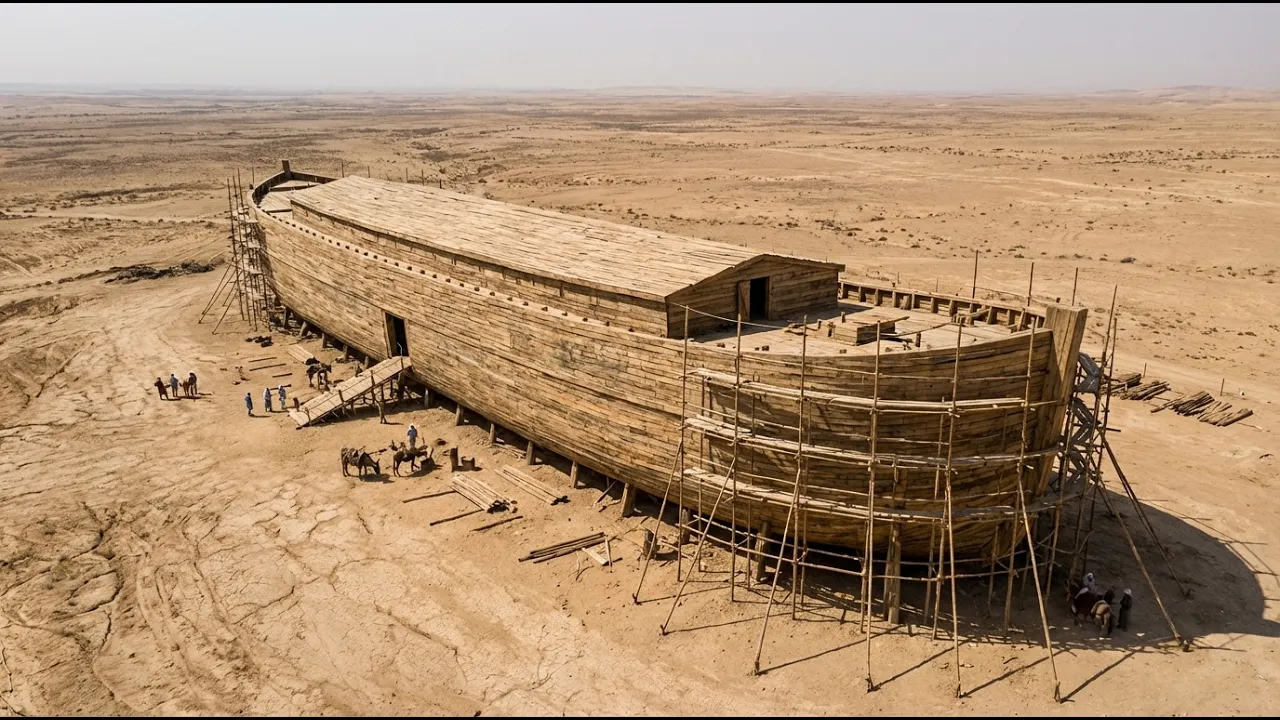
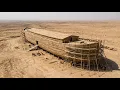
137 meters long, 23 meters wide, three full stories. These were the dimensions God gave Noah—direct, clear, and supernaturally specific. The divine order left no room for doubt: "Build yourself an ark.
" And at that voice, one of the greatest works ever undertaken by human hands began. The Bible reveals the size of the ark, the material, and its purpose. But to transform this order into wood, beams, and structure, Noah had to face gigantic challenges.
Challenges that the text doesn't detail, but that any builder of the time would understand. And it all begins with what many ignore: the terrain. A structure 137 meters long cannot be erected just anywhere.
It requires ample, firm, stable space, far from dangerous slopes and near the sypress forests, which would serve as material. So, imagine Noah walking across the terrain, analyzing the soil, observing the firmness of the earth, the proximity of the trees, the accessibility—without machines, without engineers, without maps, only discernment, practical wisdom , and faith. And when he found the ideal location, he began the first stage, and it was anything but glorious.
Removing large stones, uprooting deep roots, leveling every meter, compacting the soil to support tons of wood. All with simple tools, but with a determination driven by the word. But there was something that made the work even more challenging in the pre-flood world: the constant moisture rising from the Earth.
The Bible explains that a mist rose from the Earth and watered the entire surface of the ground. Genesis 2:6. This means that the soil was frequently moist by nature, and moist soil can turn to mud.
Tools sink. Wood absorbs moisture, the ground becomes vulnerable. So, Noah probably needed to dig small channels around the construction site, creating simple diversions so that the natural water in the soil wouldn't saturate the work area.
It wasn't rain falling from the sky; it was the earth itself releasing moisture. While he did this, people passed by watching. Some laughed, others whispered.
What sense does it make to prepare such a gigantic piece of land? But Noah didn't answer, because he didn't build according to human logic. He built according to divine instruction.
And when the ground finally became firm, flat, and dry enough, a new challenge arose before him: gathering wood for a colossal structure. The Bible says, "Make the ark of cypress wood. " And cypress trees weren't small trunks; they were enormous, sturdy, heavy trees, ideal for a work of that magnitude.
Felling such a tree with rudimentary tools required strength, patience, and persistence. Felling hundreds was a process that demanded daily discipline. Blow after blow, trunk after trunk, Noah and his sons worked until the rumble of the falling tree echoed through the forest, but the work didn't end there.
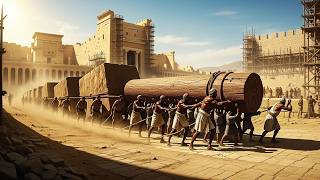
Moving a giant trunk to the construction site required technique, without wheels, without enough animals, without machines. The solution was the same one used by ancient peoples: wooden rollers. Smaller trunks were placed under the larger trunk.
With ropes and levers, they pulled slowly, moving tons of wood a few meters at a time. As the log advanced, the rear rolls were moved to the front – slow, tiring, risky. But each log transported was another step in building what God had commanded.
And Noah continued: "For he who has received instruction from God does not work by what he sees, but by what he believes. " And while all this was happening, the inhabitants around saw this unusual activity, men transporting enormous logs towards a gigantic plot of land. It was natural that many mocked, that others doubted, but none of that stopped Noah, because he did not work motivated by human eyes, but by the instruction that came from God.
As the wood accumulated on the land, the time came to begin the most complex part of the entire work. Not just cutting and transporting, but erecting a colossal structure that would need to remain firm during the greatest storm in human history. For the ark to remain firm, straight, and resistant, Noah would need to start from the base, the backbone of the entire vessel, Aquila.
The Bible doesn't describe the process, but any ancient builder would understand that. . .
A structure of this size required an extremely long and robust central beam, capable of supporting the entire weight of the hull, the three decks, and the tons of cargo that would follow. But there was a detail impossible to ignore. No tree, however large, would reach 137 meters in length.
This meant that Noah needed to join several giant beams, trunk after trunk, creating a continuous, straight, and solid line. A task that demanded technique, precision, and patience. These beams were cut and fitted with wooden joints, something known since the most ancient civilizations, male and female systems, which, when well made, became as firm as entire structures.
And to secure these joints, stakes and pegs of hardwood were inserted, creating points of union strong enough to hold everything together in violent storms. When the keel was ready, an impressive moment arose before Noah: the need to raise the ribs of the ark. The ribs were arched beams that rose from the sides and gave shape to the hull.
The ribs needed to be fitted precisely. Therefore, Noah and his sons did what ancient builders mastered very well: they created custom-made, carefully carved joints that allowed the beams to naturally tilt and arch as they were fixed to the keel. And as these ribs rose alongside the keel, the shape of the ark finally began to emerge before their eyes.
Now imagine the scene. Enormous, heavy beams being lifted by levers, thick ropes, and sheer human strength. Noah and his sons pulling, adjusting, correcting angles, watching every inch.
Because if a rib were tilted too much, the entire structure would lose its balance. That's why they probably used ropes stretched end to end as guide lines. They used stones as plumb lines to ensure verticality and repeated the process dozens of times.
When the skeleton of the ark began to take shape, the sight must have been impressive: a gigantic wooden structure emerging where there had never been a sea, the size of a modern building, but made only with simple tools and human hands. And then came a crucial moment: sealing the ark. Because a beautiful structure isn't enough.
It needed to be waterproof. And God was direct about this: "You shall cover the ark inside and out with bitumen. " This detail is profound.
Bitumen, a resin derived from the earth, needed to be boiled, thickened, and applied while still hot, creating a hard and resistant film, but applying it only to the outside wouldn't be enough. Wood, over time, absorbs moisture, and any infiltration could destroy everything. So Noah and his sons spent days, perhaps weeks, covering every crack, every joint, every crevice, both inside and out.
Each layer needed to dry before receiving another, and any flaw could compromise the entire project. In the end, when the last part was sealed and hardened, the ark was no longer just a wooden structure; it was an airtight shelter designed to face something that had never happened before in human history. And the next step would be as important as the external structure: organizing the interior to house living creatures.
The Bible reveals a fundamental detail: "You shall make compartments in the ark. " The Hebrew term used, kinningin, literally means nests, cells, small divisions. That is, the ark was not an open shed.
It was formed by smaller sections, carefully planned to maintain order, safety, and stability during the flood. And here is an important theological point. The Bible does not describe the layout, only stating that there were three floors and compartments.
Based on this, we can imagine what would have been logical, practical, and possible for Noah. To maintain the vessel's balance, the most sensible approach would have been to organize the animals by weight and size. Lower floor: heavy animals, elephants, hippos, large cattle.
This would keep the center of gravity low, preventing dangerous oscillations. Middle floor: medium-sized animals. Lions, bears, deer.
Larger domestic animals. Upper floor: birds and smaller, lighter animals, less impact on balance and closer to ventilation. This division does not contradict.
. . The Bible is entirely consistent with such a large structure.
Compartments were essential. Without them, predators could attack prey, animals could injure each other. There would be total chaos inside .
Diseases would spread rapidly. So, Noah probably built simple but strong enough internal walls to keep each species in its space. These walls needed to fit together well, without compromising the integrity of the hull.
Remember that each piece of wood added weight and needed to be planned. Ventilation. The Bible mentions: "You shall make an opening a cubit from above.
" This indicates a kind of long, continuous window below the covering. But to ventilate three entire floors, Noah probably did. Small protected side openings, external overhangs that prevented water from entering, internal corridors for air circulation, all within the logic of the pre-flood environment.
Without adequate ventilation, the gases produced by the animals would be deadly. Food storage. A year's worth of food for all creatures meant an enormous amount of supplies.
The Bible says: "You shall take food for yourself and for them. " This included hay, grains, dried fruits, roots, water stored in jars and containers. Therefore, entire areas of the ark's interior needed to be dedicated solely to food, stored in an organized manner and protected from moisture.
The ark was more than a ship; it was a floating city, with complete logistics: waste disposal, plausible possibilities, slightly inclined floors, simple drainage channels, small side openings just to drain liquids. And when each space, each division, each corridor was ready, Noah realized that the work was reaching its most critical point : the door. A gigantic opening, large enough to allow the entry of animals of all sizes and, at the same time, strong enough not to compromise the entire structure.
The door would be the most vulnerable point of the ark and also the most symbolic point, because the Bible says something extraordinary. The Lord closed the door, man built, but God sealed it. Among all the elements of the ark, none attracted more attention than the door.
The Bible clearly mentions: "And put a door in its side. " Genesis 6:16. To prevent the enormous opening from compromising the structure, Noah likely installed thick beams around the frame, diagonal bracing, strong and deep joints, and high-strength wood on the edges—all to ensure the door wouldn't become a point of collapse.
And remember, Noah didn't have enough metal to create huge hinges like modern ones. So, the most plausible system would be a vertical pivot, a large reinforced wooden shaft on the side of the door, allowing it to rotate forcefully but with stable operation. Here's a precious theological point.
The Bible says, "And the Lord shut the door. " Genesis 7:16. That is, Noah built, God sealed.
Before the animals arrived, Noah certainly walked through the interior of the ark, testing beams, checking if the pitch had fully hardened, checking for cracks, reinforcing ribs, assessing the weight of the provisions already loaded, listening to the sounds of the compressed wood. In large wooden structures, it speaks, creaks, settles, and adapts. And Noah, with the experience gained over years of construction, would know if something was wrong.
And then, something supernatural happened. The Bible is explicit. The animals came to Noah.
They weren't captured, they weren't forcibly driven, they didn't arrive randomly. They came. It seemed like an orchestrated movement, as if an invisible hand were guiding each species.
Imagine the scene. Pairs of animals emerging from the trees, birds landing near the entrance, wild creatures walking calmly alongside prey. Reptiles crawling in the exact direction, offspring following instincts they hadn't learned, and each positioning itself in order, without chaos, without confusion, without attacks.
It was the seal that this wasn't just a human project, it was a divine act happening before the eyes of Noah's family. When everyone entered—animals, birds, reptiles, Noah, his wife, his three sons, and their And then eight more people entered the ark. And so the work was completed.
Faith had been obeyed. And now began the most challenging part: how Noah and his family survived inside the ark during the days of the flood. With the door closed by God's own hand, a different silence filled the ark.
Outside, the world continued as if nothing had happened. Inside , everything was ready. Animals were accommodated, compartments organized, food stored, the structure sealed and firm.
It was the beginning of something that had never happened in the history of humanity. The Bible describes this moment with solemn words. In the 600th year of Noah's life, all the fountains of the great deep burst forth, and the floodgates of the heavens were opened.
Genesis 7:11. This indicates underground waters exploding to the surface, internal pressures released, gigantic volumes of water gushing forcefully, earthquakes, and deep ruptures in the earth. Noah's family felt the ark tremble, not from the water above, but from the violent movement of the earth below.
Then, something even more extraordinary happened. The floodgates of heaven opened. It was the first rain in history, and not an ordinary rain.
Thick drops, increasing volume, deafening noise on the wood. Thunder echoed, flashes of light ripped across the sky. The ark, until then motionless, began to feel the touch of the first waters accumulating around it.
Imagine the neighbors who laughed at Noah, those who called the ark madness. The Bible doesn't describe their feelings, but it's easy to imagine. Shouts at the unknown rain, astonishment at the rapidly rising waters, people running without understanding, panic at something that had never happened before.
The faith that had previously seemed like madness now became their only refuge. The water rose, rose, rose until the heavy , firm hull began to float. For Noah and his family, this must have been an indescribable sensation.
The wood creaking, the floor vibrating, the initial rocking, the sound of water lapping against the side, the ark lifting off from the Earth for the first time. That vessel, built over decades, was finally fulfilling its purpose. The ark wasn't guided by sails, oars, or rudders.
It didn't need them. It was in God's hands. The Bible describes it: "The waters prevailed and increased greatly on the earth.
" Genesis 7:19. This means mountains disappearing, cities submerged, trees uprooted, ancient life being extinguished before the eyes of Noah's family. Inside, the ark seemed like a world of its own.
Outside, everything was dying. Inside, God preserved life. The contrast was absolute.
How long did the rain last? The sound of the rain ceased after 40 days, but the flood was far from over. The Bible describes it: "The waters prevailed on the earth 150 days.
" Genesis 7:24. Even without rain, the waters continued to rise and move, covering mountains, plains, valleys, and everything that existed before. Inside the ark, time seemed still.
There was work every day: feeding the animals, cleaning the compartments, checking the beams, reinforcing joints, monitoring stability, praying, waiting. And then, after long months of waiting, the biblical narrative reveals a decisive moment. And God remembered Noah.
Genesis 8:1. The Bible says that God sent a wind over the earth and the waters began to recede. Slowly, day after day, the level began to decrease, until the ark rested on the mountains of Ararat.
Genesis 8:4. After months of partial darkness, Noah opened the upper window. For the first time since the beginning of the flood, fresh air entered forcefully.
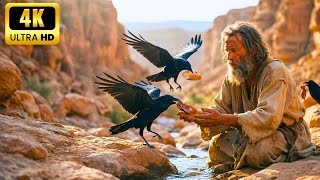
Natural light filled the interior of the ark, but he still had no way of knowing if the Earth was ready. So, he made a logical and wise decision. He released a raven, then he released a dove.
The dove returned, for it found no perch. The world was still underwater. A week later, Noah tried again.
The dove returned, but this time it carried an olive leaf. It was the first sign of a new beginning. Another week passed.
Noah released the dove for the third time, and it did not return. The earth was finally beginning to become habitable again. After more than a year inside the ark, God spoke again: "Come out of the ark, you and your wife and your sons and your sons' wives.
" "with you. " Genesis 8:16. And Noah obeyed.
The door, the very one that God had closed, was now open. An intense light flooded the interior. The animals began to emerge, species by species, following their instincts, dispersing throughout the new land.
The entire family stepped onto firm ground for the first time in many months. The smell of wet earth, the pure air, the profound silence. Everything was new.
Nothing from the old world had survived. But God's grace preserved enough life for a new beginning. As soon as he left the ark, Noah did something symbolic, powerful, memorable: he erected an altar to the Lord.
There, among rocks, dry mud, and the beginning of a restored landscape, Noah offered a sacrifice. The Bible describes that God was pleased with the sweet aroma and made a promise: "Never again will I destroy all life with water. " And then He placed a visible sign in the sky, the rainbow, an eternal covenant, reminding humanity that even in judgment, God preserves a remnant, sustains life, and opens a path of faith.
With the flood over, the ark had fulfilled its purpose. Now a new chapter began. Noah and his family would repopulate the earth.
Nations would arise from Noah's sons. The world would gain new cycles, seasons, and boundaries established by God. The story of redemption would continue.
From that vessel, all of post-flood humanity would be born. And the ark, a symbol of obedience, faith, and salvation, remained as a testament that God always rescues those who trust in His voice. If you've made it this far, you've already realized.
The ark was not just a boat; it was an act of faith set in wood. It was salvation preserved on three levels. It was the divine answer to sin and, at the same time, proof of God's love for life.
But Noah's story doesn't end with the ark. There is much more about the restart of humanity, the new covenant, the generations that came after, and how all of this connects to God's greater plan. Click on the video to the side to discover what happened after the flood and how it shaped the whole of history.
Biblical. Ka.