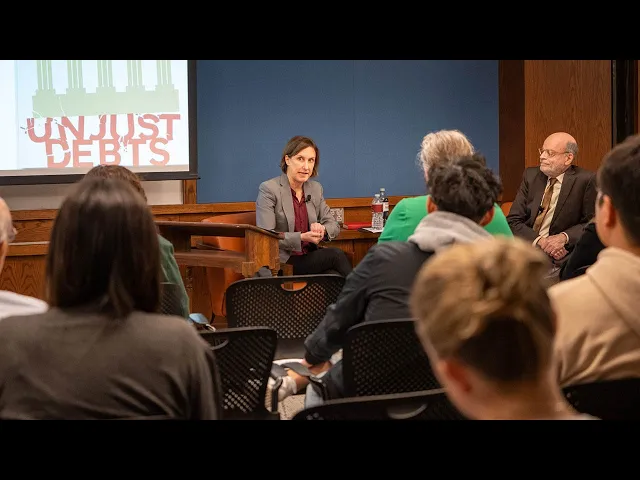
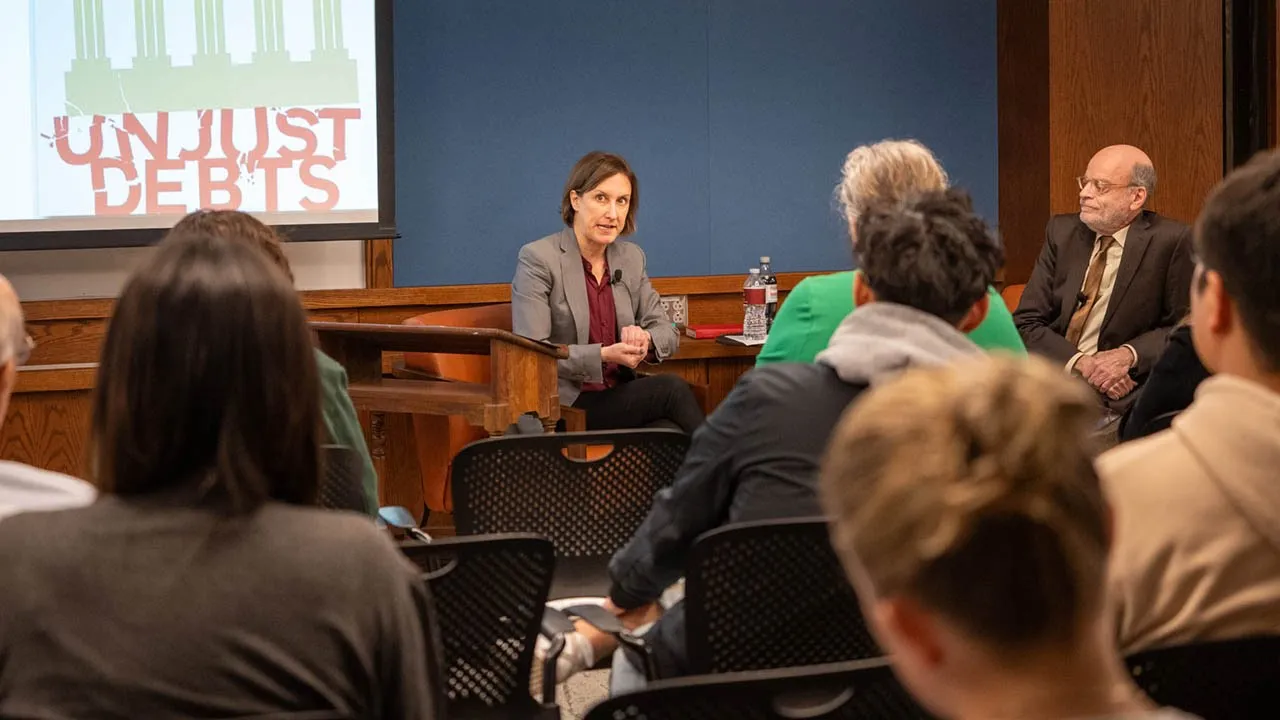
welcome to the Harvard Law School library book talk for unjust debts how our bankruptcy system makes America more unequal um by Melissa jacobe you can get a print copy of this book from the Harvard coupe right outside the store or at the coupe or check it out from the library um we'd like to thank Dean Goldberg's office for their generous support of the faculty book talk series as well as our Librarians Lisa Ryden Sarah Newberg Debbie Ginsburg and Maya buram mesco for their assistance um before we get started please silence anything you have on yourself
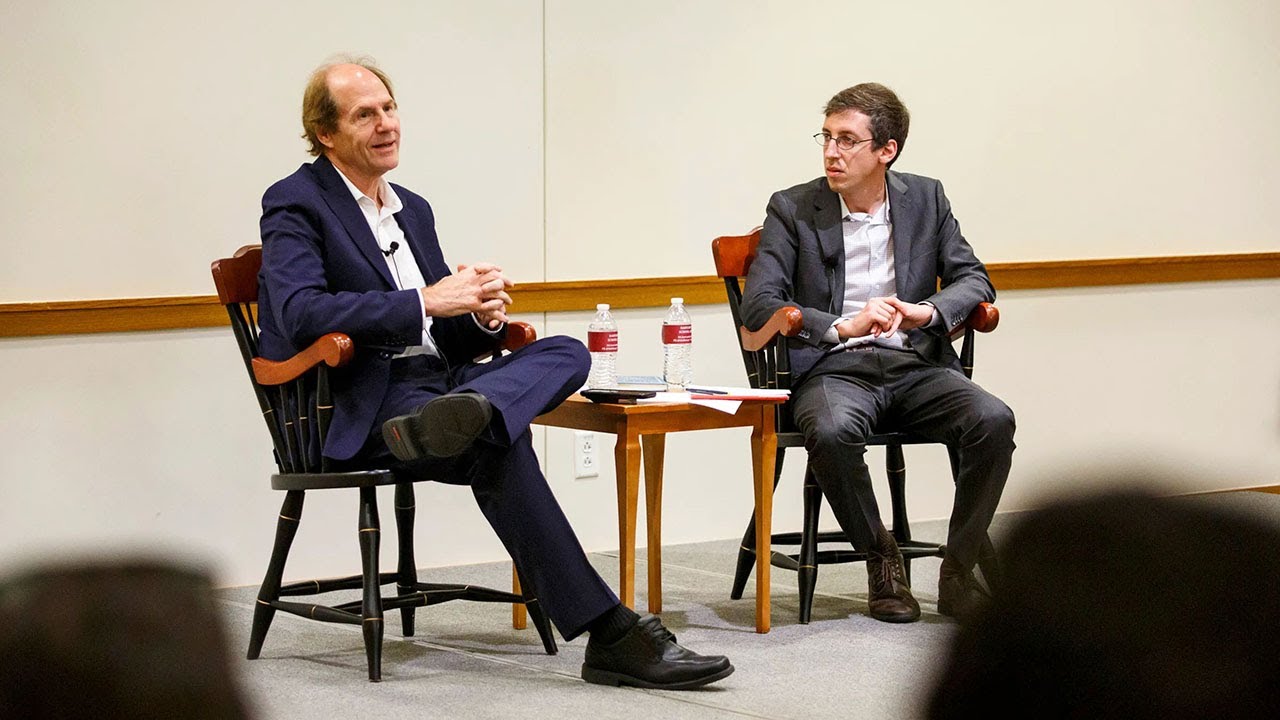
that makes noise um thank you for doing that and we're welcomed today by Melissa Jacobi and Mark row Melissa is the Sullivan and Cromwell visiting professor of law at Harvard Law School and the Graham Keenan professor of law at the University of North Carolina at Chapel Hill School of Law she teaches commercial and bankruptcy law Mark row is the David Berg professor of law at Harvard Law School where he teaches corporate law and corporate bankruptcy I'm going to turn it over to Melissa it's going to spend a few minutes talking about her book and then
we're going to have a nice robust discussion like we're used to and then we'll have a time for audience Q&A thanks which good afternoon everyone I'm going to stand and talk a little because I've heard can you hear me okay all the way on the my left side awesome uh so thank you to the library for having me thank you to Professor Row for I'm really excited to have this conversation and thanks to the audience for being here both in the room and uh virtually I know that bankruptcy isn't something that everybody naturally gravitates to
and thinks of as a core subject of course professor roow and I might think about it a little bit differently but I wanted to set the stage for you a bit on whatever you're doing especially are there one else in the room great uh about why and how this connects to the kinds of things you might be already thinking about uh after all one of the the concerns of my book is that bankruptcy is taking up too much of the legal system it's encroaching too much on issues that you're studying uh in these other courses
so let's start with some foundational principles so bankruptcy is in the Constitution uh article one section 8 a skinny little Clause that's talking about uh that Congress can write uniform laws of bankruptcy um now why would they do that well uh one debtor let's say I'm the debtor I owe all of you money and including the people watching virtually I owe everybody money and there's one of me and I cannot pay all of you there needs to be some coordinating device to treat you all equally and Once Upon a Time States might have preferred uh
Massachusetts residents would prefer its own residences and Pennsylvania would prefer its own residence and uh there would be a better coordinating device this bankruptcy power also enables cancellation of legal obligation and that is a big legal deal and uh we can't find that at state law for the most part now Congress has expansively interpreted this power at least I would say supersized it if you will uh and so uh we have to recognize that this little Clause is going to be already doing a lot of work but the Constitutional law intersections go beyond this due
process is challenged and intention in a lot of bankruptcy cases after all the consequences of a bankruptcy which might terminate legal rights forever are a big constitutional deal there better be noticed um and in addition bankruptcy courts do not have life tenure that raises all sorts of problems and challenges for the Supreme Court about the Constitutional authority of that Court to make decisions um and so one more intersection with con law is that constitutional violations are treated like debts just like a credit card in the bankruptcy system under current law now I don't think that's
right but that's what it is now so let's just throw in another couple subjects here torts if you can include a constitutional violation as a claim well certainly torts of All Sorts are included uh and are treated as creditors in a bankruptcy and some bankruptcies are primarily for the purpose of capping liability to lots of different claimants um and that's something that Professor row has been writing about for and thought about for a long time um let's bring in contracts invisible in every contract is a clause that says your enforcement right changes if one of
the parties files for bankruptcy now the bankruptcy Clause inherently changes contracts that is sort of the superpower that it has but bankruptcy law goes beyond that bankruptcy does more to contracts than I think it probably should um or is necessary to fulfill its main function property we need to know what property the debtor has if the property is going to be divided up to to compensate all of you so what is my property well we start with law of course but then bankruptcy law gets a little greeny sometimes about what they want to consider a
property so that they can make the uh there can be more other times it wants there to be less it recharacterized transactions that were thought to be Property Transfers under state law finally civil procedure bankruptcy is part of the federal courts Federal rules of civil procedure apply special bankruptcy procedure Federal of evidence apply and yet there are some major twists one of them is that unlike in any other civil action uh where you have a lot of Standards to overcome to um have an injunction in bankruptcy you automatically enjoin otherwise lawful activity that is a
really big legal deal there is coercive Federal Authority going on in the system that subverts what you might otherwise expect so in short takes a lot of fundamental concepts and it sort of shatters and remixes them in a very different way now why should you care about this maybe this is rare well one out of 10 living Americans have been through bankruptcy at least one time so people all around us have gone through this process have had severe financial distress whether the system has worked for them or not is something I try to address in
the book um mega cases the ones you read about in the newspaper Purdue Pharma Johnson and Johnson subsidiary um uh the Boy Scouts of America those can affect hundreds of thousands of claimants directly and many more indirectly there're businesses of all sizes churches and other religious organizations nonprofits and even cities public hospitals sewer authorities water authorities it's not that common this grp group but those cases bring in a lot of of people and have a lot of effects um so now maybe you think well another thing we focus on is the administrative State here at
Harvard Law School um so is bankruptcy part of that administrative estate well not exactly but there are some twists so the institutions that we deal with in bankruptcy are the bankruptcy court that's a unit of the federal district court uh and yet because it doesn't have article three Authority it's not they are not life tenured there are challenges there so opinions from the Supreme Court on the administrative State and the power of administrative agencies affect bankruptcy courts and vice versa uh so you got to watch out for those rulings um another institution that people don't
think about um is part of the Department of Justice called the United States trustee program that is uh a watchdog for the the system o administrative oversight so now what about the issues surely we only are talking about debts loaned money well no I've already told you about constitutional violations torts and the like bankruptcy has gotten broad the definition of claim and debt is very Broad and its scope is even broader so issues like climate change and the environment Health Care employment law retirement security uh all of these things even energy policy end up being
dealt with in a bankruptcy case so there's a lot going on in this system now in terms of the book a couple things I want you to know about my Approach uh that we want to think about um conceptually as I've already hinted at I don't think of this area as a purely private law area it is a hybrid of public and private interest it involves coercive Federal power it has to have that hybridity um and so um I also don't necessarily think that a system can accomplish or aim to accomplish only one thing it
is balancing competing objectives that's how I think about things um a fancy term for that is normative pluralism another way to say it is balancing different things um gets you to the same place um in terms of my research methods I like to observe and go bottom up in cases I do a lot of case studies I have been involved in systematic studies of the system um but I like to dig deep and use primary sources um and in terms of writing style I do um I like to tell some stories so this is a
book of stories it's not a book of arguments um it is written for a trade press I wanted not only law students maybe to want to read it but people who never want to go to law school ever um and so uh stories can help people understand understand how it works and that's what I'm aiming for so I think we'll end up talking about some of this any inquality is in the subtitle of the book um the publisher put it there uh inequality is a Mainframe that I'm looking at the system in but it doesn't
stand alone uh economic efficiency is an important lens on which to look at many laws including this one I just don't think it's the only lens that we look at and luckily for Me Maybe uh the two often are swimming together in other words the things that I worry are generating inequality there is also evidence of economic inefficiency I add federalism because federalism gets tossed around a bit in discussions of bankruptcy but not as sustained as I might like um and I think that bankruptcy is ending up overriding way more state law state policies uh
and uh and the like then is is healthy for the system um and so again I see these as sometimes swimming in the same direction that we can look at them as a group so I'm just um the book talks about race disparities I compare fake and real people by which I mean corporations and humans um I talk about Mission creep about how a system designed to help help negotiate new deals among lenders is being used for all sorts of other kinds of policy problems and ultimately there's a connection back to the legal system generally
this is a system that you learn that the remedy is often the payment of money so debt or creditor relations are are created by all sorts of legal obligations in our system and we're seeing that funnel back into the bankruptcy system so ultimately I let everybody label this project as they will but I see it as a somewhat small C conservative approach ultimately advocating for a narrower more targeted and effective bankruptcy system that actually takes up less space in the legal system and more for everything else so I'll just leave up my table of contents
here um in case that helps in our further discussion well good um Melissa maybe we should be m and Mark for this event instead of professors uh um so this is a good project it's a good project because the frame of reference for most people talking about bankruptcy has been on the prior slide that the efficiency idea is uh it how is bankruptcy inefficient in making things worse in terms of running businesses um how is it making it better how is it contributing to um uh financing of uh of of business or how is it
deterring the good finan ing of businesses uh what I particularly like about this project is there's a whole new frame of reference of how does bankruptcy interact with the social system how does bankruptcy interact with inequality in uh in the United States and maybe that's by the first question we've talked about this before so the the subtitle is how bankruptcy um makes makes America more unequal and the question is kind of is are we attributing to much to bankruptcy is that while bankruptcy people want to say bankruptcy is really important is this really reflecting society
as opposed to being a significant contributor that is society is unequal the um you have some nice discussion about how uh racial minorities tend to be steered to um a less favorable provision of the bankruptcy code um but there are a lot of studies showing that that happens in multiple Dimensions this is one of them so a question to start out with is is bankruptcy in these features reflecting or contributing and if they're doing both which is the dominant one yeah so I I think it is both and it is absolutely critical to recognize that
bankruptcy takes people where they are and they are bringing existing inequalities into the bankruptcy system no doubt I am a little bit of an outlier on the bankruptcy system in that I'm trying to make my own field smaller um and less relevant to too many things so um I'm I I I think that bankruptcy is an example of how very technical areas are amplifying inequality in ways that are less visible than some of the more Salient features of our society but there is no question that a lot of it is bring brought in and then
bankruptcy piles on and so part of the obligation of the book is to give different examples of the piling on of saying that even though it is UN understandable might not be the right word even though it is not a surprise that African-Americans are over represented in the bankruptcy system relative to the general population because of the the wealth Gap because of the income gap um that there are things that bankruptcy itself does that change and lead to disperate results and those those there's the most robust uh research here on um controlling for all sorts
of other variables nobody wanted this to be the story um and yet and yet here we are if your sole goal was to reduce inequality would you address bankruptcy first the tax code first housing policy schools where would bankruptcy be on the list well it would be low um and I have to say that as a citizen of this a resident of this world that I I would not start with bankruptcy and yet sometimes we have to start with places we can actually address so one thing that I think is really important for people to
see about this field is that on the Congressional side and also in terms of Supreme Court Juris Prudence um I'll put the Congressional side in terms of bipartisan and I'll put the Supreme Court Juris Prudence in terms of um sometimes people who are not considered to be ideologically similar that both when I've liked bankruptcy legislation and when I've disliked intensely bankruptcy legislation it's been bipartisan both times um and so uh I think that bankruptcy is an area that could be changed but it is absolutely not where I would start if I was trying to get
at the root of inequality in America is there a case that bankruptcy helps with inequality reduces inequality in this way um people take on debt um credit cards overextended um use the credit card to buy food because money's run out then a big medical expense and one feature of bankruptcy is that chapter 13 there are bankruptcy solutions for individuals they may not be particularly great Solutions but there is something there and so is there you know is there when you're listing the how bankruptcy contributes to inequality there are also some things that go the other
way for sure and I think that this is a really important point to say bankruptcy can be an engine of reducing inequality in that respect to say um as it is a a blunt instrument to be sure it does not retrain people for jobs it does not hand out money it cancels debt that is its biggest superpower and that can itself give people a chance to better compete to start a new business to send their help send their kids to college whatever it is so yes and I think that's why it is particularly troubling when
the bankruptcy system is piling on when it could be an engine of promoting equality or reducing inequality so and that's why ultimately I'm not going to be the one to say banish the bankruptcy system I might narrow chapter 11 for corporations but for individuals there has to be something and there are economists who have written about this who agree to say a targeted effective method of cancelling debts would be both would be good economically but also um to me go to this point um this might be this is a question I don't know the answer
to um and I have no and you might not know the answer to it either but I'll put it out I put it out there so one of the features of American bankruptcy which is different from almost every other bankruptcy system in the world is that we combine individual bankruptcy and corporate bankruptcy in the same system and to the point that several chapters of the bankruptcy code uh critical chapters of the bankruptcy code apply both to individual and corporate bankruptcy and you can see where this this is this is leading so we have things where
we're dealing with um a corporate restructuring where it would be plausible to say efficiency and financing are the central Norm um and once that decision is made or the interpretation of the section is made that same section and interpretation then applies to the next bankruptcy which is somebody who's just lost her job and piled up debts and files for bankruptcy um I don't know every bankruptcy system in the world but my impression is that almost every other bankruptcy system The World Keeps the two either completely separate or largely separate and the consequence is that you
can have one stream for and one institutional stream for individuals which is social justice oriented and another stream for businesses which is um more efficiency and finance oriented but we put them together in the United States the same judges who decide both it's the same bankruptcy code um there are only a few Provisions that apply to one and not not the other and I guess the question is for you you know is there any anything to Riff on there that this is one of the sources of uh of the problems you're identifying in the book
well I I've been thinking about this since uh I I I think it's a really important Point uh to say would we be in a different place if the systems had developed separately now I I if I recall it took a while and did go up to the Supreme Court whether individ humans could use chapter 11 and the Supreme Court said yes they could um nothing in the code said otherwise and since then there's been more and more in the code that makes clear that things apply that many of the laws apply indeed we often
have law made about a truck from an individual that affect the interest rate on billions of dollars of debt uh in big chapter 11s so I think one thing I would say in response is that there is actually a Spectrum uh and that in the middle we have very human intensive businesses some Incorporated some not some are doing business as sole Proprietors who are being treated as individuals in the bankruptcy system um and so we have a spectrum of human to Big Corporation um and I don't we'd have to disentangle that the other thing is
I'm wondering even though one of the thesis of the book and some of my other work is that corporations especially big ones are much more generously treated by bankruptcy law than individuals even with the same code would the situation be even worse if uh that if you assuming you agree that that's not desirable if they were completely separate I I am willing to have economic efficiency be part of the analysis for personal bankruptcy I um I I but I also think social the the issues of inequality need to be part of the calculation on the
corporate bankruptcy so I wouldn't want to separate say that they have those two different goals but I think we could have a good a decent system either way but I do have I do have some worries that separating would further exacerbate that there's been some carryover benefits on personal bankruptcy that make it better than it otherwise would have uh given the the politics and the lobbying that go along with only focusing on personal bankruptcy because when amendments to the bankruptcy code are put in place people who are interested in the social policy portion or individuals
can make a deal with people who want to make sure their lean will not be challenged well yes and um as I don't as I I've learned from you politics does sometime come into the making of laws corporate commercial bankruptcy and otherwise um and we have some very big lobbying interests that are proud to say the consumer credit industry that takes lots of credit for a big round of amendments in 2005 um that were roundly criticized both on on the theory but also really on the practice of just creating disruption for the sake of disruption
and cost for the sake of cost rather than putting money in individual creditors Pockets so I worry about that going even further um one of the interactions that you have in the book or maybe I should just suggest you talk about it to the to the group it is the interaction in corporate bankruptcy with mass torts which is an issue it's an issue what is the issue well can everyone stay all afternoon because we have a lot to talk about here um so the bankruptcy rules for big Enterprises whether for profit or nonprofit were written
as a both as a package deal with voting being very important weighted voting so that creditors with bigger claims would have more of a St a say and also to they were supposed to have protections that whatever happened in the case they would be at least as well off as they would be if that company or nonprofit liquidated that's called the best interest of creditors test um when you have a company that may not even be in financial distress but says wow I've got a lifetime of Tor coming and I want to manage those it
is understandable to it in theory to say bankruptcy offers the tools to get our arms around this and treat creditors equally the problem has been that the theory has not played out in practice at least in the cases where we're able to follow all the way through and it's led to very unequal results on the money but also real challenges on due process as well as um as well as issues of procedural Justice perceptions of other other reasons that people wanted went to the legal system that it wasn't getting a check uh assuming they even
get one which they they often don't um but to um because they wanted to um they wanted to confront the person who who wronged them and asked them questions they wanted to have a day in court in front of a judge um and bankruptcy in striving for I think economic efficiency saying this is a better way to do it has lost sight of some of those other goals I think some judges lawyers are are trying to put those into the into the picture but not necessarily effectively um but I still also question whether it's even
achieving the goals that those who are optimistic about Mass Tor bankruptcy um were hoping for equal treatment of creditors with similarly situated uh problems I'll mention I'll just throw out one more thing in the interest of of time but also this is very much in the news with Johnson and Johnson and their tal claims um against them um there is an issue that it this is harder to do with commercial claims but claims that may not people who may not actually have an injury that is connected at all to the company or may not have
much of an injury at all um that have been um recruited by profitable corporations to say to become part of the case to outvote the people who are on the verge of a jury trial have the most severe claims and had done the most work investigating the causal connection between their claims and the product and um I think that really has to be worked out courts are really important to that process but a lot of times that's sort of pushed off till after the case has already been the the debts have been cancelled and it's
sent to a trust and they're supposed to work it out so those are just just a couple of the the issues I'm I'm struggling with um I don't want to defend bankruptcy in Mass Tor because I consider myself largely a Critic of what's been happening let me add this though as a question is does this reflect the first question is that the mastt problem could be dealt with outside of bankruptcy and there's a good case that it should be dealt with outside of bankruptcy what bankruptcy is good at is here's a billion dollars that's owed
by the company that's only worth 500 million let's allocate it in the most effective way but with the demise of the class action with the inefficiencies of multi-district litigation um I don't want to make bankruptcy people into Heroes um but there is a heroic notion that at least one judge in New Jersey seems to have which is okay the rest of the world isn't dealing with this problem I will stand up and deal with it maybe I won't do it right but at least I will deal with it and so the you know the question
is is this also something that bankruptcy is reflecting what's happening outside of bankruptcy and it's not being handled well so it moves into bankruptcy and depending on how you look at it bankruptcy also doesn't handle it well or maybe if you're one of the heroic judges you think we're at least doing a little better than the other guys were doing yeah and I I will Echo the idea that um I I think some in the Judiciary as well as some of the professionals involved in these cases truly believe that they are helping and they are
trying to solve a very difficult problem I don't want to I don't mean to ascribe any other motives to them there of course are a range of motives out in the world um but I I believe that that's Earnest so my problem with that is so I'd say yes absolutely background conditions um there's is a problem that needs to be solved I think that bankruptcy is not the ombuds person for the Civil Justice system um and can't solve problems that are coming up elsewhere and the second thing is the errors it when these cases don't
work out the consequences are even more severe because their rights have been permanently cut off for significant harm and so and that's we haven't even gotten into these cases are trying to stretch out into the future change the legal rights of people 10 20 30 years from now who don't even know they're going to be injured based on a past exposure I worry that um those consequences are too big but I I have to agree um I I am not here saying everything's working great outside of bankruptcy um and I do think bankruptcy could work
with other systems to do the part it does best and leave the other parts to to the other institutional actors and I think originally that's how it was supposed to work the bankruptcy wasn't supposed to cut off every possible trial you would have bellweather trials to see about causation and and lead to facilitating settlements and you'd have other parties other federal judges involved I think what's happened is an idea of let's get it really all in one for him because then the leverage associated with bankruptcy is incredibly strong and that's where I I have the
most concerns maybe we ought to do questions from before Melissa and I gobble up all the time talking about our interest in bankruptcy all right if we could give a quick hand to our speakers thank you for coming um we are going to turn it over to audience Q&A uh so if you have a question for our speakers please raise your hand and someone will uh my colleague Lisa will come over um our first question is actually coming to us from a zoom viewer so I'm going to pass it to Debbie to uh ask the
zoom question and then we'll go from there all right so the first question is how a stor was the perdu scotus decision and is it common for companies to spend $1 billion do in bankruptcy legal fees it is not common to spend that much in legal fees for bankruptcies overall the vast majority of bankruptcies are filed by financially distressed families um but among the mega cases the professional fees I think it's fair to say I'm I'm deferring to Mark here our eye popping um and uh we have to compare them to how it otherwise would
have worked out in another legal regime it's not legal fees versus none um but uh that that was a particularly large amount uh of money but the the fees in the biggest cases um the hourly rates exceed $2,000 an hour and again it is a bankruptcy part of the point is supposed to be financial distress so I do it is understandable that that um that people are thinking about that uh the Purdue Pharma case was a long time coming in resolving a long contested circuit split uh and it went in favor of interpreting the bankruptcy
code in a more narrow sense consistent with prior Supreme Court decisions depending on whom you ask this is the most calamitous thing in American law today um but I think most people don't don't take that don't go that far to say that um it does shift leverage in these cases but um it leaves a lot of room open for negotiation and and other Solutions so uh I think we are seeing a shift in how how these cases are going and courts are working very hard to interpret and apply uh the Purdue Pharma Supreme Court decision
literally every day we get a new new piece of information about that hi so unjust debts strikes me as an important contribution in its own right and also it forms part of this broader growing Cannon of scholarship that identifies large scale patterns of institutional change uh that are contributing to inequality such as uh Karina pis the code of capital about how the law codes assets as capital and Julie Cohen's between truth and Power power about how information Technologies are transforming uh legal power structures I know uh you mentioned some of these in your book I
believe uh Jacob hackers and so I just wanted to invite you to share thoughts on how your book kind of extends complements challenges or otherwise adds to that Cannon sure um so because the book was meant for the general public and is a book of stories I I implicitly but not explicitly engage in some of those discussions um the the connection with Katarina pastor's work has actually come up in quite a few conversations and in a review that's going to be in the Harvard Law review of the book I think that's one of the main
things that that the reviewer is going to be discussing uh so I I I do see those those connections um and I appreciate I'll leave it as uh to be continued in a discussion but I appreciate the chance to both contribute to those debates while also not excluding people who are actually affected by these cases from being part of the conversation thank you um so I read your book with great interest and um expectations and it did delivered um on every front because I feel like what you're doing here is showing um the capture of
a legal system right it's not an agency capture I like the analogy to administrative state but but the silo this the silification of bankruptcy law allowed for a quicker and more demonstrable capture of it by larger Powers corporations whatever and so chapter six of you know from over like you're you're showing how an industry uses the code because of its Superior knowledge and Specialty against its own aims right and how that um the bankruptcy system sort of was defenseless to it because you have these um it's it's it's so separate from the normal sort of
court system but also so powerful right you're you're you're taking these companies I mean you have the the liability management but you also have just bankruptcy as a business plan right this is you know we we uh owe too much in pensions to certain pilots and so we're g to every every Airline goes through bankruptcy to avoid paying these pensions right um so that that part I thought was just really worth emphasizing but also I I wonder if if the solution your remedy is to make it smaller or to maybe like put it uh maybe
make it more harmonious with the other legal system maybe the S maybe putting in a silo allowed for capture rather than putting like integrating it into the system there's no reason for it to be over there you you have Forum Shopping and all these bad incentives that occur what do you think yeah so I do think on your latter point I think there is argument for more there there rather than a Turf battle we sometimes see in cases involved in energy for example there are um you see whether the the whether FK the the Energy
Authority or the bankruptcy court get to control and they act like it has to be one or the other and I I think there is there should be room for more collaboration between these institutions on your first point I'd like to generalize this especially for the students in the room um to say sometimes complexity and siloing really increases power because the message is you don't need to know what we're doing over here don't worry the experts are in charge and that's why the jargon and the like it's important to overcome that there is a there's
a glossery in the book occasionally the entries are a little bit just a little bit snarky not I try not to go too far but um that you deserve to know and that the complicated term should not block you from having people explain it to you in a more comprehensible way so I'm all for the Dilo of de UNS siloing I see Justice Brier but I uh question yes please 30 35 years ago um I was on I was a chief judge of the first circuit yes uh Boston and they held the bankruptcy every year
they they hold the bankruptcy convention uh at a place where the president of bankruptcy judge who's the head of the association does his work that was Boston so I went I was invited to speak and uh I saw a hotel it was the hotel by the uh freeway there uh but uh huge room absolutely huge filled filled with lawyers and judges so I I said him you know this is amazing we have First Circuit conferences every year we can never get this many people I mean nowhere near and and you have I've never seen such
was a very big crowd I said why are they all here at the bankruptcy and he said to me the reason is because this is where the commercial law of the United States is being made so my question and that's been in my mind ever since is that true and if it is true is it still true and I thought well I know nothing about this but better somewhere and and Judith resnik's written on this nobody's going going to court in the commercial area they're all going to mediators and arbitrators and the international maybe I
should add this you don't want to know said the president of the uh International uh Arbitration Association in London and I said I want the true answer why he says you don't want to know I said yeah I do want to know okay I'll give you a better better judges all okay but you see my question there there are a bunch of of things that isolate the bankruptcy system from the rest of the judicial system and from so embedded in the bankruptcy code are several pres Provisions that say once the transaction has closed you can't
undo it so appeal it if you want but whatever you say on the Supreme Court it's not undone uh and uh that then interacts with what an appell at judge will do an appell at judge um is being told um maybe railroaded but being told by somebody in the courtroom the transaction is moving and if you everything's okay a bankruptcy judge whose experienced in commercial litigation and business has already blessed this and if you hold it up to have a fullscale litigation I I can't tell you how many people are going to lose their jobs
and this business is going to fail so the appell judge is frequently unwilling to look underneath uh the hood of what the transaction is in addition to the provisions in the code there are doctrines Equitable mootness that even if the code doesn't say it can't be the transaction can't be undone there are doctrines that say you shouldn't judicial made doctrines that say you shouldn't undo it um those kind of put force field is too strong but something like a force field around the bankrupcy system in that it operates and um it operates with some oversight
by the appell at courts but not as much as somebody who's doing the federal courts course would think um won't go into the technical things but recently Supreme Court read the uh read the uh the bankruptcy code and says you can't do this within minutes um bankruptcy lawyers were saying oh we can because we can manipulate through this and the bankruptcy judge will bless it first and then the appell judges and just as they predicted um that's happened and maybe in 10 years it'll hit the Supreme Court again and the Supreme Court will again say
we told you in 200 I forget when that went 20120 you can't do this then in 2032 they'll do it again and say you can't do this and then somebody will find another mechanism that will last for uh for a few years I mean I occasionally this overstates somewhat but I think when I see some of these bankruptcy Maneuvers um I think of Andrew Jackson saying Justice Marshall has made his decision now let him enforce it and there are a number of times that the bankruptcy bar thinks Supreme Court has decided the appell court has
decided um but we're going to do it the way we want to do it and I would add to that I endorse that I I would have said I agree with a lot of what was just said by Mark and I would add that um first in teaching State commercial law uh including to some students in this room we use a lot of Bankruptcy Court decisions and it's not because we are learning bankruptcy law although we have to dip into it a little bit but because they are more likely to have published decisions on this
state courts sometimes don't have law clerks state courts have more limited means what that also means and this is a little bit of a pitch is that you still need to know the state law um what I worry about is that in the bankruptcy lawyers are so learned in so many ways but there gets to be this Glo bankruptcy gloss on state law issues that may not technically be exactly right and that's why I keep emphasizing we need to go back and look at that original state law Authority and the Uniform Commercial Code and otherwise
to do that but I do think they're still performing that commercial the predominant commercial law court today with a little bit of competition from maybe some of the specialized business courts that some states are adopting although that's more to compete with Delaware on corporate law thank you both so much for your Insight thank you everyone um our next book talk the final one of fall will be in this room on October 16th the quiet coup NE neoliberalism and the Looting of America um so we're so excited to see that one so come back then um
thank you again so much everyone there's still some lunches left if anyone didn't grab one thank you so much