Today's mini-lecture looks at the geologic time scale and how it was determined. The geologic time scale breaks the vast geologic time of four-and-a-half billion years into unequal intervals based on changes in the fossil record. So why fossils rather than tectonic changes to define the break the boundaries in the geologic time scale?
Well because that was the most obvious thing too early geologists. They could see that rocks containing trilobites were always lower down than rocks containing amphibians, for example. Let's start near the bottom at the pink.
This is the Cambrian layer. The Cambrian is a period that's characterized by the sudden appearance in the rock record of a great variety of fossils. Things that looked like clams and bugs and snails and a little higher up primitive fishes.
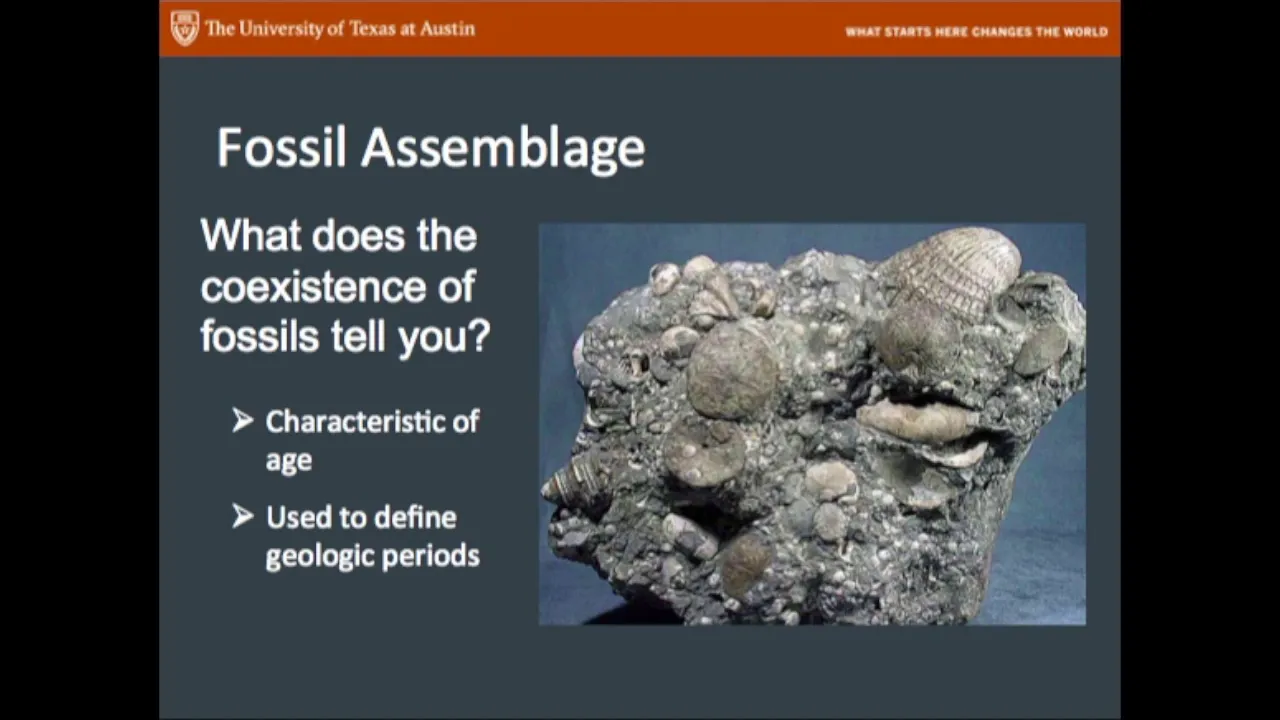
Originally geologists thought that life began at the Cambrian but later we found an abundance of soft bodied fossils in the Precambrian period. The geologic periods Cambrian, Ordovician, Silurian, Devonian, etc are defined by observations of a major change in a fossil assemblage. Something new came in, something else went extinct.
Most of the Paleozoic divisions were named for the location of the type section mostly in Great Britain, Cambria in Wales, Devonshire in England for example. Do you see a break in the pattern? Look at the Carboniferous.
It was named for the abundance of coal and other carbon rich fossils in the rocks and later it was divided into sub units based on the characteristic sites in Pennsylvania and Mississippi. Actual time on the left and millions of years ago was not determined until much later than these divisions were determined. The biggest divisions are Ian's and Men eras let's talk about geologic eras for just a minute there are four that we'll look at in detail the Precambrian which is part of the proterozoic eon the Paleozoic the Mesozoic and the Cenozoic let's hear those words again Proterozoic paleozoic mesozoic Cenozoic they all end in zoic and you know what zoology is right study of life so they're all about life Proterozoic means before life Paleozoic early life middle life Mesozoic and Cenozoic means young life now of course today we know that there was abundant life in the Proterozoic the pre life era and we'll talk about that in a bit the Proterozoic era began about two and a half billion years ago and continued until four hundred five hundred and forty five million years ago the beginning of the Cambrian so it covers about two billion years of Earth history that's almost half at the beginning of this time simple celled organisms existed the Proterozoic saw the evolution of multi-celled organisms and the first eukaryote cells those are cells with complex structures and membranes earth had continents and seas but you wouldn't have recognized the shape of the landmass masses about 1.
1 billion years ago the first supercontinent Rodinia was formed the most common fossils in the Proterozoic era are stromatolites these are masses of algae which traps sediment and end up looking like fine mount mounds they exist in the geologic records starting about 2.