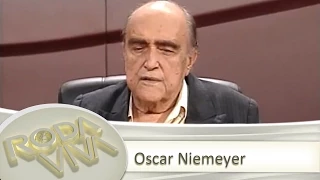
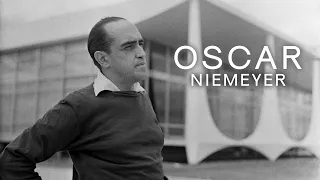
I had a dream once. I dreamt that Rio de Janeiro hadn't been occupied. <i>That the town had grown nearer to the mountains, going inland.</i> <i>And then, I went to the window and I saw the same panorama...</i> that Portugueses had seen when they arrived here. <i>That fantastic nature, all of it, the birds, the animals.</i> And the city looking at everything from far away. It would be like a paradise kept throughout times. That is the reason why once Sartre said... that perhaps the world would have been better without men. "LIFE IS A BREATH OF AIR" DOCUMENTARY FILM
BY FABIANO MACIEL AND SACHA I enjoyed drawing. I remember that when I was a child... <i>I used to draw with my finger on the air, and my mother used to ask:</i> "What are you doing?" I answered: "I'm drawing". Drawing has led me to architecture. An important moment in architecture is when the idea comes to mind. <i>For example, I work in a very peculiar way.</i> <i>Whenever I have an idea, or start to study a problem...</i> first I check what the local conditions are... <i>the economical possibilities, and so on.</i> <i>Then, I begin drawing.</i> <i>When I get to
an idea, to a solution that pleases me...</i> I write an explanatory text. If I don't find good arguments in that text... I go back to my table. <i>Once, in Brasília, it was late at night...</i> we decided to see the Alvorada structure which had been concluded. <i>When we arrived there, we were overwhelmed by its beauty.</i> It looked like a sculpture... something with no other purpose than beauty itself. <i>I told them: "See, that's the moment when architecture is born".</i> <i>The new, different, surprising form is what defines architecture.</i> <i>To us, freedom is the most important thing.</i> <i>There must
be imagination, there must be a different solution.</i> That's what is important in architecture. <i>What will stay, what has lived on...</i> <i>PALACE OF ITAMARATY aren't the small houses, very well kept.</i> <i>What has lived on are the cathedrals, the domes, the great balances.</i> ALVORADA CHAPEL Beauty is important. Take the pyramids; something that had no sense at all... <i>but they are so beautiful, so monumental that...</i> one forgets why they were built and is overwhelmed by them. BRAZILIAN NATIONAL CONGRESS If you only worry about the function... J.K. MEMORIAL the result will suck. PALACE OF JUSTICE It's usual to see
very colorful children's drawings. <i>So beautiful they could be panels. They're creative, spontaneous.</i> <i>Once they learn how to draw, they can't do it anymore.</i> The architect must know how to draw... <i>to work with figurative drawing, to loosen the hand in order to work.</i> Whenever I'm invited to do a public building project... <i>like the three buildings I've just done, in Brasília...</i> <i>I try to do something nice, different, surprising.</i> I know that the poor won't benefit anything from that. <i>But they can always stop and have a moment of pleasure, of surprise...</i> <i>by seeing something new. That way, architecture
can useful.</i> <i>Otherwise, only when there is a human, social program...</i> will architecture fulfill its destiny. <i>For now, only those who have money benefit from architecture.</i> The rest are fucked up in the slums. <i>See, that's my motto. Saw the little man up there?</i> <i>That red thing. It's written on it, "The fucked up have no rights".</i> <i>I lived in Laranjeiras, on Passos Manoel Street.</i> It was a quiet childhood. I went to a Catholic school. <i>Afterwards, there was a time of lots of euphoria, youth...</i> <i>bohemia, soccer...</i> It was as if we had come to life only to play
and have fun. <i>Later, I got married and along came the commitments.</i> My life has nothing special. Just a meaningless human being... <i>going through life, which is just a breath of air.</i> My family was Catholic. My grandpa was a Supreme Court magistrate. He had only one privilege: Attending mass at home. He was an honest man. He held office for a long time and that had great influence over me. <i>When he died, the only thing he left was the house we lived in.</i> I was still a student when I designed my first building: A house for a
doctor who was a relative of mine. I did it for free. The guy laughed a lot. "What a joke!" He thought the house was ludicrous. It was a modern house. Sometimes you have to please a person... who cannot be pleased. Obra do Berco was my first project. The director was a relative of mine. I had just finished school when I did it. I remember that that project showed where I stood in architecture. I had designed a protection with brise-soleil using some boxes... whose verticals where inclined. I traveled to Europe and when I came back the
building was done. They had thought it'd been a mistake and the facade should be normal. The sun came right into the building. Besides designing the project for free... <i>I also paid for a new facade, to correct the vertical elements.</i> It's a fact of little importance... but it shows I was an idealist. I wanted to create architecture... and felt responsible for what I did... in regards of Brazilian architecture. <i>The city of Rio de Janeiro, the capital of Brazil.</i> <i>Founded in 1565, next to the Sugar Loaf...</i> <i>it grew at the shore of the Guanabara Bay.</i> <i>Nowadays, it
has a population of two million people...</i> <i>and it has all the characteristics of a modern city.</i> <i>Where there used to be the historical Castelo Hill...</i> <i>starting point of the city, demolished twenty years ago...</i> <i>nowadays there is the new downtown Rio de Janeiro...</i> <i>the Castelo Esplanade, with modern streets and new constructions.</i> <i>I learned through life, I learned at the Lucio Costa's studio...</i> <i>Back then, when we were in college...</i> everybody wanted to work in a construction firm. But even though I was unemployed... <i>married, and short of money...</i> I chose to work with Lucio for free... because I
wanted to create good architecture. And I learned it there. I wouldn't admit doing anything that wasn't cutting-edge... LUCIO COSTA with renovation. <i>AT UNIVERSITY OF BRASÍLIA So, for almost five years I lived in an almost miserable situation.</i> People were used to coming to me when they wanted specific styles... <i>such as Renaissance, English style, French style...</i> because my former clients asked for those. <i>But I couldn't do those any longer. Once, a lady even told me:</i> <i>"I asked you for a carriage, and you are trying to thrust a car on me?"</i> I remember that when he won the
contest... <i>for the Brazil Pavilion in New York, he had liked my project.</i> NEW YORK So he invited me to go along. And there we went. <i>I spent more than a year over there, we did the project.</i> BRAZIL PAVILION IN NEW YORK DESIGN BY LUCIO COSTA AND OSCAR NIEMEYER <i>Back then, there were two different trends in Brazilian architecture:</i> One trend aimed at making a modern architecture... <i>using all the techniques available, with no restraints.</i> The other one tried to find an in-between solution. INTERVIEW TO THE DOCUMENTARY FILM It didn't make sense. "O RISCO" It was like making
a building... and then putting a small colonial window as decoration... stuff like that. An in-between architecture. <i>Gilberto Freyre, who knew nothing of architecture...</i> sometimes voiced his opinion: "A more Brazilian architecture"... That was complete rubbish. When they first talked about the hotel in Ouro Preto... Leão made a study suggesting an allusion to the old architecture... <i>the same windows, modern, but alluding to the past.</i> But Rodrigo Mello Franco and Lucio decided that... it should be something to draw a contrast. That's what I did. I designed the hotel using... <i>modern elements, nothing else.</i> <i>To protect monuments, the strategy
is to draw a contrast, not copy them.</i> Everybody likes colonial architecture. But we know perfectly well... that it is much more Portuguese than Brazilian. When I go to Europe and visit an old town... I feel better than when I visit Portugal... <i>those old villages, it seems like we are in Brazil, isn't it?</i> <i>I remember that, in Europe, sometimes they said:</i> "Your architectural past is very poor... more Portuguese than Brazilian". I said: "That's very good for us. Because while you live among monuments... we are free to create today the past of tomorrow". <i>SPEECH GIVEN BY MINISTER
The National Educational Movie Institute...</i> <i>OF EDUCATION AND HEALTH is now recording the laying of the foundation stone...</i> <i>of the future building of Education and Health Ministry.</i> The event is promising. <i>First of all, because it will be built in this beautiful city...</i> a great architectural monument... <i>whose project has been conscientiously, persistently...</i> And thoroughly studied. With the construction of this building... we will take the final step in our long effort... to organize the ministry that is in charge of finding the solution... for so many difficult problems in Brazil. Capanema's period had the effect of the Modern Art
week in São Paulo. Because he took care of our historical heritage. <i>He invited Rodrigo, who was a wonderful person...</i> who spent his life taking care of our artistic heritage... of Minas' heritage and so on. He cared for Brazilian culture. He created the Ministry of Education. That was a time of young ministers... ARCHITECT and brilliant chiefs of staff. We had Rodrigo in the Department of Education. <i>He is substituted by Capanema, who changes the chief of staff.</i> Rodrigo is out and Carlos Drummond de Andrade is in. A privileged time. Never again will we have chiefs of staff
like those. The ministers wrote really well... and the chiefs of staff were revolutionary. MINISTRY OF EDUCATION AND HEALTH <i>DESIGNED BY OSCAR NIEMEYER, AFONSO REIDY, JORGE MOREIRA...</i> <i>CARLOS LEAO, LUCIO COSTA AND ERNANI VASCONCELLOS...</i> BASED ON A DRAFT BY LE CORBUSIER. The most significant event... Was Le Corbusier project for the Ministry of Education. Because it showed the people and the rulers... what contemporary architecture was. It showed the reason for the pilotis... <i>for the brise-soleil, for the glass facade, all that.</i> <i>For the project of the Ministry, Capanema was persuaded...</i> most likely by Carlos Drummond de Andrade... to invite
Lucio Costa to do the project. And what does Lucio Costa do? He invites other modern competitors. None of them knew exactly how to do that Ministry in a real modern way. All of them were convinced of modernity... but they didn't master its language. DESIGN BY JORGE MOREIRA TO THE MINISTRY OF EDUCATION AND HEALTH So Lucio insists on calling Le Corbusier. DRAwlNGS BY LE CORBUSIER <i>He was here for 20 days, no more than that. Too little time.</i> In such little time... not even Christ in Jerusalem worked so many miracles: <i>Changed local architecture, drew the world's most
important building...</i> <i>and made Oscar into a genius. He was not, a least Lucio didn't know.</i> Le Corbusier arrived with the self-assurance of a boss... he saw the project designed by Lucio and decided to do a new one. <i>He presented a solution, Lucio accepted it.</i> <i>On that occasion, Lucio made me his assistant...</i> To help him with the drawings. FIRST DESIGN DONE BY LE CORBUSIER <i>Le Corbusier changed the project, and did it low and long...</i> with the minister's office facing the Sugar Loaf. That was not feasible: Capanema was in such a hurry... that he asked Le Corbusier
to drop that plan... the first was to be built on a municipal site. The other site belonged to the Ministry. <i>The day before flying away, Le Corbusier...</i> did a sketch for the building on its nowadays location. <i>He did it unwillingly, reporting in a letter that it was no good...</i> <i>that the project wouldn't work well, and leaves.</i> The team coordinated by Lucio works for a year and a half... <i>in the mean time, the paper story happens.</i> I found the first design better. <i>I don't know why, one day I made an outline using the first design.</i> I
changed the building direction... and made the street pass below it. <i>Leão liked the idea. When Lucio arrived, Leão said:</i> "Oscar designed a plan that I believe it's good". Lucio asked to see the paper. Since I never thought... <i>I could influence anything, I had thrown it out the window.</i> He told me to go get it. That's the first thing about Lucio that made an impression on me: His generosity. He liked the design and said: "This is the one". <i>Well, our architecture is very different from Le Corbusier's.</i> We evolved to an architecture that has more to do
with our weather: <i>It's lighter, has more hollowed surfaces, more empty space.</i> We gave him the same contribution he had given us. <i>We were influenced by him, but his last works...</i> were also influenced by our architecture. I am not the one who says it. <i>Ozoenfant, who was his partner...</i> mentioned it in his biography: <i>"Le Corbusier, who for many years...</i> Had praised the virtues of the right angle... suddenly began to think differently... following a very talented architecture that came from abroad". And there is no doubt that... POET Oscar's architecture... is brought forth by Le Corbusier's architecture in
its basic elements. Nobody invents anything from scratch. That is not true. Culture is heritage and transformation. <i>What is extraordinary is that he, in fact...</i> learns the lesson from Le Corbusier and soon after... he is already creating something which is... <i>the denial of the fundamentals of that architecture, you see?</i> Everybody knows the story of the UN building. Who really won the contest for the UN was Niemeyer... not Le Corbusier. The head office of the UN in New York... Oscar won it. The building is an Oscar project. That doesn't diminish Le Corbusier. It only shows Oscar's talent.
<i>He didn't go there with a project of his own, he did at the hotel...</i> because the president of the contest committee asked him to: <i>"Oscar, you must present a project.</i> You can't come here without a project". He went to the hotel and designed one. <i>UN HEAD OFFICE, NEw YORK</i> They chose my project for the UN building. <i>In my book, there is a photograph of all of them hugging me.</i> Here is how the project was: Le Corbusier had designed a tall block over here. The building was here. The space was parted in two. In my project...
I put the block here... separated the Councils from the General Assembly... put the Councils here and the General Assembly here. My intention was to create the United Nations square. My project was the winner... but Le Corbusier came to talk to me the following day... and asked me to put that building here. There would be no square. But I realized he wanted his project to be built. He was the master. I said: "No problem". I don't regret it. His project was number 23... <i>mine was 32, and we presented the 23-32 project.</i> <i>I mean, that's what is
built there.</i> <i>There were small changes later, but if you look at the ground plan...</i> my project with the change proposed by Le Corbusier is what's built there. For the first time after a historical period... we are gathered together around a project... whose execution will allow us to present the world... with an optimistic and clear architectonical solution. We are of different ages. The younger ones from the drawing studio and their masters... form an exceptional and unique association. <i>When I look back, I think it was good. I was young and generous.</i> <i>Sometime later, I had lunch with
him in his flat.</i> He kept looking at me and said: "You are generous". I thought: "This guy is thinking about that morning... when I agreed to change the position of the block". <i>Before designing Pampulha, I went to speak to J.K.</i> He told me he was going to build a new district in Belo Horizonte. <i>PAMPULHA YACHT CLUB A district with a church, a casino...</i> a club and a restaurant. PAMPULHA CASINO BALLROOM <i>when we finished talking, he told me: "Listen...</i> I need the casino project for tomorrow". <i>I was young, a beginner...</i> it felt like my first assignment.
I had to accept it. <i>I went back to the hotel, and worked all night long.</i> The following day I was there. <i>He realized he could go fast with me, right?</i> That's why we worked together. Brasília started at Pampulha. My intention in Pampulha was to create a different architecture. <i>Back then, architecture was very...</i> It did not quite understand nor translate the reinforced concrete. <i>Architecture was rigid, as if it were done with metallic structure.</i> Concrete was just the opposite... it suggested a new field of experience and invention. I tried to introduce the curve into architecture. We wanted
to impose the curve: Concrete's natural solution. Whenever one has a large space like that... <i>the natural solution is the curve, not the straight line.</i> So I covered the church with curves. ST. FRANCIS OF ASSISI CHURCH Architecture became something new... more connected to our country... <i>something lighter, resembling the old churches of Minas Gerais.</i> Ballroom... <i>one of the facilities, I did the marquee in a curved shape as well.</i> Architecture became more plastic... <i>a novelty, an invention, like Le Corbusier used to say.</i> This architecture generated lots of doubts... and discussions. But soon after everybody understood that... reinforced concrete
was the material of the times and we should use it. That's when a very intelligent Frenchman... who worked with Le Corbusier said: "Ll faut faire chanter les points d'appui". <i>That is, it is necessary to make the supporting points sing.</i> I gave more emphasis to the structures. <i>Around the attractive Lake Pampulha...</i> <i>a few minutes drive from the center of town...</i> <i>a new residential district is being built...</i> <i>in the traditional way of the mineiro. According to plan.</i> <i>Already in operation is the Yacht Club, with its magnificent swimming pool.</i> <i>Across the lake, at the Pampulha Casino...</i> <i>mineiros can
dine, dance or watch a small floor show.</i> <i>If they prefer, they can go to a more popularly priced ball...</i> <i>and dine and dance at the open pavilion.</i> The casino has a slight touch of Le Corbusier... <i>the church is completely Brazilian, a bit baroque...</i> and the most important thing is the popular ballroom. Oscar decided to include that in Juscelino's program... The casino was for the rich... a church is a church and they would not accept it for many years... <i>the club was for the bourgeoisie, so he created a ballroom, a tiny island.</i> It resembled a streamer
you throw up in the air... <i>an goes like that, so it looked like Brazil, Carnival, people, baroque.</i> It's that small building... that changed the image of Brazilian architecture around the world. The small one. "A house made by Oscar was the family dream. COMPOSER There was this piece of land near Iguatemi... <i>there was the sketch, a gift from Oscar...</i> There was the promise that one day we would live in Oscar's House. <i>I grew up full of impatience, because my father...</i> despite being the owner of Ipiranga Museum... never had savings enough to build Oscar's House. <i>I ended
up going to a boarding school in Cataguases, designed by Oscar.</i> I lived for six months in that big house made by Oscar. Not enough. I decided to become Oscar himself. <i>Later, I dropped architecture and became a Tom Jobim apprentice.</i> <i>When I create a good song, I think it sounds like a Tom Jobim song.</i> <i>In my mind, Tom's music is Oscar's House".</i> It is not the right angle that attracts me. MILTON CAMPOS SCHOOL Nor the straight... <i>hard, inflexible line created by man.</i> LATIN AMERICAN PARLIAMENT what attracts me... <i>is the free, sensual curve.</i> The curve I find
in the rivers of my country... <i>SUPREME COURT ANNEX in the clouds up in the sky, in the body of my favorite woman.</i> ASA SUL (SOUTH WING) BRIDGE All the universe is made of curves. The curved universe of Einstein. BOAT-TO-BUS TERMINAL My architecture is not a solution for all architecture. It's just my architecture. If we agree that there is not... <i>modern and ancient painting, but just good and bad painting...</i> The same happens with architecture. Everyone should find their own way and do what he or she likes. NIEMEYER BUILDING I must confess I'm tired of talking about
architecture. Because it is the same conversation... <i>over and over, the questions are the same.</i> More important than architecture is protesting in the streets. That is the important stuff: When someone feels good... <i>and believe they're not a piece of shit, that they can be useful.</i> People must think about politics. Politics are important. It is life itself. <i>One must think about poverty, and must try to help.</i> When one feels that everything is too horrible... <i>and hope has faded away, then it's time for revolution.</i> <i>Architect Oscar Niemeyer...</i> <i>receives the Lenin Peace Prize...</i> <i>awarded by the Soviet Government.</i> <i>The
Russian Ambassador gives him the prize...</i> <i>and praises Niemeyer's work.</i> <i>The artist receives the medal handed to him by a Russian representative...</i> <i>as a tribute to the culture of our country.</i> I joined the Party in 1945. when the guys were released from prison... <i>Prestes went to my office, some comrades...</i> I put fifteen of them in my office. <i>I listened to that conversation, that struggle, that enthusiasm...</i> that abnegation. I lent the house to Prestes... where he created the Metropolitan Committee. And things went on. <i>I remember that when I went to Moscow, many years ago...</i> <i>it was the
time of Stalinism, a teacher there asked me:</i> <i>"Dr. Niemeyer, what is your opinion about the Soviet architecture?"</i> <i>I answered: "I side with you in the political aspects, peace...</i> <i>BULGARIA 7O's and so on, but I've no answer to that.</i> Your architecture is very bad". He said: "Show us your criticisms". <i>I said: "I didn't come here to criticize, but since you asked...</i> The columns here are too close to each other... too thick for the space that exists between them... <i>circulation is bad, and ventilation is bad".</i> <i>So, in our relationship with the Left...</i> <i>we had to be fraternal,
but telling the truth.</i> IBIRAPUERA PARK AwNING BIENAL PAVILION <i>MONTEVIDEO, URUGUAY</i> wRITER It's well known that Oscar Niemeyer... hates capitalism... and hates the right angle. <i>Against the right angle, that offends the space...</i> He has done an architecture... as light as the clouds... <i>free, sensual...</i> that looks a lot like the landscape... of the mountains of Rio de Janeiro. Mountains that look like naked women lying down... women designed by God... on the day God thought he was Niemeyer himself. Then I designed this house. I looked for a piece of land with a view. <i>I wanted a simple house,
small, fully adapted to nature.</i> And I designed it as I wanted: As simple as my way of life. It is well integrated to the space. I did not change the landscape. <i>The rooms are downstairs. Upstairs, the living room and the kitchen.</i> A friend of mine gave me some seedlings... and they just grew in a natural way... without much strict control. <i>After the house was finished, Gropius showed up for a visit.</i> <i>I showed him the house. When he was leaving, he said:</i> <i>"It is a beautiful house, but it is not multipliable".</i> <i>I thought it was funny,
such a rubbish...</i> in the lips of such a great man. There was nothing to be multiplied. It's a unique piece of land. The house was built to that specific site... How could that be multiplied? But I found it funny. Stupid stuff has always been said. It's not new to us. We didn't invent rubbish. It has always been around. <i>Bauhaus was a paradise of mediocrity, as Le Corbusier used to say.</i> The fellow learned how to draw something... <i>a dinner service, for example...</i> and that was established with a series of rules... that they had to follow. <i>Architecture
has nothing to do with that, architecture is invention.</i> Of everything I got from Le Corbusier... the most important was something he told me: "Architecture is invention". <i>I understood that later, by reading several books. When I first read...</i> that French poet... <i>I can't remember his name now. He said that invention, that awe...</i> is the main characteristic of a work of art. <i>In my architecture, in what I do...</i> my first worry is to do something different. <i>I want people to stop there, surprised to see something new.</i> Baudelaire. One of the basic definitions of the new architecture... BOAVISTA
BANK in the beginning of the 20th century... is the exclusion of the other arts. <i>The wall, the panel, let's say the inside of a building...</i> <i>is beautiful in itself, in its proportion and functionality.</i> There is no need for anything else. PAULO WERNECK'S PANEL But Oscar starts using glazed tiles and murals. <i>He includes the artist, the painter, the sculptor...</i> That's part of his rebelliousness too. ATHOS BULCAO'S PROJECT <i>In my work, I have always invited artists, painters, sculptors.</i> I did that on my first assignment in Pampulha. Architecture cannot be seen as something isolated. PORTINARI'S GLAZED TILES when
the architect creates a project... <i>ITAMARATY'S INTERIOR when he draws a wall, he is already wondering whether...</i> <i>ATHOS BULCAO'S PROJECT that wall will bear a painting, a whitewash, a stone wall...</i> ATHOS BULCAO'S GLAZED TILES or a sculpture. Artists shouldn't come later to put the painting wherever they want to. OUR LADY OF FATIMA CHURCH Of course there are influences. Even in literature. There is this guy who wrote... the influence of... <i>I must give up speaking for today. I might forget Camões, damn it.</i> - I've been forgetting names... - Oh! That is normal. But I even forget the
name of the guy next to me. <i>The other day, talking to them, I couldn't remember Mies van der Rohe.</i> <i>- That's too much. - Once, I was autographing...</i> <i>a book of mine, and there came an engineer who had been mayor of Rio.</i> - I can't remember his name. - Passos? <i>What? No, a guy our age, from our generation.</i> - Tamoio. - No. - There are lots of engineers... - He came with the book and I said: "I forgot your name". He got so pissed off! <i>- Well, politicians... - So he told me his name.</i> <i>Brazilians
no longer thrive on the sand like the crabs.</i> <i>Brasília, a magnetic pole in Goiás...</i> <i>is the answer to two centuries of that customary practice.</i> <i>Brasília, already a provisional city of ten thousand people...</i> <i>built by private initiative...</i> <i>with investments that exceed 500 million cruzeiros...</i> <i>is one of the great works of this administration.</i> Juscelino came here and called me. We went downtown together and he said: "My intention is to build a capital. A different capital. I don't want a provincial capital. <i>I want something beautiful, that shows the greatness of our country".</i> <i>That was good, we started working.</i>
<i>At first, I thought Brasília was too far, but then I got used to the idea.</i> Juscelino's willpower was so strong... that everybody started thinking everything would fine. <i>Brasília was some adventure, full of problems and misunderstandings...</i> the lodgings were primitive... <i>But J.K. Didn't lose heart, and the project went on.</i> Juscelino often finished working at Catete... wRITER next to here. <i>He finished at 6 PM, got on the plane...</i> <i>at Santos Dumont airport, arrived in Brasília around midnight...</i> <i>inspected the building sites, at 6 AM he flew back to Rio...</i> and at ten he was back to work at
Catete again. It was a very hard time. Brasília was not welcome. <i>The whole press was against it, in São Paulo and in Rio as well.</i> "Rio de Janeiro will be over..." "Rio de Janeiro will mean nothing..." "Let's go to Brasília!" It sounded like a threat. <i>"I am not going to Brasília, nor me, nor my family.</i> <i>Not even for a load of cash, I will leave Copacabana".</i> To encourage people to go to Brasília... <i>not only civil servants, but other people as well...</i> <i>to populate Brasília, there was the double pay:</i> <i>Servants who accepted to go, received a
double pay.</i> So Billy Blanco wrote this song: "Not even to be loaded with cash... I'd rather be a poor old beggar without leaving Copacabana". <i>In one of the IAPI buildings there is a fully decorated flat...</i> <i>with all the requirements of modern comfort.</i> <i>All flats under construction will be like that one.</i> <i>Sometimes I went by plane, a DC-3. It could land anywhere.</i> But that took three hours. I remember one day... I was having lunch with the president... when he said: "When we finish lunch... you must come in the helicopter with me to inspect the building sites.
<i>If not, I will have you arrested".</i> <i>So I went in the helicopter with him, we flew all over the city...</i> and I was at ease. It was said that whenever a helicopter... has any kind of problem... <i>it lands naturally, with that control propeller.</i> <i>But once I was back on the floor, I talked to the pilot and he said:</i> <i>"The other one is much safer, this one falls down if it has to".</i> When I went to Brasília... I took fifteen architects with me. <i>But I also took a doctor, an engineer, two journalists...</i> <i>five friends of mine
who were in a shitty situation, in need of a job...</i> and I felt that was my chance to help them. And I hoped our talks in Brasília could be diversified... not only about architecture. <i>I wanted life to be more pleasant, more fun.</i> <i>We had a good time, we went out, did not take things too seriously.</i> <i>We had stories to tell, it was a joyful and entertaining group...</i> That is how life should be. Let's make things clear. Life is about laughing and crying. We must enjoy the easy moments while we can and have fun. And learn
to bear the other moments. Life is a breath of air. <i>While we worked there, we went to the same night clubs...</i> <i>the construction workers did, everybody dressed the same.</i> We even had the impression that society would improve... that men would become really equal. Since we Brazilians were being able... MOVIE DIRECTOR to build our new capital... a capital with special characteristics... all designed by Oscar Niemeyer and Lucio Costa... with an aesthetic thought... a completely different city planning thought... <i>focused on the modern, the new...</i> <i>wow, then we were also able to do all the necessary to change
Brazil.</i> That was the whole idea: Change. Moving the capital to Brasília meant changing Brazil. <i>No way. After inauguration, there came the politicians...</i> <i>the businessmen, it was all the same shit:</i> <i>The class struggle, the power of money...</i> <i>the business intrusion, everything that's still there today.</i> <i>J.K.'s dream, he used to say...</i> was to bring progress to the countryside. That was done. <i>BRASÍLIA, CAPITAL OF HOPE</i> <i>The joy of the worker Is seeing Brasília's inauguration</i> <i>The president at the Palace Smiling at the workers</i> <i>I am happy</i> <i>Among the working class</i> <i>I let myself go I wear myself out</i> <i>Night
and day</i> I tried to give more relevance to architecture and its structures. MINISTERIAL BUILDINGS I valued the engineer's work. <i>In Brasília, whenever a structure was finished...</i> architecture was already there. <i>I mean, architecture and structure are things that are born together...</i> and should be made more meaningful together. BRAZILIAN NATIONAL CONGRESS <i>when Congress was ready, the structure...</i> The architecture was already there. The small details dropped to a secondary level. I like that project very much. It is very simple. It enlightens what has to be enlightened... what is more important: The House and the Senate. I wanted the
roof to be leveled with the avenue. It's easy to explain: When people arrived... <i>I wanted them to see the Three Powers Square, where Congress is.</i> If you want to emphasize the architecture around a square... you must leave the square empty. Because then you look around... <i>THREE POWERS SQUARE and see the different buildings, the connection among them.</i> You feel how that square is important. Sometimes in Brazil... The mediocre face of people come up to complain: "Why can't the Three Powers Square have any vegetation? Why all this sun?" we're compelled to explain what should be intuitive: <i>"Because
it's a civic square, it's something different...</i> one must emphasize architecture". Can you imagine San Marcos square if we filled it with trees? <i>What would happen? Lt'd be shadowy, but the square would disappear.</i> All that artistic work. People want everything explained. Active mediocrity sucks! <i>We had long discussions, even though we were short of time.</i> <i>I remember that one day, Cardoso, a poet...</i> <i>a very bright guy, phoned me and said:</i> "I found the tangent which will allow the House dome... to look as if it barely touched the floor". <i>So, I tried to make the palaces barely touching
the floor...</i> with thin columns. <i>In the Palace of Planalto, the columns were like this.</i> Since I wanted the people who walked between them and the building... <i>felt protected, I made the columns always like that.</i> PALACE OF PLANALTO <i>The other building had similar columns, only they were lower.</i> Here they're three meters apart. Here just one. So they were like this. I remember the lack of understanding. <i>Once, a journalist in São Paulo asked me:</i> <i>"Dr. Niemeyer, you always talk about a different architecture...</i> so why did you make these columns similar to the other ones?" I said: "If
you knew what unity was... you wouldn't be asking that question". There used to be... <i>FEDERAL SUPREME COURT a connection in the past. If you go to Paris, the heights are the same.</i> The windows are the same. That's what we call unity. <i>In architecture, unity...</i> is when the elements that compose a whole are plastically connected. The Alvorada. I tried to do a different column. I did not want a parapet... nor anyone stuck to the parapet. I wanted the columns to follow an unusual rhythm... so that a visitor would either be above or below the column. And
the column worked very well. PALACE OF ALVORADA I see that column in lots of places... I saw it once in Greece. <i>One day, I was at the beach and when I came out of water...</i> I saw a building with Alvorada columns. That column made Brazilian architecture be known. <i>Then there were the other buildings. For example, the Cathedral.</i> I didn't want a cathedral like the old ones. <i>CATHEDRAL I wanted a cathedral that could express concrete.</i> <i>And even though I'm not a Catholic, I pondered...</i> A person in the nave should be able to see the infinite space.
I looked for a connection which is meaningful for the Catholic: <i>The connection of the nave, of earth with heaven.</i> I remember that an emissary of the Pope went there... and was overwhelmed with such a good idea. <i>Later, we placed the stained glass windows, which are very beautiful...</i> but we left a space so that the eyes could look up to the sky. The first time I went to Brasília by plane... <i>we went with the militaries, and I sat next to marshal Lott.</i> On the way he asked me: <i>"Niemeyer, our building is going to be in classical
style, right?"</i> I smiled at him and answered: <i>"At a war, what would you prefer, an old weapon or a modern one?"</i> ARMY'S GENERAL HEADQUARTERS HISTORIAN I think Niemeyer belongs to... an enormously important generation in Brazil... <i>which to some extent reconstructed, built in their own mind...</i> <i>and for the benefit of the public, the idea of what Brazil could be.</i> The new Brazil. <i>This generation, which is extraordinarily interesting...</i> <i>very influential in literature, in non-fiction, I mean...</i> <i>in history, in creating an image of Brazilian history...</i> which begins to be influential in music and architecture too. SETTING BY OSCAR
TO THE PLAY There's an overlap between... "ORFEU DO CARNAVAL" all these things. <i>In some way, for instance, Jobim began as an architect...</i> and gave it up for becoming a musician. In some ways the image of what people imagine... <i>their new country to be, the Brazil of future...</i> is the one created by this generation of the 1930s. <i>We saw each other, musicians, movie directors, theater people.</i> It was the same gang. We used to go to the same places. And architecture was included in that too. So much so... that Vinicius invited Oscar to create the setting of
"Orpheus". Vinicius and Tom went to Brasília... during its construction and composed the Brasília Symphony. <i>Everything was together: Music, poetry, literature...</i> Everything was happening at the same time. <i>Architects Lucio Costa and Oscar Niemeyer.</i> <i>The first was in charge of designing and coordinating urban planning.</i> <i>The second was responsible for the architecture.</i> <i>Technicians as well as artists...</i> <i>they're deservedly admired all over the world and...</i> <i>compose with lines, volumes, colors and spaces the Brasília symphony.</i> Brasília was born from one's primary gesture of marking a place... <i>to take possession of it. That is, the sign of the cross.</i> The city
of Brasília is based on the Athens Charter. <i>The same system of isolated areas: Work, lodging, and so on.</i> It has advantages and disadvantages. But Lucio did it with so much feeling... he managed to obtain something very difficult: He created the housing areas... <i>with a simpler, cozier architecture...</i> <i>and created the monumental area with that axis, as required by a capital.</i> One million inhabitants. More than one million inhabitants. Is there room for anybody else? No. <i>Nevertheless, people like you keep on coming, from all over Brazil.</i> <i>And it's fair. The future is here, in the Central Plateau.</i> <i>We
from social care, we take care of you...</i> and we guide you. We shelter all the families. <i>Well, it can't be here, in the heart of the city.</i> Brasília should stop. It has reached such a point of demographic density... that nothing should be added to it. No more apartment blocks should be built in Brasília. <i>The real estate speculators want to change the gauge, it'll be chaos.</i> <i>If they construct higher buildings, and create new housing areas...</i> the city will suffer the same degradation of Rio and São Paulo: <i>Crowded streets, everybody tense for not being able to move
around...</i> unemployment... <i>Cities shouldn't grow spontaneously, without control.</i> They should stop and then multiply. That is the correct urban planning point of view. Brasília is at this point. It should stop growing. There should be a green belt around it. And then... <i>other cities, that are already growing, should form around it...</i> all guided by the same idea that they should not grow indefinitely... because that is the problem of the big cities. <i>In Brasília, guests arrive at Palácio dos Arcos...</i> <i>monumental work by Niemeyer. They come to a marvelous party.</i> <i>Around tables decorated by Burle Marx, more than a
thousand guests...</i> <i>pay homage to first lady Yolanda Costa e Silva...</i> <i>who is sponsoring the fashion show by French stylist Pierre Cardin.</i> <i>Cardin was as successful as one could expect and told the press...</i> <i>he wants to create not only for the elite, but also for the people.</i> <i>And even for men. And Brasília, in this charming evening...</i> <i>has also been made capital of the fashion world.</i> There came a moment when I had to choose. <i>There had been a military coup, and they started to screw me.</i> They wanted me to resign. I knew I couldn't work anymore... but
they didn't have the guts to fire me. I decided to go away. And thus they made me a favor. <i>They wanted to shut me up, but by letting me go...</i> they allowed me to show my architecture overseas. <i>ALGIERS, ALGERIA</i> UNIVERSITY OF SCIENCE AND TECHNOLOGY OF ALGIERS I went to work in Algeria. I was very happy. I realized one can find sympathy anywhere in the world. <i>In general, men are good.</i> <i>When I arrived in Algeria, Boumedienne was the president.</i> He was in a state of euphoria due to the victory of the revolution. He told me: "You
are going to be my architecture consultant". <i>And I worked there, I made a study for Algiers.</i> I designed the University of Constantine. <i>CONSTANTINE, ALGERIA</i> <i>Constantine, for example, was a university...</i> with twenty-two buildings. I proposed seven. I designed a building for the all the classes... a Science building... <i>the library, the auditorium, the restaurant...</i> <i>and the administration building, which was a high one, ok?</i> CONSTANTINE UNIVERSITY I turned a university of 22 buildings... into one of six. And it works pretty well. Spaces became more generous. I tried a pretty radical change. <i>This building, for instance, is very long.</i>
It's 300 meter long and the columns are 50 meters away from each other. So this wall here... <i>must be stronger in order to support those spans, right?</i> <i>When the French firm examined the project, they said:</i> <i>"It's great, but the wall above the columns must be...</i> <i>1 ,5O meter thick". Our engineer made it with 30 centimeters.</i> The French had said that the construction was infeasible. ENGINEER That's the word they used: Infeasible. <i>I got the blueprint, studied it for one or two days...</i> and presented a solution to that infeasible between inverted commas. Then the French said at
the meeting: "That we can do". <i>And the Algerian: "what do you mean, you can do that?</i> <i>First, you say it's infeasible, then a Brazilian comes around...</i> show us a solution and you decide you can do it?" <i>Moral of the story, the Algerian said:</i> <i>"You can do it alright, but the Brazilian is going do it".</i> We traveled around Europe showing everybody that Brazil is good... <i>that we are no Indians, that Latin America must find its place...</i> that we know the stuff. <i>With time, by working...</i> we end up creating our own principles... that we follow. And one
always thinks different from the others. One's work is something personal. One sits down and comes to a solution. <i>Sometimes, it is not necessary to think a lot.</i> ALGIERS MOSQUE I remember when I had to design a mosque in Algeria. <i>ABORTED PROJECT I was in bed, ready to sleep...</i> But thinking about the mosque. It came to me that the mosque could have a circular shape. <i>I went on thinking, got out of bed and drew it.</i> <i>That was it, the mosque was created when I was half-asleep.</i> <i>PARIS, FRANCE</i> <i>Afterwards, we went to Paris. The Party's building, for
example.</i> I created a curved building. But I wanted to be ready to answer to any question. <i>In order not to leave an empty space, those are the accesses.</i> The auditory had a big dome. I did not want the dome to occupy much of the space. <i>So, the building is like that, here is the site...</i> <i>and the dome is below it, only a piece of it shows.</i> <i>HEADQUARTERS OF THE COMMUNIST PARTY - PARIS, FRANCE</i> And I explained to them something they had forgotten: That's really important the connection... between volumes and free space in architecture. It's essential.
<i>OSCAR NIEMEYER SPACE LE HAVRE, FRANCE</i> Havre: The funny thing is that the square is very big. The size of the square is four hundred by four hundred. I got there and said: "I want to lower the square". <i>They asked: "Lower the square?" Complicated, right?</i> But I said: "I want people to see the square from above. I want to protect the square from the wind". They understood and the job was done accordingly. <i>Along the square, I created a series of buildings:</i> <i>A theatre, a cultural center...</i> And since they are buildings that can be closed... <i>the result
was a different, more sculptural architecture.</i> I did not want to interfere with the city architecture... <i>which is simple, but important.</i> <i>After there, I went to Italy.</i> <i>I worked with Mondadori, another great character.</i> <i>He wanted something beautiful, different. He made a palace.</i> It is a palace and the arches are different. <i>MONDADORI PUBLISHING HOUSE MILAN, ITALY</i> <i>In architecture, when we draw an arch...</i> <i>not only the arch is important, but also its internal space.</i> It's like Rilke used to say: "When you see a grove... not only the trees are important... but also the space among them". So I
made those arches with different internal spaces. <i>One with a span of 15 m, another with 9 m, another with 6 and so on.</i> It was something that had to do with music. An Italian engineer came to me and asked: "Can't we do them all with 8 m span?" I said: "No". This thing of reason being the enemy of imagination is fantastic. <i>We do not want a correct architecture, which works well.</i> <i>I mean, all architecture has to work well.</i> <i>When I designed the headquarters of Mondadori, I made a palace...</i> <i>Later, when he wanted a building in
downtown Milan, he came to me.</i> <i>If the headquarters hadn't worked, he wouldn't have come.</i> They liked when I designed the Party's headquarters. <i>Ten years later, they decided to build the L'Humanité...</i> and asked me. Do you think that if it hadn't worked they would call me? <i>Nobody is stupid, right?</i> <i>NEwSPAPER L'HUMANITÉ PARIS, FRANCE</i> <i>Once I was abroad, upset, far from everything.</i> <i>I kept thinking about Brazil, my friends, my family.</i> I was so mad I made a poem and put it on the wall. It went like this: "I'm far away from everything Everything that I like From
that beautiful country That saw me be born One day I'll get burnt Set my foot on the road It is there in Brazil That I want to live Everyone in their place Everyone in their home Playing with friends watching time pass by I want to look at the stars I want to feel my life deep It is there in Brazil That I want to live I'm really pissed off This cold never ends Of hearing so much crap I can't hold much longer One day I'll get burnt Leave everything behind It is there in Brazil That
I want to live This doesn't suit me Doesn't suit me at all I have made my mind Nobody can stop me Fuck this crappy work Fuck this shitty world It's there in Brazil That I want to live" There was a house with many rooms in the Conde de Lage street. <i>For a long time, my studio was there.</i> <i>But things changed along time, it's become a prostitution zone.</i> <i>And the square turned into a brothel, as it was meant to be.</i> I remember being a kid and walking around that area. It felt good to see those free
women... <i>almost naked, around the streets.</i> <i>The bar at the corner, the guy playing the guitar...</i> we used to drink beer there. <i>My studio was always like that, a bohemian milieu...</i> but that didn't interfere with work. We were young. Sometimes we would close the studio and make... a kind of Modern Art week there. We played a little. Rio has suffered a lot. <i>Nature is rebellious, but accepts everything.</i> If they had built Barra... <i>instead of increasing the center, and had preserved the old Rio...</i> <i>Old Rio, I'm not being nostalgic, but the old Rio was better.</i> <i>We used
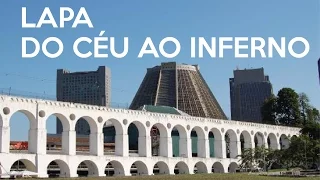
to walk around its streets, Ouvidor Street, Goncalves Dias...</i> There was the tram; one could read the newspaper in the tram. <i>We had Lapa, one could go and have fun there.</i> It was different and more humane... Downtown was very nice. I'm ashamed to go to Barra. <i>It's sad, because the real estate speculation influenced it a lot.</i> All the buildings have balconies... although nobody uses them because it's too windy. But apartments with balconies sold better. The buildings are ugly... <i>big squares, one against the other.</i> It's Miami. A Miami suburb. There's even a Statue of Liberty. <i>I mean,
we go to Barra and see that connection...</i> that American pressure over us. <i>That Bush is a damn son of a bitch, isn't he?</i> He said he could trade half of Brazilian debt for Amazonia. We hear that and nobody protests. THE LAND IS OURS TOO what fill us with enthusiasm nowadays is... LANDLESS wORKERS' MOVEMENT the landless and homeless movements. Their struggle in the countryside... defending a land that should've been theirs a long time ago. <i>I designed some monuments, and they're all protest monuments.</i> The first one was for "No more torture". I designed a monument... with a
human figure stuck here. <i>Later, I created the monument...</i> for the three workers assassinated by the military in Volta Redonda. We built the monument... <i>and on the day of the unveiling, they went there and exploded it.</i> <i>I went back there, rebuilt the monument, left the scars and...</i> the workers stood there for 3 days watching over it. There it remained. MONUMENT TO wORKERS I was invited to do a big job in the United States... so I went to the consulate. A lady there said: "There's no visa for you". <i>I said: "why not? Is it personal?" "Yes, it's
personal".</i> I said: "You know what? That makes me happy. If after twenty years you deny me a visa... It means I haven't changed". WRITER One has to be faithful to principles... <i>not to tactics, political strategies, the rise to power...</i> nothing to do with that. I said principles and we can't renounce our principles. Niemeyer didn't renounce them and I don't congratulate him for that. I don't congratulate Oscar for not renouncing. I don't thank him either... because that is simply an expression of his very humanity. I believe he is a person at peace with himself. And to
be at peace with oneself is not easy. We live in a world of contradictions and tensions. The bottom line is we live under a storm. And keeping the course... <i>in the middle of this storm, with winds blowing from everywhere...</i> is something Oscar managed to do. <i>I find optimism ridiculous, it doesn't take us anywhere.</i> <i>We don't want nihilism, but we want a realistic life...</i> <i>within the possibilities. It is hard, but that's what's there.</i> <i>Just think of Sartre, the most pessimistic of them all.</i> He used to say all existence is a failure. <i>But he fought for Cuba,
he cared...</i> he was a great writer and enjoyed life. He said he had money in his pocket only to give alms to the poor. <i>That's it, that's life.</i> <i>Do you believe, according to...</i> SARTRE IN SAO PAULO what some say around the world... that Fidel Castro has distorted the purpose of Cuban Revolution? Jean-Paul Sartre will hold a press conference today... - Only to the viewers... - He is very tired. Jean-Paul Sartre believes that Cuban Revolution... is following its natural course... and that is the only course it should have. And everything Fidel Castro is doing is completely
correct. - Long live Cuban Revolution! - Statement by Jean-Paul Sartre... <i>at his arrival in São Paulo, at Congonhas airport...</i> where he was greeted by local intellectuals... And members of the new generation. During one of the many times I went to testify... they asked me: "Dr. Niemeyer..." <i>they had put me in a dark, closed room...</i> a sound-proofed room. I was answering their questions... a black lad at the typewriter. At a point the other guy asked me: <i>"Dr. Niemeyer, what do you people want, anyway?"</i> <i>"We want to change the society". So, the guy said:</i> <i>"Type that, change
the society". So the black lad...</i> <i>who probably wanted a better life, turned to me and said:</i> <i>"That's gonna be tough, huh?"</i> SAMBODROME <i>Carnival in the sambodrome is magnificent, wonderful.</i> <i>The women are beautiful, they dance, they swing, it's great!</i> That facility has many good characteristics. <i>For example, under the stands, Darcy built schools.</i> <i>When Jack Lang, the Ministry of Culture of France visited Rio...</i> he was surprised by seeing schools under the stands: "Schools under the stands? What a great idea!" He was delighted. And that had been criticized. INTEGRATED CENTER OF PUBLIC EDUCATION I had to work with
prefab material... <i>the finishes are very simple, but we could work fast.</i> That's a project that takes education to the whole state. One must be a scoundrel to criticize that. <i>I don't usually go out, but I went to one of those society gatherings.</i> I sat there and after a while the living-room was full of people. <i>Everybody dressed up, beautiful women...</i> <i>wearing lots of jewels, everybody showing off...</i> <i>speaking loud, every one trying to impress more than the rest.</i> <i>I found that disgusting, so I left a note to my friend and went home.</i> <i>We need to have moments
of leisure, of joy, but not by witnessing...</i> how the Brazilian bourgeoisie is stupid. <i>This tendency to see things only on the bright side, at Carnival too...</i> they don't give a damn to the poor on the slums... but when they dance in the streets... it's to please the bourgeoisie. SCULPTURES AT LEME BEACH FORMER PRESIDENT OF PORTUGAL whenever I go to Brazil... and visit Rio de Janeiro I dine with Aparecido de Oliveira... and Oscar Niemeyer... in a restaurant near Copacabana. <i>One of the last times I went there, some years ago...</i> <i>I went to the other side of
Rio, to Niterói.</i> The mayor of Niteroi told me something extraordinary: It was Oscar Niemeyer who chose the site where to build that museum. He said: "I want the museum to be here". The mayor hesitated: "Do you really think this is the place?" <i>"Yes, it is here, period. It's here".</i> They all went to a steak house and on the very paper... <i>which was on the table, he took his pen out...</i> and quickly drew the museum that is standing there today. That masterpiece known everywhere as MAC. <i>He did it like that, with four lines.</i> NITERÓI CONTEMPORARY ART
MUSEUM Then I designed Niteroi museum. <i>It was a nice spot, the mayor wanted something spectacular.</i> There was this hill... a piece of land spreading over the sea. <i>Incredibly enough, it's a very simple project.</i> <i>The building was to be here, the sea was here...</i> It would go over the water... <i>so it had to be something light, in order not to disturb nature.</i> So I designed it like that. <i>The Sugar Loaf, and all that landscape are seen below the museum.</i> <i>It's a well-thought museum, it is circular.</i> And I made a balcony all around... because that view is
a magnificent spectacle. The visitor admires the view from here and the museum is here. And the museum was successful because... I tried to avoid the practice of hanging paintings onto panels. <i>The guy here, looking at the painting here.</i> <i>I wanted to recover the old museum, with paintings on the wall.</i> The emphasis is on the painting. There are no loose panels in the museum. The walls were built in such a way that... paintings and sculptures can be shown in an intelligent way. Then I designed a ramp that is like a stroll around architecture. <i>It comes this
way, goes back and forth.</i> Oscar is a militant man... all his life actively committed to fighting for social equality... and changing society. <i>Nevertheless, when he produces architecture...</i> what he wants to give people is beauty. The joy of the beautiful form. That's what he wants to give people. Because he knows how important beauty and wonder are. He says: "I want people to be in awe". BANCO DO BRASIL CULTURAL CENTER Anyone who sees the Statue of Liberty says: <i>"New York", but it is not beautiful because of that.</i> The Eiffel Tower is beautiful and we say "Paris". Both
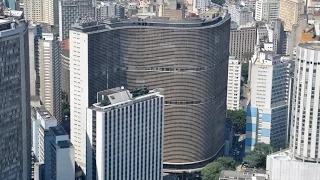
are emblematic. <i>The Christ is Rio, although it is not a masterpiece of sculpture.</i> But Oscar is able to create a masterpiece that has... the emblematic power that certain forms have. <i>Thus, you identify the city, the country, the soul, the moment...</i> even history with Oscar's form. That's why... whenever a soap opera wants to show... <i>that a story takes place in Rio, they film the Christ.</i> COPAN BUILDING But if they want to show that it's in São Paulo... the helicopter flies over Copan. Oscar has the amazing ability to create a form... in such a way that that
form becomes the symbol of a place. We all have a hidden being within us... who leads us to one way or the other. <i>Mine is this one: He likes things, he likes women...</i> <i>likes having fun, likes to cry and worries about life.</i> <i>He is a complicated fellow, isn't he?</i> LEONEL MIRANDA RESIDENCE But we are not fully responsible for our qualities and flaws. <i>The person is born white, black, yellow, blue...</i> <i>rich, poor, intelligent...</i> So we must accept people as they are. <i>Whenever I see a grown-up, I always say:</i> <i>"It is like a house, we can paint
it...</i> <i>fix the roof or the walls, but if the design is no good...</i> it will always be defective". NIEMEYER WAY UNDER CONSTRUCTION I get anxious when I'm alone. <i>I need to get busy: I write, draw, I do anything.</i> <i>I can't sit still. And I am curious, I want to know about stuff.</i> This is important. Everything is connected nowadays. I am a pessimist. I follow the line... of the old pessimists. I think life is a minute. <i>Human beings are completely despised, they're born and die.</i> Men must look up to the sky and realize that they're small...
<i>that they must be modest, and nothing is important.</i> <i>Life is a breath of air, one minute. I see no reason for all this hatred.</i> I believe everything will disappear. Cosmic time is way too short. <i>The other day, I was asked: "Doesn't it please you to know...</i> that in the future some human being will see the work you've done?" In the future that human being will disappear as well. It is the evolution of nature. Everything starts and ends. The time during which anything can last is relative. <i>I'm an optimist when it comes to the world getting
better, not humanity.</i> OSCAR NIEMEYER MUSEUM we have to get adapted to the world we live in. Laughing and crying all the time. What's left to us is to fight for a better world... is to achieve equality... and make life more decent to everyone. That should be the thought of a normal person. <i>Now, facing life, you look up to the sky and feel amazed.</i> It is a fantastic universe that humiliates us... and we cannot enjoy any of it. We feel amazed by the force of human intelligence... Human being were born just like any other animal... and
now they're able to think. In short they'll be among the stars... talking to other human beings... of other galaxies. <i>At the end, the answer to all that is simple:</i> <i>Was born, died... got fucked.</i> What gives you pleasure nowadays? <i>The most important is women, right? The rest is a joke.</i> <i>The interview is over, isn't it?</i> Don't you agree? <i>"In the end of 2006, at age 99...</i> Oscar Niemeyer got married for the second time".