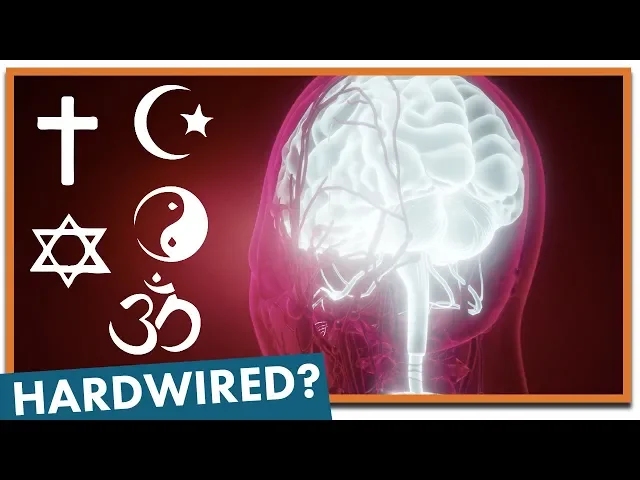
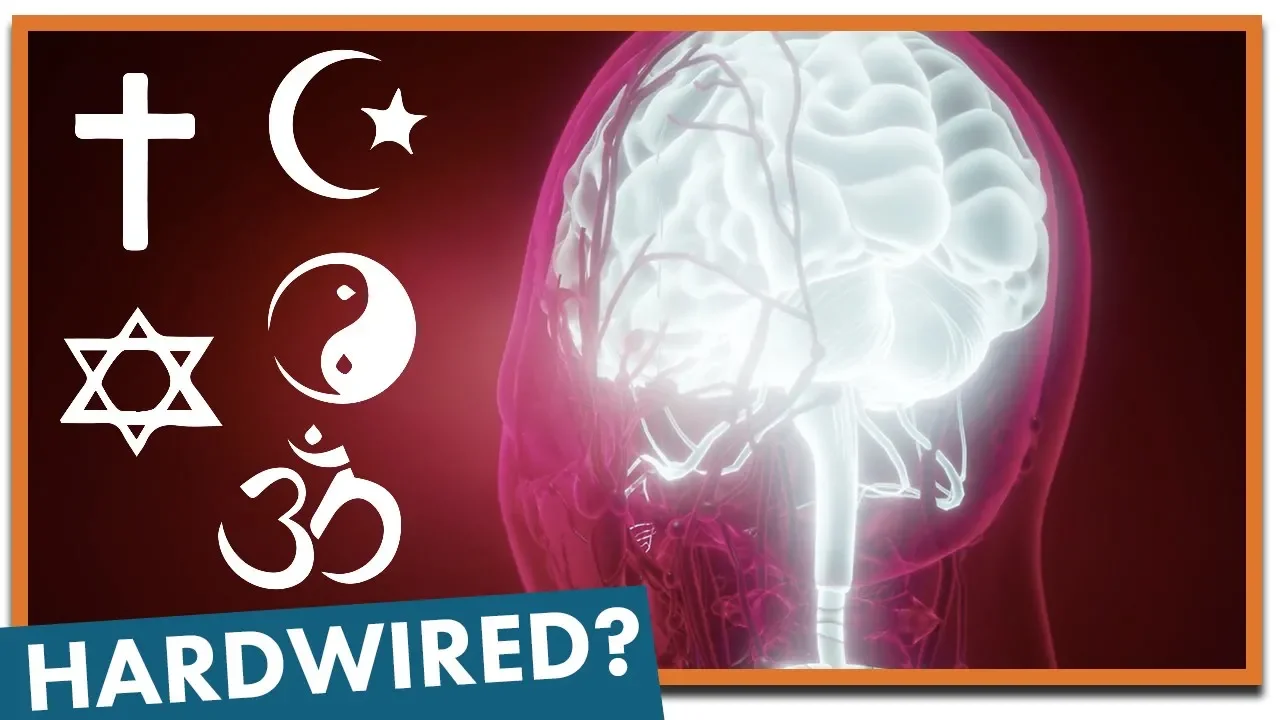
is religion biologically hardwired today we'll consider one theory that says it is but we'll also consider some shortcomings of that theory it's called hyperactive agency detection device or had the fancy name for a human's innate tendency to see agency intention or personhood in the world around us even when agency intention or personhood is ambiguous or might not even be there so here are some examples you hear a branch snap in the woods and you immediately think that someone is following you you awake in the middle of the night and you see a shadow looming over
you it must be a ghost or a demon turns out it was your coat rack a breeze slams a door shut and you whirl around because you think someone's behind you but no one's there these are had experiences the uncanny feeling that someone else is there with you it's an instinctual response developed through our evolution as a species as our species evolved in prehistoric times it was to your advantage to be overly cautious to avoid predators to be overly sensitive to every sound or every image in your peripheral vision because those who had a hypersensitive
or shall we say a hyperactive sense of agency detection would avoid being eaten by that saber-toothed tiger stalking you in the woods so if humans evolved a hyperactive sense of agency detection a sense hardwired into the brains of homo sapiens everywhere what are the implications of this if we apply it to religion well some evolutionary psychologists see this theory as the explanation for the origins of religious beliefs and supernatural beings hyperactive sense of agency detection plus our ability for abstract thinking equals the building blocks for more complex religious ideas about the existence of invisible agents
gods spirits or ancestors that live on after death if so religion is hardwired into the very cognitive structures of our mind but does this theory hold any water let's get into it the psychologist justin barrett is one of the main proponents of this theory here's his thesis part of the reason people believe in gods ghosts and goblins also comes from the way in which our minds particularly our agency detection device functions our agency detection device suffers from some hyperactivity making it prone to find agents around us including supernatural agents given fairly modest evidence of their
presence this tendency encourages the generation and spread of god concepts like i said earlier he defends this thesis by pointing to how we evolve to deal with predators if you're possibly being stalked by a predator over detection matters way more than under detection if you under detect a predator you get eaten if you over detect a predator there's really no downsides besides the occasional jump scare so our minds must have evolved to over detect so how did our ancestors make the leap from invisible predators to invisible supernatural gods proponents of this theory say that the
jump from predators to gods is because humans not only hyperactively assume that there is something out there during a hat experience but humans also developed a tendency to anthropomorphize everything in the world around us assuming that there is intention or personhood at work when we experience unexplained motion and the natural world justin barrett writes cognitive scientists have demonstrated repeatedly that from infancy movement that looks self-propelled and goal-oriented activates thinking about objects as agents and further can trigger attribution of mental states beliefs desires and sometimes even personality and social roles so a door slowly creaking open
a branch falling out of a tree barrett argues that our ancestors blamed invisible human-like agents for these unexplained motions this is not a new theory ironically charles darwin himself theorized about the anthropomorphizing of invisible agents in the descent of man though with a little bit more racism he explains that savages believe that natural objects and agencies are animated by spiritual or living essences for the same reason that his pet dog barks at an umbrella blowing in the wind his story goes as it was every time that the parasol slightly moved the dog growled fiercely and
barked he must i think have reason to himself in a rapid and unconscious manner that movement without any apparent cause indicated the presence of some strange living agent so in some way modern scientists are reviving a very old theory the anthropologist stuart guthrie the pioneer of this field argues that humans over assume the existence of human-like intention in the natural world now of course it's impossible to psychoanalyze early humans to confirm this but archaeologists have inferred that our ancestors tens of thousands of years ago would anthropomorphize basically everything the archaeologist stephen mython an expert on
the evolution of the human mind argues that the late pleistocene and early holocene hunter-gatherers ascribed personhood to objects and animals based on archaeological evidence such as humans being buried with animals and cave paintings with half-human half-animal creatures which suggests that our ancestors viewed the natural world in social terms okay so we've been relying on archaeological data and evolutionary anthropology but critical to this theory is that hyperactive agency detection and anthropomorphizing the natural world is hardwired so does neurology corroborate this well some scientists seem to have located the part of our brain that's responsible for this
here i'll be referring to a study by lasanna harris and susan fisk published in the journal social cognition harrison fisk set out to confirm if there's a neurological basis responsible for our propensity to anthropomorphize objects and the natural world in general using an mri machine they scanned the brains of their princeton university undergraduates they found that two parts of our brain the superior temporal sulcus and the amygdala activate when the test subjects were anthropomorphizing objects while in the machine this is interesting because the superior temporal sulcus is responsible for social perception the processing of eye
gaze where somebody's looking the processing of hand or lip motion as you're talking to somebody the processing of biological motion it's responsible for everything our brain needs to interact socially this part of our brain is also responsible for our sense of agency predicting the consequences of actions and as well as our ability to predict and discern intention of other agents so what are the implications of the study our brains on a subconscious level treat non-humans as social agents and that there must be a neurological basis for hyperactive agency detection now for some counter-arguments and shortcomings
of this theory because there are some dr mark anderson a scholar of the cognitive study of religion isn't quite convinced while this theory provides a convincing evolutionary explanation of how such a bias may have developed it does a poor job at explaining how the perceptual system encompassing this bias actually operates this underspecification is not a trivial matter because it makes it difficult to make detailed predictions about when false positives of agents are supposed to arise in human minds basically it's a plausible origin story but it doesn't provide a mechanism for how it's supposed to work
how the jump from predators to gods actually happens anderson argues that experiments have actually found the opposite that religiosity predicts agency detection if you are more religious you're more likely to blame supernatural agents for had experiences if you believe in paranormal activity you're much more likely to blame a ghost or a demon for that sound behind you than when compared to a skeptic person so here is where i put on my durkheim hat i'm convinced that religion is primarily a social construct something that humans do in groups and create together as an obligation to the
community hyperactive agency detection does a poor job explaining why some concepts of god or gods endure for millennia from generation to generation it can't really explain why humans intentionally anthropomorphize objects instead of subconsciously anthropomorphizing objects such as intentionally carving figurines and statues of their gods these are cultural practices and i think the social sciences are better equipped to explain these phenomena than neurology jonathan lanman a cognitive anthropologist at queen's university belfast agrees little evidence supports the claim that the had is an important cause of general religious beliefs despite a number of empirical explorations rather the
most potent causal factors in determining whether or not an individual acquires general religious beliefs appear to involve cultural learning mechanisms so how we are socialized explains our religious beliefs we get our beliefs by the people around us in u.s politics you're much more likely to be a republican or a democrat if you live in an area surrounded by fellow republicans and democrats you're more likely to believe certain supernatural beings if your parents believe them or your community believes them in any case in the words of my friend and colleague john bulch who is an expert
on this had is clearly important for the story of religion but there is still work to be done to understand the way it interacts with cultural and social dynamics it's interlaced with culture in a much more complex and interesting way than just being a misfire a misfire of false positives when there's a noise behind you hyperactive agency detection might provide evidence for a cognitive default for humans belief in supernatural beings but we should be careful to not over commit to this theory because it has some serious shortcomings explaining how this process actually works i've only
scratched the surface of this topic so if you'd like to read more or check my research i'm putting a ton of articles in the description below as always thanks for watching and subscribing and i'll see you next time you