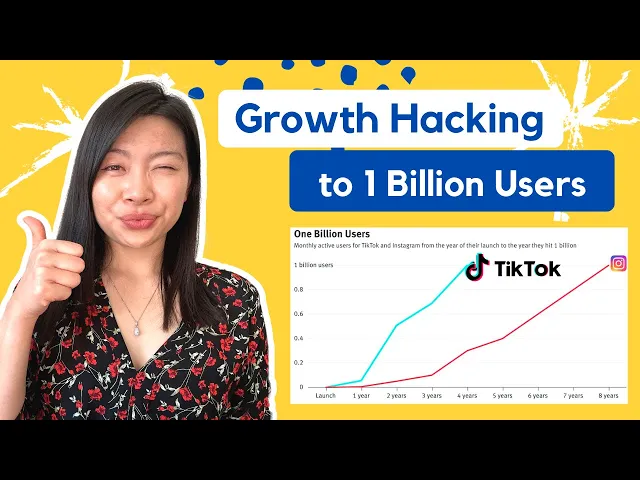
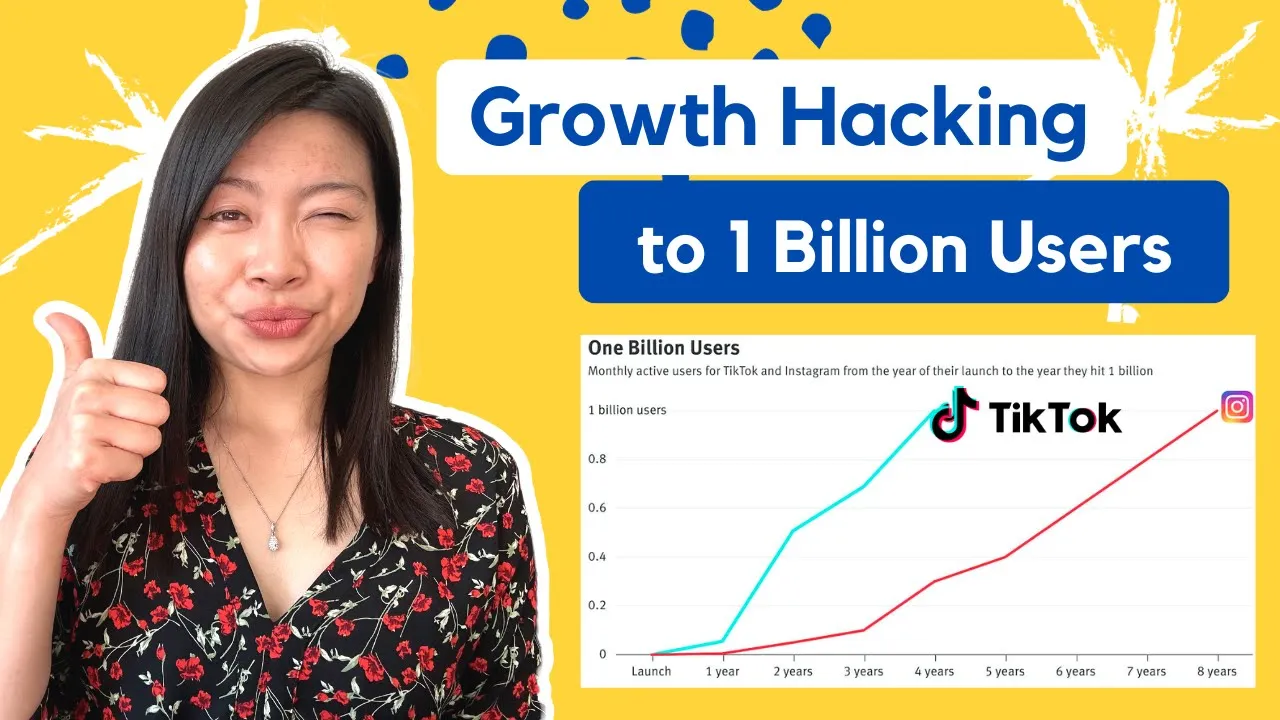
growth hacking has helped companies like Facebook and Tick Tock grow to millions of users in a very short span of years so in this video we're going to uncover eight product growth tactics that are going to help you grow your product to millions of users starting with the foundations or the first principles of growth hacking secondly we're going to dive into a framework for growth and third we're going to talk through some examples so you know exactly what I'm talking about so let's talk through some statistics to show you how certain companies really Unleash the
Power of growth so if we look at Facebook as an example in around less than a year they grew to over a million users and around six years they grew to 600 million users another great example is Tick Tock where in less than five years they overtook some of the most famous social media apps including Instagram Etc and grew to a billion users over a billion users so sure there was a lot of virality going on for these social media products but also a lot of product growth tactics that you might not have even noticed
so we're going to be talking about some of those hidden product growth tactics that you might have been targeted for but not even notice you fell for it but first we're going to start off with first principles of product growth that you need to know even before you start your growth efforts with number one is start with product Market fit before you start growing hence you might ask what in the world is product Market fit even well qualitatively product Market fit is when you have a size of population that needs loves wants and is obsessed
with your product but you might ask how do I even measure that well a survey is a great way so surveying a ton of your customers to get a generalizable population that says they need your product could be a good way to give you the indication that your product has a market a great example is an email product called superhuman where they help optimize your email tools so that you could spend less time answering emails and more time doing real work and the CEO rahuvora talks about how he was able to use a survey basically
ask the question to his users how sad would you be if you couldn't use superhuman tomorrow and it kept building certain features and iterating and after building those lot of features you would ask that question again and as users reported that they would be more sad or more users reported they would be sad the more confident that Rahul had that he had something that had product Market fit quantitatively how could you measure if you have product Market fit well if you can show in the data that you have users still using your product after X
days that is a good sign scientifically we would call that looking at retention curves and having a non-zero retention rate after X number of days on the x-axis is the number of days on the y-axis shows you the percentage of users that are still using your product and here are some examples of good retention curves and some examples of bad retention curves basically users signing up and forgetting about the product or the product is not useful anymore after a certain number of days common question that people ask especially product leaders is well what's a good
retention rate and here if you just Google online there is no Benchmark that sits across all but I have found some useful benchmarks from some leaders in the growth World such as Andrew Chen who say that if you're able to hit greater than a 30 retention rate after a year that's a pretty good number again it'll depend on what type of product you have so here's a couple of examples of different mobile apps and their retention rates again on a Blog article showed by Andrew Chen so the combination of qualitative and quantitative understanding and measurement
of product Market fit will give you some semblance whether you have it before you start growing a second principle foundational growth hacking is growth is a game of inches sure some experiments you run on growth will leave you with one percent of a jump and you might look at it and say that's so insignificant that didn't work not necessarily why because of a couple of principles basically it seems tiny but with the compounding Effect one percent on top of one percent on top of one percent will give you ginormous gains over time or another effect
that comes in play here is the synergistic effect that the combination of different growth tactics will basically equate to the sum ending up to be greater than the individual components and what's important about growth is that you're trying to learn the levers through experiments that work and don't work and hence some things will give you one percent some things will give you five percent and you're basically testing these different levers so that in the future you're able to understand the effects and what size the effects have and the third first principle of growth is balance
is key which means you don't want to give up long-term success for short-term wins so imagine this in the short term any product team can spam its users to try to increase engagement and Views Etc but in the long term these users might have a bad perception of the brand and stop using the product or they might be so annoyed with the product that they entirely disengage and yes I'm looking at you Zillow I've unsubscribed to your newsletters so many times and I am still getting emails to the point that I've had to put them
on my block list so that's an example where spamming will lead your users to disengage completely which is again not good for the long term let's dive into the eight growth tactics that I want to share with you today and we're going to separate them into three different categories the first being increase in conversion the second being targeting and the third we're going to talk about content and visuals so the first bucket around increasing your conversion starts with shortening the funnel what does that mean one example I like to show here is the infamous or
rather famous Tick Tock most mobile apps will ask you to sign up first before you're able to get any value from the product and I remember finally that my first experience of tick tock was not that instead they delivered me the value first which was they allowed me to see and peruse the content so that I understood what value I was getting before I gave any value to the company which was signing up with my personal information and from that I remember being more enticed to sign up because I was excited to then get more
personalized content so what is this tactic actually it's basically removing the number of steps it takes for your users to complete the action you want them to take because think about it the more steps you add in there for them to complete that action the less likely they're going to do the thing that you want them to do so make the process easier for them and how would you do that you'd map out the funnel of the different steps it takes to complete the action you want them to do whether that's purchasing something whether that's
engaging with the video you would identify amongst the steps what is the largest drop-offs and then ask yourself do you really need this step for example if you were asking users to sign up and let's say one of your steps is asking them for their social security number me as a company I would ask myself do I really need this information for the users to accomplish a task or for me as a business again in benefit probably not and if for some reason you actually did need the social security number say you're the IRS and
if the answer is yes it is necessary the the fourth thing you want to do is can you make this step easier perhaps for example some people don't have their social security on hand but maybe there's some service that you can link them to which automatically Imports your Social Security number so as you can tell growth is basically a set of experiments which is all about learning what levers work and what impact they have if you're curious about experiments and want to see a video comment below with your questions and I'll look to create maybe
a future video on experimentation tactic number two we'll talk about is setting smart defaults so an example have you ever donated to Wikipedia so I always donate to the Wikipedia Foundation when asked because sometimes they'll sign out these campaigns and I've noticed the astute for donations instead of a fill in the blank they've given me a preset default choices ranging from five dollars to ten dollars to twenty dollars Etc another example have you gone to a restaurant recently where they use a point of sale system and when they swivel around that tablet for you to
pay a tip they give you options of 15 20 25 for you to choose rather than previously what existed where one you had to write it on paper but it was a fill in the blank that you then had to figure out how much to give so these smart defaults if you looked at the data have allowed users to engage more with the product because making a decision is just easier so what is this tactic basically when users are asked to make a decision have preset defaults that's a good balance between the user's interest and
your business interests and why I emphasize this balance is because a product can have defaults that skewed towards the product's interest which then disengages users so imagine we talked about the Tipping and instead of the 15 20 25 a business could show a default of 25 40 and 50 percent and because those numbers go out of the usual range that users would tip users seeing that might then decide to not tip at all another example where defaults have really helped me stick to a product is TurboTax so the first time you use it they saved
my information and then the next years it just became easier to file my taxes because all that information was safe hence because of that I will probably stay a TurboTax customer for a number of years though I feel like they are definitely taking advantage of that because this year they decided to charge me for certain features that in the previous years were free how would you use this tactic because basically start with mapping out the funnel and understanding where are their key user decision points and where of those decision points are their drop-offs then secondly
you go look at the data to understand well in these key decision points what our users usually choosing if it's currently fill in the blank today what are the most common things that people are choosing to select or even not looking at the data you might ask yourself as a product team what are defaults that you would select that's a fair balance between what users want and what our product team wants and we know from high school test taking days how much easier multiple choice exams were than fill in the blank the third tactic is
saving unfinished progress so have you ever done some online shopping and you've spent 30 minutes an hour shopping adding a bunch of things into your cart then either accidentally or you exit out of the website because you forget that you were on it then when you come back all the things in your career gone so you did all that work and you're much less likely to do that shopping experience again to put things into the cart versus companies like Sephora have really understood this and it's that every time I have shopped in Sephora for a
while and so don't forget about the website and exit my whole browser when I go back to the website they'll have the things that I put into my cart ready for me and this is even if I'm not logged in I believe so that way when I go back to the Sephora website I can start on where I left off hence what is this tactic here if people abandon a part of the flow and they leave the website make sure to save their progress so for example if a customer is signing up for this lengthy
form for example I worked at a company where we're helping companies incorporate their businesses that is pretty lengthy and a lot of times people will leave in the middle but we help them save their progress so that when they came back they were able to jump back into where they left off which made it easier and more likely for them to not go to a different service and you can go even one step further and follow up with the users over email to remind them where they left off and to start I didn't include this
here but there's a bunch of growth tactics around social validation what drove a lot of these social companies and this is a very powerful bucket in itself that have gotten users to take certain actions if you want a video on this comment below and let me know what questions you have the second bucket of growth tactics that I talked about was to do with targeting so this is targeting the right people at the right place at the right time so my tactic number four on this list is to use behavioral versus demographic targeting so an
example the last year I was shopping for a winter jacket and I landed on Dick's Sporting Good chose a size was about to check out but decided not to because I wanted to keep it in the car to see if there's anything cheaper and I noticed after doing that whether I was on Instagram or some news app I was seeing that same jacket as an ad yes it's creepy and it almost seemed like this cookie or whatever it was was follow me around but it's highly effective you can imagine I wasn't bothered by it and
I noticed it did lead me to want that jacket even more and to go back to Dick's Sporting Good again to see if I should buy it so what is this tactic doing if people take certain user actions which is then defined as a behavior then Target them this is as opposed to demographic targeting which is more like oh if there's a 35 year old mother Target those specific people hence how do you want to do this first you want to identify certain user actions that are the most correlated or closest to the tasks that
you want users to complete in the example I gave with Dick's Sporting Good it might Target users who have chosen a size and are about to check out but it might not Target users who are just perusing through different listings and the Second Step it would then find people who are taking those user actions and targeting them with messages or in this case it was an ad across the internet that way it would nudge them towards completing certain actions of course here there's a fine balance we talked about that foundational principle of balance you don't
want to be spammy or super creepy or take too much information from a user tactic number five is the right placement so have you ever noticed recently when you've booked a flight on an airline right before you check out they will ask you do you want travel insurance do you want car rentals hotel bookings the whole night do you want this travel vacation package basically they're selling you all these other services that are related and in context with the thing that you were doing which was booking a flight which totally makes sense because when you're
booking a flight you'll need to do those things anyways so what is this tactic it's basically putting the things you want your users to accomplish in context or that's complementary to something else that they're already doing tactic number six is targeting users at the right time you have no idea how important this can be so for example so I've noticed in the mornings YouTube is more likely to show me meditation yoga videos versus if I log into YouTube at night it'll show me more music videos why this is because previously most times when I go
onto YouTube I'm searching for yoga meditation breathing videos so they've learned that at that time of the day those are the type of videos that I am most engaged with and hence this leads me to engage with the product even more so what is this tactic it's basically showing users things at times when they are most likely to complete the action you want them to take so something like this you might not necessarily know off the top of your head you can rationalize so for example when people are at work maybe they're not likely to
book a flight or maybe they are because we're trying to find distractions during work so hence you might not Target them during the work day to book a flight but show them that at night a third bucket of things is to test content so have you ever noticed Those ads at the bottom of certain websites that are pretty clickbaity they'll Show some photo of Sometimes some grotesque thing and then have content like guess what happened to this person after they did X or show some celebrity dramatic thing or you've most likely have seen news headlines
that seem almost over dramatic or more innocently has there been a time where you've noticed yourself opening up an email that was not relevant to you at all but because it had your name you're more likely to open it so this all comes with the power of content and here the tactic is content is hugely important on the action that you're taking so when you create content that's more urgent or shocking or creates this what we like to call curiosity graphs and this is actually what we're taught when we're creating our thumbnails creating a heading
that's attention grabbing of course I'm not devising product teams to create things that are clickbaity but rather realize the power content has and design it so it does provide a good ratio between value and informational but also has some elements of it that lure people in so what are some ways you can do this for example a couple are you can make your call to action more urgent you can lead with aspirational text rather than telling users what they should do you can guide people to the next step and hand hold them making it easier
for them to accomplish the action you want them to do personalize emails with names or any type of personalization people love and lastly localize the content of their language so it increases their comprehension of what you're trying to tell them the last tactic we'll talk about I would say might be even more powerful than content is visuals for example Airbnb what learned early on that photos was hugely important in getting its customers to book places and knowing this Insight it actually sent photographers to people's homes to capture the photos for them because we know us
trying to take a photo when we're not professionally doing it might be lackluster but what is this tactic well we know that visuals capture people's attention and hence leveraging that to show visuals that really resonate with users and what you're trying to get them to accomplish it doesn't necessarily have to be the most cinegraphic but using visuals that either speak to a pain point or shows a customer aspiration anything that perhaps resonates with them could be a great way for them to then engage with your product so in this video we talked about eight growth
tactics that you can use to grow your product to millions of users well how might you add a multiplier effect with this well you'd want to combine it with growth marketing strategies so here's a video on six effective growth marketing strategies that you can use to continue to grow your product to millions of users and I will see you guys in the next video