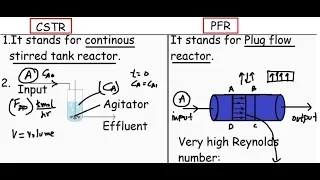
I'm going to present a brief overview of plug-flow reactors and what are some of their important properties and why we might use them, and so I've drawn a representation. Essentially we're going to take a tubular reactor and model it as a plug-flow reactor. So what we have coming in is a molar flow rate of A, so this is moles per minute for example and we'll call that F_A0 for the inlet, and then leaving we have a different molar flow rate because is A is reacted.
The way we model this for this change due to reaction is that we have a plug that's essentially moving through the reactor. It does not interact with the material in front of it, it does not interact with the material behind it, but just moves along and so it looks the same as a batch reactor that spends a certain amount of time and indeed the equations for a plug-flow reactor are equivalent to the equations for a batch reactor. So it's similar to a batch reactor and what this means is that each plug has the same history, same temperature and pressure history, and it also means all molecules spend the same time in the reactor.
This is particularly important when we compare a plug-flow reactor to a CSTR where in a CSTR molecules don't all spend the same time in the reactor. So when we look at modeling this, we'll use volume as our independent variable and say volume is 0 at the inlet and at the outlet, volume is the total volume in the reactor. So the concentration profile, we're going to assume for a plug-flow reactor that we have no radial gradients.
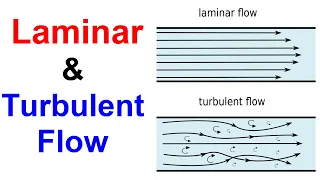
This means no radial gradients in concentration, in temperature and in velocity, so that means if we look at a plug-flow reactor the velocity near the wall, same as the velocity here, the same as here and so we have a plug. This is in contrast to a laminar flow reactor where the velocity would be low near the wall and get bigger in the center and again lower near the wall in a parabolic flow. It turns out plug-flow reactors are not a bad approximation to a laminar flow reactor.
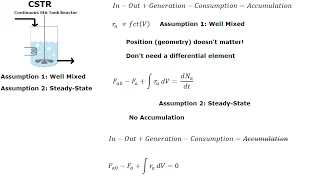
This is a plug-flow reactor, this is a laminar. In order to write down the mole balance for a plug-flow reactor, we look at a differential volume, and we have flow rate in and the flow rate leaving is different because of reaction and we write a mass balance, accumulation is in minus out plus generation due to the reaction. We're interested in steady state, so accumulation is 0.
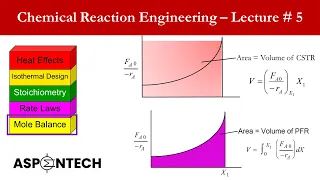
We're going to do a balance on one component, so that's A in this case, in minus out. And the generation is some rate of reaction in this differential volume so the rate of reaction is per volume, so we multiply by the differential volume and this simplifies to the change in the molar flow rate with cumulative volume is r_A where r_A might be k, concentration of A raised to some power. What we're not going to do is write it this way, because remember the molar flow rate is the volumetric flow rate times the concentration.
This is moles per minute, volumetric flow rate for example, Liters per minute and concentration in moles per liter. We're not going to do this because the volumetric flow rate changes. It changes because the temperature changes, because the pressure changes and because the moles change.
Namely, if A in the gas phase reacts to form 2 mol of B in the gas phase we increase the number of moles. This changes the time in the reactor. Now there are other ways we can write this mass balance, the change in the flow rate with respect to z, and I'll just bring the cross sectional areas so the equation otherwise is the same, or I could write it in terms of the cumulative amount of catalyst, the weight of catalyst.
So I'll write this r_A prime because now units of mol/min for example, per kg of catalyst on both sides of the equation. In addition to solving the mass balance we'd also have an equation for energy balance, an equation for pressure and we could write a mole balance for each of the species in the plug-flow reactor. So why would we use a plug-flow reactor?
So here's when we use a plug-flow reactor: large quantities of material so we're continuous, and therefore in large quantities we want to do it continuously at steady state. Certainly has an advantage if we don't have to worry about maintenance, there's no moving parts. Plug-flow reactors typically contain catalyst.
Now the fact there are no moving parts also means that mixing can be poor. This maybe a concern depending on the particular process and sometimes we can get around that by having static mixers in the plug-flow reactor, but certainly the catalyst causes mixing much more so than a tubular reactor without catalyst. The other concern is hot spots.
Namely as we move down the reactor and the rate gets faster, exothermic reaction, the temperature increases and we have a potential for thermal runaway, and we can decrease the potential for this by using smaller diameter tubes and therefore increasing the heat transfer rate, and a shell and tube system, just like a shell and tube heat exchanger, with catalyst in the tubes, heat transfer fluid on the shell side is one way that this is compensated for if we have an exothermic, very exothermic reaction. So this is just a brief overview of plug-flow reactor and some of the things that are important in plug-flow reactors when we might use them.