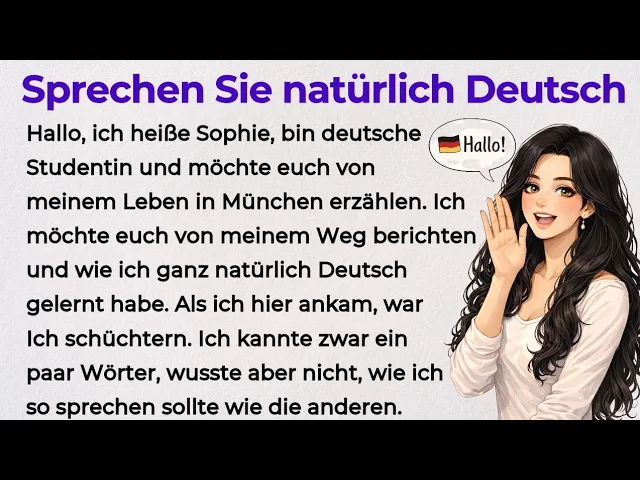
Hi, my name is Sophie, I'm a German student, and I want to share my life in Munich with you. I want to tell you about my journey and how I learned to speak German naturally. When I first arrived here, I was shy.
I knew a few words, but I didn't know how to speak like the others. But I found a way to learn. Let me tell you my story.
When I arrived in Munich, it felt like I was entering another world. The city was bustling, and people were always in a hurry. I had seen Munich in movies, but I found myself in the middle of a busy street, with car horns honking and people speaking German.
It was impressive. I held my bag, feeling small among the towering buildings. I had dreamed of coming here for a long time, but now that I was here, I felt lost.
I had studied German in my home country, but it wasn’t the same as at school. I learned grammar rules and vocabulary lists. I could write sentences and pass exams, but speaking was different.
When I heard people talking around me, I had difficulty understanding. They spoke quickly, with different accents, and used expressions I had never seen in my textbooks. Even when I recognized words, I didn’t always understand their meaning.
Together, it felt like everyone was speaking a secret language I didn’t belong to. I moved into a small apartment that I shared with another student named Clara, who came from Spain. She spoke a little German, but we often faced the same problem of being surrounded by Germans and not knowing how to speak naturally.
We helped each other when we could, but most of the time, we stayed silent, afraid of making mistakes. The challenge was going to the bakery. I wanted to buy some bread, but I was scared to speak.
I entered a small bakery near my apartment and grabbed a German baguette. When I reached the checkout, the cashier said something, but I didn’t understand. I looked at her, feeling my face blush.
She repeated more slowly this time: “Do you want a bag? ” I finally understood, but I was too nervous to answer. I just nodded and smiled at her as she handed me the bag, but I felt embarrassed.
Why was it so hard to say one word? The next day, I decided to explore the city. I took the subway, but it was complicated.
The announcements were in German, but they were too fast for me to understand. I watched others trying to figure out what to do. I hopped on the train, hoping I was going in the right direction.
At one station, a man asked me, "Excuse me, do you know if this train goes to my destination? "' I panicked because I understood the words, but I didn’t know how to respond. I had to find a way to use German in everyday life.
I had to listen more, speak more, and stop being afraid of making mistakes. The next morning, I decided to challenge myself. I would go to a café and order something in German.
It seemed simple, but for me, it was a big step. I entered a small café near my apartment. The fresh smell of coffee filled the air.
The waiter smiled at me and said, “Hi, what would you like, dear? ” My heart started to beat faster. I had practiced this moment in my head.
I took a deep breath and said, “I would like some tea, please. ” The waiter nodded. “What kind of tea?
” I wasn’t prepared for that question. My mind went blank, and I looked at the menu, but the words no longer made sense. Instead of speaking, I simply pointed at a name on the menu.
The barista looked at it and said, “Ah, green tea, good choice. ” I nodded quickly. After paying for the tea and drinking it, I felt relief and disappointment.
I spoke, but I didn’t really have a conversation. When I left the café, I thought about what had just happened. I had taken a step forward, but I was still afraid to speak.
I realized that my problem wasn’t just the words. I was afraid of not being perfect. I didn’t want to make mistakes.
But if I stayed silent, I would never progress. I needed a new plan. I had to learn how people really speak in daily life.
I had to listen to real conversations and understand how people speak naturally. That was exactly what I decided to do. That evening, I sat in my apartment thinking, and I remembered something my German teacher had once told me: “If you want to speak a language, you have to listen to it first.
” It made sense. When children learn to speak, they don’t start with grammar rules. They listen to their parents.
They hear the words repeatedly until they understand them, and then one day, they start speaking. I decided to try this method. If I wanted to speak German naturally, I had to listen to how people really spoke.
The next day, I went out with a new plan. Instead of just wandering the city, I paid attention to the conversations around me. I went to a park and sat on a bench.
A woman was talking to her friend. She said, “Oh my God, I was so tired this morning. I needed my coffee.
” The sentence was simple, but I noticed something. She didn’t say “I was tired” like I learned in school. She said, “I’m tired.
” I pulled out my notebook and wrote it down. After a few minutes, a man walked by talking on the phone and said, “We’ll talk later. ” I understood what he meant.
I realized he wasn’t talking about holding something. He meant, “I’ll see you later. ” I smiled.
I had just learned a new expression from real life. I continued listening in cafés, grocery stores, subways, everywhere people used simple words, but they were different from what I had learned in school. I wrote down every new expression I heard.
My notebook started to fill up. After a few days of listening, I decided to take the next step. I had to start using these expressions myself.
My first chance came at a grocery store. I was waiting in line when the cashier greeted me. “Hi, how are you?
” I had heard that before. Normally, I would have answered, “I’m fine, thank you,” because that’s what I learned in school, but no one here spoke like that. I wanted to sound natural, so I smiled and answered, “I’m fine, and you?
” I had already prepared what I was going to say. “I’d like a ham sandwich, please. ” But then something unexpected happened.
The cashier asked, “White bread or whole wheat? ” I froze. What did that mean?
The cashier saw my hesitation and pointed to the bread. “Do you want white or whole wheat? ” she asked.
“Ah,” I said. She was asking me what kind of bread I wanted. I smiled and answered, “Whole wheat, please.
” That moment taught me something important. I didn’t understand everything, but it didn’t matter. If I didn’t understand something, people would explain it to me.
I didn’t have to be perfect. From then on, I gained confidence in myself. I started asking little questions to people in clothing stores.
I asked about the smaller size. In a café, I asked, “What’s the most popular drink here? ” At first, my sentences weren’t perfect.
Sometimes I forgot words, but the more I spoke, the easier it became. One of my favorite moments happened in a bookstore when I was looking at a book. A woman next to me said, “It’s a great book.
You should read it. ” I smiled and answered, “Oh, what’s that? ” She explained it to me, and I listened carefully.
When she was finished, I said, “Thanks. I’ll take a look. ” She smiled and answered, “No problem.
Have a good day. ” After I left, I realized something. I had just had a real conversation with a stranger without a script, without preparation—just natural German.
I was thrilled. I was learning a little more each day. I was listening to people, using new words, and asking questions.
Little by little, German was becoming less of a school subject and more a part of my life. I understood something essential. The best way to learn German isn’t just through books but through real conversations.
One evening, I was sitting in my apartment with my roommate, Clara. She asked me, “How was your day? ” Without thinking, I answered, “It was great.
” Clara’s eyes widened. “Sophie, you’re speaking so naturally! You don’t even think about it anymore.
You’re getting better. ” She was right. I wasn’t content memorizing words anymore.
I was living in German. That’s when I knew I was on the right track. After realizing that real conversations were the best way to learn German, I was excited.
I no longer saw German as something difficult. On the contrary, I saw it as a way to communicate with people. But there was still a problem.
I was learning new words, speaking more, but I was mostly talking with strangers in simple situations, like in stores and cafés. These conversations were short. I wanted to talk more and have real, deep conversations.
I wanted to make friends, but the thought scared me. Talking for a few seconds at the bakery was one thing, but talking to someone for a long time was different. What if I made too many mistakes?
What if people found me boring? What if I didn’t understand them? The fear came back.
One evening, I was sitting in my apartment thinking about all of this. My roommate, Clara, was browsing her phone. She looked up and said, “Hey, Sophie, there’s a language exchange at the library tomorrow.
Do you want to go? ” I wanted to say that not meeting new people meant talking more in German, which meant making more mistakes. But I remembered something I had promised myself: I would stop being afraid.
I came to Munich for this, and it was my chance. So, I took a deep breath and said, “Yes, let’s go. ” The next evening, Clara and I arrived at the library.
The event was aimed at foreign students learning German. The room was filled with people talking loudly, laughing, and telling jokes. Others, like me, stood near the walls looking nervous.
A woman came over with a big smile. “Welcome! My name is Camille.
What’s your name? ” Clara answered quickly, but I hesitated. Why was I hesitating?
Finally, I said, “My name is Sophie. ” Camille smiled. “Sophie!
You’re from where? ” My heart raced. I had already answered that question, but my mind went blank.
I took a deep breath and said, “I’m from Italy. ” The words came out slowly, but they came out. Camille nodded.
“Italy! How wonderful! It’s beautiful.
” I smiled, feeling more relaxed. One of them, a tall boy wearing glasses, said, “Hi, Sophie. I’m Lucas.
Is this your first time here? ” I nodded. “Yes, it’s my first time.
” Lucas smiled calmly. “Don’t worry, we were all nervous at first.