Imagine waking up without an alarm. No phone buzzing on the nightstand, no traffic sounds filtering through the window, no schedule to check, no emails waiting, no meetings to prepare for. Instead, you open your eyes to the soft gray light of dawn filtering into a rock shelter. The air is cool and crisp, carrying the scent of wood smoke and earth. Somewhere nearby, you can hear the low murmur of voices as others in Your group begin to stir. A baby cries briefly, then settles. Someone laughs. Outside, birds are calling to each other in the growing light. This
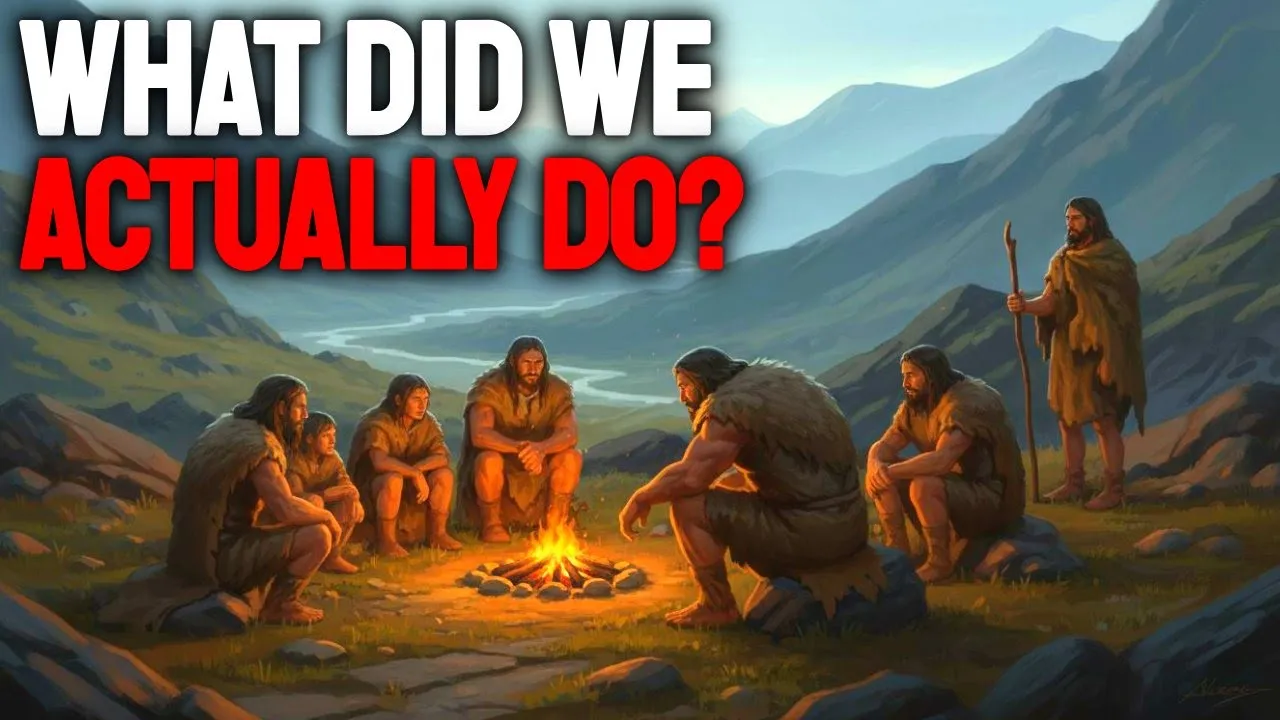
is how humans woke up for hundreds of thousands of years. This was mourning. It's 40,000 years ago, give or take a few millennia. You're a homo sapiens living somewhere in what we'd now call Europe or Africa or Asia. Anatomically, you're identical to modern humans. same brain size, same body structure, same capacity for Language and thought and emotion. But your world, your daily reality is so alien to ours that it's almost impossible to imagine. So here's the question that keeps archaeologists and anthropologists endlessly fascinated. What did you actually do all day? See, we have this image
burned into our minds from countless movies and documentaries. Cavemen, brutish and hairy, constantly running from saber-tooth tigers, spending every waking moment desperately Searching for food, always on the edge of starvation, living nasty, brutish, and short lives of pure survival. That's the picture, right? Prehistoric life is one long nightmare of hardship and terror, except it's almost completely wrong. The archaeological evidence tells a radically different story. Early humans weren't just surviving. They were living. They had rich social lives, leisure time, art, music, spirituality, humor. They told stories around fires. They decorated their bodies. They carved intricate figurines
and painted breathtaking images on cave walls. They cared for their elderly and disabled. They buried their dead with ceremony and grave goods. They had culture, complex and sophisticated culture that we're only beginning to understand. But we're getting ahead of ourselves. Before we can talk about cave paintings and ritual burials, we need to understand the basics. What did a Typical day actually look like? How did our ancestors spend their time when there were no jobs to commute to, no bills to pay, no grocery stores to visit? when survival meant something entirely different than it does today.
The truth is going to surprise you. Early humans probably worked less than you do. Study of modern huntergatherer societies, which offer our best window into prehistoric lifestyles, show that people typically spent only 4 to 6 hours A day on what we'd call subsistence activities. gathering food, hunting, preparing meals, maintaining tools and shelters. That's it. The rest of the time was leisure. Socializing, playing, creating art, telling stories, just hanging out. This flies in the face of everything we've been told about progress. We imagine our ancestors as desperately poor in time and resources while we're rich and
comfortable. But in terms of Free time, the opposite might be true. A prehistoric human probably had more leisure hours in a week than most modern people get in a month. If you're watching this to fall asleep, that's exactly why I make these videos. Maybe subscribe and let me know where are you right now and what time is it. I always check the comments and it's fascinating. Someone in Tokyo at sunrise, someone in London at lunch, someone in California at midnight, all drifting off to the Same stories about our shared human past. The more we study
prehistoric life, the more complex and nuanced the picture becomes. Yes, there were dangers. Injuries were common and often serious. Infant mortality was high. Infections that we'd treat with antibiotics could be deadly. Life expectancy was lower than today, though not as low as you might think. If you survived childhood, you had a decent chance of living into your 50s or 60s. Some individuals made it much longer. But here's what really matters. Within those years, people lived full lives. They laughed, loved, mourned, created, struggled, celebrated. They weren't just biological machines optimized for survival. They were human in
every sense. We understand that word. They have the same fundamental needs we do. Food and shelter, yes, but also connection, meaning, beauty, play. So, let's walk through a day together. Not a Dramatic day with a mammoth hunt or a confrontation with a rival group, though those happen, too. Just a regular day. an ordinary day 40,000 years ago when an early human woke up to the dawn and lived their life in ways that were both utterly foreign and strangely familiar to how we live ours. Because understanding how our ancestors actually spent their time doesn't just teach
us about the past. It raises uncomfortable questions about the present, about how We live now, about what we've gained with civilization and what we might have lost, about whether progress always means what we think it means. Let's start at the beginning with that moment when gray light filters into the rock shelter and another prehistoric day begins. You're not waking up to an alarm. There are no alarms. There's no concept of being late, no schedule to keep, no boss waiting. Instead, consciousness returns slowly, naturally, Pulled back by the gradual lightning of the sky and the stirring
of bodies around you. The first thing you notice is the cold. Not the bone deep, life-threatening cold of deep winter, but that crisp morning chill that makes you reluctant to leave the warmth of your sleeping spot. You're lying on a bed of dried grasses and animal skins, pressed close to other members of your band. Not for intimacy necessarily, just survival. Body heat is a resource too Valuable to waste. The second thing you notice is the smell. Wood smoke. Always wood smoke, but faint now. The fire that burned bright last night has died down to embers.
Mixed with that is the scent of unwashed bodies. Not unpleasant exactly, just human. The smell of rendered animal fat from yesterday's meal. The earthy mineral smell of the rock shelter itself. If you're near the coast, maybe salt air. If you're inland during spring, the green smell of new Growth. Someone is already awake. There's always someone awake. Sleep in the Paleolithic wasn't like modern sleep. We have evidence both from studying modern hunter gatherers and from sleep research that humans probably practiced what scientists call bifphasic or polyphasic sleep. You'd sleep for a few hours after dark, then
wake for a period in the middle of the night. This wasn't insomnia. This was normal. During that wakeful period, people would talk Quietly, tend the fire, check on children, maybe make love, maybe just lie there thinking whatever thoughts people think when the world is silent and dark. This meant that at any given moment during the night, someone was usually awake. Someone was listening for the sounds that didn't belong. The footfall of a predator, the crack of a branch, the distant howl that meant danger was moving through the territory. Safety wasn't something you could take For
granted. It was something you maintained hour by hour through vigilance and cooperation. The person who's awake now is feeding the fire. You can hear the soft sounds of movement. See the sudden brightening as flames catch on new fuel. Fire management was maybe the most important skill your people possessed. Let it die completely and you'd have to restart it. Either by carrying embers from another group's fire, possibly miles away, or by Using friction methods that were exhausting and timeconsuming. Better to keep it going. Better to make sure someone always took responsibility for feeding it through the
night. Who did that job varied? Sometimes the elderly who slept lighter anyway and had already proven their worth to the group in a thousand other ways. Sometimes young adults, particularly those without small children who needed their parents' full attention. Sometimes it rotated, an informal understanding that everyone contributed to the survival of the whole. As the fire builds, more people begin to stir. children first. Usually, kids wake up ready to move, ready to play, just like they do now. You hear a small voice, the rustling of bodies, a mother's soft murmur, telling a child to stay
close, stay warm, wait for the sun. But children are terrible at waiting. Within minutes, a few of the older ones are up, Stretching, moving toward the fire, their breath visible in the cold air. The adults wake more slowly. There's no rush. This is important to understand. The entire concept of rushing, of hurrying, of being pressed for time. These are modern inventions. Your day is governed by light, by hunger, by the weather, by the seasons. The sun is just beginning to paint the eastern sky in shades of gray and pink. There are hours before you need
to be Doing anything in particular. Right now, the most important thing is transitioning from sleep to wakefulness in a way that doesn't waste the precious calories you'll need for whatever the day brings. So, people stretch slowly, methodically, working out the stiffness that comes from sleeping on the ground. They yawn, scratch, attend to basic bodily functions. If you're in a rock shelter or cave, there's probably a designated area for waste, far enough Away to avoid contamination, but close enough to be safe. If you're in a temporary camp, people simply walk a short distance into the surrounding
vegetation. Someone, probably one of the more experienced members of the group, steps outside the immediate sleeping area to check the surroundings. Not paranoid exactly, but careful. What changed during the night? Are there tracks near the camp that weren't there Yesterday? What's the weather doing? Is that cloud formation in the west promising rain or just passing through? Is the wind shifting, bringing different scents, different information about what's happening in the wider world. This morning assessment is crucial. Paleolithic humans were readers of signs in ways we can barely imagine. They could tell from the behavior of birds
whether a predator was nearby. They could read weather patterns days in Advance by watching clouds, feeling humidity, noticing how different plants responded to atmospheric changes. They could identify individual animals by their tracks and tell you how long ago they passed, whether they were healthy or injured, alone or part of a herd. All this information gets processed and importantly shared. As more people wake and gather around the growing fire, there's conversation. Quiet at first, then building as the group consciousness Comes online. Dreams might be discussed. The Paleolithic mind probably didn't draw hard boundaries between dreaming and
waking reality. A vivid dream might be interpreted as a message, a warning, a visit from ancestors, worth talking about, worth considering. Plans begin to form, but loosely. The group needs food, but that's always true. The question is what kind of food and where to find it. Someone might have noticed yesterday that certain berry Bushes were nearly ripe. Someone else might have seen signs of a large animal moving through a particular valley. A third person might suggest checking fishing spots if you're near water. None of these are orders. Nobody is in charge in the way we
think of leadership. Instead, decisions emerge from discussion, from consensus, from individuals choosing to follow those with relevant expertise. But that's still ahead. For now, in these early Morning moments, the main activity is simply being together. The band, your extended family, your survival unit is reassembling after the night's dissolution. Everyone made it through another period of vulnerability. Everyone is here, accounted for, ready for another day. There's comfort in that. There's safety in numbers, yes, but also something deeper. Something that explains why humans are so fundamentally social. We literally Evolve to need each other. Those who felt
content in groups who drew comfort from proximity to kin who enjoyed cooperation. Those were the ones who survived the bottleneck. Their descendants us carry genes that make isolation feel wrong and community feel necessary. Children are playing now. Their energy infectious. They're not playing anything structured. Nothing with rules. Just running, chasing, wrestling. the physical play that builds Strength and coordination. The adults watch with half an attention, letting the kids be kids, but ready to intervene if play gets too rough or someone wanders too far. Meanwhile, practical concerns are being addressed. Someone is checking tools from yesterday.
Is that spear point still secure in its shaft? Did that carrying basket develop any weak spots that need repairing? Is there enough cordage for today's needs? Or does someone need to Spend time making more? These aren't chores in the modern sense. They're not unpleasant tasks you do before getting to what you want to do. They're just part of life, as natural as breathing. And all of this, all of it is happening without any sense of time pressure. The sun is higher now, the morning chill beginning to fade. You've been awake maybe an hour, though you
have no way to measure that and no reason to care. Your stomach is starting to remind you it's Empty. Other people are probably feeling the same. Soon, attention will turn to food, but not yet. For now, you're warm. You're safe. You're surrounded by people who know you and care about your survival because your survival increases their own chances. This is waking up in the Paleolithic. No sudden jarring into consciousness. No racing to get ready. Just the slow communal transition from sleep to activity guided by light and bodies and the ancient rhythms that Governed human life
for hundreds of thousands of years. It's a pattern so fundamental that we still carry the biological echoes of it. That desire to hit snooze, to wake up slowly, to ease into the day rather than attacking it. That's not laziness. That's your paleolithic brain remembering how mornings used to work back when we had all the time in the world and the only schedule that mattered was the movement of the sun across the sky. Let's talk About breakfast. Except your ancestors 40,000 years ago didn't have breakfast. Not in the way you think about it. They didn't wake
up at 7:00 a.m., stumble to the kitchen, and pour themselves a bowl of cereal. They didn't have meal times at all. Not really. They ate when food was available, when hunger demanded it, when the opportunity presented itself. This might sound chaotic, but it wasn't. It was perfectly adapted to their reality. Picture yourself waking up in That rock shelter as the first light filters through the entrance. Your stomach growls. You're hungry, so you eat. So simple as that. What you're eating depends entirely on what's available. Maybe there's leftover meat from 2 days ago when the hunters
brought down a red deer. It's been hanging in the cool back of the shelter away from direct sunlight wrapped in the deer's own hide. The cold autumn air has kept it from spoiling, though it's starting To develop that slightly gy smell. That means you should probably finish it today. You pull off a strip and chew it slowly. It's tough, requires real jaw work, but it's protein and fat and exactly what your body needs after a night of sleep. Your teeth are strong, your jaw muscles powerful. Dental analysis of paleolithic skulls shows remarkable wear patterns. Evidence
of lifetime spent processing tough foods. But here's what's fascinating. Those Same teeth show something else. Microscopic plant residues, starch grains from roots and tubers, phytoliths from seeds and nuts. Your ancestors weren't just eating meat. They were eating everything. Beside the meat, there's a wooden bowl. Really, just a section of bark folded and sealed with pine resin filled with hazelnuts gathered 3 days ago. You crack a few between your back mers. The technique passed down through generations. Children watch adults do this from infancy, learning the exact angle and pressure needed to crack the shell without crushing
the meat inside. Next to the nuts, there's a leather pouch containing dried berries. Blackberries gathered during the late summer abundance and dried in the sun. They're wrinkled now, concentrated sweetness, and you eat a handful. The sugar hits your system immediately, providing quick energy. But the real treasure is the Basket of roots near the fire. Someone, probably one of the older women with decades of plant knowledge, dug these up yesterday from the riverbank. They're cattail roots, starchy and nutritious, but basically inedible raw. So, they've been placed near the fire, not in it, just close enough that
the heat is slowly breaking down the tough fibers and converting complex starches into digestible sugars. This is cooking, but not like you know It. No recipes, no precise temperatures, no timers, just knowledge accumulated over thousands of generations about what heat does to different foods. The roots have been sitting there all night, slowly roasting in the residual heat from the fire that never quite goes out. By morning, they're soft enough to eat, sweet enough to enjoy. You pull one out, careful not to burn your fingers. It's hot but manageable. You peel away the Outer layer and
bite into the flesh. It's not delicious by modern standards, but it's filling and more importantly, it's safe. Raw, these roots contain toxins that would give you a nasty stomach ache. Cooked, they're perfectly edible. This transformation, turning in plants into food through fire, might be one of the most important technological breakthroughs in human history. It effectively doubled or tripled the number of plant species your ancestors Could eat. Tubers that were toxic raw became staple foods when roasted. Seeds that would pass through the digestive system unchanged became valuable nutrition when ground and heated. The evidence for this
incredible dietary diversity comes from multiple sources. Coprolytes fossilized feces have been found at archaeological sites across Europe and Africa. When scientists analyze them under microscopes, they find an astonishing variety of plant Remains. Seeds from dozens of different species, pollen from flowers, microscopic fragments of leaves, roots, and bark. Some coprolytes show evidence of insects, grasshoppers, beetle lavi, termites. These might seem unappetizing to modern western pallets, but they're actually excellent sources of protein and fat. Many contemporary huntergatherer societies consider insects delicacies, and there's no reason to think your ancestors felt Differently. Dental calculus, the hardened plaque that
builds up on teeth, tells a similar story. When archaeologists scrape it off paleolithic skulls and examine it under high-powered microscopes, they find plant starches from across the spectrum. Wild grains, root vegetables, nuts, berries, even plant fibers that were probably chewed to extract moisture or to soften them for other uses. What emerges from all this evidence is a picture of incredible Dietary flexibility. Your ancestors weren't specialized. They were opportunists capable of exploiting virtually any food source in their environment. Coastal groups ate fish, shellfish, seaweed, seabirds, and sea mammals supplemented with whatever plants grew near the shore.
Inland forest dwellers ate deer, wild boar, nuts, berries, roots, and mushrooms. groups living near rivers ate fish, water fowl, aquatic Plants, and the land animals that came to drink. This flexibility was crucial for survival. Environments change, seasons shift, animal migrations follow unpredictable patterns. A group that could only eat one or two types of food would starve when those resources became scarce. But a group that could eat 50 different things, they'd always find something. As you're eating your morning meal, others are doing the same. The young mother is sharing nuts with her Toddler, showing him how
to crack them, how to pick out the meat without getting shell fragments. He's not very good at it yet. His small hands lack the strength and coordination, but he's learning, and in a few years, he'll be teaching his own younger siblings. The old woman is preparing something more complex. She's taken some of the leftover meat and is pounding it between two stones, mixing it with rendered fat and dried berries. She's making pemkin, Though she doesn't call it that. It's just food that lasts, concentrated nutrition that can be carried on long journeys or stored for lean
times. This is knowledge, technical and precise. The ratio of meat to fat to berries has to be right or it spoils. The pounding has to be thorough or it doesn't bind together. She learned this from her mother who learned it from hers. A chain of knowledge transmission stretching back thousands of generations. Nobody's eating alone. That almost never happens. Food is social, shared, distributed according to complex rules that everyone understands implicitly. The hunter who made the kill yesterday isn't eating any more than anyone else. In fact, he might be eating less because that's how the system
works. Kill an animal, share it with the group, and when someone else makes a kill, they'll share with you. This is insurance, risk pooling, the social glue that keeps the Group together. Children run back and forth, stealing bites from different adults, getting swatted away playfully, or having food pressed into their hands. Nobody's stingy with children. There's always enough to go around. and or if there isn't, the adults eat less to make sure the young ones get fed. The meal isn't formal or ceremonial. People eat standing up, sitting down, walking around, checking tools, talking, laughing, but
it serves crucial social Functions anyway. Everyone's together reinforcing bonds, sharing information, making plans for the day. Who's going to gather plants today? Who's going hunting? Who's staying back to work on that deer hide? These decisions happen organically, emerging from consensus rather than command. Someone mentions that the hazelnut trees by the northern grove should be producing well right now. Several women and older children volunteer to check. Someone else notes That there were deer tracks near the river yesterday. The hunters exchange glances, nod, start mentally preparing for a possible pursuit. Food preparation continues throughout this conversation. Hands
are always busy. Someone's grinding seeds between stones. Someone else is sorting through dried herbs, discarding any that show signs of mold. A teenager is learning to use a sharp flint flake to slice thin strips of meat, preparing them for drying. These Skills are crucial and they're learned entirely through observation and practice. No written recipes, no formal instruction. Children watch adults try to imitate, get corrected, try again. By the time they're adults themselves, they possess encyclopedic knowledge about food, which plants are edible and when, how to identify them in different seasons, where to find them, how
to process them, how to store them. This knowledge base is staggering. Ethnographic studies of modern hunter gatherers show that they typically know detailed information about 200 to 300 plant species. They know which parts are edible, which require processing, which are medicinal, which are toxic, which are useful for other purposes like cordage or poison for arot tips. Your ancestors almost certainly possessed similar knowledge. They had to. Their survival depended on it. Eat the wrong mushroom and you're dead. Fail to Properly prepare certain roots and you're spending the next 3 days with debilitating cramps. This isn't casual
knowledge. This is life and death information carefully preserved and transmitted across generations. As the morning meal winds down, the fire is fed a few more sticks. The embers never go out entirely if someone's paying attention. Fire is too valuable, too difficult to make from scratch. Better to keep it alive, feeding it Regularly, protecting it from rain and wind. Someone's always responsible for fire tending, usually rotating through different individuals. The meal wasn't elaborate, but it was adequate. Everyone's eaten something. Bellies are reasonably full. Energy levels are sufficient for whatever the day will bring. And that's really
all that matters. Your ancestors weren't gourmets, but they understood nutrition in a deep, intuitive way. They knew that Variety mattered, that different foods provided different benefits, that balance across days and weeks was more important than perfection at every meal. They were eating to live, but they were also living to eat. Food was pleasure, even when it was simple. The satisfaction of cracking a nut perfectly. The sweetness of ripe berries. The rich fattiness of bone marrow roasted over fire. These weren't just calories. They were experiences. Shared moments, connections to the landscape and to each other. And
now, with morning fully arrived and stomachs filled, it's time to get to work. The day's real activities are about to begin. Here's what nobody tells you about prehistoric life. The hunt gets all the glory. The dramatic confrontations with mammoths, the coordinated takedowns of deer, the dangerous faceoffs with predators. That's what captures our imagination. What ends up in museums and documentaries. But here's the truth that would have been obvious to anyone actually living 40,000 years ago. Hunting was the exception. Gathering was the rule. On any given day, somewhere between 60 and 80% of your calories came
from plants, roots, tubers, nuts, seeds, berries, leaves, flowers. The percentage varied by season and location. Groups living near Coastlines might have gotten more protein from shellfish. Communities in northern regions might have relied more heavily on meat during long winters, but for most human populations, most of the time, plants were what kept you alive. This wasn't because our ancestors were particularly fond of vegetables. It was simple evolutionary math. A successful hunt might provide enough meat to feed your band for several days, but hunts failed More often than they succeeded. Animals are fast, unpredictable, and dangerous. They
require hours of tracking, careful coordination, and considerable luck. Plants, meanwhile, stay put. They're exactly where you left them last season, growing in predictable patterns that anyone with enough knowledge could learn to read. So while the hunters were out there hoping for glory, the majority of your band was engaged in the real work of Survival, walking the landscape with practiced eyes, reading signs invisible to the untrained, collecting the foods that would actually end up in tonight's meal. Now, here's where we need to be careful about assumptions. For decades, anthropologists told a neat story about prehistoric gender
roles. Men hunted, women gathered. It was presented as natural, inevitable, maybe even biologically determined. But the evidence tells a more complicated story. Yes, in many prehistoric societies, women and older children did most of the gathering while men specialized in hunting. But not all societies, not even most necessarily. Archaeological evidence from various sites shows women buried with hunting weapons. Isotope analysis of ancient bones reveals some women ate diets as meattheavy as any male hunter. Some groups practiced communal hunting where Everyone participated. Others had specialized gatherers of both sexes who spent their entire lives perfecting knowledge of
plants. The truth is probably this. Prehistoric societies were pragmatic. They organized labor in ways that made sense for their specific circumstances. In some groups, women who are pregnant or nursing might have focused more on gathering because it was compatible with carrying infants. In others, Post-reroductive women might have become the most valuable members of the community precisely because they could hunt without the constraints of childbearing. The key point is this. Don't imagine gathering as something less important or prestigious than hunting. It was specialist knowledge. It required years of training, and it kept everyone alive. So, picture
yourself on that gathering expedition. It's midm morning now. The Sun has been up for a few hours, burning off the morning mist. You're heading out with three other people. Your mother's sister, who knows the plant locations better than anyone in your band. a younger cousin, maybe 11 years old, who's learning the roots and the knowledge, and your own child, 3 years old, strapped to your back in a sling made from carefully softened deer hide. You're not just wandering randomly. You're following a mental map that's Been built up over years of observation. The oak grove, 3
mi north, should have acorns ready for collection right now. The patch of wild onions near the creek will be past their prime, but there's a stand of cattails just beyond it where you can dig up the starchy roots. If you're lucky, you might find a beehive with honey. If you're really lucky, bird's eggs. The walk itself is no casual stroll. You're covering somewhere between 5 and 10 mi today. Most of it over terrain that would challenge modern hikers. Rocky hillsides, thick underbrush, streams to ford, slopes to climb. You're doing all of this while carrying a
child, plus the tools of your trade. A digging stick, fire hardened and worn smooth from use. Several baskets woven from plant fibers nested inside each other. A leather bag for small fines. Maybe a stone knife tucked into a belt made from twisted plant fibers. But Here's what makes gathering so different from hunting. It's not about adrenaline or drama. It's about attention. You're reading the landscape like a book, noticing details that would be invisible to outsiders. The slight discoloration of soil that indicates wild tubers growing below. The pattern of animal tracks that suggests a fruit tree
nearby. the specific angle of sunlight that tells you which side of the hill will have ripe berries. Your aunt stops At what looks like an unremarkable patch of ground. But she sees something you're still learning to recognize, a particular type of grass that always grows near edible roots. She drives her digging stick into the earth, probing carefully. 3 in down, she strikes something solid. She works the stick around it, loosening the soil, then reaches in with her hands and pulls up a tuber the size of your fist. It's pale, knobbybly, completely unappetizing to Look at.
But you know from experience that when it's roasted in the coals of tonight's fire, it'll be sweet and filling. She hands it to you. You place it carefully in your basket. She digs again. Another tuber and another. This spot is rich. In 10 minutes, you've collected enough tubers to feed everyone tonight. Maybe with leftovers for tomorrow. But you're not done. Your aunt knows these plants by heart. More importantly, she knows Their stories. The stories are how you remember the knowledge. She tells your young cousin about the time her grandmother got terribly sick from eating a
root that looked almost exactly like this one, but had slightly different leaves. She points out the distinction. Three veins in the leaf instead of five. That tiny difference means the other plant would kill you, shutting down your breathing within hours. This is education, but it's Nothing like sitting in a classroom. It's survival knowledge passed down through stories demonstrated with actual plants reinforced through years of observation. Your cousin will learn hundreds of these lessons. By the time she's your age, she'll know perhaps 300 different plant species by sight, by season, by location. She'll know which ones
are edible, which ones are medicinal, and which ones will kill. She'll know when to harvest each one, how to prepare it, and what it's useful for. Modern botonists spend years in university learning to identify plants. Your ancestors learned it by necessity, starting in early childhood, because getting it wrong could mean death. The group moves on. You wade through a shallow stream, the cold water shocking against your legs. On the far bank, your aunt spots something that makes her smile. Mushrooms growing in a fallen Log. She approaches carefully, examines them from multiple angles, even smells them.
Mushrooms are tricky. Some are nutritious and delicious. Others cause violent illness. A few will kill you. She picks three, leaves the rest. She's certain about these ones, but caution is always wise. Hours pass in this rhythm, walking, observing, collecting. The baby on your back has fallen asleep, lulled by the gentle motion. Your baskets are getting Heavier. Wild grapes, still slightly tart but edible. Seeds from a grass that you'll grind into flour back at camp. Bark from a specific tree that when boiled makes a tea that reduces fever. Your aunt collects this last one carefully, never
taking so much that she damages the tree. She learned long ago that you have to think about next season, next year, the generations coming after you. This is sustainable harvesting. Though your ancestors didn't Have a word for it, they just knew that if you stripped a plant bare, it wouldn't be there next time you needed it. The groups that learned this lesson survived. The ones that didn't face starvation when resources ran out. By early afternoon, you're miles from camp. Your legs are tired. Your shoulders ache from the weight of your baskets. But there's something almost
meditative about this work. No rush, no pressure, just the steady rhythm of walking and Gathering, the warmth of the sun, the sound of birds calling to each other in the canopy above. You're completely present in a way that modern humans rarely experience. Every sense is engaged. You're listening for the rustle of animals, watching for the shimmer of water that indicates a stream ahead, smelling the air for smoke that might mean another band is camping nearby. Your younger cousin asks a question. She spotted a plant with bright red berries And wants to know if they're safe
to eat. Your aunt doesn't just answer. She walks over, examines the plant, and launches into another story. How her mother once found these berries during a harsh winter when other food was scarce. How they sustained the band through 3 days of blizzard. How you have to be careful because birds can eat them safely but humans need to cook them first otherwise they cause stomach cramps. The knowledge transfer continues. Every plant is a lesson. Every location is a memory. This landscape isn't just territory to your people. It's a library. Every tree, every stone, every stream carries
information that's been accumulated over generations. Your ancestors didn't write anything down, but they were far from ignorant. They were repositories of sophisticated ecological knowledge that rivaled anything a modern scientist could Compile. Finally, late in the afternoon, the group turns back toward camp. Your baskets are full now, heavy with food that will feed your entire band tonight. You've walked maybe 8 mi total. Your feet hurt. Your back aches. The baby has woken up and is fussing, wanting to be fed. But you're satisfied. This is good work. Important work. The kind of work that keeps everyone alive.
When you get back to camp, there will be no fanfare. Nobody's going to celebrate your return The way they celebrate a successful hunt. But everyone knows the reality. The hunters might come back empty-handed tonight. They often do. But you brought food. reliable, nutritious, life sustaining food. And tomorrow you'll go out and do it again. This is the rhythm that sustained humanity for hundreds of thousands of years. Not the dramatic moments, the steady, patient, knowledgeable work of gathering. Your ancestors were reading the landscape in Ways we've almost completely forgotten. They were paying attention to nature with
an intensity that most modern humans never experience. and they were doing it not as a hobby or a spiritual practice, but as the fundamental work of survival. Here's something that might surprise you. Your ancestor probably wasn't hunting today or yesterday, maybe not even this week. We have this image of prehistoric life as a constant struggle. Early humans Waking up each morning and immediately heading out to chase down mammoths or wrestle with saber-tooththed cats. Hollywood loves this narrative. Man versus beast, daily death matches for survival. But the reality was far more interesting and far more strategic.
Hunting for early humans wasn't a daily grind. It was an occasional highstakes event that required immense planning, patience, and more often than not ended In failure. A successful hunt might happen every few days if you were lucky. every few weeks if you weren't. The rest of the time you were preparing, planning, tracking, and most importantly relying on gathering to fill your stomach. But when the hunt did happen, it was extraordinary. Let's say today is one of those days. The signs have been building for a while. Yesterday, scouts spotted fresh tracks from a small herd of
antelope Moving through a valley about 5 mi from camp. The animals are heading toward a seasonal water source, following patterns your people have observed for generations. The timing is right. The weather is clear. And most crucially, several experienced hunters are available and healthy enough to make the attempt. This is how it begins. Not with sudden impulse, but with careful deliberation. The group gathers in the early morning, Six men and two women, all proven trackers and hunters. They discuss the plan using a combination of spoken language and hand signals that have been refined over thousands of
years. Who will take which position? Where the animals are likely to go, what the fallback options are if things don't work out. They carry spears, each one a masterpiece of prehistoric engineering that took days to create. The wooden shaft carefully straightened over fire And seasoned for months to prevent warping. The stone point napped from high quality flint traded from a quarry 200 miles away. Hafted with plant resin and sineue that's been processed and dried to create a bond stronger than most modern adhesives. Some of the hunters also carry atals, spear throwers that use leverage to
triple the velocity and distance of a thrown spear. This technology is relatively new, maybe only a few thousand years old in your region, But it's revolutionizing hunting in the same way the bow will revolutionize it thousands of years from now. The group moves out and immediately you notice something. They're not rushing. There's no frantic chase, no dramatic sprint across the savannah. Instead, they're walking at a steady, sustainable pace, reading the landscape as they go. This is where hunting becomes a science. One of the trackers kneels beside a depression in the sandy soil. He studies It
for several long moments, then signals to the others. The track is fresh, probably from this morning. The depth and clarity tell him the animal was moving at a walk, not alarmed. The spacing between tracks indicates it's a young adult, healthy, good size, but not too large to bring down. He can tell all this from a single hoof print. This isn't magic. It's pattern recognition honed over a lifetime of observation. Your people have been Tracking animals since childhood, learning to read the landscape the way you might read a book. Every broken twig, every disturbed pebble, every
scratch on a rock face tells part of the story. Where the animals went, how fast they were moving, how long ago they passed, whether they were calm or alarmed. The group follows the trail for hours. No rushing, just steady walking, periodically stopping to check signs and Adjust their strategy. This is the part of hunting that never makes it into the dramatic retellings. The long patient stalking that requires more mental endurance than physical strength. Around midday, they spot the herd. Eight antelope grazing in a shallow valley near a water hole. Now comes the critical decision point.
Do they attempt an ambush trying to get close enough for spear range? Or do they use the Technique that humans, uniquely among all predators, have perfected? They choose persistence hunting. Here's what makes humans terrifying predators. We can't outrun almost any animal in a sprint. A healthy antelope can hit 50 mph. A human tops out around 15. But we have something no other animal has. We can run for hours in the heat of the day without overheating. Thanks to our nearly hairless bodies and incredible capacity for sweating, most animals, Covered in fur and lacking efficient cooling
systems, have to stop and rest after intense exertion, or they'll literally cook from the inside. The hunters spread out and begin to jog toward the herd. Not a sprint, just a steady, sustainable trot. The antelope spot them immediately and bolt. They're gone in seconds, disappearing over a ridge. But the humans don't stop. They follow the tracks at that same steady pace, reading the signs, keeping up the Pressure. An hour passes, 2 hours. The sun is brutal now. The kind of heat that would drop most predators in their tracks. But the humans keep moving. Their bodies
designed for exactly this kind of endurance. They're sweating profusely, yes, but that's the point. Each drop of moisture evaporating from their skin is carrying away heat that would otherwise build up and shut down their muscles. They find the herd again. The antelope run, but they're showing Signs of stress now. Their tongues are hanging out. They're panting heavily. They can't cool down fast enough. The chase continues. 3 hours 4. The trackers are rotating the lead position, allowing individuals to drop back and recover slightly while others maintain the pressure. This is cooperative hunting at its finest. No
single human could do this alone. But a coordinated group communicating constantly, sharing the effort, can Accomplish what seems impossible. Finally, after nearly 5 hours, they close in on a single antelope that is separated from the herd. The animal is stumbling now, its cooling system overwhelmed, its muscles beginning to fail from the combination of heat and exhaustion. One hunter moves in close enough for a spear throw. The weapon flies true, striking behind the shoulder, and moments later, it's over. The hunters stand around the fallen animal, not cheering or celebrating yet. First comes the practical work. One
of them makes a quick precise cut and offers a prayer or acknowledgement. We can't know the exact words or gestures, but evidence from multiple prehistoric sites suggests early humans performed some kind of ritual around successful kills, respect for the animal that gave its life, gratitude to whatever spirits or forces they believed governed the Hunt. Then comes the butchering which is itself a sophisticated technical operation. These hunters know animal anatomy better than most modern surgeons know human anatomy. Every muscle group, every organ, every useful piece. They work quickly and efficiently. The hide comes off in one
piece, valuable for clothing and shelter. The choicest cuts of meat are separated for immediate consumption and for carrying back to camp. Organs that spoil quickly are prepared for eating on site. Nothing is wasted. Even the bones will eventually be cracked open for their marrow, one of the most nutrient-dense foods available. But here's the problem. They're 5 mi from camp and they've just produced several hundred lb of meat and materials. They can't carry it all in one trip. And leaving meat unattended means lions, hyenas, and vultures will claim it within hours. This is where the Social
dimension of hunting becomes crucial. Two runners head back to camp at speed to bring reinforcements. The rest stay with the kill, building a fire to keep scavengers at bay and beginning the process of smoking some of the meat for preservation. Within a few hours, more people arrive from camp. Elders, children old enough to help carry. Nursing mothers who left their infants with relatives. Everyone Participates in the harvest. The trip back to camp is a celebration. Successful hunts are rare enough that they're social events. There will be feasting tonight, stories told around the fire, probably dancing
and music. The hunters will recount the chase in detail. And in the telling, it will become part of the community's collective memory. Another story to teach young people about strategy, persistence, and cooperation. But let's be clear about something. This doesn't happen every day or even every week. Between successful hunts, there are dozens of failed attempts. Tracks that lead nowhere. Animals that prove too fast or too alert. Injuries that force the hunters to turn back. Hunts that simply don't work out despite everyone doing everything right. And this is crucial to understanding prehistoric life. Hunting was important.
Absolutely. It provided concentrated Protein and fat that gathering alone couldn't match. The social bonds formed during cooperative hunts helped cement group cohesion. The skills required, tracking, weapon crafting, strategic planning pushed the development of human intelligence and communication. But hunting was never the main source of calories for most prehistoric groups. That honor went to gathering which happened every day provided the majority of nutrition and didn't require risking Life and limb. Hunting was the occasional glory, the high stakes gamble that sometimes paid off spectacularly. What made early humans successful wasn't that they were the best hunters. It's
that they were good enough at hunting while also being excellent at everything else. gathering, tool making, social cooperation, adapting to new environments. They were generalists who could deploy specialist skills when needed. And the hunt, when it succeeded, Was just one thread in the complex tapestry of prehistoric survival. Tomorrow, whether today's hunt succeeded or failed, there would still be roots to dig, nuts to gather, tools to repair, children to teach, and the endless, patient work of staying alive in a world that was beautiful, abundant, and occasionally willing to reward the clever, the persistent, and the cooperative.
The antelope is gone now, transformed Into food, clothing, and tools. But the knowledge of how it was taken that lives on, passed from this generation to the next, refined and improved with each retelling until it becomes not just survival strategy, but culture. By midday, the camp was alive with a sound that would have been instantly recognizable to any crafts person throughout history. The rhythmic tap tap tap of stone on stone. Not loud, not violent, just persistent, purposeful. The sound of someone making something that didn't exist before. Your aunt was sitting on a flat rock near
the central fire, a hammerstone in one hand and a piece of flint in the other. Every few seconds, she'd strike the flint at precisely the right angle, sending a small flake spinning off into the dust. around her, a scatter of rejected pieces and failed attempts. The archaeological debris that would still be visible 40,000 years later, telling stories to People who'd learned to read stone. This wasn't occasional work. This was daily maintenance, essential as eating or sleeping, because tools didn't last forever. That spear point you used yesterday, it might have chipped when it hit bone. The
scraper someone used to process that hide last week. Its edge was dull now, almost useless. In a world without metal, without mass production, without the ability to simply buy replacements, you made your tools or you Didn't survive. But here's what's remarkable. Stone tool making, what archaeologists call napping, wasn't something you just figured out one afternoon. It was a skill that took years to master, requiring an understanding of stone properties that bordered on intimate knowledge. Different rocks fractured in different ways. Flint was predictable. Obsidian was sharp but fragile. CH was reliable but harder to work. You
had to know Where to find good stone, how to test it, how to recognize quality before you invested hours of work. watch your aunt working and you'd see expertise that took a lifetime to acquire. She wasn't just hitting rocks together randomly. She was reading the stone, seeing lines of potential fracture invisible to untrained eyes. Each strike was calculated. Too hard and the piece would shatter. Too soft and nothing would happen. The angle had to be exact. The Point of impact precisely chosen. It was geometry and physics executed entirely through intuition and muscle memory. The process
was called the prepared core technique and it represented centuries of accumulated knowledge. Your aunt had shaped this piece of flint over the past hour, carefully removing flakes to create a core with just the right shape and angle. Now she was ready for the payoff. one perfect strike and a long thin blade detached from the core sharp Enough to slice through hide or meat with minimal pressure. She examined it critically, running her thumb along the edge, then nodded. Good enough, but she wasn't done. The blade needed hafting, attachment to a handle that would make it actually
useful. This was where craft became art. She had prepared a wooden handle earlier, a piece of hardwood with a slot carved into one end. Now she pulled out a small leather pouch containing pine resin She'd collected and heated until it became sticky. Mixed with a bit of charcoal and crushed bone for strength. This would become the prehistoric equivalent of superlue. Watching her work, you'd notice something fascinating. She didn't need to think about most of the steps. Her hands moved automatically through processes she'd performed thousands of times. Heat the resin over the fire, apply it to
the handle slot, position the blade Precisely, wrap the joint with thin strips of sineue that would shrink and tighten as they dried. The entire process took maybe 10 minutes, but it drew on decades of experience and generations of accumulated knowledge. Near her, your brother was working on a different problem entirely. He had a piece of antler from that deer killed 3 days ago and he was slowly, patiently carving it into a spear point. This was different from stonework. Antler was organic, flexible, capable of taking impacts that would shatter stone. But it was also harder to
shape, requiring different tools and different techniques. He was using a stone burrin, a chisel-like tool to scrape and carve the antler. The work was tedious, producing a constant soft scraping sound that formed a counterpoint to your aunt's rhythmic napping. Thin curls of antler fell away with each stroke, accumulating in a small pile at his Feet. Every so often, he'd stop and test the point against his thumb, checking for sharpness and balance. This point would be different from the stone tipped spears most hunters used. Lighter, more flexible, it could be thrown farther and was less likely
to break on impact. But it took hours to make. An antler was only available when someone successfully hunted deer or similar animals. Stone was everywhere. Antler was precious. So you used it carefully for special Purposes. And you made sure everyone in the group knew who'd made what. Because here's something the archaeological record has only recently revealed. Prehistoric crafts people took pride in their work. We know this because we find tools that are more beautiful than they needed to be. Stone points shaped with perfect symmetry, even though asymmetrical points would work just as well. Bone needles
decorated with tiny carved patterns. Antler spearthrowers carved into the shapes of animals. Nobody decorates something purely functional unless they care about aesthetics, unless they want their work to be recognizable, admired. Your brother's spear point would be efficient, yes, but it would also be beautiful. Cuz when you carried it, when you used it to feed your family, you wanted everyone to know who'd made it. status, reputation, identity, all conveyed through craftsmanship. Across the camp, three women were working on an equally essential task, clothing production. One was scraping a deerhide stretched across a wooden frame, using a
stone scraper to remove every trace of fattened membrane from the inner surface. The sound was distinctive, a rhythmic that carried across the camp. Her hands moved in steady strokes, overlapping each path slightly to ensure complete coverage. This wasn't quick work. A Single hide might require hours of scraping, and even then, you weren't done. The hide had to be treated either by smoking it over a fire or by rubbing it with a mixture of brain tissue and fat that prevented it from becoming stiff when it dried. The brain tanning process was chemistry without labs, developed through
centuries of trial and error. Someone somehow had figured out that brains contained exactly the right compounds to Preserve leather. Maybe they discovered it by accident. maybe through systematic experimentation. Either way, the knowledge had been passed down parent to child for generations. Nearby, her sister was working on a high that had already been tanned. She had a bone all, a pointed tool for punching holes, and she was slowly, methodically creating a garment. Punch a hole, thread senue through it, punch another hole. The stitching was crude by modern standards, but remarkably effective. These clothes would be warm,
durable, and flexible. They'd last for seasons, maybe years, protecting their wearers from cold that could kill in hours. The third woman was doing something that would have seemed impossible to earlier humans. She was sewing with an actual needle, a tiny piece of bone drilled with a hole at one end threaded with sineue. This technology was less than 20,000 years old in your time. A recent innovation that had revolutionized clothing production. With needles, you could make clothes that actually fit, that could be tailored to individual bodies, that could be decorated with sewn on beads or dyed
leather strips. She was making winter clothing for her daughter, furlined and layered, warm enough for the brutal cold that would come in a few months. The little girl sat nearby, watching intently, Occasionally trying to help. This was how knowledge transferred, not through formal instruction, but through constant observation and imitation. By the time the girl was 10, she'd be competent at basic hidework. By 20, she might be one of the most skilled leather workers in the group. But clothing and tools weren't the only things being made. An older man sat by himself working on something smaller,
more delicate. He had a collection of shells he'd traded for Last summer when a neighboring group had visited from the coast 3 weeks walk away. Now he was drilling tiny holes in them with a stone drill. A painstaking process that required steady hands and infinite patience. These would become beads strung on plant fiber cord to make necklaces or bracelets. Purely decorative, purely social. Nobody needed jewelry to survive. But humans had been making it for at least 100,000 years, probably longer. Because survival wasn't enough. We needed beauty, status markers, ways to express identity and affiliation. Those
beads said, "I have connections to the coast, and I have time to make beautiful things, and I value aesthetics." All of that conveyed through pierced shells on a string. What's striking about all this activity is the specialization. Not everyone was good at everything. Your aunt had spent decades mastering Stonework and was genuinely expert at it. Your brother excelled at antler and bone carving, but was merely adequate at napping. The woman making winter clothing was the best leather worker in the group, and when her skills were needed, others contributed food or help with other tasks in
exchange. This wasn't quite a market economy, but it was close. a recognition that different people had different talents and that the group Benefited when people specialized. It was also the foundation for something that would become increasingly important, social complexity. In groups where everyone could do everything equally well, there wasn't much basis for hierarchy or status differentiation. But when individuals developed specialized skills that others needed, power dynamics shifted. the best toolmaker, the best leather worker, the best artist. They all gained influence That transcended simple physical strength or hunting ability. And everywhere, children watched. A boy of
maybe eight sat near your aunt, trying to replicate her movements with his own small stones. Most of his attempts failed, producing nothing useful, but she encouraged him anyway. Occasionally she'd take his hand, guide his strikes, show him the right angle. This was education, prehistoric style. No schools, no formal curriculum, just Constant observation and practice under the guidance of experts. By the time the boy was 15, he might be competent at basic tool making. By 25, if he had talent and dedication, he might be expert enough to teach others, and the knowledge would flow forward another
generation. each one adding small refinements, tiny improvements that would accumulate over centuries into technological revolutions. The afternoon sun moved across the sky, and the sounds Of craft continued, tapping, scraping the crackle of fire, occasional conversation, creating the material culture that made human life possible, building one patient stroke at a time, the foundation for everything that would come after. If you imagine early humans as exhausted half-st starved figures trudging endlessly across the landscape, constantly hunting, constantly gathering, constantly on the brink of Collapse. You're not alone. That image has been drilled into us for decades. Life before
civilization, we're told, was nasty, brutish, and short. A constant struggle for survival. No time for anything except work. But when anthropologists started living with modern huntergatherer societies and actually counting how they spent their time, a very different picture emerged. On average, adults in many foraging societies only spend about 4 to 6 hours A day on what we would call work. Finding food, preparing it, maintaining tools, basic camp upkeep. The rest of the day, it isn't filled with frantic scrambling. It's filled with nothing in particular. Resting, talking, playing, making music, grooming, staring into the distance, simply
existing. If your day 40,000 years ago were plotted on a modern time sheet, it would probably confuse a corporate manager. Yes, there are bursts of intense effort, tracking Animals for hours, carrying heavy loads of gathered food back to camp, shaping stone tools with careful precision. But these bursts are surrounded by long stretches of low inensity flexible time. Time you can bend around your body's energy, the weather, the mood of the group. So what did people actually do with all those hours? A lot of it would look surprisingly familiar and strangely slow. You rest. That might
mean lying on your side under a patch of shade, half Listening to the chatter of your relatives. It might mean sitting near the fire, absently turning a smooth pebble in your fingers, watching the smoke drift upward in twisting ribbons. When the body is your only real tool, preserving it is part of survival. Resting isn't laziness. It's maintenance. You socialize. Conversation in a small band of 20 or 30 people isn't optional background noise. It's the web That holds the group together. Every talk about who saw which herd of animals, who found a new stand of tubers,
who argued with whom last night. These aren't just idle gossip. their information sharing systems, conflict management strategies, emotional first aid. You play with children. You let them climb over you like a living jungle gym. You show them how to throw little sticks at a target or how to gently handle a piece of stone without cutting Themselves. Their games might look like chaos, but through them they're rehearsing adulthood, practicing coordination, testing social boundaries, experimenting with risk and trust. For long stretches of the day, there is no urgent agenda, no tight schedule, no alarm clock dragging you
from one task to the next. The pace of life is often dictated by the slow cycles of the sun, the seasons, and the movements of animals, not by the minute hand on a Dial. And then somewhere in all that unscheduled time, something else begins to happen. Humans start to invent fun. Archaeologists have found small objects at prehistoric sites that don't fit neatly into any category of tool or weapon. Tiny carved animals made of bone or antler. Smooth shaped pieces of stone drilled through the center like early spinning tops. Little figurines of people sometimes exaggerated in
strange ways. To a hungry adult crouching over a Fire, these might not do much. But to a child, they're toys. You can picture it. A small hand trying to spin a stone disc on the packed earth. Two kids pretending to hunt with miniature spears made from twigs. A parent half amused, half attentive, letting them help with a task that doesn't really need helping. Play isn't a distraction from real life. It is real life. Through play, children learn to aim, to negotiate, to share, to lead and follow. There are hints of Games for adults, too. Certain
small stones and bones found together in patterns that suggest dice or counters. Etched lines on flat rock surfaces that might have been game boards. Places where pieces were moved back and forth in quiet competitions that passed the time and strengthened social bonds. We don't know the rules they used or the stakes they played for, but the impulse is clear. When immediate needs are met, human minds look for patterns, Challenges, little puzzles to solve. Games are structured daydreams, and early humans seem to have had time for plenty of them. And then there's music. In caves in
Europe, archaeologists have discovered delicate flutes carved from bird bones and mammoth ivory, some of them more than 40,000 years old. They're not crude noise makers. Some have carefully spaced holes that produce recognizable musical scales. Someone sat down and experimented, Adjusting each hole just a bit, learning by ear how to turn raw bone into a working instrument. Imagine the first time someone in your band brings one of those flutes out by the fire. The sky is dark. The stars are beginning to appear. Embers are glowing. They lift the flute to their lips, take a breath, and
a strange clear sound rises above the crackle of the fire and the soft murmur of voices. For a moment, everyone freezes. Then the notes repeat, Hesitant at first, then more confident. Someone starts to clap a rhythm. Another person taps a stick against a log. Feet begin to move. Bodies sway. The camp which just a few minutes ago was quietly settling in for the night is suddenly alive with dance. Music and dance are more than entertainment. They synchronize bodies and minds. When everyone moves together, breathes together, voices rise and fall together. Something powerful happens in the
brain. Group identity strengthens. Anxiety fades. The world feels for a moment coherent and safe. In small vulnerable bands of early humans, those moments of shared rhythm may have been as important as any spear or shelter. After the dancing comes the other great technology of leisure, stories. You're back at the fire. The night is quiet now. A few last sparks drift upward like tiny glowing insects. The older members of the group edge closer to the flames. Children lean against their parents. Someone maybe the best talker in the band begins a story. It might be about the
last great hunt when the wind changed suddenly and nearly ruined everything. It might be about the time the river flooded and the group had to move camp in a hurry. It might be about a trickster animal who steals fire or a spirit who lives in the thunderclouds and punishes the greedy. Some of these stories are clearly about Real events. Others reach into the world of myth and imagination. But all of them carry something. A warning, a clever strategy, a memory of who did what and why it mattered. Without writing, without records, stories are the memory
of the group. They carry information across years and generations where the good water is in a dry season. Which plants can cure a fever and which can kill you? What happened the last time someone broke a Particular social rule? Listening to these tales by fire light, half awake, half drifting. You're not just being entertained. You're being trained quietly and gently for the rest of your life. But not all of this time is spent in conversation, music, or play. Some of it is devoted to the slow, meticulous work of grooming. If you've ever watched primates in
a documentary, you've seen it. Monkeys and apes carefully parting each other's fur, Picking out dirt and parasites, inspecting skin with absolute concentration. It looks fussy, but it serves two purposes: hygiene and bonding. Early humans did the same, but with a slightly different twist. No fur, but plenty of hair. You sit with your back to a friend or sibling or partner while they gently comb through your scalp with fingers or a simple comb made from bone or wood. They pick at little bumps, Remove bits of debris, crush an unlucky louse between their nails. It's both practical
and soothing. The kind of intimate contact that says without words, you matter. I'm paying attention to you. Then comes decoration. Red ochre, a naturally occurring ironrich pigment, shows up at human sites going back hundreds of thousands of years. It's often ground into powder, mixed with fat or water, and applied to skin or hair. Is it sunscreen, insect Repellent, symbolic body paint? It might be all three at once. You sit while someone traces lines on your face, your chest, your arms. Maybe they mark you as a member of a particular band. Maybe they signal your role
in a ritual or your status as someone who has completed a dangerous hunt. Hair is braided. Beards are trimmed or decorated. Simple jewelry made from shells. teeth or carved bone is threaded through hair or hung from Cords around wrists and necks. These acts take time. They're not required to eat, drink, or stay alive. But they're part of how early humans turn bare survival into a life with identity, beauty, and meaning. And in between all this talking and playing and decorating and music making, there are long stretches of something that in the modern world we've almost
forgotten how to do, just watching. You lie on your back and look at the Clouds drifting across the sky. You sit quietly and follow the path of a line of ants carrying food back to their nest. You stand at the edge of camp and watch a herd of animals grazing in the distance. the way they cluster and scatter, how the wind shifts their scent. You trace the patterns of stars, noticing how some constellations rise at particular times of year, how the moon waxes and waines. To a modern observer, this might look like boredom. But for
Early humans, this constant, gentle observing is part of how they build a mental map of the world. It trains attention. It sharpens intuition. The person who has spent hundreds of evenings quietly watching the sky might be the first to notice an unusual pattern of clouds that hints at an approaching storm. The child who has spent endless hours following animal tracks just for fun might become the best tracker in the band without ever Being formally taught. And there's something else here, something less practical and more mysterious. When you have no glowing screens, no written words, no
background music piped in from distant speakers, silence and stillness don't feel empty. They feel full, full of insect hum and bird calls, the sigh of wind through grass, the distant rush of water, the soft breathing of people you love nearby. In that stillness, the boundary Between you and the world can feel thinner. You're not a separate mind trapped in a frantic schedule, glancing at nature through a window on your day off. You're an animal in an environment embedded in it, attentive to it, shaped by it. So the day of an early human 40,000 years ago
is not a blur of endless toil. It's a pattern of effort and ease of focused work and rambling leisure, hunting, gathering, crafting. Yes, but also joking, singing, dancing, Grooming, decorating, storytelling, cloud watching, stargazing. Their lives were dangerous in ways ours usually aren't. Illness, injury, and hunger were always nearby. But they also had something that's become rare in many modern lives. Long unbroken stretches of time in which nothing urgent had to be done. Time to let the mind wander. Time to be with others without an agenda. Time to simply be awake in a living world. And
as the Fire dies down and the last story fades into the warmth of the night, that spaciousness follows you into sleep. Tomorrow there will be work again. But there will also be music and laughter and the slow, quiet business of being human. So let's zoom back in on that ordinary day. 40,000 years ago. You're not alone out there on the savannah or in the forest or along the icy river bank. You live in a band, not a village, not a city, a tiny human world of maybe 20, 30, 40 people, rarely more than 50. Small
enough that you know every voice, every laugh, every step in the dark. You can tell who's walking behind you by the way their foot scrapes the ground. You recognize a cough in the middle of the night. This isn't an accident. It's how your species works. Bands that are too small can't defend themselves, can't share enough skills, can't find enough marriage partners. Bands that are too big become unstable, too many conflicts, Too many mouths to feed, too hard to move together when the herds leave or the seasons change. So natural selection, culture, and sheer practicality have
all pushed your ancestors into a kind of sweet spot. A living room size society, intimate, flexible, deeply personal. Everyone in that little group fits into a mental map in your head. Who's generous? Who's lazy? Who can be trusted to keep a secret? Who will share food when the Hunt goes badly? Who will quietly slip your child a piece of dried meat when you're not looking? These invisible maps of relationships are as important as stone tools or fire. They're how your people survive. And where there are relationships, there is conflict. Not courtroom drama, not kings and
judges, but everyday frictions. Someone took more meat than they earned. Someone flirted with someone else's partner. Someone skipped their turn watching the Fire. In a band this small, you can't just walk away and never see them again. You're going to be sleeping 10 ft from them tonight. So, how do you keep the peace without police, laws, or prisons? You use the oldest tools human beings ever invented. Gossip, mediation, reputation. Gossip in your world isn't idle chatter. It's law enforcement, news, and social media rolled into one. When two hunters argue over who wounded the antelope First,
people notice. The story gets repeated around the fire that night, retold and reshaped. By the time it's made the rounds, everyone knows who was selfish, who was generous, who apologized, who held a grudge. No one writes anything down, but nothing is forgotten. If someone hoards food, that becomes a story. Remember when he hid that marrow bone? The next time there's a shortage, people may be slower to share with him. If Someone is brave in a dangerous hunt or kind to a sick elder, that becomes a story, too. These stories are your social credit score. They
determine who gets help when they're in trouble. Who's trusted with important tasks? Who's allowed to sit in on serious conversations? For bigger conflicts, you don't have a courthouse. You have elders. the older woman who has seen a hundred arguments about meat and marriage. The man who remembers the last Time two brothers almost came to blows and how that was settled. They're not judges in the modern sense, but people turn to them when tempers flare. They sit between the angry parties, speak slowly, bring up past events. They add context, remind everyone of shared hardships and past
kindnesses. Mediation is a survival strategy. A feud in a band of 30 can be a death sentence. Split the group in half and suddenly each side is too small to defend itself, too weak to Move far, too vulnerable to the next bad winter. So the whole social system is quietly biased toward reconciliation. People tease instead of accusing directly. They complain in roundabout ways. They sing songs that hint at bad behavior rather than naming names. It might sound indirect, but that soft pressure is powerful. It lets people change without losing face. It lets them step back
from the edge. Underneath all of this, there's a simple truth. Your Survival depends on other people. That starts early, from the moment you're born. In your band, children don't belong to just one nuclear family in the modern sense. They belong to the camp, to the group, to the network. Your mother matters, your father matters, but so do your grandparents, your aunts and uncles, your older siblings, and even unrelated adults who've basically been adopted into the family circle. In the language of modern anthropology, this is Cooperative breeding. In the language of your ancestors, it's just life.
Your mother might be off gathering roots, carrying your younger sibling, or helping process meat. Someone else keeps you entertained. An aunt lets you gnor on a bit of hide. An older cousin shows you how to stack little stones. A grandmother hums a rhythmic pattern while she braids cord, and your brain quietly absorbs the sounds of your language. It takes a village isn't a Metaphor here. It's a job description. If your mother dies or gets injured or simply has to walk all day to track a migrating herd, you don't automatically die with her. There are other
breasts to nurse from, other arms to carry you, other minds invested in your survival. That redundancy, multiple adults caring for the same children, is an invisible safety net woven through early human life. It also frees people to specialize. Some adults are better at Patient teaching, some at rough play that teaches balance and strength, some at comforting you when you wake from a nightmare. The result is that by the time you're 10 or 12, you've learned from a whole village worth of teachers, each passing on tiny fragments of knowledge cribbed from their own parents and grandparents.
Relationships and partnerships within this world are more varied than simple one man, one woman forever. Different Environments, different cultures, and different times probably saw different patterns. In some groups, long-term pair bonds might have been the norm, partners raising children together for many seasons. In others, partnerships may have been more fluid with people forming and dissolving unions as circumstances changed. There could have been arrangements we would today call polygenous with one man linked to multiple women or polyanderous with one Woman at the center of multiple male alliances especially in tough environments where resource sharing was critical.
The key point is that there was no single natural prehistoric marriage model. What remained constant was the need to manage jealousy, share resources and protect children. Formal taboss, joking relationships, and unspoken rules all evolve to make this possible. Who can approach whom? Who owes whom meet or Favors? Who can joke about what in public? These patterns act like quiet traffic lights guiding everyone through the emotional maze of desire, loyalty, and responsibility. And a band of 30 isn't the whole world. Beyond the circle of familiar faces around your fire, there are other bands, other groups speaking
similar languages or dialects tied to you by distant cousinship, old alliances or simple habit. You might only see them a few Times a year, but those visits are some of the most important events in your life. Imagine late summer or the end of the dry season when resources are temporarily abundant in one particular valley. Herds gather, fish are running, fruit trees are heavy. Word spreads, not with phones or maps, but through chains of meetings. A lone hunter passes another band and mentions where the game is thick. A visiting cousin talks about a riverbend full of
fish. Slowly, bands Converge. This is your version of a festival. At the seasonal gatherings, trade blossoms. A man from a coastal group brings shells and dried fish. Someone from the mountains brings obsidian for blades. Others have ochre for paint, fine skins, carved bone tools. Objects travel hundreds of miles in small jumps, changing hands again and again. Each trade sealed with conversation, stories, maybe a shared meal. Mating happens here, too. If your Band only has 30 people, you don't want everyone pairing up exclusively inside that tiny circle for generation after generation. Inbreeding is a silent killer.
So alliances with other bands matter. Young people meet potential partners from outside. Some return to your band with a new mate. Some leave joining another group permanently. In modern terms, this is population genetics. For your ancestors, it's just life moving Forward. These gatherings are also where information spreads. Someone has discovered a new way of attaching stone points more securely to a spear with plant resin. Someone has found a valley where winter is a little less harsh. Someone has noticed a new predator in the area. Stories, warnings, and techniques ripple out through these networks like radio
transmissions traveling across the continent. but Carried in memories and words instead of wires. All of this depends on one extraordinary adaptation. Language, not just grunts and gestures, but layered, flexible, combinatorial speech. The ability to say not just lion and there, but three lions came from that ravine last dry season when the river was low, so don't camp there with small children. the ability to explain a hunting strategy, a myth, a dream. By 40,000 years ago, your ancestors almost Certainly had languages as capable as any spoken today. Different vocabularies, different rhythms, but the same basic cognitive
machinery, syntax, tense, metaphor, jokes, insults, love songs, lullabies. Language lets your band coordinate complex hunts. It lets elders tell children about dangers they've never personally seen. It lets news of a drought in the next valley overreach you before you run out of food. And at Night, lying half asleep near the fire, language lets you drift on waves of quiet storytelling. Tales of heroic animals, clever ancestors, dangerous spirits, lost lovers. In this world, the elderly aren't pushed aside. Their hard drives. In a physically demanding life, an old body can't do everything it once did. Knees ache,
eyes blur, hands shake a little when napping stone. But the mind, honed by decades of experience, becomes more valuable with each passing Year. The old man who can't chase a deer can still remember which stars mark the change of season. The grandmother who no longer gathers as far from camp remembers which plants cure stomach pain and which ones are deadly. The elder who has lived through a brutal winter can advise when it's time to move, even if the sky and ground look deceptively calm. When a child's fever spikes, the elders recall past fevers and what
helped. When smoke on the horizon hints At a distant fire, they remember the last time the forest burned. Which animals fled which way? Which valley stayed safe? Their walking libraries of famine and abundance, of floods and dry years, of conflicts and reconciliations. In a world without books, losing an elder suddenly is like a modern library catching fire overnight, which brings us to death. People died young, often infection, injury, childbirth, accidents while hunting, or simply falling from a Tree. But what's striking in the archaeological record is not just the fact of death. It's how people responded
to it. We find graves, not just bodies dropped in holes, but careful arrangements. skeletons curled in fetal positions, sometimes dusted with red ochre as if painted for a final journey. Individuals buried with tools, beads, pieces of meat, animal teeth, ornaments. In some Neanderthal sites, bodies appear to have Been laid to rest in pits that were then filled deliberately, perhaps even with flowers. This suggests something more than disposal. It hints at ritual. Maybe your band believes the dead continue on in another place. Maybe they become animals. Maybe they watch over the living. Maybe there are stories
about a shadow world under the ground or above the clouds. Whatever the specific belief, one thing seems clear. Death is not treated as nothing. When someone Dies in your camp, the ordinary rhythm breaks. Gathering trips are postponed. Hunts are quieter. People sit closer together at night. Words are spoken more softly. Children ask questions. Adults tell stories about the dead person's bravery, generosity, or foolish mistakes. Death, too, becomes part of the gossip of the group, but in a different register. Not about behavior to be judged, but about meaning to be found. The act of burying the
dead, of returning them to the earth with care, does something to the living. It knits them together in shared grief, shared memory, shared fear, and shared hope. In that sense, social life and community aren't just pleasant add-ons to early human existence. They are the core technology that made everything else possible. Your ancestors didn't survive because they were the strongest individuals. They survived because they Were embedded in networks of care, obligation, communication, and memory. Around that small circle of 20 to 50 faces, faces you know better than your own reflection. The entire human story is already
unfolding. Cooperation and conflict, love and jealousy, wisdom and foolishness, birth and loss, tiny moving tribe carrying fire, tools, stories, and genes across the landscape. As the sun drifts lower and the day begins to cool, those bonds of community will shape the Last hours of your prehistoric day. How you gather around the fire, what you sing, what you remember, and what you dare to dream about for tomorrow. By the time the hunting and gathering of the day were done, when bellies were mostly full and the fire had burned down to a steady orange glow, something else
usually began. something that didn't fill the stomach or sharpen a spear, but still felt necessary. Your ancestors had another job besides Staying alive. They had to make sense of being alive. Picture the entrance of a cave as night falls. The last light is fading outside. The air cools and the sounds of insects and distant animal calls begin to rise. Inside, the fire paints the walls with moving shadows. Someone picks up a piece of red ochre. Someone else unrolls a length of senue with shell beads threaded onto it. In the half darkness, people start to transform
themselves and the world Around them. To us, it looks like art and religion. To them, it was probably just life. Let's start with the most famous evidence of that in a world. Deep in the dark, far from the cave mouth, far beyond where anyone needed to go to sleep or store food, there are paintings, not casual doodles near the entrance, not quick sketches you might make while waiting out the rain. Some of the most spectacular images in ice age Europe appear hundreds of meters underground in places you can't even reach without crawling or climbing. Places
where no sunlight is ever reached. Horses, bison, lions, woolly rhinoceroses, mammoths. Herds flowing across the stone as if the rock itself was alive. Carefully chosen curves in the cave wall become the bulging shoulder of a bison, the arch of an animal's ribs, the swell of a horse's chest. Some images are shaded and Layered as if the artist wanted them to move in the flickering torch light. This wasn't interior decoration. Nobody was living down there. To get these paintings, people had to gather torches, fuel, pigments, and tools. They had to organize expeditions into absolute darkness. They
had to know the cave well enough not to get lost. They chose these places deliberately, then filled them with images that, as far as we know, only they would ever see. Why? We don't Know. But there are clues. One possibility is teaching. Imagine the hunters of your group bringing adolescence into the cave, torches in hand, pointing at painted herds while they tell stories, where to aim your spear, how a wounded animal behaves, which season the bison pass through which valley. The cave walls become a kind of three-dimensional blackboard, a school hidden under the earth. Another
Possibility is ritual. In many traditional societies, images of animals aren't just pictures. They're tools to influence reality. To draw a successful hunt into being before it happens, to honor the spirit of the animals you depend on. To apologize even for taking their lives. Those painted bison may have been more like prayers than paintings. Or maybe it was both. teaching wrapped in myth, practical knowledge encoded in sacred stories, a Ritual hunt painted in the dark that prepared you for a real hunt in the dawn. And still the question lingers, why so deep? Why risk the dangers
of underground tunnels when a rock face outside would work just as well? Some archaeologists think those deep chambers were chosen exactly because they cut you off from ordinary life. Once you were down there, there was no day or night, no horizon, no weather, just stone, darkness, fire, voices, and whatever Moved inside your own mind. That's the perfect recipe for altered states of consciousness. Which brings us to something we can't fossilize, but we can infer. Early spirituality. Across many huntergatherer cultures today, there are figures we would call shamans. People who dance, chant, fast, or use psychoactive
plants to enter trance states. They travel to other realms, talk to ancestors, negotiate with animal spirits, heal the sick. If Something like that existed tens of thousands of years ago, and the evidence suggests it might have, it would make perfect sense to bring those ceremonies deep underground into the belly of the earth itself. In the dark caves of Europe, archaeologists have found strange clusters of dots, lines, and geometric signs around the animals. Not just realistic pictures, but abstract marks, ladders, zigzags, hand stencils, series of dots that may line up with Lunar cycles. Some researchers think
these marks formed an early notational system, a way of counting days, tracking seasons, maybe even predicting migrations. Others think those shapes resemble patterns people see in visions, the geometric flashes of light that appear behind closed eyes during trance. If that's true, then the walls of these caves are not just records of animals, but records of experiences inside the human mind. While all this was happening underground, something else was happening on the surface. People were decorating themselves. Long before the famous cave paintings of Europe, tens of thousands of years earlier, humans in Africa were grinding ochre,
ironrich minerals into powder. They mixed it with fat or water. They rubbed it on their skin. They smeared it on tools. They used it to stain hides. At sites over 100,000 years old, Archaeologists have found pieces of ochre deliberately shaped and engraved, as well as shells pierced for threading. Little beads worn smooth in places where they rubbed against skin or clothing stained with pigment, necklaces, bracelets, maybe anklets that jingled when you walked or danced. Personal dormant might sound trivial compared to hunting mammoths, but it marks a profound shift. When you start decorating your body, you're
sending Messages without words. Color, pattern, and jewelry tell people who you are and where you belong. Married or single, healer or hunter, member of this group, not that one. Those beads and pendants may have carried stories, too. A shell from the coast worn by someone who lived far in land means trade or travel or a memory of a journey. A tooth from a dangerous animal might be a trophy, a reminder that you faced fear and survived. Red ochre in particular shows up over and over in burials. Bodies dusted with red, graves lined with pigment. Maybe
it symbolized blood or life or the setting sun. Maybe it was meant to protect the dead on a journey or to make them visible to spirits. Whatever it meant, it meant something. By the time you get to about 35,000 years ago, this symbolic world becomes crowded. Now it's not just beads and paint and animal images. People start carving the human Form itself. The Venus figurines, small, often handheld sculptures carved from bone, ivory, or stone. They share a similar style across huge distances from France to Siberia. Many have exaggerated breasts, hips, and bellies. Faces are often
minimal or absent. Arms and feet may be barely indicated. The focus is bodies that look pregnant, fertile, abundant. What were they? Some think they were fertility charms held by women as a kind Of hope for healthy children. Others suggest they were representations of a mother goddess, an early form of deity that embodied birth, nourishment, and the cycles of life and death. There's even a theory that some were self-portraits carved by pregnant women looking down at their own bodies, seeing their belly, hips, and breasts, but not their face. We can't be sure, but whatever their purpose,
these figures show something crucial. People were Thinking about themselves as symbols, not just that is a woman, but this small object stands for something bigger. Womanhood, motherhood, life. And that symbolic thinking didn't stop with bodies and animals. It extended to the sky. There are hints, just hints, that some early humans were paying careful attention to the stars. At a few sites, carved bones and stones show series of notches that may match the phases of the moon, or seasonal events like migrations And plant ripenings. Certain animal images and caves appear clustered in ways that some researchers
argue line up with star patterns seen at particular times of year. These interpretations are controversial, but it wouldn't be surprising. If your survival depends on remembering when the herds move, when the salmon run, when certain plants are edible, you watch the sky, you notice patterns. Eventually, you might start to think the Sky is a kind of giant story written just for you. And if the sky tells stories, then maybe the animals do, too. For huntergatherer peoples around the world, animals are rarely just meat. They are persons of a different sort. Teachers, tricksters, guardians, the bear
that walks on two legs, the raven who steals the sun, the antelope that gave humans fire. These stories aren't just entertainment. They're moral lessons, ecological knowledge, maps of The landscape woven into memory. Your Paleolithic ancestors almost certainly saw the world this way. When they painted a running horse on a cave wall, they may not have been drawing a horse. They may have been invoking a spirit that moves like a horse, thinks like a horse, sees the world from a horse's height. To offend that spirit might mean bad hunting for years. To honor it might bring
abundance. The result is a world where everything Is alive with meaning. rocks, rivers, trees, animals, clouds, stars, all beings, all with stories and intentions. And in that world, special people would emerge. The ones who dream vividly, who notice patterns no one else sees, who can calm a panicked child or soothe someone in pain with words and songs. These might become the shamans or whatever your ancestors called them. Imagine a night near the fire. The day's work is done. People sit in a loose Circle, some mending nets, others half asleep. The shaman or the storyteller, the
singer, the one who goes between begins. A drum starts. Maybe nothing more than stretched hide over a frame or a hollow log struck with a stick. The beat begins slow, heartlike, then faster. Voices rise. Feet start to tap. The group's breathing unconsciously synchronizes. After a while, you're not just listening to the rhythm, you're inside it. Music Is one of the oldest human technologies we know. Bone flutes made from the wing bones of birds. Hollowed out reindeer antlers that can be played like wind instruments. Simple percussion instruments that would leave no trace in the archaeological record,
but are almost certainly as old as language itself. In the flickering fire light, rhythm and melody do something extraordinary. They dissolve the boundaries between Individuals. When everyone moves in time, sings the same phrase, claps on the same beat, the group becomes a single organism for a while. Fear contracts, time stretches. People enter shared trance states, mild or deep, without needing drugs, just breath and sound and movement. In those moments, the stories about animal spirits and ancestors and journeys to other realms aren't just tales. They feel real because you are Experiencing something that is in fact
real. A different mode of consciousness, a different way of being a mind in a body surrounded by other minds and bodies doing the same thing. That's the social function of early spirituality. It isn't only about explaining thunderstorms or what happens after you die. It's about welding small, fragile groups of humans into something strong enough to survive. Shared rituals, shared symbols, shared songs. They're the glue that holds the band together when food is scarce and danger is near. And when you put all of this together, the deep cave art, the beads and ochre, the carved figurines,
the abstract marks, the music and trance, you get a picture of early humans that's very different from the caricature of brutish cavemen. By day, they tracked animals, napped stone, dug roots, watched the weather. By night, they stepped into a different world. A world Where the dead might listen, where the sky might speak, where animals had secret names and mountains remembered. They carried heavy spears and sharp tools. But they also carried invisible things, myths, songs, rules, taboss, dreams. And when the fire finally burned low and the last stories ended, when the ochre stained hands were wiped
clean on hides, when the drums went silent and people stretched out on beds of grass and skins, they fell asleep in a Universe they had helped to create. A universe of meaning layered over the raw facts of cold, hunger, and danger. While they slept, the painted herds waited in the dark tunnels underground. The beads rested against sleeping skin. The Venus figurine lay beside someone's head or buried in a pouch with other small treasures. Above them the stars turned slowly whether anyone watched or not. By morning the practical work of survival would begin again. But that
inner life, the songs, the symbols, the sense of hidden forces moving through everything that never really stopped. It's still with us. Only now, instead of torch light on limestone, we use screens in the dark. Instead of ochre on skin, we use digital avatars and fashion brands. Instead of carved ivory figurines, we have icons and logos and characters that mean far more to us than their physical substance. The tools have changed. The Wiring underneath has not. As the night deepens in our Paleolithic camp, the last embers glow red. Someone turns over in their sleep. A child
murmurs and is soothed. Outside, a distant wolf howls and no one wakes. They've heard it a thousand times. Tomorrow will bring more walking, more gathering, maybe another hunt. But for now, in the quiet between the crackling coals and the first light of dawn, the inner life of early humans rests, Not vanished, just waiting to rise again with the sun and the stories. And as that new day begins, we can follow them into the next part of their routine. By late afternoon, the light is changing. Shadows start to stretch, colors drain out of the landscape, and
the temperature drops faster than you'd expect. For Paleolithic people, this isn't just a pretty sunset. It's a signal, a quiet alarm clock telling everyone, "Whatever You still need to do, finish it now." The open landscape that felt manageable in daylight becomes something very different in the dark. depth perception collapses. Predators that spent the day hiding in the shade start to move. So your ancestors begin to contract their world, pulling it inward, drawing activity toward the same thing that has defined evening for humans for at least hundreds of thousands of years. Fire. Not everybody had it
all the time. There Were probably still groups that lost fire occasionally or went without during travel. But for many late Paleolithic communities, fire was as central to the evening as gravity is to your body right now. It's not just a tool. It's a boundary line inside the circle of light and warmth. Us outside it, everything else. As the sun sinks, people drift back toward camp, toward that flickering center. Gatherers return with armloads Of wood, bundles of plants, maybe a few surprise finds, eggs, honey, shellfish. Hunters straggle in later, sometimes triumphant with meat, sometimes empty-handed and
silent. Children who have spent the day in a swarm of games and experiments tighten their radius, pulled in by the same invisible gravity. The noise level shifts. Daytime work is all scraping, chopping, calling out across distances. Evening is more contained. You hear the crackle of wood, The soft thud of someone hammering a last flake off a stone tool, the muted murmur of voices as people settle into the glow. Before anyone truly rests, though, there's one more job that matters as much as food. Building a place to sleep. Beds sound like a luxury, but they're really
a survival technology. The ground is cold. It's damp. It's full of insects, parasites, and heat sucking stone. Lie straight on it night after night, and your body pays For it. So, your ancestors learn to build barriers between themselves and the earth. Archaeologists have found traces of ancient bedding, compressed layers of grasses, leaves, and aromatic plants laid down in thick mats, sometimes renewed over and over in the same spot. Think of it as a low tech mattress. First, someone clears the worst of the stones and debris. Then they lay down a base of dry material, grass,
reads, Leaves, anything that traps air and sheds water. On top of that, maybe softer plants, maybe moss. Then, if they have them, animal skins, hides from deer, antelopee, maybe even bigger game. Hair side up for insulation, flesh side in for durability. It's not individually owned furniture. Sleeping spots follow a social map. Parents near children. Elders placed where they're easiest to assist and protect. People with tense relationships. Maybe not right next to Each other. Over time, everyone knows where they belong when night comes. These arrangements reveal status, alliances, and affections without anyone having to say a
word. And while all this quiet bed building is happening at the edge of camp, something more dramatic is happening at the center, the evening meal. If you imagine early humans constantly chewing all day like grazing animals, the evidence doesn't really support that. For many groups, the Largest and most reliable meal seems to have clustered around nightfall. During the day, people might snack a handful of berries here, a cracked bone for marrow there, a few nuts or roasted tubers on the go. But the full accounting of the day success, especially when there was meat involved, tended
to happen in the evening around the fire. Food isn't just eaten, it's transformed. Meat gets roasted or boiled in skin bags or bark containers. Bones split for fatrich Marrow. Organs cooked quickly before they spoil. Plant foods are pounded, peeled, ground, leeched of toxins. Someone tosses roots into the ashes. Someone else turns skewers of meat. Another person keeps the fire at the right intensity, adding logs at just the right time. This isn't random chaos. It's a practiced choreography and the distribution of that food is a social performance. Who gets the first piece? Who gets the best
cuts? Does the Successful hunter keep most of the meat? Or does it get divided according to custom, elders first, small children next, then everyone else? Different groups probably did this differently, but almost all of them would have understood one basic truth. You don't survive long in a foraging society if you're selfish at the big meal. So the evening becomes a lesson in generosity and memory. People notice who shares and who hoards, who makes sure the child on The far side of the fire gets a piece of liver or fat, and who pretends not to see.
These choices sink deep. In a world with no written laws, these are the behaviors that shape your reputation, determine who will help you when it's your turn to be unlucky. While hands are busy, mouths are too. Firelike conversations are where human social life thickens. During the day, communication is often practical and shouted across distance. Over here, Watch out. Try this way. At night, the volume drops. The content changes. People debrief the day. A hunter quietly explains how the antelope bolted faster than expected. A gatherer laughs about the time they tipped over a whole basket of
berries. Someone brings up a minor conflict from earlier, a harsh word, a broken tool, and the group smooths it over while chewing cuz carrying that tension into tomorrow could be dangerous. There's planning, too. When To move camp, who will scout that distant ridge? Whether to follow the reindeer herds north or stay near the river a bit longer. These aren't formal councils, but patterns emerge. Some people speak more, others listen and nod, influencing the flow with a single quiet remark. Children absorb all of this, learning not just facts about animals and plants, but how decisions are
made, what counts as persuasive, when to speak and when to stay silent. And then there are the stories. Once stomachs are full and the sharp edge of hunger is gone, the tone changes again. Someone might start with a familiar tale about the time an ancestor killed a monstrous lion or when the river rose so high it carried away half the camp. These stories aren't mere entertainment. They're memory storage. In a world without writing stories carry maps. Which valley has the bitter tasting roots that are safe to eat only if Boiled twice? Which rocky outcrop hides
flint suitable for blades? where the dangerous spirits or in practical terms sudden storms and flash floods like to dwell. Wrapped around these facts are layers of myth, speculation, outright invention. Did people embellish? Absolutely. But the exaggerations helped make critical information unforgettable. Under that same fire light, another listener might add a different kind of Story, one that reaches up instead of out. because above them is the same sky you see now if you step away from city lights. A sky so full of stars that it looks almost crowded, stre occasionally with the ghostly band of the
Milky Way, pierced by the sudden scratch of a meteor. We can't know the first moment a human looked up and wondered, "What is that?" But it would be strange if no one ever did. Long before constellations had names we recognize, people were probably Tracing shapes with their fingers, connecting stars into animals ancestors, paths. Maybe they decided that a particular bright star was the eye of a giant creature watching over them, or that the Milky Way was the path taken by souls after death, or that the changing phases of the moon marked the moods of a
powerful being whose favor you wanted to keep. None of this leaves fossils, but the human brain hasn't changed that Much. Give people time, a dark sky, and the need to explain a dangerous world, and they will invent stories. Those stories would shape behavior, when to travel, when to plant in later eras, when to attempt risky hunts. Slowly, night after night, a cosmic calendar might have formed in their minds, stitched together from light points no one could touch but everyone could see. But while eyes are turned upward and thoughts wander far, the body is still Here
in a very real and risky place. Night in the Paleolithic world isn't safe. Beyond the ring of fire, predators move. Hyenas, lions, leopards, wolves. In some regions, they smell the meat, hear the voices, sense the heat. Most nights, the fire itself and the concentrated human presence are enough of a deterrent, but not always. There are fossil sites where human bones bear the unmistakable damage of carnivore teeth. Caves that show layered Occupancy, humans one season, big cats the next. So, someone always stays half awake. Vigilance becomes a rotating duty. Some people may be natural light sleepers.
Others take turns, waking to toss on more wood, listening for the wrong kind of rustle in the grass. The camp is arranged to slow anything that approaches. The densest brush cleared away, thorny branches piled at key access points, sleeping spots clustered so that if one person startles awake, Others can be roused in seconds. And in many late Paleolithic camps, there is another set of eyes and ears sharing this watch. Dogs, or at least the animals that would soon become dogs. By around 40,000 years ago, the process of domestication seems to be underway in some places.
Wolves that were a little more tolerant of humans, a little less fearful, a little more willing to hang around the edges of camp, scavenging bones and scraps. Over generations, Those slightly tamer wolves may have been tolerated in turn, even encouraged. They're noisy when strangers approach. They smell predators before you do. They follow tracks. They can help you hunt. At night, they earn their place again and again. Curled at the edge of the fire light or even pressed against human bodies on the bedding, they add warmth. Their thick fur is a living blanket, especially for children.
Their ears twitch at faint sounds no human would Notice. A growl, a raised head, a sudden bark. They're an early warning system wired directly into your nervous system. Once you begin to rely on that, life without them starts to feel more dangerous. So, you have this layered watchfulness. The humans drifting towards sleep. The half awake adult poking at the embers. The not yet fully domesticated dogs shifting and sniffing the wind. Together they create a margin of safety in a World that never fully sleeps. Gradually, conversations thin out. The fire drops from bright flame to glowing
coals. The harsh oranges softening into deep reds. Someone adds one last log, not for cooking now, but to keep the cold alive until morning. Sparks rise and vanish into the darkness, briefly imitating the stars above before going out. People find their places on the bedding. Children wedge themselves between Adults, heads tucked against warm shoulders. An elder pulls a hide up around their neck, hands folded under their cheek. A hunter, sore and satisfied, stretches out on his side, facing the fire, one arm draped loosely over the dog that has decided to sleep there tonight. The sounds
of night settle into layers. Nearby, the crack and sigh of the fire, the soft rhythm of breathing, the occasional murmur from someone caught in a dream. A little Further off, the rustle of small animals, the distant call of a nightb bird. Farther still, the long eerie whoop of hyenas, the deep, chesty roar of a lion declaring territory. These distant threats are terrifying, but also familiar, woven into the background of every childhood. People learn to distinguish danger by sound. The difference between a hunting roar and a frustrated one, between a curious rustle and an approaching charge.
Under all That, the sky keeps turning. Stars wheel slowly toward the horizon. The moon climbs or sinks, depending on its phase. Clouds pass, sometimes covering the light, sometimes revealing more. Some members of your little band fall asleep quickly, exhaustion winning over anxiety. Others linger in that liinal space, neither fully awake nor fully gone. Thoughts wandering between the day's memories and whatever half-formed images drift in from the fire and the Stars. Maybe they replay a close call from the hunt. Maybe they think of the child they lost last winter, imagining them among those distant lights. Maybe
they just listen to the breathing of the people they love and feel for a moment, something like gratitude. Eventually, even the l watchers drift inward. The fire slumps into a bed of shimmering coals. The dogs settle their heads on their paws. For a few hours, this tiny Cluster of humans is as vulnerable as they will ever be. Eyes closed, weapons out of reach, minds in other worlds. And yet, in another sense, they have never been safer. They are wrapped in layers of protection they have built themselves. knowledge of where to camp and where not to.
A carefully maintained fire. Beds that keep the cold ground at bay. A circle of kin who will wake if one person cries out. The warning growl of an animal that chose for reasons it Doesn't fully understand to live alongside them. This is what a day in the life ultimately leads to. Not just survival, not just constant struggle, but a nightly return to a shared center, to warmth, to story, to the faint but persistent feeling that for all the dangers, this small circle of light in the dark is enough, at least until morning comes again. So
after all of this, what did early humans actually do all day? They worked. They walked miles To find roots and berries. They hauled meat back to camp. They shaped stone until their hands achd. They mended. They fed children. They watched the fire. They kept an eye out for teeth and claws glowing at the edge of the dark. But that wasn't all they did. They also sat. They stared into the flames and did nothing at all. They watched clouds drift over hills and lines of migrating animals pass along the horizon. They told stories so slowly that
a single Tale might last several evenings. They played not just the children but the adults too. Mock fights, little contests, teasing games with pebbles and sticks and bones. They sang. They traced patterns on cave walls and on their own skin. They rested. Their lives were hard, but not in the way we often imagine. Not a non-stop scramble from dawn to dusk, but pulses of effort and long stretches of low, quiet time. A few hours of intense work, then a lot of Simply being together, moving with the seasons, moving with the light. That balance is the
part we tend to forget. Because here we are with machines that do our grinding and lifting, with lights that turn night into day, with more information in our pockets than any hunter gatherer could have imagined. And yet somehow many of us end up with less true leisure than they had. Less unstructured time, fewer evenings where we simply sit and watch the world Without checking a clock. The irony is deep. We've built tools to free our time and then filled that time back up with noise. Your Paleolithic ancestors never scrolled. They never answered emails by firelight.
When the sun went down, there were only a few options. Talk, listen, make, dream, or sleep. Their attention belonged to the people around them, to the flames in front of them, to the stars overhead. But if you strip away the technology, the basic things that Mattered then still matter now. community, the circle of people who know your stories, who would share their last scrap of dried meat with you, who would stand beside you when the hyenas came too close. Today, that might be family, friends, an online community. The shape has changed, but the need hasn't.
Our nervous systems are still calibrated for small groups around a shared task, a shared meal, a shared joke. creativity. The first carved bone pendant, the first Handprint on stone, the first rhythm tapped on a log, none of it helped catch more antelope. But it made life richer. It turned bare survival into a story worth telling. That impulse to make something unnecessary and beautiful is still one of the most human things we do. Nature. For almost all of our history, we woke and slept with the light. We learned the seasons by heart. We could read a
landscape the way we now read text. Even If you live in a city, a part of your brain still quiets when you hear rain on a window or wind in trees or waves hitting shore. Those sounds are older than language, older than homo sapiens. Purpose. Early humans didn't have 5-year plans, but they had reasons to get up, feed the children, help the group, keep the fire alive one more night. Meaning was woven into daily tasks. Our purposes may be more abstract now, but underneath the Same question is always there. Who am I doing this for?
And why? When we look back at their days, at the walking, the watching, the talking, the work broken up by laughter and silence, what we see is not a lost world we can never touch again. We see a template, a reminder that a good human day has a certain rhythm, effort and ease, noise and quiet, togetherness and a little solitude. As you lie here listening, you're Already doing something profoundly ancient. You're letting the day end. You're stepping away from the hunt of emails and notifications and back toward the fire. If you've enjoyed this slow journey
into the past, you can gently tap like so the algorithm spirits know to show you more. You can leave a comment if you'd like. Maybe tell us where in the world you're listening from, which landscape is outside your own camp tonight. desert, forest, city Lights, mountain air, it all becomes part of this extended circle. If you want to walk with us regularly through these quiet corners of history, you can subscribe so you don't miss the next story. And if you feel moved to support the channel in a deeper way, there's the option to join as
a member here on YouTube. That helps us make more of these long, gentle explorations. It's completely optional. Watching, listening, and resting with us is Already more than enough. For now, you don't need to do anything at all. Just imagine this. The fire in your ancestors camp has burned down to deep, steady coals. Most of the group is already asleep, curled under furs, breath slow and even. Someone adds one last piece of wood, more out of habit than necessity. Above them, above you, the same moon drifts across the sky. The same constellations look down, slightly shifted
by time, but still recognizably Themselves. 40,000 years ago, a child blinked up at those stars, fighting sleep for one more story. Someone reached over, smoothed their hair, promised that the hunt could wait until morning. Tonight you share that same human need to stop, to be safe, to let the mind loosen its grip on the day. The hunt can wait until morning. The world can wait until morning. For now you can rest under the same ancient sky.