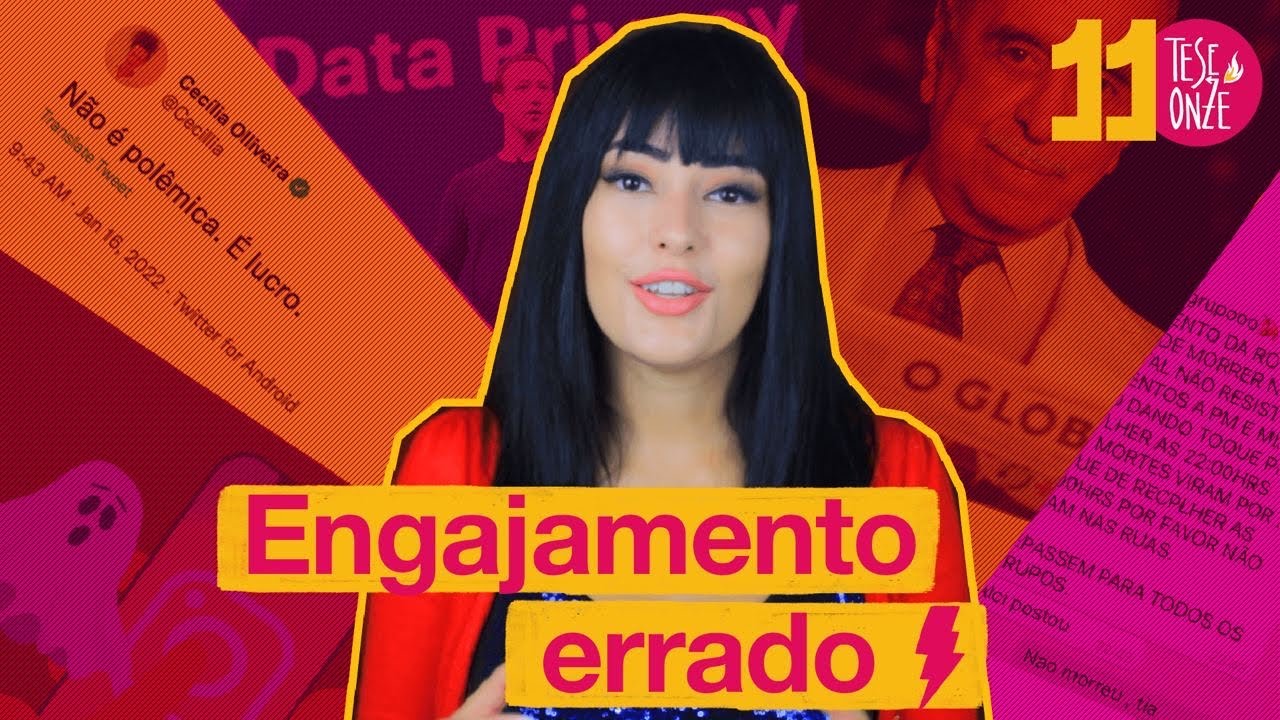
Right at the beginning of the Bolsonaro government, I made a video showing that things were already going wrong. But by getting in touch with people nowadays, it is evident that much of what we warned would be bad, turned out much worse. We are almost at the end of Bolsonaro's four-year term and the warning today is simple: remember that everything that is already bad can still get worse, a lot worse.
This means that several negative feelings circulate en masse in our society today. There is fear, there is hatred, there is anguish, there is anxiety, there is mistrust, there is contempt, and perhaps the most widespread of all these is fear. Brazil today is a society of fear.
[Music theme] Subtitles by André Gavasso Several fears inhabit our society today and I believe that it is important for us to name these fears because this will help us understand what is happening right now, what is at stake, and how we got here. I have been talking for a while about depoliticization in Thesis Eleven, and ultrapolitics is one type of depoliticization. Ultrapolitics runs on the logic of the militarization of political daily life.
Suddenly there is no opposition, not even antagonism, which is the opposition rooted in different interests of society, right? Like the bosses who take from their employees to profit more while the employees struggle, there is an antagonism between them. Antagonism is part of inequality and social conflicts that exist in society and it is our duty to politicize people about them.
But today, this material antagonism doesn't determine how we are living. It is the logic of war. It’s me against you, us against them, even if there is no basis for the antagonism against us, because this war is based on the creation of a specific type of enemy.
The Enemy with a capital “I” that threatens everything we think we want to society, everything we think we represent. Those who encourage ultrapolitics need to create this figure of a very threatening enemy in order to mobilize people through fear. And this fear sometimes ends up becoming panic, but an immaterial panic that is not based on history and facts, but panic that reproduces itself because of the monter stories that are being told, and we have already talked about it here in the channel.
That's why today in Brazil there are so many people afraid of an imaginary bathroom in which 5-year-old girls will be forced to use the toilet in front of a 40-year-old man, and everyone will take off their pants in the same place, at the same time, in front of each other. But this false picture is aimed to inhabit people's imagination and distract most of them from the fact that we have 3,700 schools with no bathroom at all in Brazil. That Bolsonaro has cut the budget for building new schools and daycare centers and that he abandoned the poorest children during remote teaching in the pandemic.
The fear generated by ultrapolitics is very well represented in Damares' speech on a spiritual war. For them, it is much better to put it in these terms because what do believers do then? They will leave it in the hands of pastors, the anointed ones, the spiritual authorities in their lives that will tell them who to vote for.
Or they will make some sly speech saying that religious people don't get involved in politics but then they will raise a gigantic flag at the headquarters of their colossal church that cost millions of reais and say that they are just #PrayingForBrazil. In this build up of fear, there is also the idea of an imaginary homeland that only exists because it has borders and on the other side of the wall is the place of the thug, the delinquent, the predator, the different ones, the ones I am so afraid of that I am willing to to put my future in the hands of a number of men who say they will protect us. Meanwhile, our lives get worse.
But if it gets worse, it's never because of the generals, that's rubbish. That happens because the enemy is cunning, the enemy stalks us and they told us to stay at home in the pandemic and that's why Brazil is broke, okay? There's nothing to do with Paulo Guedes' policies… In other words, spreading this fear helps the current government to shield itself from criticism.
More than that, it helps them shield themselves from reality itself. And in this regard, to uncover the lies they tell about the economy, I recommend the episode on Entreteses called “Brasil à Venda” and Juliane Furno's YouTube channel. But there is another kind of fear that is well mobilized and that is at the basis of this depoliticization.
There's moral panic, which I already talked about here, but there is also confusion about rights and privileges that Rodrigo Nunes explains well in his book, “From Trance to Vertigo”. He says: “Fostering the confusion about the anxiety of loss of rights and the fear of losing privileges. It is thanks to this maneuver that radical reactionaries have managed to gather in recent years, at the same time, the support from sectors that have few material concerns, but resent the achievements of certain groups, and from others that are haunted by the decline in their standard of living and the prospect of no longer being able to enjoy the rights they once had.
” What does that mean? Brazil began to go through an economic crisis and with that things became unstable. The crisis brought together external factors but also the very dependent structure of the Brazilian capitalist system.
But at the same time, there was the context of social achievements, of trying to build social welfare policies, policies of inclusion, so at the same time that there were people afraid of losing recent social achievements, there were people feeling threatened by groups that were being included. This was very well handled by the Right, with a mixture of fear, anxiety, and resentment that was later consolidated into this fear of the other. And so the Other is not a good Brazilian, they are not good citizens, they are not religious, and it goes down to racism, sexism, LGBTphobia, religious intolerance, ableism, xenophobia, and so on.
And of course the pandemic set up a scenario of a lot of fear and not just fear of death. Fear of uncertainty. Fear of new things, new measures, new threats, new information.
This fear was very well fed by Bolsonarism because it allowed for more mistrust. In 2020 new conspiracy theories were made up every day. Even Brazilians who, when thinking of China, thought about little trinkets made in China that they used to buy in stores, now are afraid of the Chinese threat, the Chinese virus.
Just imagine, I had to go to CNN Brasil to explain that it was not a Chinese virus while the other interviewee just repeated unfounded conspiracy theory arguments. This face expression represents the inner me to this day. And I’m not suggesting that there aren't real fears.
The point is what do we do with them. We live in an insecure country that has been facing problems of criminality, which range from not standing having one's cell phone stolen again, Whatapp schemes, to the fear of murder, and being kidnapped. And Bolsonarism not only does not offer substantive, concrete solutions to solve this, but it does two things to make it worse: It comes up with false solutions that worsen the general situation, like Tarcísio in São Paulo who said that if he becomes governor he will copy one approach model for public safety.
From where? Oh, yeah, Rio de Janeiro! Oh, because it is working very well, isn’t it?
And they do this by making people more afraid, which is what both these police news TV programs and the bizarre fake news about the Left allowing crimes and things like that are for, something Samuel has already refuted on Thesis Eleven's Instagram profile. And so fear doesn't just have to have them as a main source because it starts to reproduce itself. Fear makes people imagine the worst scenarios and that way they start to make up bizarre theories and have suspicions that they then consider as certainties and this makes it difficult to see reality as it is.
It makes millions of Brazilians have a very crooked view of what Brazil went through in Bolsonaro's hands. And that's why now I want to tell you a little bit about what Brazil has gone through in the hands of Bolsonaro and his allies. There is the part of destruction, the part of neglect, and the part of the consolidation of a specific way of structuring economy, culture, and governance.
For those who say that Bolsonaro is nothing more than an incompetent, I doubt that. He delivered a lot on what he promised and he pleased a lot of people along the way. Bolsonaro's problem is not a lack of competence or technique, but the kind of project he advocates for society.
It is a project of deep social helplessness, high profits, hatred for the Left and the marginalized groups upholded by the Left, and of great strengthening of conservative ideas that are also part of anti-communism, which also makes this a project of fear, of controlling people through fear, and using maneuvers and force as tools. All this together makes Bolsonaro's project an authoritarian one — and there's a video here in which I talk about what authoritarianism is. If we look at the environment, the destruction part is evident.
Bolsonaro started cutting the budget for every possible area from day one. Back in 2019, he had already cut 95% of the budget for the National Policy on Climate Change and 83% for the National Policy on Solid Waste. He took 5.
4 million reais right away from the inspection and prevention of forest fires, which was perfectly synchronized with the increase of fires in Brazilian biomes, not only in the Amazon. And deforestation in the Amazon increased even in conservation units, because Bolsonaro dismantled the entire protection apparatus. In the region of the Uraricoera River alone, we are talking about a deforested area that is equivalent to 1400 soccer fields, and I talked about these data with the Progressive International in this video and in this link.
Destruction was Bolsonaro's general rule on the environmental issue, but he takes advantage of people's confusion about increase and decrease rates to try to dodge criticism. But he’s lying. Of all the things Bolsonaro lies about, this is clear as day: after Lula took office in his first term, there was a decrease in the rate of deforestation.
When Bolsonaro took office, there was an increase in the rate of deforestation – with continuous increase in all the years of his administration. Bolsonaro has cut the budget of all federal universities, he has froze scholarships, made interventions in Enem, has stopped delivering school textbooks, and in the planning for 2023 he made huge cuts everywhere: the resources for the construction of daycare centers went from 220 million in 2021 and 100 million in 2022, to just over “amazing” 2 million in 2023. The National Education Plan states that at least 50% of children up to 3 years old have to be enrolled in public daycare centers by 2024, and the 2019 data correspondeds to only 37% of children attending day care facilities.
With Bolsonaro we have a 0% cance of reaching this goal. Bolsonaro also made huge cuts on health. He cut from the Farmácia Popular program, health research, HIV treatment, materials and equipment.
And of course, all this has to do with the bribery scheme in Congress known as “Bolsolão”, the so-called “secret budget”, because several billions reais are put in a pile of “rapporteur's amendments reserves”, and they will say: “Oh, that amount of money will be invested in public health", yes, through a congressperson. But we don't know what the criteria is and nothing prevents the money from going to something else too, especially with the lack of transparency of this scheme. That’s why the federal public ministry is investigating it and has already started arresting people related to the secret budget funds in Maranhão, it has already started to arrest those involved.
This is a gigantic scheme of phony invoices and fraud. There’s an example in São Francisco do Maranhão, which received funds that were justified as medical appointments equivalent to 25 visits to the doctor per resident in two months. This denotes something very serious: Bolsonaro's dismantling plan is part of a plan to set up and consolidate other schemes, other policies.
Policies that enrich very specific people and that make corruption a way of governing like never before seen in recent Brazilian history. If we get into the issue of the pandemic, this is where the neglecting becomes more evident. Denialism is like that, because it is not just an anti-science stance.
It is a stance intended to neglect or even eliminate aspects of life, specific lives. If Bolsonaro doesn't care about the poor, "so what if the poor get covid". If adequate treatment for Covid is expensive, the profits of private healthcare companies are preferable.
The neglecting is part of the project. Bolsonaro doesn't act inhumane just because of his character, even if it is possible to claim that a lot of things happen because of character deviation. But neglecting is a type of management of death and illness that works well in several areas.
If they can't kill, neglecting exists to let people die. That's why Brazil is reaching 200,000 homeless people and that doesn't make people panic. And there are estimates wihch point to half a million What makes people panic is the talk about unisex bathrooms, spread by bolsonarist social media in a totally distorted way so that it causes fear and so people may controlled by fear.
Neglecting is useful because it makes people distance themselves from things. If people fall for a talk that CPX means something related to drug trafficking and not "Complex", as in the case of "Complexo do Alemão", it is because there is a social distance between center and periphery that is part of the economic and racial division in Brazil, but which is also ruled by fear. That's why Bolsonaro has no shame in calling the people that Lula visited as all thugs and criminals, because Bolsonaro's consituency, that is fueled by penal populism, is afraid of favelas and doesn't want to meet favela residents, because they think they are actually thugs and a criminal.
In fact, I'll mention Samuel again, who just published a book that talks about these punitive pictures that the Right uses, I'll link it here for you. Neglecting as a project relates well to austerity, this way of reducing the State's debt based on fiscal responsibility, but which continues to forgive billionaire debts of their buddies. After all, neglect reflects directly on the cut of rights, and then you have to manage on your own as a consumer to have access to the market.
There is a lack of equipment in the SUS? You have to hire a healthcare plan. There's no public daycare facilies near you?
Search for a private one . Is public transport bad? Buy a car.
The result of this is the normalization of neglecting from the government and life as an individual game to get things done. The neoliberal mentality wins and it is not by chance that Bolsonarism operates as a type of entrepreneurship, as Rodrigo already said. And that is why there is dismantling and neglect on the one hand, and on the other there is the consolidation of a specific structure of economy and life and death management.
If Bolsonaro acts directly in the destruction of environmental protections, it is because in this way it is also possible to introduce measures that transform everything into commodities. I've already published articles about it and even warned about Joaquim Leite, the current minister for the environment, who so many people thought would be wonderful just because Ricardo Salles was horrible. If Bolsonaro cuts the budget for public research, it doesn't happen just because his government hates research, it happens because he wants to implement public-private partnerships and impose that the research produced in our country becomes useful to the market.
Markets and corporations directly. If Bolsonaro has neglected a public security policy aimed at strengthening communities, it happened because he knows that the general feeling of insecurity favors his arms policy. If Brazilians lack food on their tables, they know that their allies in agribusiness can go on making exorbitant profits, producing commodities for export, and that the working people will submit to bad jobs, doing everything they can to survive.
These and many other things were presented in almost 4 years of Thesis Eleven's videos. 4 years in which I talked about ministries, minimum wage, corruption, pandemic, climate change, moral panic, anti-communism, punitivism. More recently, we have further contextualized Bolsonaro' problems in several episodes of Entreteses, our podcast.
And I'll tell you something: I'm still sad and worried. Because what's at stake is not just winning the second round – and we need to win the second round. And for that to happen we need strength, courage and excitement.
But we also need bases for renegotiating society so that we can also defeat Bolsonarism, which is this new Right that foments fear, distrust and political violence. And in terms of political violence, enough of the false symmetries we see out there. I keep hearing: "Wow, the elections need to end because Lula and Bolsonaro's supporters keep threatening to kill each other on the street.
Oh, what a lie. We know very well which ones are pulling the trigger, wielding knives, and punching others. Bolsonarism is violent and when it not attacking directly, it is intimidating.
Since the 2018 campaign, with all that talk of gunning down PT supporters, and there are those who still try to equal the two sides, mainly as a way to justify their actions against PT. Oh, antipetismo, the thing I had to explain in 2018 and which unfortunately remains one of the most up-to-date videos on the channel. We need to establish a common ground of understanding in our society so that people can see beyond lies and manipulation.
And it sounds cliché, but we need to conquer fear. Part of that is overcoming fear with love, looking at the most vulnerable people in our society and understanding that they are human beings that deserve respect, support and care. This means that overcoming fear is a task of a lot of affection and of many political tasks.
To overcome fear we need solidarity, attention, boldness, care, a lot of care, taking care of people is essential. But we also need antagonism. We need to politicize society's conflicts so that people can see where the root of their fear is and who is fomenting it.
And that if there is panic, it has to be concrete panic, panic of what has already happened and that cannot go on, so that with this we feed on forces to build a society of care, a society that builds alternatives to the terror established by Bolsonarism. And that, in the end, is a society that names its real enemies, the enemies of the people, those who profit when workers are hungry, those who foment fear and hatred among us so that we don't look at them. Our task is to beat Bolsonaro.
But beyond that, our task is to overcome the articulation of the new Right that transformed our country, Brazil, into a laboratory of ultrapolitics so that the profits of the most powerful people would remain increasing. We have to overcome those who generate hunger, those who foment war and those who get rich by fomenting exclusion and misery. Yeah, "Bread, peace and land", that's the first step.
And we need to do this together.